The corn maze is the signature October outing — but most families do not realize they are walking through prime tick habitat at the exact peak of fall tick season. The ticks corn maze fall collision is real: adult blacklegged ticks quest at their highest October levels from tall vegetation, waiting for a warm body to brush past. Waist-to-head-height stalks brushing faces, arms, and legs for an hour or two is practically designed for tick encounters.
This is not a reason to cancel the maze. It is a reason to prepare for it the way you would prepare for sun or cold: clothing choices, repellent used correctly, and a tick check afterward that becomes as automatic as brushing teeth. This guide covers which ticks you are likely to meet, the before-during-after routine that public-health experts recommend, the safe way to remove a tick if one gets through, and the cat-safety warning every permethrin user needs to hear.
Why Corn Mazes Are Prime Tick Habitat in Fall
Ticks do not hunt — they quest, climbing vegetation and waiting with front legs extended for a host to brush by. Corn mazes offer everything they want: dense tall vegetation at human height, humid microclimates between rows, and a steady stream of warm bodies from opening day through Halloween.
Fall adds the timing. Adult blacklegged ticks (deer ticks), the species most associated with Lyme disease in the eastern and midwestern US — peak in October and November. Unlike summer’s tiny nymphs, fall adults are larger and easier to spot, but numerous and fully capable of transmitting disease. Lone star and American dog ticks can also be active on warm fall days, and all three quest at the heights a corn maze provides.
What separates a corn maze from an open pumpkin patch is the exposure pattern. In an open field, ticks quest at ankle height from grass. In a corn maze, stalks put questing ticks at knee, thigh, and waist height, while kids’ faces and arms brush directly through the questing zone. Children running ahead with bare arms collect more ticks than adults on the cleared center path, a reason for a routine, not for fear.
Before the Maze: Clothing and Repellent Strategy

The most effective tick protection at a corn maze is not a product — it is what everyone is wearing. Ticks are far less likely to reach skin through a proper clothing barrier, and light-colored clothing makes the ones that do hitch a ride visible before they attach.
Dress for the maze, not the photo. Long pants tucked into socks or boots, long sleeves, and closed shoes. It is not fashionable, and kids will complain — tuck anyway, and frame it as the maze uniform. Light colors (khaki, light gray, white) let you spot a dark tick against the fabric during the walk. Treat the outing like a hike, because for tick purposes, that is what it is.
Use repellent the right way — two products, two jobs. EPA-registered skin repellents such as DEET or picaridin go on exposed skin per the label. Permethrin goes on clothing and gear only — never on skin. Permethrin-treated clothing kills ticks on contact and survives several washes, making it the single most effective tick measure for a maze day. Buy pre-treated clothing or treat your own with a 0.5% permethrin clothing spray, following the label exactly.
The cat warning is non-negotiable. Permethrin is highly toxic to cats while wet. If your household has cats, treat clothing outdoors or in a closed garage, keep cats completely away from the treatment area and the wet garments, and let everything dry fully before it comes back inside or near the cat. Once permethrin-treated fabric is completely dry, it is generally considered safe to wear around cats — but follow the product label, and never apply any permethrin product to a cat or use dog flea products on one. For a refresher on safe removal technique to pair with this strategy, see how to remove an attached tick safely.
One more before-you-leave step: pack a small kit. Fine-tipped tweezers, a sealable bag or small container, antiseptic wipes, and a change of clothes for the ride home. It fits in a jacket pocket and turns a tick discovery from a crisis into a two-minute procedure.
During the Maze: Simple Habits That Cut Exposure
A few low-effort habits meaningfully reduce the ticks that make it onto clothing.
Stay on the cleared path. Maze operators mow or trample the walking lanes, and ticks quest from vegetation, not from bare dirt. Every shortcut through uncut corn is a shortcut through the questing zone. Keep kids, the highest-exposure group — on the path with a simple rule: racers stay on the trail.
Do a mid-maze buddy check. Halfway through, pause at a clearing and do a quick visible check of each other’s legs, arms, and necks. Ticks that have just climbed aboard are still crawling, looking for a place to attach — this is the easiest moment to catch them. Make it a game for kids: “tick patrol” beats a lecture.
Keep sleeves down and pant legs tucked. The tuck will loosen; re-tuck at the halfway point. If anyone strips off a jacket mid-maze because the sun came out, shake it and check it before it goes back on.
Avoid sitting in the corn. Rest breaks happen — take them at the maze’s designated rest areas, on benches or cleared ground, not sitting in the stalks. Ticks questing at ground level in leaf litter will happily climb onto a seated person.
None of these habits require vigilance that ruins the outing. They are the tick equivalent of looking both ways before crossing: quick, habitual, and effective.
After the Maze: The Full-Body Tick Check Routine

The after-maze tick check is the single highest-value step in this entire guide, because even perfect clothing and repellent let some ticks through. Public-health guidance treats the post-outing check as mandatory, not optional, and for kids, the check is a parent’s job, not the child’s.
Shower within two hours. Showering soon after coming indoors has been shown to reduce the risk of Lyme disease, partly by washing off unattached ticks and partly because it forces the full-body check. Make the maze-day shower non-negotiable, and do the check during or right after it.
Check the whole body, with attention to the hiding spots. Ticks migrate upward and inward, seeking warm, hidden skin. Check in this order: hairline and behind the ears, neck, armpits, waistband line, groin, backs of knees, and between toes. On children, be thorough at the hairline, ears, and neck, the corn-maze exposure pattern puts ticks at face and arm height, and kids’ checks need a parent’s eyes. A lint roller run over clothing before it goes in the hamper catches crawling ticks too.
Toss clothes in the dryer. Maze clothes go straight into the dryer on high heat for 10 to 15 minutes before washing — heat kills ticks that washing alone may miss. Do not drape them over a bedroom chair “for later.”
Check the dog too. If the dog came along, run your hands against the fur over the whole body, feeling for small bumps — ears, between toes, under the collar, armpits, and groin are the classic spots. Dogs are tick magnets and tick taxis; a tick that rode home on the dog can end up on a couch, and then on a person.
If You Find a Tick: Safe Removal and What to Do Next
Finding a tick is not an emergency — it is a procedure. Most tick-borne diseases require the tick to be attached and feeding for many hours before transmission becomes likely, so prompt, correct removal is what matters.
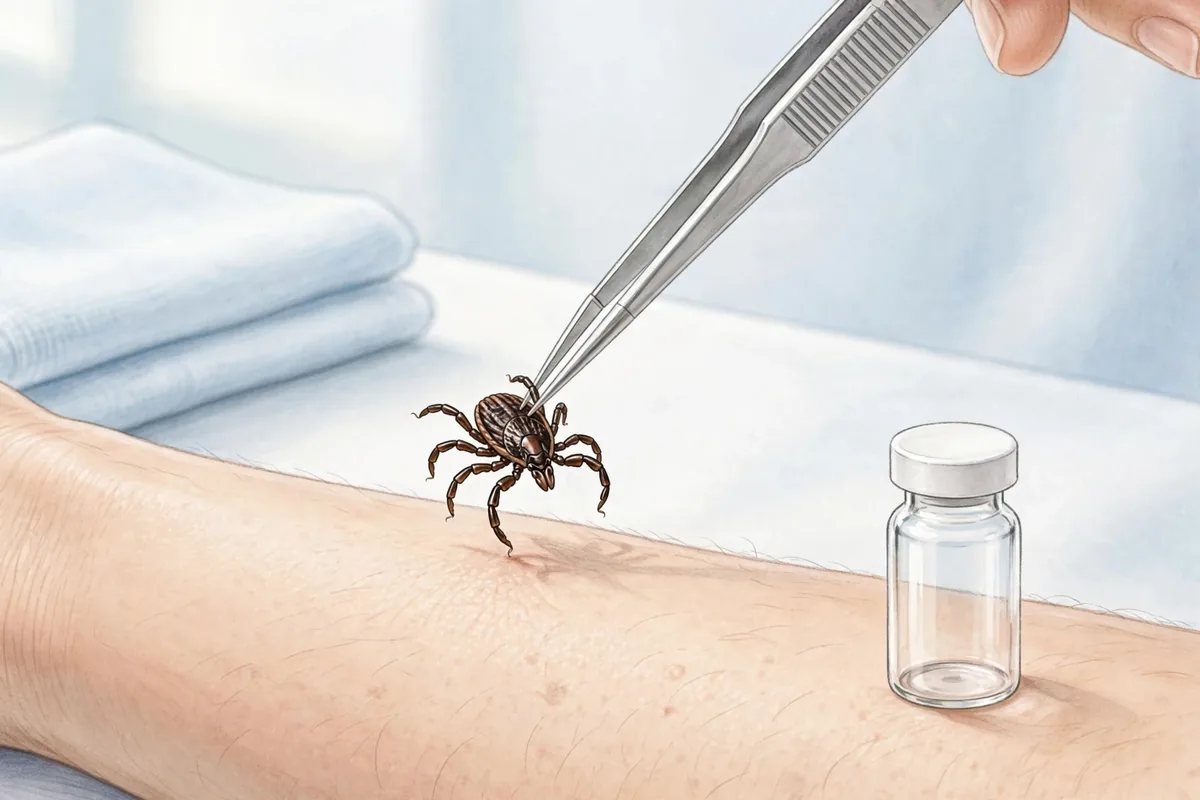
Remove it with fine-tipped tweezers. Grasp the tick as close to the skin’s surface as possible and pull straight upward with steady, even pressure. Do not twist, jerk, squeeze the body, or apply heat, nail polish, or petroleum jelly — folk methods increase the chance of the tick regurgitating into the bite or the mouthparts breaking off. After removal, clean the bite area and your hands with soap and water or an antiseptic wipe.
Save the tick. Seal it in a bag or small container with a damp cotton ball, labeled with the date and likely bite location. If symptoms develop, an identified tick helps your doctor assess risk. More on the why and how: should you save a tick after a bite.
See your doctor — do not self-diagnose. Call your doctor or pediatrician promptly after any attached tick bite, especially if the tick was engorged or the attachment time is unknown. Follow their guidance on monitoring versus preventive treatment. Do not identify the disease from the bite’s appearance, and do not start antibiotics on your own. Pediatricians expect these calls in October.
Watch for symptoms for 30 days. In the weeks after a bite, watch for rash (including but not limited to the classic bull’s-eye), fever, chills, fatigue, joint aches, or headache. Any of these after a known tick bite warrants a prompt call to your doctor. Mark the calendar: the window that matters is about a month.
When to See a Doctor for a Bug Bite
For tick exposures specifically, the guidance is more proactive than for most bug bites:
- Any attached tick of unknown duration: call your doctor or pediatrician the same day for guidance. Bring the saved tick if you have it.
- Rash, fever, or flu-like symptoms within 30 days of a bite: call promptly. Early treatment of tick-borne illness is far more effective than late treatment.
- A tick you cannot fully remove: if mouthparts break off and remain in the skin, or the bite area looks infected (increasing redness, swelling, warmth, pus), get medical help rather than digging.
- Signs of severe allergic reaction: difficulty breathing, facial swelling, or widespread hives after any bite or sting — call 911.
- Immunocompromised family members or very young children: a lower threshold for calling is appropriate; mention the tick exposure explicitly.
Never attempt to diagnose a tick-borne disease yourself from internet photos. The diseases, the rashes, and the timelines overlap too much for amateur ID — that is what the saved tick and your doctor are for.
Frequently Asked Questions
Are ticks really active in October?
Yes. Adult blacklegged ticks have a distinct fall activity peak, questing on mild days whenever temperatures are above freezing. A sunny 55-degree October afternoon at a corn maze is prime tick weather. The idea that tick season ends with summer is one of the most persistent, and most consequential — misconceptions in tick safety.
Can ticks fall from the corn onto us?
Ticks do not drop from heights onto hosts — they quest upward from vegetation and latch on when you brush past. In a corn maze, the “brushing past” is constant, which is why the exposure feels like ticks are raining down. The mechanism matters because it means the cleared path, not the sky, is your protection.
Is it safe to use DEET on children for a corn maze?
Public-health agencies consider EPA-registered repellents, including DEET, appropriate for children when used according to the label, which includes age guidance, application to exposed skin only (not under clothing), and washing off when back indoors. For very young children, clothing barriers and avoiding peak exposure do most of the work; discuss repellent choices with your pediatrician if you are unsure.
Do I need antibiotics after every tick bite?
No, and you should not start them on your own. Whether preventive treatment is appropriate depends on the tick species, how long it was attached, local disease rates, and timing, all of which your doctor evaluates. The right move after a bite is a prompt call, the saved tick, and monitoring, not self-prescription.
Medically reviewed by Dr. Sarah Jones, MD.
This article is for informational purposes only and isn’t medical advice. If you’re worried about a bite or sting, talk to a healthcare professional.