Direct answer: The main asian tiger mosquito bite vs jumping spider bite treatment differences are certainty, timing, and expected severity. Asian tiger mosquito bites are common blood-feeding events that usually become itchy. Jumping spiders rarely bite people, and when verified bites occur they are usually limited to local pain, itching, redness, and swelling rather than a medically significant envenomation.
These two exposures can both leave a small red bump, but they behave very differently. Asian tiger mosquitoes actively seek blood meals from people. Jumping spiders are visual hunting spiders that normally prey on insects and usually retreat from humans. A spider bite becomes much more credible when the spider was actually seen biting or was trapped against the skin.
Fastest practical clue
A later itchy wheal after outdoor mosquito activity fits Asian tiger mosquito exposure. A brief painful pinch after handling or trapping a small, compact, large-eyed jumping spider fits a verified spider bite better. If no spider was seen and the lesion is hot, increasingly painful, draining, or rapidly worsening, do not assume a jumping-spider bite.
Asian tiger mosquito bite vs jumping spider bite: quick comparison
| Clue | Asian tiger mosquito | Jumping spider |
|---|---|---|
| Arthropod | Aedes albopictus, a small black-and-white mosquito | Family Salticidae, a large family of compact visual hunting spiders |
| Human biting behavior | Regularly takes blood meals from people | Does not seek humans; may bite defensively if handled or trapped |
| Typical sensation | Tiny prick or unnoticed feeding; itching often becomes more noticeable later | If a bite occurs, a brief painful pinch or sting-like sensation may be noticed |
| Typical local reaction | Itchy papule or wheal with redness/swelling | Minor pain, itching, redness, and swelling are the usual reported effects |
| Best identification clue | Seeing the black-and-white mosquito feeding | Seeing and correctly identifying the spider involved |
| Main next step | Symptom relief + prevent additional mosquito bites | Basic wound care + observe; seek care if symptoms are severe or atypical |
Neither a central dot nor the size of the red bump can reliably identify the culprit. Exposure history is more useful than matching a photo to an internet gallery.
What an Asian tiger mosquito looks like
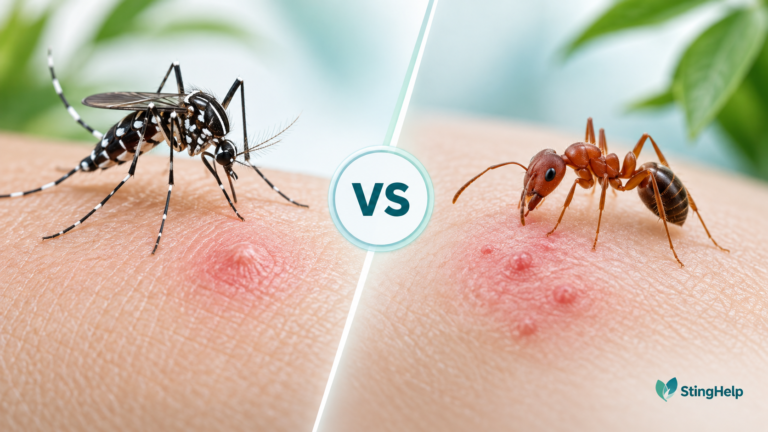
The Asian tiger mosquito, Aedes albopictus, is a small dark mosquito with bright white bands on the legs and a distinctive white stripe on the upper body. It is strongly associated with small containers of standing water and is commonly encountered around yards, gardens, shaded vegetation, patios, and residential areas.
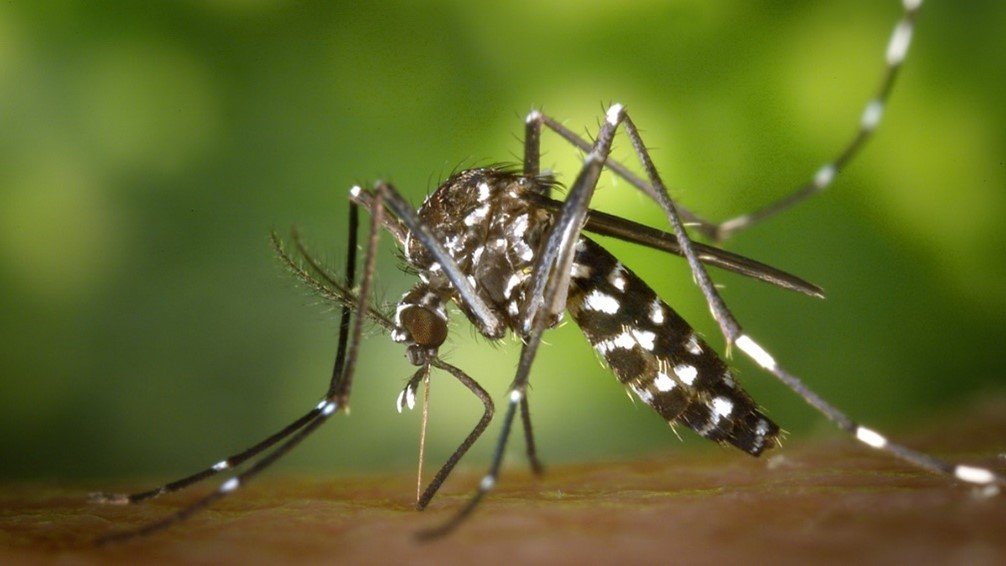
A bite may feel like a tiny prick or may be missed entirely. Itching, redness, and localized swelling often become more obvious after the mosquito has already left. Multiple bites can occur on exposed skin when mosquitoes are active.
What does a jumping spider look like?
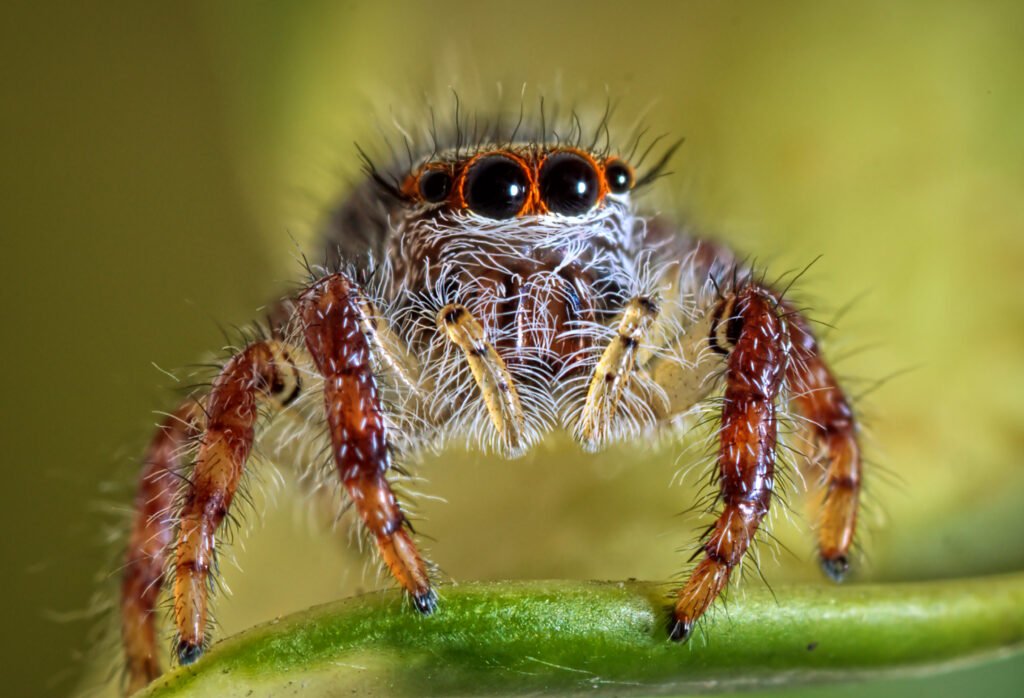
Jumping spiders belong to the family Salticidae. They are usually compact, active spiders with excellent vision and a distinctive arrangement of large forward-facing eyes. Many move in short bursts, turn to look directly toward movement, and pounce on insect prey instead of relying on a large prey-catching web.
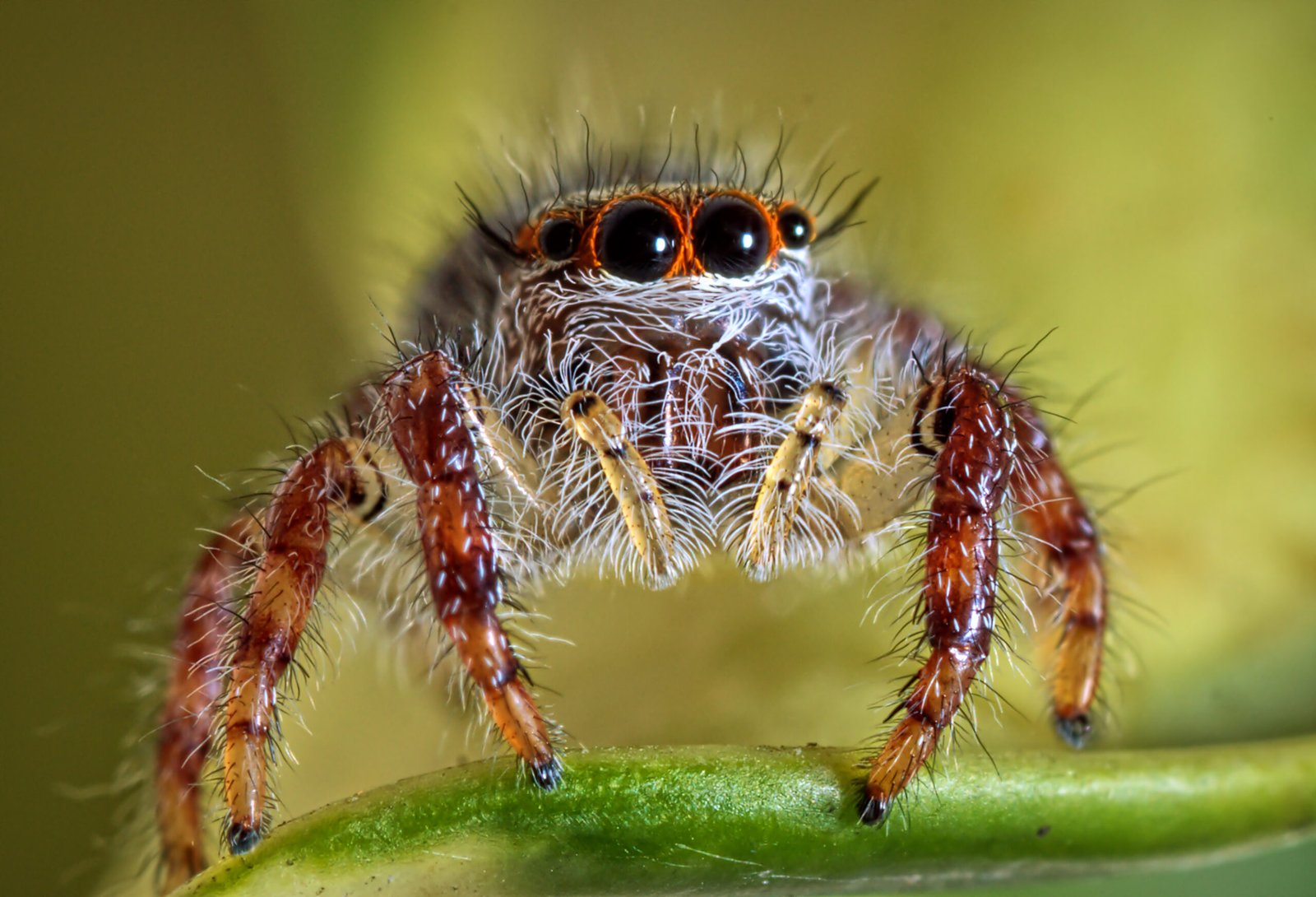
The family includes many species, so “jumping spider” is not one single species. In North America, the bold jumper Phidippus audax is a frequently encountered species around homes. In Europe, the zebra jumper Salticus scenicus is a familiar species and has also been introduced widely into North America.
Are jumping spiders dangerous to people?
Current extension guidance does not consider common jumping spiders medically important. Penn State describes bold jumpers as shy spiders that usually retreat from people; when bites occur, minor pain, itching, swelling, and redness may persist for one or two days. Its 2026 zebra-jumper guidance similarly says the species does not have a medically significant bite.
Utah State University also describes jumping spiders as common, beneficial indoor or outdoor hunters rather than a human health hazard. That does not mean a bite can never hurt. It means common jumping-spider bites are not in the same medical-risk category as widow, recluse, or Australian funnel-web spider envenomation.
Why many suspected spider bites are misidentified
CDC’s 2026 Yellow Book cautions that many alleged spider bites are not actually spider bites. People often attribute an unexplained painful lesion to a spider even when no spider was seen. Bacterial skin infections, boils, abscesses, other arthropod bites, and inflammatory skin conditions can produce overlapping appearances.
This matters because a progressively hot, tender, draining, or necrotic-looking lesion should be evaluated for its true cause rather than labeled a jumping-spider bite because a spider happened to be nearby.
Do not diagnose from “fang marks” alone
Two tiny dots, a central punctum, a red ring, a blister, or a dark center are not specific enough to prove a jumping-spider bite. If the spider was not actually involved in the exposure, the diagnosis remains uncertain.
Asian tiger mosquito bite vs jumping spider bite symptoms
Asian tiger mosquito bites have a predictable general pattern because mosquitoes routinely feed on people. Jumping-spider bites are much less common, so the most useful comparison is between a typical mosquito reaction and the mild local effects reported after verified jumping-spider bites.
Typical Asian tiger mosquito reaction
- Small itchy papule or wheal.
- Localized redness and swelling.
- Itching often becomes more noticeable after the mosquito leaves.
- Several lesions can appear on exposed skin.
- Scratching can irritate the skin or contribute to secondary infection.
Typical jumping-spider bite reaction
- A brief painful pinch may be felt at the time of the bite.
- Localized redness can develop.
- Mild swelling or itching may occur.
- Symptoms reported for common species generally remain localized and resolve without a serious systemic syndrome.
- A severe, expanding, ulcerating, or infected-looking wound should prompt evaluation for another cause.
Penn State’s bold-jumper guidance notes that minor local symptoms can last one to two days. That is very different from internet claims that any jumping-spider bite should cause severe tissue damage or systemic poisoning.
Pictures: can you tell the difference from the skin?
Usually not with confidence. For asian tiger mosquito bite vs jumping spider bite pictures, the arthropod itself is the most useful image. A clear photograph showing the Asian tiger mosquito’s black-and-white markings or a jumping spider’s compact body and large forward-facing eyes can be informative.
Skin photographs are useful for tracking whether redness, swelling, blistering, or drainage is getting better or worse. They are much less reliable for identifying which species caused the lesion.
If you did not see the culprit, use the StingHelp What Bit Me? guide to compare exposure clues without overdiagnosing from appearance.
Asian tiger mosquito bite vs jumping spider bite treatment differences
For mild reactions, both can start with gentle cleansing and a cool compress. The main difference is that mosquito care emphasizes itch control and prevention of additional bites, while a verified spider bite is treated more like a minor localized wound unless concerning symptoms develop.
What to do after a likely Asian tiger mosquito bite
- Wash the area gently with soap and water.
- Apply a cool compress for itching or swelling.
- Avoid scratching and keep broken skin clean.
- Use an appropriate over-the-counter anti-itch product only if safe for you and according to the label.
- Prevent more bites with EPA-registered repellent, protective clothing, screens, and standing-water control.
- If significant systemic illness develops, mention recent travel and local mosquito-borne disease activity to a healthcare professional.
What to do after a verified or suspected jumping-spider bite
- Wash the area with soap and water.
- Apply a cool compress or wrapped cold pack for discomfort or swelling.
- Do not cut, squeeze, burn, or try to “extract venom.”
- If the spider is available, photograph it safely rather than handling it with bare hands.
- Monitor the area for increasing warmth, spreading redness, drainage, worsening pain, blistering, fever, or other systemic symptoms.
- Seek medical advice if symptoms are severe, progressive, or inconsistent with a mild local reaction.
For broader wound and symptom-care guidance, see the StingHelp bite and sting first-aid guide.
Decision guide: what should you do next?
Itchy bump after seeing a black-and-white mosquito: routine mosquito-bite care and bite prevention are usually appropriate.
Small jumping spider was definitely trapped against the skin and a brief bite was felt: wash, cool, and monitor a mild local reaction.
No spider was seen and the lesion is hot, very painful, draining, or rapidly expanding: seek medical evaluation rather than assuming a jumping-spider bite.
Breathing difficulty, throat or facial swelling, fainting, severe dizziness, confusion, or collapse: seek emergency care.
When should you seek medical care?
Medical evaluation is appropriate when redness keeps spreading, pain is worsening instead of improving, the area becomes increasingly hot, pus or drainage develops, a blister or ulcer is progressing, fever appears, or the person feels systemically unwell.
Seek emergency care for difficulty breathing, swelling of the tongue or throat, fainting, severe dizziness, collapse, confusion, or another rapidly worsening severe reaction.
If a spider was actually seen, bring a clear photograph or securely contained specimen only if doing so does not create another bite risk. Correct identification can be useful, but emergency symptoms should never be delayed while trying to identify the spider.
What about swelling after a jumping-spider bite?
Mild localized swelling can occur after a spider bite, just as it can after many insect bites and stings. The important distinction is whether swelling stays near the bite and begins to settle or becomes extensive, rapidly progressive, unusually painful, or associated with whole-body symptoms.
A large or worsening reaction deserves medical advice, especially when the diagnosis is uncertain. A person can also develop irritation from scratching, adhesive products, topical remedies, or secondary skin infection after the original exposure.
Can a jumping-spider bite become infected?
Any break in the skin can become secondarily infected, particularly when it is scratched or picked. Increasing warmth, spreading redness, pus, drainage, fever, or worsening tenderness are reasons to seek evaluation.
CDC’s broader spider-bite guidance is particularly useful here: an unexplained warm, tender lesion may be a bacterial infection rather than a spider bite in the first place. That is why the clinical course matters more than the assumption that a spider must have caused the wound.
USA: bold jumping spiders are common around homes
The bold jumper, Phidippus audax, is one of the most familiar jumping spiders in many parts of the United States. Penn State describes it as a small, compact visual hunter frequently encountered around homes, windowsills, railings, tree trunks, and other daylight hunting sites.
It is shy around people and usually does not bite when approached. Verified bites can cause brief local symptoms, but the species is not treated as a major medically important spider.
Europe: zebra jumping spiders are familiar and medically low-risk
The zebra jumper, Salticus scenicus, is native to Europe and western Asia and is commonly found on sunlit walls, fences, stones, vegetation, and building exteriors. Penn State’s updated 2026 guidance notes that it has spread widely in North America as well.
Like other common jumping spiders, the zebra jumper is not considered medically important. This is useful GEO context because European readers searching “jumping spider bite” are often dealing with different local species than U.S. readers, yet the general medical message remains similar for these common salticids.
Jumping spider vs medically important spiders
A jumping spider should not be confused with a widow or recluse spider simply because all are spiders. Widow envenomation can cause severe muscle cramping and systemic symptoms, while recluse bites can occasionally cause tissue injury. Common jumping spiders do not share those established medical syndromes.
If the spider looks like a funnel-weaver rather than a jumping spider, see the hobo-spider comparison. If you are dealing with a generic indoor cobweb spider, the house-spider guide may fit better.
How Asian tiger mosquito disease risk changes the comparison
Asian tiger mosquitoes matter medically for a different reason: infected Aedes albopictus can transmit dengue, chikungunya, and Zika where those viruses are circulating. A routine itchy mosquito bite does not mean infection occurred, but local epidemiology, travel history, season, and systemic illness can change the level of concern.
Jumping spiders are not a comparable vector for those mosquito-borne viral diseases. Their main relevance is a possible mild local bite when direct contact occurs.
How to prevent Asian tiger mosquito bites
Use EPA-registered insect repellent, wear protective clothing when practical, maintain window and door screens, and remove standing water from buckets, plant saucers, gutters, toys, tires, and other containers around the home.
How to reduce jumping-spider encounters indoors
Jumping spiders are beneficial predators, but if you do not want them indoors, seal gaps, use screens, reduce insect prey around windows and lights, and relocate individual spiders with a container instead of handling them directly. Vacuuming or catch-and-release are reasonable non-contact approaches.
For other painful arthropod exposures, compare the fire-ant guide or honey-bee comparison. More spider information is available in the StingHelp Spider Bites hub.
Frequently asked questions
How can you tell an Asian tiger mosquito bite from a jumping spider bite?
The best evidence is a witnessed exposure. Seeing a black-and-white mosquito feeding strongly supports Asian tiger mosquito exposure. A jumping-spider bite is much more credible when the spider was actually seen biting or was trapped against the skin. Skin appearance alone is not enough.
Are jumping spider bites dangerous?
Common jumping spiders such as bold jumpers and zebra jumpers are not considered medically important. Verified bites can cause minor local pain, itching, redness, or swelling, but severe progressive symptoms should prompt evaluation for another spider species or another medical cause.
What are the most useful differences to compare?
Compare whether the arthropod was seen, whether the main symptom is delayed itching versus immediate local pain, the exposure setting, the spider’s large forward-facing eyes and jumping behavior, and whether the lesion behaves like a mild local reaction or a worsening wound.
What should you do if a jumping spider bites you?
Wash the area with soap and water, use a cool compress, avoid scratching, and monitor the reaction. Do not cut or squeeze the bite. Seek medical advice if pain, redness, swelling, drainage, fever, or other symptoms are severe or worsening.
Which warning signs matter most?
Seek care for rapidly spreading redness, increasing warmth, worsening pain, drainage, fever, blistering, ulceration, or significant systemic symptoms. Breathing difficulty, throat or facial swelling, fainting, confusion, severe dizziness, or collapse requires emergency evaluation.
When should someone seek medical care after a mosquito or suspected jumping-spider bite?
Seek medical advice when symptoms are severe, progressive, infected-looking, systemic, or diagnostically uncertain. After mosquito exposure, also mention recent travel and local mosquito-borne disease activity if fever, rash, severe headache, marked joint pain, or other significant illness develops.
Authoritative references
- Penn State Extension — Bold Jumper Spider
- Penn State Extension — Zebra Jumper, updated January 19, 2026
- CDC Yellow Book 2026 — Post-Travel Dermatologic Conditions
- American Academy of Dermatology — When Bug Bites Need Medical Care
- CDC — Asian Tiger Mosquito
Bottom line
The practical asian tiger mosquito bite vs jumping spider bite treatment differences are driven by exposure and expected severity. A typical mosquito bite mainly needs itch relief and mosquito prevention. A verified jumping-spider bite usually needs basic local wound care and observation. Severe, infected-looking, ulcerating, or systemic symptoms deserve medical evaluation rather than being blamed on a common jumping spider.
Educational information for a U.S.- and Europe-focused audience. This article cannot diagnose a spider species, infection, allergic reaction, or mosquito-borne illness from a photograph and does not replace professional medical care.