
Do Male Wasps Leave the Nest? Yes — and They Never Come Back
Dr. Sarah Jones, MD is still reviewing this article, and her sign-off is awaited before publication. Yes. Every male wasp leaves the nest —…
Dr. Sarah Jones, MD is still reviewing this article, and her sign-off is awaited before publication. A wasp in the house is almost never random. Wasps hide in predictable places,…
Dr. Sarah Jones, MD is still reviewing this article, and her sign-off is awaited before publication.
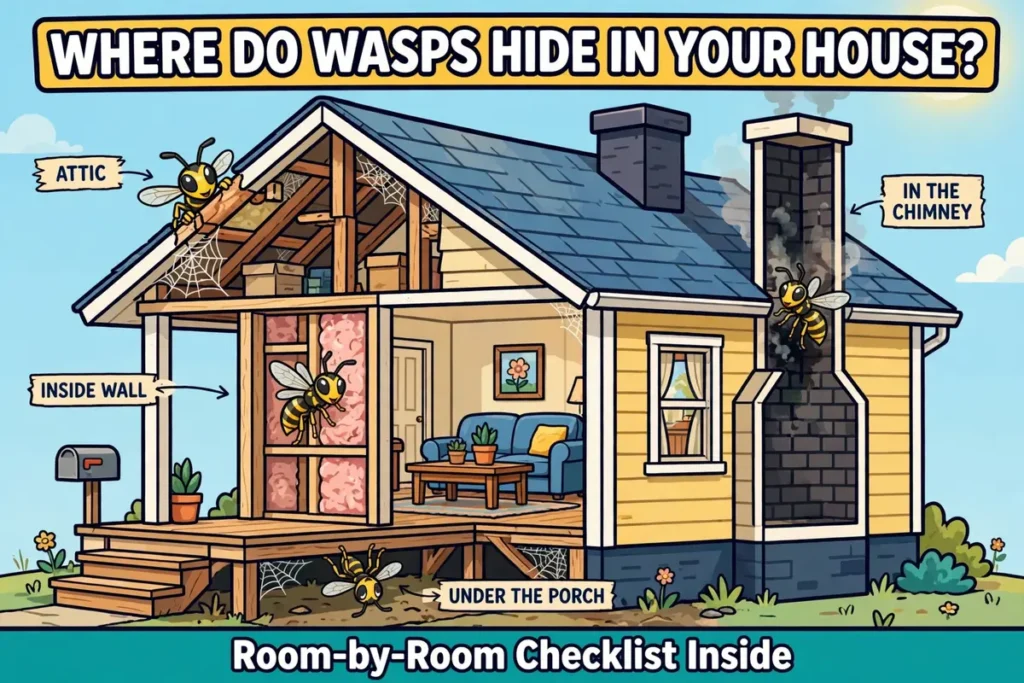
A wasp in the house is almost never random. Wasps hide in predictable places, and the place tells you which problem you actually have: an active nest somewhere in the structure (a summer problem), or a single overwintering queen sheltering indoors (a fall-to-spring problem). The fixes for those two problems are completely different, so the first job is knowing where to look.
The short list of favourite hiding places: the attic, inside wall voids, the chimney, behind siding and eaves, in window frames and curtains (queens in winter), and in garages, sheds, and wood piles. Below is the full room-by-room checklist, the signs that separate a hidden nest from a lone queen, and how the hiding places change with the seasons.
| Clue | Likely an active nest | Likely a sheltering queen |
|---|---|---|
| Season | Late spring through fall | Late fall, winter, early spring |
| How many wasps | Several, appearing repeatedly | One, occasionally two or three |
| Behaviour | Purposeful traffic in and out of one spot | Slow, sluggish, drawn to windows and light |
| Where seen | Near one wall, ceiling corner, or eave | At windows, curtains, lamps |
| Sound | Faint rustling or ticking inside a wall | Silent |
This distinction matters because University of Minnesota Extension makes a point most homeowners miss: a wasp found indoors in winter has come from a shelter, not an active nest — colonies do not survive the winter, even inside a building. Treating a lone January queen like a nest emergency (or ignoring a July wall nest like a stray) are the two classic mistakes.
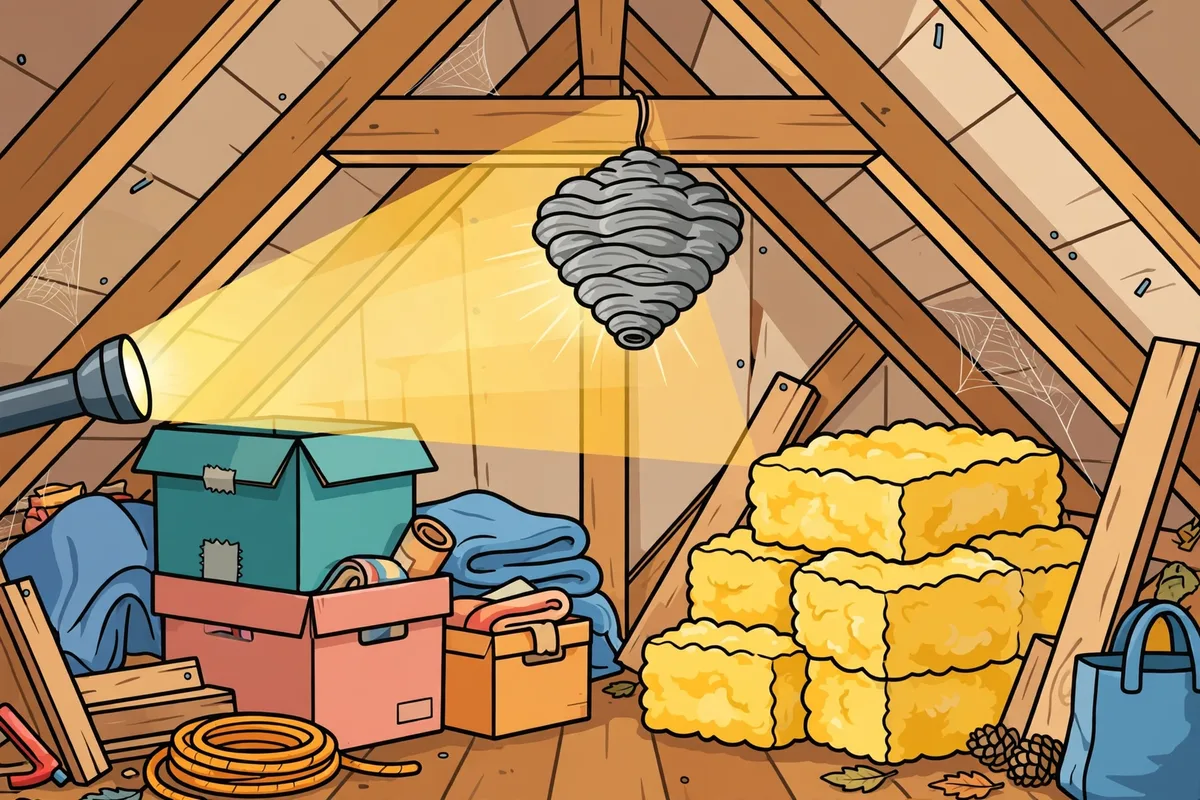
Attic. The number one hiding place. Paper wasps build their open umbrella nests on beams and supports in attics, and yellowjackets nest in insulation and attic cavities. In winter the attic flips roles: it becomes a shelter where queens overwinter — NC State Extension lists attics first among paper wasp queens’ hiding places. Check: rafters and ridge beams, around the chimney stack, above insulation near eaves, and any stored boxes that have sat undisturbed.
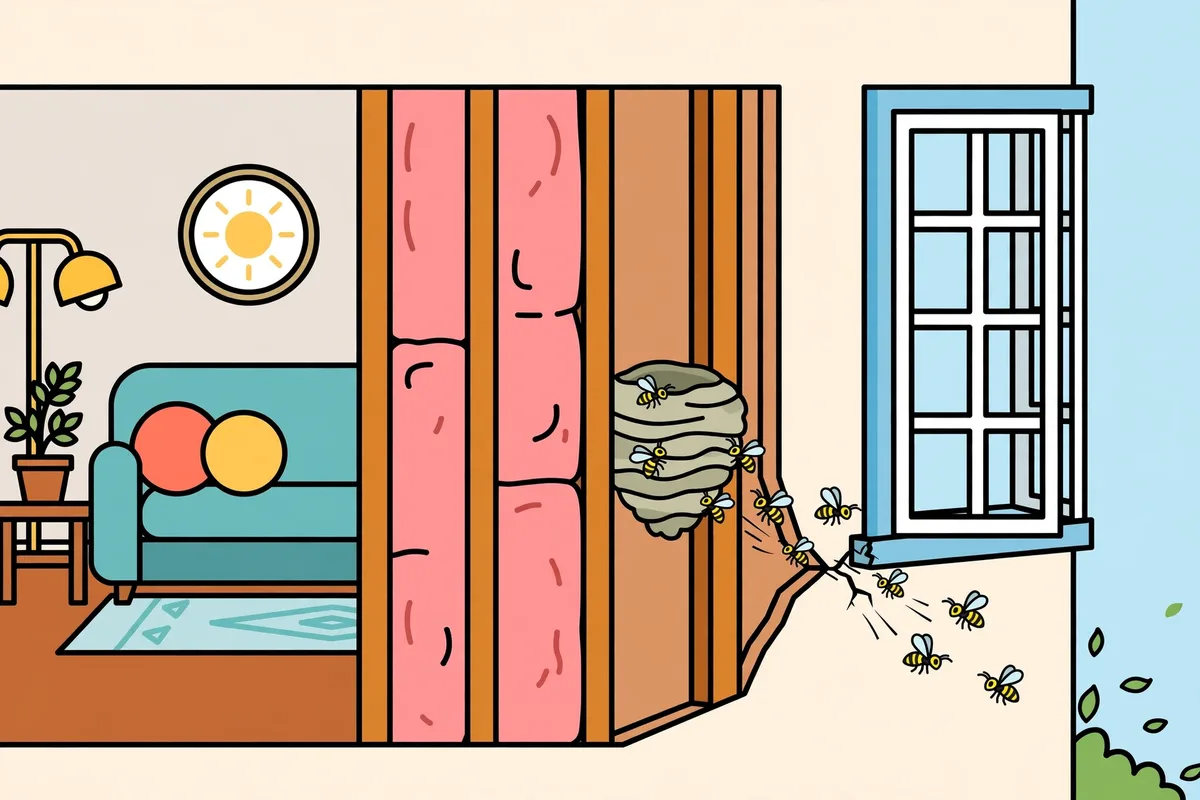
Inside the walls (any room). Yellowjackets are the wall-void specialists — University of Minnesota Extension notes they nest in buildings, including attics and wall voids, entering through cracks and gaps outside. A wall nest announces itself through a small, steady stream of wasps using one exterior entry hole, wasps appearing indoors through light fittings or vents, and sometimes a faint rustling or ticking from inside the wall. If this is your situation, read what to do about a wasp nest in the wall of your house before doing anything else — and do not seal the entry hole while the nest is active, which can drive the wasps through the wall and into your rooms instead.
Chimney and fireplace. A classic queen shelter — NC State Extension lists chimneys among the overwintering sites for paper wasp queens. Queens drop down into living spaces in spring when they wake, which is why a slow wasp on the hearth in March is usually a queen, not a scout from a nest.
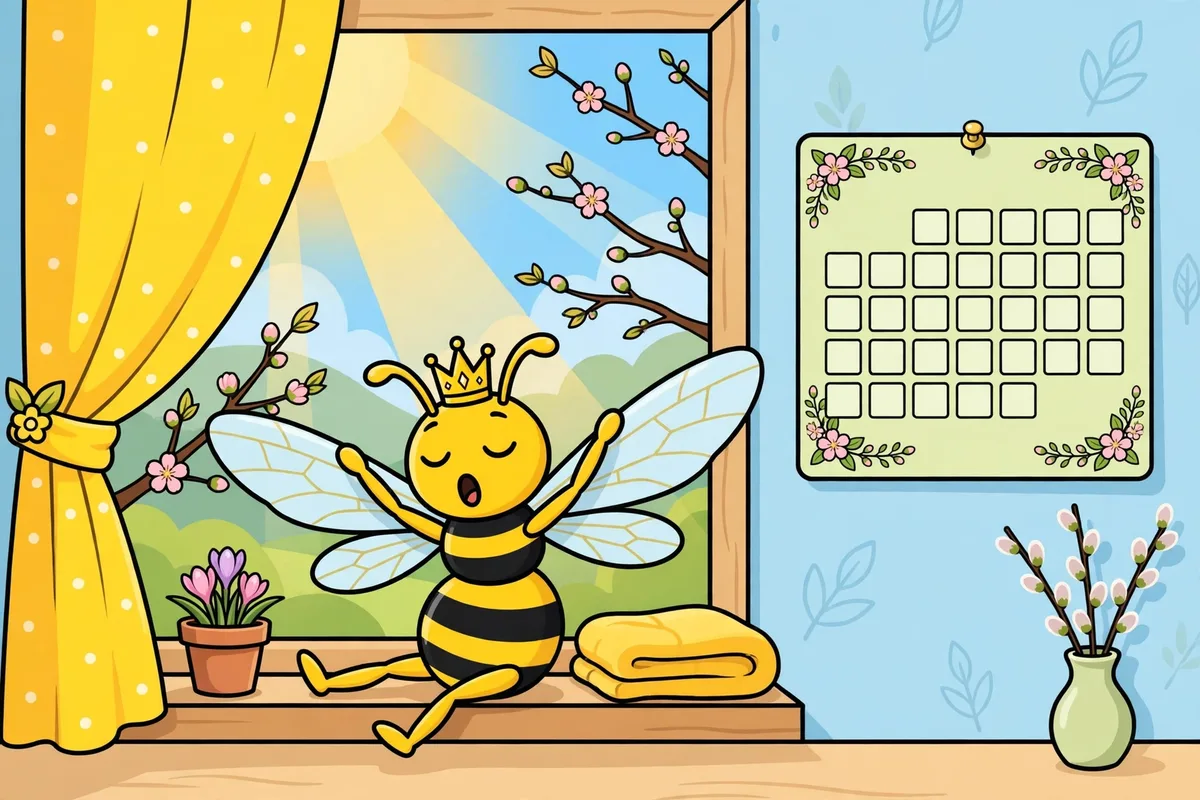
Bedrooms and living rooms — windows and curtains. Winter and spring queens move toward light. NC State Extension describes overwintering queens heading for windows when they stir, and homeowners typically find them on curtains, window frames, and lampshades. One slow, large wasp at a window in the cold months is a queen who has been hiding in the house for months — behind the curtain rail, in the window frame, or in the wall or attic void behind it.
Kitchen. Kitchens attract wasps but rarely host nests. In late summer and fall, yellowjackets become aggressive scavengers around food and drinks and slip in through open doors and window screens to work your fruit bowl and bins. A kitchen wasp in September is usually a forager, not a resident — but check the exterior wall and eaves outside the kitchen if visits repeat daily.
Bathroom and utility vents. Vent ducts, extractor openings, and gaps around pipes are quiet, sheltered voids. Wasps use them as entry points and occasional nest sites, and queens shelter in them. Check vent covers inside and out for traffic.
Basement and crawl space. Cool, dark, and undisturbed: queens shelter here, and ground-level gaps let yellowjackets into floor voids. Check joist ends, the tops of foundation walls, and around utility penetrations.
Garage, shed, and porch. Paper wasps favour the sheltered beams of garages and sheds and the ceilings of porches — exactly where University of Minnesota Extension says their nests turn up. Queens also shelter in stacked wood, hollow posts, and stored equipment; NC State Extension specifically lists stacked wood and hollow metal posts among queen hiding places.
Behind siding, eaves, and shutters. This is the hidden entry layer rather than a room, but it is where indoor problems start. Queens spend the winter within buildings such as under siding, and workers slip through gaps at eaves, soffits, and shutters to reach wall and attic voids. A careful exterior walk-around in spring — watching for wasps disappearing into one repeated gap — finds most nests before they grow.
| Sign | What it usually means | Where to check |
|---|---|---|
| Wasps entering and leaving one small hole, all day | Active nest behind that entry point | Wall void, eave, or attic on the other side of the hole |
| A wasp or two indoors every day in summer | Nest in a wall void or attic with an indoor leak point | Light fittings, vents, and the wall nearest the sightings |
| Faint rustling/ticking inside a wall | Nest activity (or chewing) inside the void | The wall section nearest the sound; exterior entry outside |
| One large, slow wasp at a window in winter/spring | Overwintering queen waking up | Curtains, window frames, attic, chimney |
| Several sluggish wasps indoors on a mild winter day | A group of queens sheltering together (paper wasp queens overwinter in groups) | Attic, wall voids, behind siding |
| Dead wasps on indoor windowsills in spring | Queens that woke, sought light, and could not get out | The nearest voids and the attic above |
| Season | What is hiding, and where |
|---|---|
| Spring | Queens emerge from shelters (attics, chimneys, wall voids, under siding) and found new nests on eaves, beams, and porches. A single big wasp indoors now is a queen looking for the exit — or a nest site. |
| Summer | Colonies grow. Nests hide in wall voids, attics, and under eaves; foragers appear everywhere. This is hidden-nest season. |
| Fall | Colonies peak, then produce new queens and males. Yellowjackets scavenge around food. Queens leave nests and start slipping into houses to find winter shelter. |
| Winter | No active nests survive — freezing temperatures kill workers and old queens, and nests do not survive winter even indoors. The only wasps in your house are dormant queens in attics, chimneys, wall voids, and behind siding. |
Understanding the season is half the diagnosis: the same attic that holds an active paper wasp nest in August holds only sleeping queens in January, and an old nest found in winter is an empty husk — colonies do not reuse last year’s nest, as our explainer on whether wasps reuse nests covers. For nest timing overall, see how long a wasp nest stays active.
Two look-alikes cause needless alarm. Old nests: a papery nest found in winter is empty — the colony died off and will not return to it, so an old nest in the attic is memorabilia, not an infestation. Mud dauber tubes: the mud nests solitary wasps build on walls, eaves, and garage corners belong to a solitary wasp that provisions each tube with paralysed spiders for her young. Mud daubers are not colony defenders and are famously reluctant to sting; their tubes in a garage corner are one of the most harmless “nests” a house can host. The problems worth acting on are the active social-wasp nests and the repeated indoor appearances described above.
Medical disclaimer: This article is general information, not medical advice. Most wasp encounters indoors end without a sting, but if you are stung and develop trouble breathing, swelling of the face or mouth, tightness in the throat, difficulty swallowing, weakness, or dizziness, call 911 immediately — these can be signs of a severe allergic reaction (anaphylaxis). Anyone with a known sting allergy should keep their prescribed epinephrine available and avoid nest-disturbing tasks entirely.
Where do wasps hide in your house most often? In the attic and inside wall voids for nests; in attics, chimneys, wall voids, and behind siding for overwintering queens. Paper wasps favour beams in attics, garages, and porch ceilings; yellowjackets favour wall voids and ground-level cavities.
Why is there a wasp in my house in winter? It is almost certainly a queen who has been sheltering indoors since fall — under siding, in the attic, chimney, or a wall void — and has stirred on a mild day or been drawn to a warm, lit room. There is no active winter nest; colonies die off and do not survive winter even inside buildings.
Can wasps live in my walls? Yes — yellowjackets nest inside wall voids, entering through small exterior cracks. Steady traffic through one hole, wasps leaking indoors, and faint rustling in the wall are the classic signs. Do not seal the hole while the nest is active; get a professional assessment.
Where do wasps hide at night? Workers return to the nest at night, which is why nest traffic stops after dark. Queens sheltering in winter stay put in their hiding place around the clock, and a stray forager caught indoors at night will usually settle somewhere quiet and high — a curtain top, a lampshade, a corner near a window.
How do I find where wasps are coming into my house? Watch from outside on a warm day. Foragers fly a direct line to their entry point, and a nest reveals itself as a steady two-way stream at one small hole or gap. Indoors, note which room and which wall the wasps appear in — the void behind it is the first place to investigate.
Should I worry about one wasp in the house? Usually not. One wasp is either a lost forager (summer) or a sheltering queen (winter and spring) — both are best handled with a cup, a card, and an open window. Worry instead about repetition: wasps appearing indoors day after day mean a nest or a group of queens inside the structure, and that is worth a proper inspection.
Dr. Jones oversees StingHelp’s clinical verification process. Every guide is systematically evaluated against active Centers for Disease Control and Prevention (CDC), Environmental Protection Agency (EPA), and American Academy of Allergy, Asthma & Immunology (AAAAI) medical consensus standards to ensure symptom distinctions and care recommendations are clinically sound.
Explore physician-reviewed first-aid procedures, identification clues, and symptom comparisons for other common outdoor bites and stings.

Dr. Sarah Jones, MD is still reviewing this article, and her sign-off is awaited before publication. Yes. Every male wasp leaves the nest —…

Dr. Sarah Jones, MD is still reviewing this article, and her sign-off is awaited before publication. Search "how long does a wasp live without…
A wasp the size of your thumb lands on the patio furniture, and the yard goes quiet. Cicada killer or European hornet? The direct…