Papular Urticaria: Why Your Child’s Old Bug Bites Keep Flaring Up Like New Ones
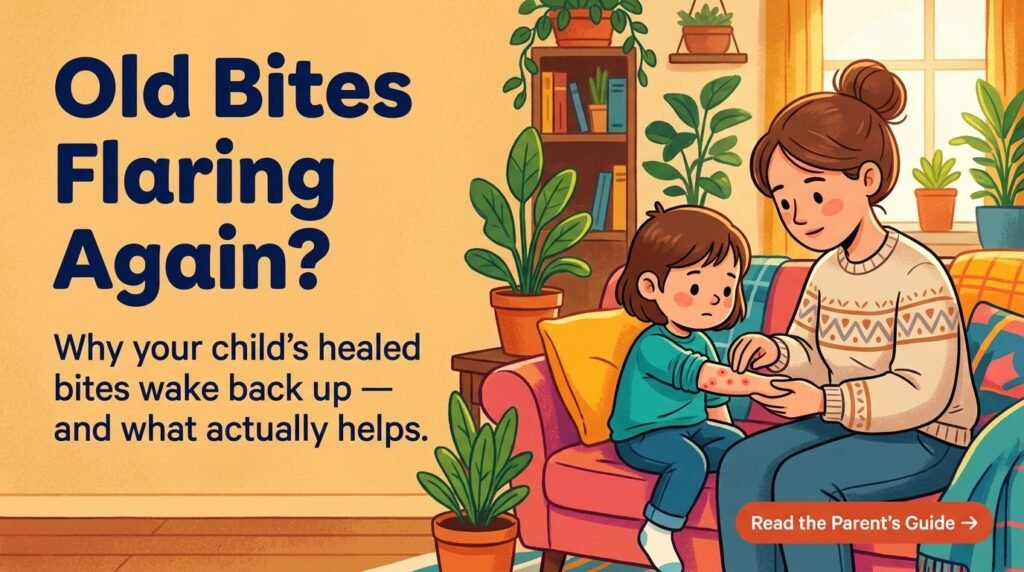
The fast answer: If your child keeps “getting bitten” in their own bed, in winter, or in the same old spots — and nobody else in the house has a single bump — the most likely explanation is papular urticaria. It is a delayed allergic reaction pattern in which a child’s immune system becomes sensitised to bites from fleas, mosquitoes, bed bugs, or mites. After that, one new bite anywhere on the body can re-activate the sites of old bites, which swell and itch again as if they were fresh. It looks like an endless stream of new bites. Usually, it is the same old bites, waking up. It is common, it is not contagious, it is not caused by poor hygiene — and most children outgrow it.
What Papular Urticaria Actually Is
Despite the name, papular urticaria is not ordinary hives, and it is not an infestation living on your child’s skin. It is a hypersensitivity reaction: the immune system over-responds to the saliva proteins that biting insects leave behind. “Papular” simply describes the bumps — small, firm, raised papules. “Urticaria” refers to the hive-like, itchy swelling that can surround them at first.
In a child who is not sensitised, a flea or mosquito bite itches for a few days and disappears. In a child with papular urticaria, the immune system treats each bite as a major event. The reaction is stronger, lasts far longer, and — the part that confuses every parent — spreads its alarm to places that were not bitten at all.
The usual triggers are everyday biters: fleas are the most common culprit, followed by mosquitoes, bed bugs, chiggers, and mites. It only takes occasional exposure. A child does not need to be covered in bites to develop the pattern; a handful of bites over a season can sensitise a reactive immune system.
The Flare Cycle: How One New Bite Wakes Up All the Old Ones
This is the mechanism that makes papular urticaria so baffling, and once you see it, the last few months of “mystery bites” usually make sense.
- Your child gets bitten — say, a flea bite on the ankle at a friend’s house, or a mosquito bite at the park. The bump reacts strongly, takes one to two weeks to settle, and finally fades to a flat mark.
- Days or weeks later, another bite happens somewhere else — a bite on the arm, perhaps so minor your child never mentions it.
- The immune system sounds a general alarm. Because it has been sensitised, it doesn’t just react at the new bite. It reactivates the inflammation at the sites of previous bites too — dermatologists sometimes call this an “id reaction,” a reaction at a distance from the actual trigger.
- The old spots flare. Yesterday’s faded ankle mark is suddenly a raised, itchy bump again — joined, often, by several other old sites. To a parent inspecting at bedtime, it looks exactly like a fresh crop of bites that appeared overnight.
Multiply that cycle across a summer — or across a winter with an unnoticed flea problem indoors — and you get the classic story: “new bites” every few days for months, always on the same child, while everyone else in the family is untouched.
Flare-Up or Fresh Bites? Telling Them Apart
| Clue | More like a papular urticaria flare | More like genuinely new bites |
|---|---|---|
| Where the bumps are | In exactly the spots where bites were before — old sites lighting up again | In new places, often where skin was freshly exposed |
| Who else is affected | Only your child, despite shared beds, sofas, and pets | Other family members have some bites too (though reactions vary) |
| Timing | Bumps appear even after nights indoors, travel away from home, or in cold weather when outdoor insects are inactive | Bumps follow a clear exposure: the park, the yard, a trip, a new pet |
| How each bump behaves | Firm, persistent bumps that take 1–2 weeks each to fully settle, and can re-flare | Ordinary bumps that itch a few days and are gone |
| Pattern over time | Comes in crops every few days or weeks for months, mostly in warm seasons | Matches actual insect activity and stops when exposure stops |
Real life can mix the two — flares are triggered by real new bites, after all. But if the “same old spots” keep relighting and the timing doesn’t match any plausible exposure, you are most likely watching the flare cycle, not a new infestation. That distinction matters because it changes the solution: fewer flare triggers and calmer skin, rather than an escalating war on your house.
What It Looks Like
Papular urticaria bumps are typically small — roughly 3 to 10 millimetres across — firm, and red to reddish-brown. They tend to arrive in groups or clusters, often on exposed skin: legs, arms, face, and the waistline. A tiny central punctum (the original bite point) is sometimes visible on top. Bumps may blister, and in children who scratch — most children — they crust over. Each individual bump usually takes one to two weeks to resolve, and as it fades it can leave a flat darker mark behind for a while, especially on deeper skin tones. Those marks are pigment changes, not scars, and they fade.
Why Your Child — and Not Their Sibling?
Papular urticaria is most common in young children, roughly between 18 months and 10 years of age, with the toddler-to-early-school years being the peak. Babies under a few months old rarely show it — their immune systems haven’t been sensitised yet — and adults get it far less often than children.
Within one family, the pattern is famously unfair. Even when every child shares the same pet, sofa, and backyard, often only one child reacts. The others may be getting bitten just as much; their immune systems simply shrug it off. So “nobody else has bites” is not evidence against insect-triggered reactions — it is one of the most typical features of this condition, and one reason families spend months doubting the explanation. Children with eczema or an allergic tendency in the family seem to be more prone, though any child can develop it.
How Long It Lasts — and the Good News
There are two timelines to keep separate:
- Each bump: usually one to two weeks from flare to flat, sometimes longer for large ones.
- The condition: the cycle of flares can continue for months — occasionally longer — as long as occasional bites keep triggering it and the immune system stays sensitised.
The good news is that papular urticaria is a phase, not a life sentence. With repeated low-level exposure over seasons, most children’s immune systems gradually become desensitised to the saliva proteins — the same tolerance-building process described in our article on whether you can build immunity to mosquito bites. Reactions get smaller, flares get rarer, and one summer the whole pattern quietly stops. Treatment in the meantime is about comfort, skin protection, and cutting down the bites that trigger the cycle.
Managing a Flare: What Actually Helps
- Calm the itch first. A thin layer of over-the-counter 1% hydrocortisone cream, or a topical steroid your pediatrician recommends, on the itchy bumps once or twice daily for a few days. Calamine lotion can soothe milder patches.
- Add an oral antihistamine if itching is disrupting sleep. Cetirizine, loratadine, or fexofenadine are the usual non-drowsy options — always dosed for your child’s age and weight, and checked with your pediatrician for children under two or kids on other medications.
- Protect the skin barrier. Keep nails trimmed short, dress your child in soft sleep clothing that covers the itchiest areas, and discourage scratching as much as realistically possible. Broken skin is how a harmless flare turns into a bacterial infection.
- Watch the scratched spots. Increasing pain, spreading redness, warmth, pus, or crusting honey-coloured scabs are signs of secondary infection — those need a clinician, and sometimes antibiotics. Our guide to hives vs. bug bites can help you sort out what kind of bump you’re looking at in the first place.
- Photograph the pattern. A few dated phone photos of where bumps appear — and reappear — are genuinely useful at a pediatrician or dermatologist visit, because the “old sites relighting” pattern is the key diagnostic clue.
Cutting Off the Triggers: Finding the Culprit
You do not need to eliminate every insect from your child’s life — you need to reduce bites enough that the flare cycle loses momentum. Start with the most common source:
- Check the pets. Fleas are the number one trigger. Ask your veterinarian about effective flea control for every pet in the home, and wash pet bedding hot. Do not rehome the dog — treat the fleas. (And note: never apply a dog’s flea product to a cat; some dog flea treatments containing permethrin are dangerous to cats.)
- Check the sleeping area. If bed bugs are a possibility — recent travel, second-hand furniture, bites concentrated after nights at home — inspect mattress seams and the bed frame, or call a pest professional for an inspection rather than spraying blindly.
- Dress for the outdoors. Long sleeves and pants for yard and park play in bite season, with socks over pant cuffs in grassy areas.
- Use repellent appropriately. An age-appropriate insect repellent on exposed skin for outdoor play, following the label — your pediatrician can advise for the youngest children.
- Vacuum and wash. Regular vacuuming of carpets, rugs, and upholstered furniture, plus hot washing of your child’s bedding, reduces indoor flea life stages.
For mosquito-heavy homes, the swelling-control advice in our guide to mosquito bite swelling in children is a useful companion while you work on the source.
When to See a Pediatrician or Dermatologist
- The bumps keep coming for more than a few weeks and you can’t identify or control the trigger.
- Your child is losing sleep, scratching skin open, or developing signs of infection (spreading redness, pain, warmth, pus, fever).
- Bumps are leaving marks that worry you, or the pattern doesn’t fit — for example, it involves the finger webs, wrists, and skin folds, or other household members develop an intensely itchy rash too. Look-alike conditions exist, and an in-person examination is how a clinician sorts them out.
- Over-the-counter treatment isn’t controlling the itch — a clinician can prescribe a stronger topical steroid, and occasionally a short oral course for severe flares.
- Your child is under two, or has eczema or immune problems — get individualised advice earlier rather than later.
Frequently Asked Questions
Is papular urticaria contagious?
No. It is your child’s own immune reaction pattern, not an infection and not something living on their skin. Siblings can’t catch it — though a sibling can independently be a non-reactor who shows nothing at all.
Why do the bumps appear in the morning if nothing bit my child overnight?
Because flares are delayed and site-based. A minor bite from yesterday — at school, at the park, from the family pet — can trigger old sites hours later, and parents typically discover the “new” bumps at the next morning’s dressing or bath. The timing points to when you noticed them, not when the trigger happened.
Will papular urticaria leave scars?
Usually not. Bumps can leave flat, darker patches that take weeks to months to fade, particularly on medium and deeper skin tones. True scarring is uncommon and is mostly a risk where scratching caused a secondary infection — another reason itch control and short nails matter.
Should we get rid of our pet?
Almost certainly not. If fleas are the trigger, effective veterinary flea control for the pet, plus bedding washing and vacuuming, usually reduces bites enough for the cycle to fade. Rehoming is a drastic answer to a manageable problem — talk to your veterinarian and pediatrician first.
When will my child outgrow this?
Most children outgrow papular urticaria as their immune systems desensitise over repeated seasons of exposure. For many, the pattern lasts months to a few bite seasons, shrinking year by year. There is no fixed birthday when it stops, but persistence unchanged into the later school years is a good reason to check in with a dermatologist.
Could it be something else, like allergies to food or detergent?
Food and contact allergies more often cause ordinary hives — soft, shifting wheals that move around and fade within hours — rather than firm, fixed bumps that sit in the same spots for a week or two and relight old bite sites. If the pattern doesn’t match this article, that’s worth an in-person look rather than more guesswork.
This article is general information for parents and cannot diagnose your child. If the pattern doesn’t fit, or your child is unwell, an in-person assessment is the right next step.
By Dr. Sarah Jones