Kissing Bug vs. Look-Alikes: Is This Really a Kissing Bug?
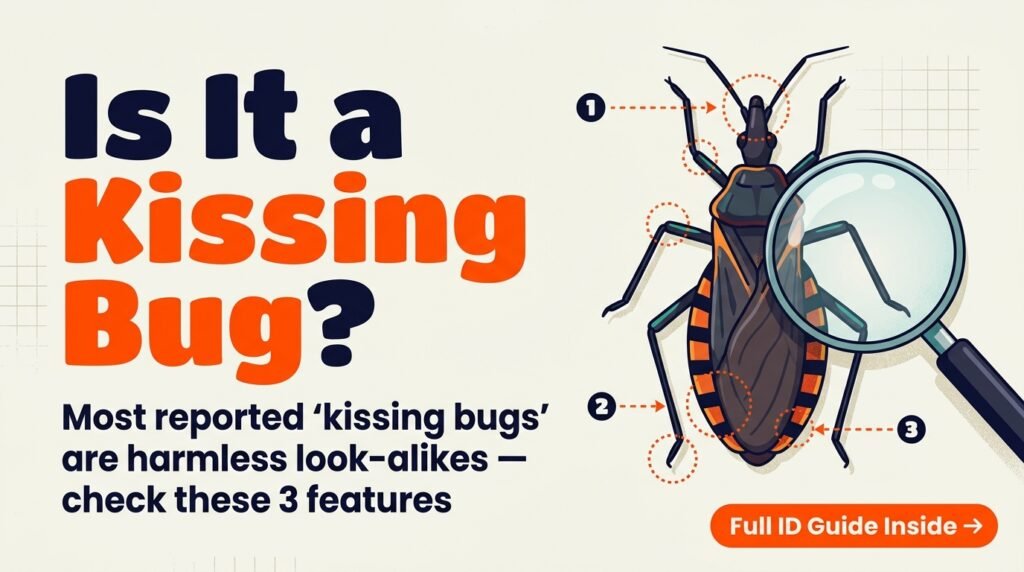
The fast answer: Probably not — and that is genuinely good news. When worried homeowners send photos of suspected kissing bugs to university extension services, the insect usually turns out to be something else. Purdue University reported that most “kissing bug” submissions it received in 2022 were actually wheel bugs, and when Virginia Tech entomologists reviewed the photos sent to a news outlet during a 2015 kissing bug scare, every single one was a wheel bug. Kissing bugs have three features no look-alike shares all at once: a narrow, cone-shaped head, a thin straight beak folded under that head, and a smooth back with orange or red banding along the edge of the abdomen. The 60-second check below walks you through them.
The Real Kissing Bug in 30 Seconds
Kissing bugs (also called triatomine bugs or bloodsucking conenoses) are a group of species in the genus Triatoma. Adults are roughly an inch long, dark brown to black, with a distinctly narrow, elongated, cone-shaped head. Their mouthpart — called a proboscis or beak — is thin and straight, and at rest it lies tucked in a groove under the head. The flattened abdomen extends beyond the wings, and its exposed edge typically carries orange, red, or yellowish bands or patches. Their six legs are thin and even in thickness, with no flattened sections.
Behavior matters as much as looks. Kissing bugs are nocturnal blood feeders. They come out at night, feed painlessly on sleeping people and animals — often on the face, which is how they got their name — and hide during the day in cracks, woodpiles, rock piles, and animal shelters. A bug that is active on your porch at noon, stalking caterpillars, is behaving like a predator, not a kissing bug.
The 60-Second ID Check
Before you panic, look for these three features — ideally from a photo taken from above, with something like a coin for scale:
- The head and beak. Kissing bug: narrow, cone-shaped head with a thin, straight beak tucked underneath. Wheel bug: head is also narrow, but the beak is noticeably thicker and curved, like a pick. Stink bugs and boxelder bugs: much wider, triangular heads.
- The back. Kissing bug: smooth, unarmored back — no crests, no humps. Wheel bug: an unmistakable raised half-wheel or cogwheel crest with “teeth” along the top of the thorax. If you see the wheel, it is a wheel bug, full stop.
- The legs. Kissing bug: all legs thin and plain. Leaf-footed bugs and western conifer seed bugs: the hind legs have a flattened, leaf-shaped flare — the single easiest reassurance that you do not have a kissing bug.
Color banding helps too: orange-red edging on a dark abdomen fits a kissing bug, while a mostly gray, rough-textured body fits a wheel bug, and bold orange-black patterns with three stripes on the thorax fit a boxelder bug.
Kissing Bug vs. Wheel Bug vs. Leaf-Footed Bug vs. Boxelder Bug
| Feature | Kissing bug | Wheel bug | Leaf-footed bug / western conifer seed bug | Boxelder bug |
|---|---|---|---|---|
| Size | About 1 inch | About 1 to 1¼ inches | About ¾ to 1 inch | About ½ inch (noticeably smaller) |
| Color | Dark brown to black with orange/red bands along the abdomen edge | Dull gray to grayish-brown, rough texture | Brown, sometimes with a pale zigzag across the back | Black with red-orange stripes and markings |
| Tell-tale feature | Cone-shaped head; thin straight beak tucked under it | Semicircular cogwheel crest on the back — unique | Flattened, leaf-like flare on the hind legs | Three stripes on the thorax; red-edged wings |
| What it eats | Blood of sleeping animals and people | Other insects — a garden predator | Plant juices: seeds, cones, garden fruit | Seeds of boxelder and maple trees |
| Does it bite people? | Yes — painlessly, at night, while feeding | Only defensively if handled or trapped against skin — and it hurts immediately | No meaningful bite; a plant feeder | No; a nuisance invader, not a biter |
| Health concern | Can carry the parasite that causes Chagas disease | None beyond a painful defensive bite | None | None |
| Typical place found | Near beds, pet sleeping areas, woodpiles; comes out at night | Gardens, trees, fences; active in daytime | Gardens; wanders indoors in fall | Siding and windows in fall; indoors in winter |
The wheel bug: the #1 mistaken identity
Wheel bugs are fellow assassin bugs — same family as kissing bugs — which is why the body plan looks similar at a glance. But wheel bugs are hunters, not blood feeders. They stalk caterpillars and other insects in gardens and on tree trunks, they are gray rather than dark-and-banded, and the cogwheel crest on their back is found on no other North American insect. If one bites you, you will know instantly: Ohio State extension describes the defensive bite as equal to or more powerful than a hornet sting, sometimes taking over a week to heal. That immediate pain is itself a clue — kissing bug feeding is designed to go unnoticed. Leave wheel bugs alone (they are free pest control), but do not handle them. For bite care, see our wheel bug bite treatment guide.
Leaf-footed bugs and western conifer seed bugs
These plant-feeding bugs cause enormous unnecessary alarm every fall, when they wander into houses looking for sheltered winter quarters. The western conifer seed bug is long and brown with a faint zigzag pattern; the family’s signature is the flattened, leaf-shaped segment on each hind leg. Kissing bugs never have this. These bugs feed on seeds, cones, and ripening garden produce with straw-like mouthparts built for plants. They do not bite people, do not feed on blood, and do not reproduce indoors — a vacuum and a sealed crack solve the problem.
Boxelder bugs (and milkweed bugs)
Boxelder bugs are about half the size of a kissing bug, black with red-orange trim and three distinct stripes on the thorax. They feed on boxelder and maple seeds, gather on sunny walls in fall, and slip indoors for winter. They are harmless to people and pets. Large and small milkweed bugs — bold orange-and-black insects found on milkweed plants — are also regularly reported as kissing bugs; they are plant feeders and equally harmless. In both cases, bright warning colors plus small size plus plant association equal “not a kissing bug.”
Painless vs. Painful: What the Bite Tells You
One of the most useful distinctions is timing of pain. A kissing bug’s bite is typically painless — the bug feeds for several minutes on a sleeping host and leaves. The problem associated with kissing bugs is not the bite itself but what can follow if the bug defecates near the wound and the person rubs the droppings into the bite, the eyes, or the mouth. A wheel bug’s defensive bite, by contrast, is immediately and memorably painful, and a leaf-footed or boxelder bug essentially does not bite at all. So: a bug that “bit me and it really hurt” while you were gardening is almost certainly a defensive predator, not a kissing bug. A bug found near your bed that you never felt at all is the one worth identifying carefully. If you do have a confirmed kissing bug bite, our kissing bug bite treatment guide covers first aid and monitoring.
Found One Indoors? Do This, Step by Step
- Don’t crush it with your bare hands, and don’t handle it directly. If it is a true kissing bug, you want to avoid contact with the bug and especially its droppings.
- Contain it, don’t kill it. Place a jar or container over the bug, slide a stiff card underneath, and seal it. An intact specimen (or a clear photo from above, beside a coin for scale) is far more useful than a squashed one.
- Get an expert ID. Contact your state health department, your local cooperative extension office, or a university triatomine program — many will identify a photo for free and can tell you whether testing the bug is worthwhile in your state. Several states actively track kissing bug reports because it helps map where the Chagas parasite circulates.
- Clean the area where the bug was found with regular household cleaning, and wash your hands afterward.
- Check the sleeping areas. Look along mattress seams, bed frames, pet bedding, and nearby cracks and clutter, and repeat the check for any more bugs — one bug is often a wanderer; several suggest a nearby harborage.
- Close the entry routes. Seal cracks around windows, doors, and utility lines; repair screens; move woodpiles, rock piles, and debris away from the house; and keep outdoor lights near bedrooms in mind — kissing bugs are attracted to lights at night, so switching a porch light to a less attractive bulb or moving it away from the door can help.
- Protect pets’ sleeping areas. Outdoor kennels and dog houses near woodpiles are classic kissing bug habitat in the South and Southwest. Keep them clean and inspect them periodically.
For ongoing prevention around bedrooms, see our guide to keeping kissing bugs out of the bedroom.
Chagas Disease: The Honest Basics
Chagas disease is caused by the parasite Trypanosoma cruzi. Its main route to people is not the bite itself: an infected kissing bug deposits feces while or after feeding, and the parasite enters when the person rubs those droppings into the bite site or touches their eyes or mouth. That inefficient route is one reason transmission in the U.S. is uncommon compared with parts of Latin America.
What is the actual U.S. picture? In September 2025, a CDC journal report concluded that Chagas should be recognized as endemic in the United States: infected kissing bugs have been documented in 32 states, and locally acquired human cases have been confirmed in at least eight (including Texas, Arizona, California, Louisiana, Arkansas, Mississippi, Missouri, and Tennessee). Estimates suggest roughly 280,000–300,000 people in the U.S. carry the infection, most without knowing it.
The illness itself comes in two phases. The acute phase, in the weeks after infection, is often silent or mild — sometimes fever or fatigue. One classic sign is Romaña’s sign: painless swelling of one eyelid, which happens when the parasite enters through the eye. The chronic phase arrives years to decades later in a minority of infected people and can damage the heart (rhythm problems, an enlarged or weakened heart) or, less commonly, the digestive tract. The critical, calming context: most kissing bug encounters in the U.S. do not lead to infection, the look-alikes are harmless, and infection can only be confirmed or ruled out with a blood test — never by looking at a bug, a bite, or a rash.
When to See a Doctor
- You found a confirmed kissing bug in your home and live in a state where they are established — ask your doctor whether a Chagas blood test makes sense for you, especially if the bug was in a bedroom.
- You develop one-sided eyelid swelling, fever, or flu-like illness in the weeks after sleeping in a place where kissing bugs were present.
- You were bitten by any bug and develop spreading redness, warmth, pus, fever, or red streaks — signs of an ordinary bacterial skin infection, which needs treatment regardless of the species.
- Allergic warning signs — swelling of lips or tongue, trouble breathing, widespread hives, dizziness: seek emergency care (call 911 for breathing problems).
- Your dog is lethargic, losing appetite, or has a swollen abdomen and you live in kissing bug country: dogs can contract Chagas too, and a veterinarian can test for it.
Frequently Asked Questions
Are wheel bugs dangerous?
Not in the way people fear. Wheel bugs do not feed on blood and cannot give you Chagas disease. Their one real hazard is a defensive bite if you grab one or trap it against your skin — described as comparable to a hornet sting. Admire the cogwheel, give it space, and it will spend its day eating garden pests.
Do boxelder bugs bite or spread disease?
No. Boxelder bugs feed on tree seeds, do not bite people, and do not transmit disease. They are a fall and winter nuisance when they slip indoors, nothing more.
Should I kill a kissing bug if I find one?
Containing it is more useful than killing it. An intact bug in a sealed jar — or at minimum a clear photo — lets a health department or extension expert confirm the species and, in some states, test it. If you must kill one found indoors, avoid bare-hand contact, don’t crush it on bedding or skin, and wash your hands and the surface afterward.
Can kissing bugs infest a house like bed bugs?
Not typically in U.S. homes. In parts of rural Latin America they colonize cracks in walls and thatch; in the U.S., they more often live outdoors — woodpiles, rock piles, animal burrows, kennels — and wander or are drawn in by lights at night. Finding one indoors is a reason to inspect and seal up, not a sign of an established indoor colony.
Can my dog get Chagas disease?
Yes. Dogs are bitten by the same bugs, can become infected, and can develop heart problems from chronic infection. In kissing bug country, keep dogs from eating bugs they catch, keep kennels clean and away from woodpiles, and ask your veterinarian about Chagas testing if your dog has compatible symptoms or you have found kissing bugs around your home.
This article is general information, not medical advice, and it cannot diagnose Chagas disease or any other condition. A blood test ordered by your doctor is the only way to know.
By Dr. Sarah Jones