Sand Flea vs. Sand Fly Bites: What Actually Bit You at the Beach?
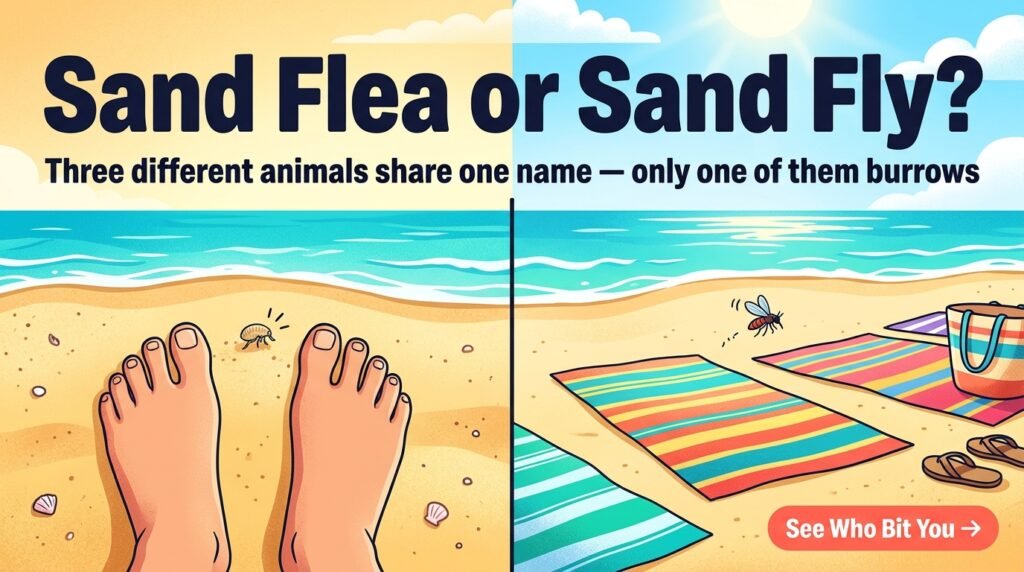
The fast answer: If you came home from a U.S. beach with intensely itchy welts clustered around your ankles and lower legs, you were almost certainly bitten by sand flies or biting midges (the near-invisible flies everyone calls no-see-ums) — not by a “sand flea.” The confusing part is that three completely different animals share the sand flea name: a harmless jumping crustacean that cannot bite you at all, a tropical flea that genuinely can burrow into skin, and the biting flies that cause nearly every itchy beach bite in the United States. Knowing which one you met changes what you should do about it.
One Name, Three Different Animals
“Sand flea” may be the most misleading nickname in the entire bug world. Depending on where you are and who you ask, it can refer to a crustacean, a true flea, or a fly. Here is each animal, one at a time.
1. The beach hopper: the crustacean that doesn’t bite
The creature most scientists mean by “sand flea” is not an insect at all. Beach hoppers (also called sand hoppers or beach fleas) are small, shrimp-like crustaceans in the family Talitridae — distant cousins of crabs and lobsters. They live in damp sand near the high-tide line, feed on decaying seaweed and other organic debris, and hop away when disturbed, which is how they earned the “flea” nickname. They have no interest in blood, they cannot feed on you, and they die quickly away from wet sand, so they are not coming home with you in any meaningful way. At most, Cleveland Clinic notes, these common beach creatures may cause mild, short-lived skin irritation. If something at the beach left you with real, itchy welts, this animal is not your culprit.
2. The chigoe flea: the “true” sand flea (and the one to respect)
The true sand flea is Tunga penetrans, better known as the chigoe flea or jigger. It is the smallest known flea, and the fertilized female does something no other flea does: she burrows head-first into skin — usually on the feet, around the toenails, or between the toes — and stays there, swelling as her eggs develop. The resulting condition, called tungiasis, can cause significant inflammation, pain, and skin wounds, and the burrow leaves the skin open to bacterial infection. The important context for U.S. readers: chigoe fleas are tropical. They are established in parts of Central and South America, the Caribbean, and sub-Saharan Africa, and they are rare in the United States. This is overwhelmingly a traveler’s issue, not a Florida-beach issue.
3. Sand flies and no-see-ums: the usual suspects
The bites blamed on “sand fleas” at U.S. beaches are, in the great majority of cases, the work of tiny biting flies: sand flies and their close cousins the biting midges, better known as no-see-ums (and regionally as punkies or sand gnats along the Southeast coast). Only the females bite, because they need blood to produce eggs. These flies are weak fliers that hug the ground, which is why their bites concentrate on feet, ankles, and lower legs — or on whatever skin touches the sand if you were lying on a towel. They are most active around dawn and dusk, in calm, humid air near wet sand, marshes, and decaying seaweed. In the United States, sand fly and midge bites are essentially a miserable itch problem rather than a disease problem — with one exception worth knowing: sand flies in parts of the southern U.S., including areas of Texas and Florida, can carry the parasites that cause leishmaniasis, a disease that typically shows up as a skin sore that does not heal.
Sand Flea vs. Sand Fly vs. No-See-Um: The Comparison Table
| Feature | Beach hopper (“sand flea”) | Chigoe flea (true sand flea) | Sand fly | No-see-um (biting midge) |
|---|---|---|---|---|
| What it is | Crustacean (like a tiny shrimp) | True flea; smallest known flea | Tiny true fly | Tiny true fly, often nearly invisible |
| Does it bite people? | No — feeds on decaying matter | Yes — female burrows into skin | Yes — female takes blood meals | Yes — female takes blood meals |
| What it leaves behind | At most, brief mild irritation | A swollen spot, often on the foot, with a dark center where the flea entered | Small red welts, often in clusters, that itch hard | Red welts that can grow surprisingly large and itch intensely |
| Where you meet it | Damp sand near the high-tide line, U.S. coasts | Tropical regions: Central/South America, Caribbean, Africa; rare in the U.S. | Coastal and marshy areas, mostly at dawn and dusk | Coasts, marshes, and inland waterways; dawn, dusk, and calm humid days |
| How long it bothers you | A few days at most | Until the flea is removed; infection risk while embedded | Itch peaks in the first 1–2 days; welts usually settle within about a week | Itch peaks in the first 1–2 days; large welts can linger up to two weeks |
| Main concern | None | Tungiasis (burrowing infection) and bacterial infection | Itch and skin infection from scratching; rarely, leishmaniasis in parts of the southern U.S. | Itch, swelling, and skin infection from scratching |
How to Tell Which One Bit You
You usually cannot identify a biter from a bump alone — individual skin reactions vary too much. But three clues narrow it down quickly:
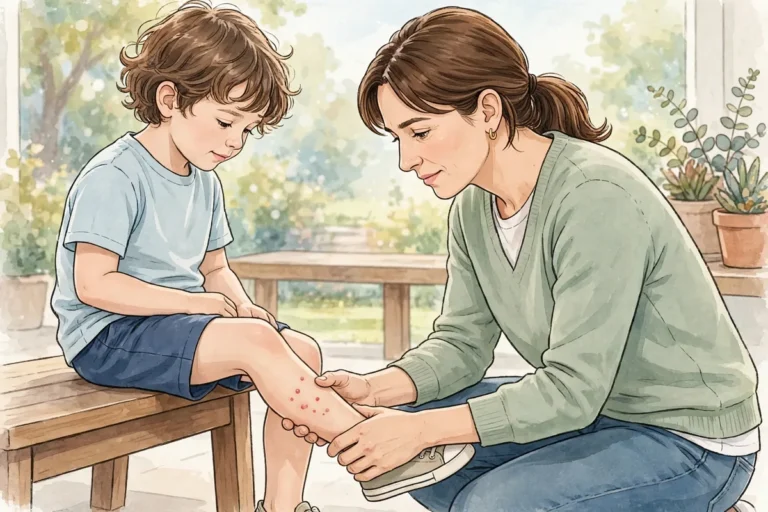
- Where the bites are. A cluster of itchy welts on the feet, ankles, and shins points to ground-hugging flies — midges or sand flies. A single painful, swollen spot on a foot with a dark center, especially after walking barefoot in a tropical region, points to a chigoe flea.
- When they appeared. Fly bites usually announce themselves the same evening or the next morning after a beach visit, and the itch is worst in the first day or two. A chigoe lesion develops over days at one fixed spot and tends to become more painful and swollen rather than simply itchy.
- Where you have been. On a U.S. beach, sand flies and no-see-ums are the answer almost every time. Chigoe fleas enter the picture only with travel to tropical areas where they are established, particularly with barefoot walking on sandy soil or dirt floors.
Treating Sand Fly and No-See-Um Bites, Step by Step
For the common U.S. beach bite, treatment is about calming the itch and protecting the skin barrier while the reaction runs its course:
- Wash the area with soap and water as soon as you can. This removes sand, salt, and bacteria from skin that is about to be scratched.
- Apply a cold compress or ice wrapped in cloth for 10–15 minutes at a time. Cold is the fastest reliable way to quiet the first wave of itching.
- Use calamine lotion or 1% hydrocortisone cream on the welts once or twice a day. Both are standard over-the-counter options for itchy bites.
- Take an oral antihistamine (such as cetirizine or loratadine during the day) if the itch is disrupting sleep or covering a large area. Follow the package directions.
- Don’t scratch. Broken skin is how a nuisance bite turns into a bacterial skin infection. Keep nails short, and cover children’s bites at night if needed.
- Set your expectations. These bites commonly itch hardest on days one and two. Welts from no-see-ums can look dramatic and persist up to two weeks in sensitive people, gradually shrinking. A bite that instead keeps expanding, growing more painful, or developing pus after several days is not following the normal script — see the warning signs below.
For day-by-day care of the bites themselves, see our guide to sand flea bite treatment, and for midge-specific care, our no-see-um bite treatment guide.
Treating a Chigoe Flea (Tungiasis): What Not to Do
If you suspect a chigoe flea after tropical travel — a swollen, tender spot on the foot with a dark center that keeps enlarging — the rules are different. Do not squeeze it, dig at it with a needle, or try to burst it. Crushing the flea inside the skin can rupture it and worsen inflammation and infection risk. Instead: keep the area clean and covered, avoid walking barefoot, and see a clinician, who can remove the flea intact with sterile instruments and check whether you need a tetanus update or treatment for a secondary bacterial infection. This is one beach souvenir that genuinely benefits from professional handling.
Prevention: Your Next Beach Day
- Use an EPA-registered repellent containing DEET, picaridin, IR3535, oil of lemon eucalyptus, or 2-undecanone on exposed skin, and pay special attention to feet and ankles — the flies’ favorite landing zone. Reapply as the label directs.
- Time your visit. Biting midges and sand flies peak around dawn and dusk and on still, humid days. Midday with a good breeze is their least active window — and yours.
- Mind your towel placement. Damp sand near seaweed piles and marsh edges is prime midge habitat. Sit on a chair or a towel laid on drier sand, and consider light ankle coverage for sunset walks.
- Use fine mesh and fans. Standard window screens do not stop no-see-ums; they pass through ordinary mesh. Fine “no-see-um” netting and a simple fan work well because these flies are weak fliers and struggle in moving air.
- After tropical travel, wash feet carefully, inspect them over the following days, and wear shoes rather than going barefoot on sandy soil in rural areas where chigoe fleas are common.
If beach flies are a recurring problem for you, our sand fly bite treatment guide goes deeper on relief options for sand fly bites specifically.
When to See a Doctor
Most beach bites need nothing more than home care. Get medical attention if you notice any of the following:
- Spreading redness, increasing pain, warmth, red streaks, swelling that keeps growing after several days, or pus — signs of a bacterial skin infection.
- A sore that does not heal, or that slowly enlarges over weeks — especially if you live in or traveled to an area where leishmaniasis occurs, or you visited tropical regions.
- A swollen spot on the foot with a dark center after barefoot exposure in the tropics (possible chigoe flea).
- Signs of a serious allergic reaction: swelling of the lips, tongue, or face, trouble breathing, widespread hives, or feeling faint. Call 911 for breathing difficulty or facial/throat swelling.
- Fever accompanying any bite reaction.
Frequently Asked Questions
Do sand fleas actually bite humans?
The crustaceans commonly called sand fleas (beach hoppers) do not bite people at all — they feed on decaying seaweed and debris. The true sand flea, the tropical chigoe flea, does burrow into skin, but it is rare in the United States. The itchy bites most people call “sand flea bites” are actually from sand flies and biting midges.
What do sand fly bites look like?
Typically small, red, raised welts, often in clusters on the feet, ankles, and lower legs. They can itch intensely — often more than the size of the bump suggests — and the itch usually peaks within the first 24–48 hours. Sensitive people may develop larger welts that take up to two weeks to fully fade.
How long do beach bites last?
For typical sand fly and no-see-um bites, the worst itching lasts one to two days, most welts settle within about a week, and larger reactions can linger up to two weeks. A bite that is still expanding, becoming more painful, or oozing after several days should be evaluated for infection rather than assumed to be a slow-healing bite.
Can sand fleas come home with me from the beach?
Beach hoppers cannot survive away from damp sand, and sand flies and midges do not infest homes the way bed bugs or pet fleas do. Finding itchy welts after a beach trip does not mean your home is infested. Chigoe fleas are the exception: a burrowed flea travels with the person, which is another reason post-travel foot spots deserve a clinician’s look.
I got bites at the beach but never saw a single bug. What bit me?
Almost certainly no-see-ums. Biting midges are small enough that many people never see them at all; you feel the sharp bite or discover the welts later. Their absence is exactly how they got their name — and why ankle clusters after a calm evening near the water are such a reliable signature.
This article is general information, not medical advice. If you are unsure about a bite or a reaction, a clinician who can examine your skin is always the safer call.
By Dr. Sarah Jones