# Kissing Bug vs Look-Alikes: Is This a Kissing Bug?
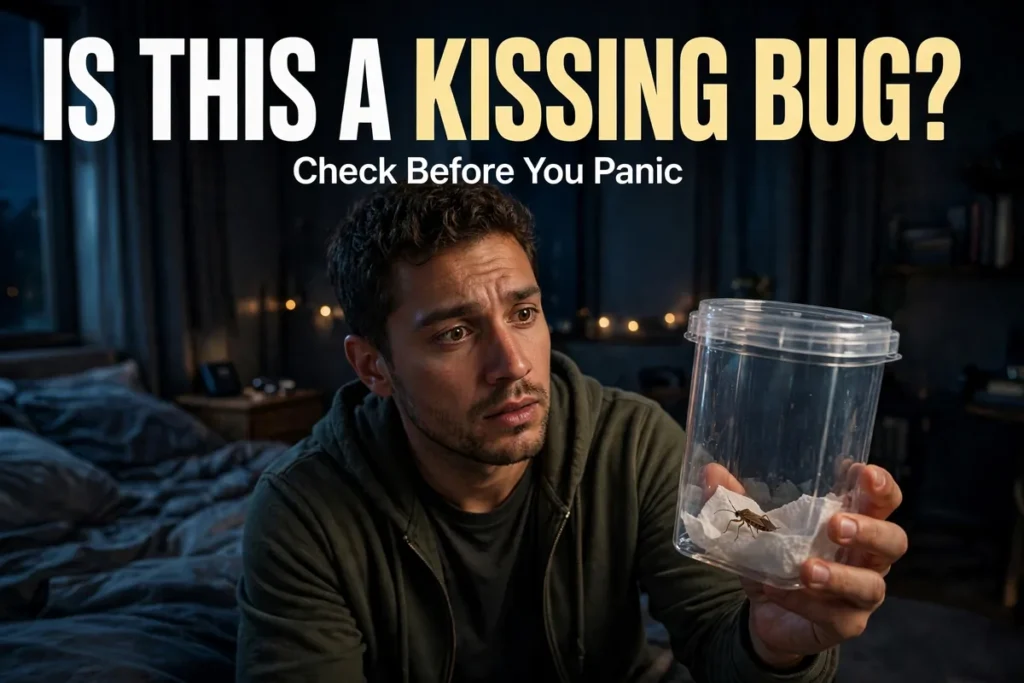
If you found a dark bug in your bedroom at night and you are wondering whether it is a kissing bug, here is the direct answer: most bugs found in homes in the United States that look like kissing bugs turn out to be harmless look-alikes, but a true kissing bug has a specific combination of features that is worth learning. Do not try to decide from one feature alone. Use the full combination of the head shape, the beak, the abdomen edge, the size, and the behavior, and when you are unsure, contain the bug safely, photograph it, and ask your state health department or university extension service for identification. Do not crush it with bare hands, do not touch it, and do not assume that a single bug means you have been exposed to disease.
This guide gives you one combined midnight identification key that works across all the common look-alikes, instead of asking you to read a separate comparison for each insect. You will learn what a true kissing bug, also called a triatomine or conenose bug, looks like, how each look-alike differs, what to do if you find one, and what to do about a bite. If you have a bite that worries you, the safest step is prompt medical advice, and the “When to See a Doctor” section below explains when to seek emergency care.
What a True Kissing Bug Looks Like
A kissing bug belongs to a group of insects called triatomines. They are also called conenose bugs because of the shape of the head. In the United States, several kinds of triatomines occur, and they can vary in color and exact size, so identification depends on the pattern of features together, not on color alone.
The long cone shaped head and thin straight beak
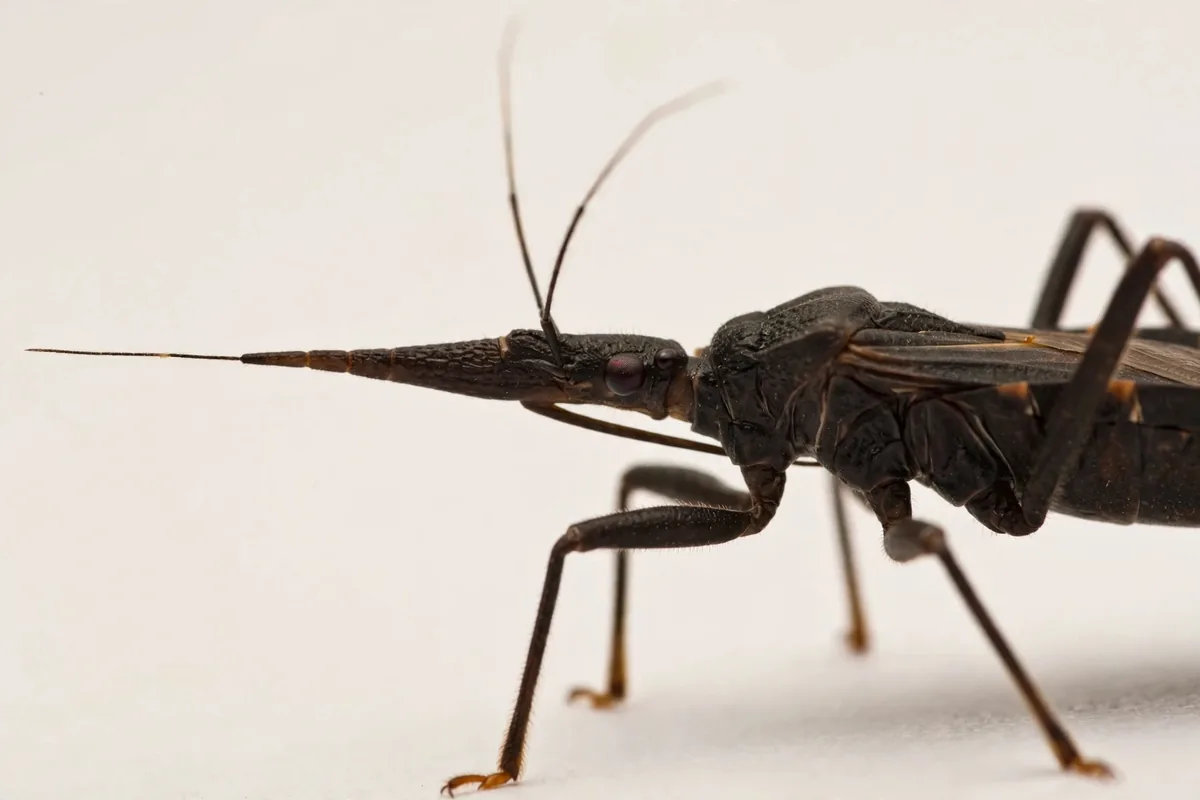
The most useful feature is the head. A true kissing bug has a long, cone shaped head that narrows toward the front, like an elongated cone or snout. Under the head sits a thin, straight beak that the bug uses for feeding. The beak is slender and straight, not thick and curved. If the bug in front of you has a short, broad head or a thick, strongly curved beak, that points away from a kissing bug and toward another kind of insect, especially the wheel bug or other assassin bugs described below.
Take a photo from the side if you can do so safely, because the head profile is often clearer in a side view than in a view from above. Do not pick the bug up to get a better angle. A photo taken through a clear container, or from a safe distance with zoom, is enough for an expert to review.
The abdomen edge and banding
Many kissing bugs have a banded pattern along the edge of the abdomen, often in orange or red, where the edge of the abdomen extends slightly beyond the folded wings. This banding is one of the features people notice first, and it can be striking. It is helpful, but it is not proof on its own, because some look-alikes also have red or orange markings. Look for the banding together with the cone shaped head and the thin straight beak. A bug with red markings but a shield shaped body, or with leaf like paddles on its hind legs, is not matching the kissing bug pattern, even if the color reminds you of one.
Also notice the overall body shape. A kissing bug has a somewhat flattened, oval body with wings that lie flat over the back. The legs are relatively slender. It does not have a shield shape like a stink bug, it does not have a raised crest on the back like a wheel bug, and it does not have flattened, leaf like expansions on the hind legs like a leaf footed bug.
Size, color, and night behavior
A kissing bug is about 0.5 to over 1 inch long. That range covers the variation among kinds found in the United States, and it means a very small bug is less likely to be an adult kissing bug, while a bug in this size range deserves a closer look using the other features. Color is usually dark brown to black, sometimes with the orange or red banding described above. Color alone should never settle the question, because lighting at night changes how color looks, and because several look-alikes are also dark brown or black.
Behavior can add useful context. Kissing bugs are active at night and are attracted to warmth and to the carbon dioxide that people and animals breathe out during sleep. That is why encounters often happen in bedrooms, and why the name kissing bug comes from bites that sometimes occur near the face. A bug found crawling on a wall near a bed at night fits the pattern, but so do many other insects that wander indoors, so behavior is supporting evidence only, not a diagnosis.
If you are trying to remember one sentence, remember this: a true kissing bug combines a long cone shaped head, a thin straight beak, a flattened oval body about 0.5 to over 1 inch long, and often orange or red banding along the abdomen edge. If one of those features is clearly missing, consider the look-alikes below before you worry.
One Midnight ID Key for Every Look-Alike
Use these steps in order, at night, with a flashlight and from a safe distance. Do not touch the bug at any point in this key. If you cannot see a feature clearly, take a photo and move to the next step rather than handling the insect.
Step 1: Look at the body shape first
Start with the overall outline. If the body is broad and shield shaped, like a small shield, think stink bug. If the body is flattened and oval with red markings and the bug is one of a group clustered on a wall or window, think boxelder bug. If the hind legs have flat, leaf like paddles, think leaf footed bug or western conifer seed bug. If there is a raised, wheel like crest on the middle of the back, think wheel bug. Only if the body is a flattened oval without any of those features should you move on to the kissing bug check.
Step 2: Look at the head and beak
Now look at the head. A long cone shaped head with a thin straight beak supports a kissing bug. A thick, curved beak supports a predatory assassin bug such as a wheel bug. A short, blunt head with no long cone supports a stink bug, a boxelder bug, or a leaf footed bug. This single step separates many look-alikes quickly, and it is the step people skip most often when they focus only on color.
Step 3: Look at the abdomen edge and legs
Check the edge of the abdomen for orange or red banding, and check the legs for leaf like expansions. Banding plus a cone shaped head is a strong kissing bug pattern. Banding without a cone shaped head is not. Leaf like paddles on the hind legs point firmly to leaf footed bugs, which feed on plants, not to kissing bugs, even when the body color is similar.
Step 4: Look at the context and behavior
Finally, consider where and when you found the bug. A single bug near a bed at night is consistent with a kissing bug, but also with a wandering stink bug or boxelder bug that came indoors for shelter. A group of bugs clustered on a sunny wall, a bug on a plant, or a bug found in fall near a window points more toward plant feeding look-alikes that enter homes seasonally. Context never replaces the physical features, but it can help you decide how urgently to seek expert identification.
If after these steps you still cannot tell, that is a normal outcome, not a failure. Many insects look similar at night, and even experienced observers use photos and expert help. Contain the bug if it is safe to do so, photograph it, and ask for identification as described in the protocol section below.
Quick Comparison Table: Kissing Bug vs the Common Look-Alikes
The table below summarizes the key differences at a glance. Use it with the detailed sections that follow, not instead of them, because no single row settles an identification on its own.
Insect
Head and beak
Distinctive feature
Feeding and bite risk
True kissing bug (triatomine, conenose)
Long cone shaped head, thin straight beak
Often orange or red banding along the abdomen edge, flattened oval body about 0.5 to over 1 inch long
Feeds on blood, active at night, may bite near the face during sleep
Wheel bug
Shorter head, thick curved beak
Raised cogwheel crest on the thorax, like a small gear on the back
Predator of other insects, painful defensive bite if handled, does not transmit Chagas disease
Leaf footed bugs, including western conifer seed bug
Short blunt head, plant feeding mouthparts
Leaf like paddles on the hind legs, long body
Plant feeders, enter homes in fall for shelter, do not bite people for blood
Boxelder bugs
Short head, no long cone
Red markings, flattened body, often found in groups
Plant feeders, gather in groups on walls and windows, do not bite people
Stink bugs
Short blunt head, no long cone
Broad shield shape
Plant feeders, may release an odor when disturbed, do not bite people for blood
Other assassin bugs generally
Varies, often a thicker or curved beak
Predatory body shape, no cone shaped head with thin straight beak
Predators of other insects, a painful bite is possible if handled, not the same risk pattern as a kissing bug
Read the table from left to right for any bug you find. If the distinctive feature column matches a look-alike, that match matters more than a vague similarity in color or size.
Wheel Bug: The Crest Gives It Away
The wheel bug is one of the most common insects mistaken for a kissing bug, and it is also one of the easiest to separate once you know what to look for.
The cogwheel crest on the thorax
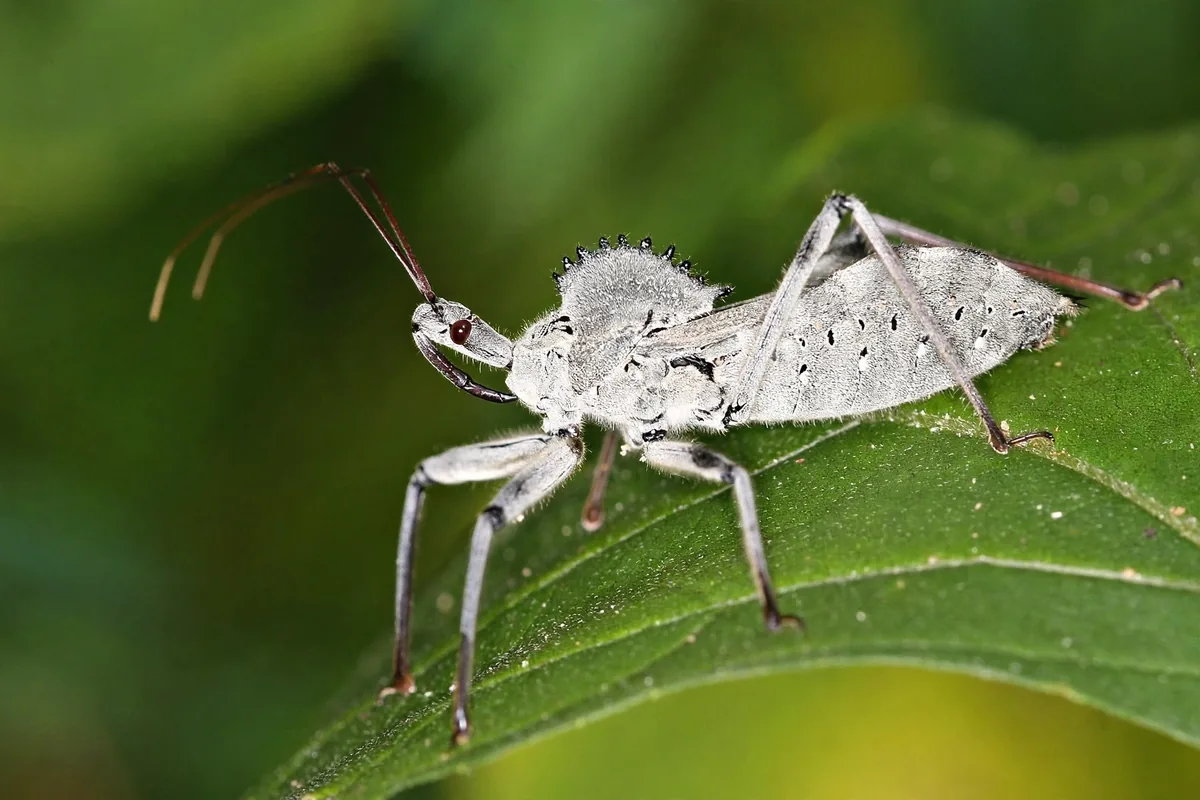
A wheel bug has a raised crest on the thorax, the middle section of the body behind the head, that looks like a cogwheel or a small gear with teeth around the edge. This crest is unique among the insects in this guide, and it is visible from above and from the side. If you see that wheel like crest, you are looking at a wheel bug, not a kissing bug, no matter how dark the body color is.
The thick curved beak and painful defensive bite
A wheel bug also has a thick, curved beak, very different from the thin straight beak of a kissing bug. Wheel bugs are predators that feed on other insects, and they can deliver a painful defensive bite if they are handled, squeezed, or trapped against skin. That bite can be painful and can cause local swelling and discomfort, and it deserves prompt first aid and medical advice if the pain is severe or if swelling spreads, but a wheel bug does not transmit Chagas disease. The distinction matters: a painful bite from a wheel bug is a different problem from a kissing bug encounter, and it calls for a different conversation with a clinician.
Wheel bugs are often found outdoors on plants, where they hunt other insects. They can wander indoors, but they are not seeking a sleeping person for blood. If you find one indoors, do not handle it, use the containment steps below, and release or remove it only with gloves and a container if that is safe.
Leaf Footed Bugs and the Western Conifer Seed Bug
Leaf footed bugs are another frequent source of confusion, especially in fall, when they enter homes looking for shelter.
Leaf like paddles on the hind legs
The defining feature is in the name: leaf footed bugs have flattened, leaf like expansions, or paddles, on their hind legs. The western conifer seed bug, a common kind of leaf footed bug in many parts of the United States, shows this feature clearly, along with a long, somewhat narrow body. If the hind legs look like they have small leaves attached, you are not looking at a kissing bug, because kissing bugs have slender legs without those paddles.
Plant feeders that enter homes in fall
Leaf footed bugs feed on plants, including seeds and fruits, not on blood. They enter homes in fall as temperatures drop, often gathering near windows, doors, and sunny walls. Finding several of them indoors in fall, or finding one on a houseplant or near a window, fits the leaf footed bug pattern well. They do not bite people for blood, and they do not transmit Chagas disease. They can be a nuisance indoors, and they may release an odor if disturbed, but they are not a medical concern in the way a kissing bug bite can be.
If you find leaf footed bugs indoors, seal entry points such as gaps around windows and doors when you can, and remove them with a container or vacuum rather than by hand. You do not need the kissing bug protocol for these insects, and identifying them correctly can save you a great deal of worry.
Boxelder Bugs: Red Markings in Groups
Boxelder bugs are small, flattened insects with red markings that often gather in large groups, and that group behavior is itself a clue.
Red markings without a cone shaped head
Boxelder bugs are dark with red markings, including red lines on the back and red edging that can remind people of kissing bug banding. The difference is the head and body shape: a boxelder bug has a short head with no long cone, a flattened body, and no thin straight beak for blood feeding. Its mouthparts are made for feeding on plants, especially boxelder and maple seeds. If the bug has red markings but a short, blunt head, it does not match the kissing bug pattern.
Gather in groups and do not bite
Boxelder bugs gather in groups, often on sunny walls, windows, and trees, especially in fall and on warm days. A cluster of similar bugs on a wall is far more consistent with boxelder bugs than with kissing bugs, which are usually found singly near sleeping areas. Boxelder bugs do not bite people. They can stain light surfaces if crushed, and they can be a household nuisance, but they are not a biting or disease concern. Removal is a housekeeping matter: sweep or vacuum them, seal entry points, and avoid crushing them on light colored walls or fabrics.
Stink Bugs: The Shield Shape
Stink bugs are among the most common indoor invaders in many regions, and their shield shape makes them straightforward to separate from kissing bugs once you look at the outline.
A broad shield, not a long cone
A stink bug has a broad, shield shaped body that is wider across the shoulders and tapers toward the rear, like a heraldic shield. It has a short, blunt head with no long cone shaped snout. That outline alone rules out a kissing bug, even when the color is dark brown and the size is in a similar range. Some stink bugs have mottled brown coloring that can look confusing in dim light, so check the outline before you check the color.
Plant feeders that do not bite for blood
Stink bugs feed on plants, and they do not bite people for blood. They are known for releasing a strong odor when disturbed or crushed, which is unpleasant but not a sign of disease risk. If you find a stink bug in a bedroom, it has almost certainly wandered in from outdoors through a gap around a window, door, or vent. Remove it with a container or tissue, avoid crushing it indoors, and seal the entry point if you can find it. You do not need to follow the kissing bug identification protocol for a clear shield shaped bug, although a photo can still be useful if you remain unsure.
Assassin Bugs Generally: Predators With a Painful Bite Possible
Kissing bugs belong to a larger family that includes many other assassin bugs, and this is where confusion is most understandable, because the insects are related and can share a general shape.
Predators, not blood feeders
Most assassin bugs are predators that hunt other insects. They have beaks made for piercing prey, and that beak is often thicker or more curved than the thin straight beak of a kissing bug. Their bodies can be slender or stout depending on the kind, and some have spines or other raised features on the back or legs. What they share is a predatory lifestyle: they are looking for other insects, not for a sleeping person, and they do not carry the same Chagas disease pattern as triatomines.
A painful bite is possible if handled
An assassin bug that is handled, squeezed, or trapped against skin can bite defensively, and that bite can be painful, with local swelling, redness, and discomfort. That is a reason to never handle any assassin bug with bare hands, whether you think it is a kissing bug or a look-alike. A defensive bite from a predatory assassin bug is not the same as a kissing bug bite, and it does not mean Chagas disease is involved, but any bite that is painful, swells rapidly, or shows signs of infection deserves prompt medical advice. Keep the distinction clear when you talk to a clinician: describe what the bug looked like, whether you have a photo, and how the bite happened, so the clinician can give advice based on the actual insect and symptoms rather than on a label alone.
Second Comparison Table: Bite, Risk, and What to Do
This second table focuses on what matters after identification: whether the insect bites people, what kind of problem a bite can cause, and what your next step should be.
Insect
Does it bite people?
What a bite or encounter can mean
Next step
True kissing bug
Yes, feeds on blood, often at night
A bite near the face or body during sleep, with a need for expert identification and medical advice about follow up
Contain safely, photograph, contact state health department or university extension, seek medical advice about the bite
Wheel bug
Only defensively if handled
Painful defensive bite, local swelling and discomfort possible, does not transmit Chagas disease
Do not handle, first aid for pain and swelling, seek medical advice if pain is severe or swelling spreads
Leaf footed bugs, including western conifer seed bug
No, plant feeders
Nuisance indoors, odor if disturbed, no blood feeding bite
Remove with container or vacuum, seal entry points
Boxelder bugs
No
Household nuisance, possible staining if crushed, no bite
Sweep or vacuum, seal entry points, avoid crushing on light surfaces
Stink bugs
No, plant feeders
Odor when disturbed, nuisance indoors, no blood feeding bite
Remove with container, avoid crushing indoors, seal entry points
Other assassin bugs generally
Only defensively if handled
Painful defensive bite possible, local swelling and discomfort, not the kissing bug disease pattern
Do not handle, first aid, seek medical advice if pain is severe or symptoms worsen
If you are unsure which row applies, treat the encounter with the kissing bug row until an expert tells you otherwise. That cautious approach costs little and avoids missing a true kissing bug.
Risk Calibration: What the Endemic Finding Does and Does Not Mean
It is understandable to feel alarmed when you read that Chagas disease is now considered endemic in the United States. A report in a CDC journal in Sept 2025 declared Chagas disease endemic in the United States, with infected bugs documented in 32 states and locally acquired human cases in at least 8 states. That finding matters for public health awareness, and it is one reason accurate identification matters more than before.
At the same time, that finding does not mean that every bug that looks like a kissing bug carries Chagas disease, or that every kissing bug encounter leads to disease. Most United States kissing bug encounters do not result in Chagas disease, and most people who find a bug that worries them have found a harmless look-alike. Never assume that a single bug means infection, and never assume that a bug is safe just because it looks like a look-alike. The point of the identification key above is to replace fear and guessing with a careful check and, when needed, expert help.
Chagas disease is caused by a parasite that can be carried by some triatomines, but transmission to people is not automatic from a bite alone, and many factors affect risk. That is why clinicians and public health experts ask for the bug itself or a clear photo, details about the bite, and information about symptoms, rather than giving a yes or no answer from a description alone. If you are worried, seek medical advice and share what you know, including any photo and the steps in the protocol below, and let the clinician decide about testing or follow up. Do not try to diagnose yourself from this article or from a photo alone.
What to Do If You Find a Bug: The Safe Protocol
Follow these steps in order, and stop at any step that does not feel safe. Your safety comes before keeping the bug for identification.
Do not crush it with bare hands and do not touch it
Do not crush the bug with bare hands, do not touch it with bare skin, and do not press it against bedding or clothing. Crushing can spread material from the bug and can make identification harder, because experts need an intact bug or a clear photo to confirm the kind. It can also expose skin to material that should be kept away from broken skin and from the eyes and mouth. If the bug is already dead, still avoid bare hand contact and use gloves or a container to move it.
Contain it in a sealed container with gloves if safe
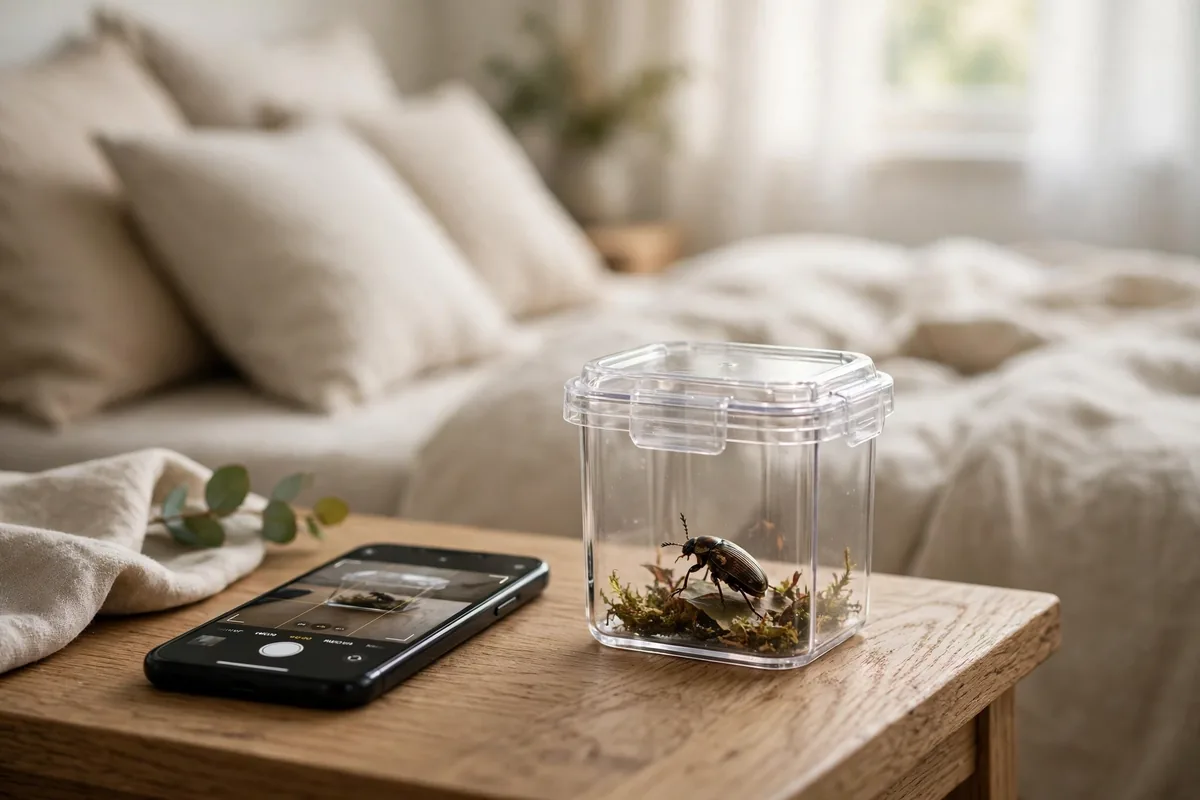
If it is safe to do so, put on disposable gloves, place a clear, sealable container over the bug or coax it gently into the container without touching it, and seal the container. A clear container helps experts and helps you photograph the bug without handling it again. Label the container with the date and where you found the bug, if you can do so safely, and keep it out of reach of children and pets. If the bug is in a place where containment is not safe, or if you feel unsure, leave it alone, take a photo from a safe distance if possible, and move to the next step.
Wash your hands thoroughly with soap and water after handling any container, even if you wore gloves. Clean any surface the bug touched, and avoid touching your face until your hands are washed. If material from a bug contacts broken skin, eyes, or mouth, wash the area promptly and seek medical advice about what to do next.
Photograph it clearly
Take several photos if you can do so safely: one from above, one from the side showing the head profile, and one close view of the abdomen edge and legs. Good lighting helps, and a photo taken through a clear container is often clearer than a photo taken while the bug is moving on a wall. Photos are valuable even if you cannot keep the bug, because an expert can often narrow down the identification from a clear head profile and body outline.
Contact your state health department or university extension
Contact your state health department or your university extension service for identification. These services can often review a photo, tell you whether the bug is a triatomine or a look-alike, and advise you about whether to submit the bug for further review and what to do about a bite. Follow their instructions about how to send a photo or a contained bug, and do not mail a live bug unless they specifically ask you to do so and explain how to package it safely.
When you contact them, share the date, the location in the home, whether anyone was bitten, and any symptoms that have appeared. That context helps them give useful advice. Keep a note of who you spoke with and what they advised, so you can share it with a clinician if needed.
What to Do About a Bite
If you wake up with a bite that you think may be from a kissing bug, or if you find a bug near your bed and have a new bite, take the following steps promptly.
First, wash the bite area gently with soap and water. Avoid scratching, and avoid applying home remedies that could irritate broken skin. A cool compress can help with itching or mild swelling, and an over the counter product for itching may be reasonable if you have used it safely before, but check with a pharmacist or clinician if you are unsure, especially for children, during pregnancy, or if you take other medicines.
Second, note when the bite appeared, where on the body it is, and whether you have other symptoms such as fever, swelling, or a swollen eyelid. Take a photo of the bite if that helps you track changes, and keep the bug or its photo for expert identification if you have it. That record is useful for a clinician and for public health follow up.
Third, seek medical advice promptly, especially if the bite is near the eye, if an eyelid swells, if swelling spreads, if you develop fever, or if you feel unwell. Do not wait to see whether symptoms develop before seeking advice when a true kissing bug is a real possibility. A clinician can examine the bite, review the bug identification, and decide about testing, monitoring, or referral. For more detail on bite care steps, see the guide on kissing bug bite treatment. If you are trying to tell whether a bite is improving over time, the guide on how to tell if a bug bite is healing explains the signs to watch for.
Do not try to treat a suspected kissing bug bite by crushing the bug onto the bite, by applying the bug to skin, or by using unproven home treatments. Those steps do not help and can increase risk. If you have already touched a bug with bare hands, wash your hands promptly and seek medical advice about the exposure.
Dogs Can Also Be Affected
Dogs can also be affected by kissing bugs, and pet owners should know the same identification basics. Dogs that sleep outdoors, in kennels, or in areas where kissing bugs are present can be bitten at night, and dogs can develop health problems related to Chagas disease. If you find a kissing bug near where your dog sleeps, or if your dog shows swelling, lethargy, loss of appetite, or other illness after a possible bite, contact a veterinarian promptly and share the bug photo or identification information if you have it.
Keep dog sleeping areas clean, check bedding regularly, and reduce places where bugs can hide near kennels and outdoor sleeping spots. Do not let dogs play with or mouth insects found indoors, and if a dog contacts a bug, keep the dog away from the bug, wash any contacted area if it is safe to do so, and seek veterinary advice. As with people, do not assume every bug near a dog is a kissing bug, and do not assume a single encounter means disease. Expert identification and veterinary advice are the right next steps.
Preventing Encounters at Home
Prevention focuses on keeping bugs out and reducing hiding places near sleeping areas. These steps also help with look-alikes that enter homes seasonally.
Seal cracks and gaps around doors, windows, and utility openings, and repair torn window screens. Move wood piles, debris, and dense vegetation away from the house where practical, because those areas can harbor insects outdoors. Keep bedrooms tidy, avoid clutter near beds, and check bedding and bed frames if you have had an encounter. For pets, keep outdoor sleeping areas clean and check kennels regularly.
Use good lighting when you check a room at night, and keep a clear container and gloves in an accessible place during seasons when insects enter homes, so you are not tempted to handle a bug with bare hands. If you live in an area where kissing bugs are known to occur, talk to your state health department or extension service about local guidance, because recommendations can vary by region and by season.
When to See a Doctor
Seek prompt medical care if you have a bite that you think may be from a kissing bug, if you found a kissing bug in your bed, or if you develop symptoms after a possible bite. A clinician can assess the bite, review any bug identification, and decide about testing or follow up. Bring your photos, your notes about when and where the bite happened, and any information from your state health department or extension service.
Call 911 or seek emergency care right away if you have signs of a severe allergic reaction, including trouble breathing, swelling of the lips, tongue, or throat, widespread hives, dizziness, fainting, or a feeling that your throat is closing. Also seek emergency care right away if swelling spreads rapidly, if pain becomes severe, if you have trouble breathing, or if a child, an older adult, or a person with a serious health condition has a concerning reaction. Do not wait to see whether a severe reaction improves on its own.
Seek prompt care, the same day if possible, if you develop a swollen eyelid after a possible kissing bug bite, because swelling around one eye, sometimes called Romana’s sign, is a reason to seek prompt medical evaluation after a possible kissing bug exposure. This article does not diagnose that sign, and swelling around the eye can have many causes, but after a possible kissing bug bite it deserves prompt clinical review rather than watchful waiting at home. Also seek prompt care if you develop fever, spreading redness, increasing pain, pus, red streaks from a bite, or a bite that worsens instead of improving. If you are unsure whether care is urgent, call a clinician, an urgent care line, or local emergency services for guidance and describe the bite, the bug, and your symptoms clearly.
For bites that are not from a confirmed kissing bug, the same general rule applies: seek care if symptoms worsen, spread, or do not improve, and seek emergency care for any severe reaction. When in doubt, seeking advice is safer than waiting, especially for bites near the eye or face, bites in children, and bites in people with weakened immune systems or chronic illness.
Frequently Asked Questions
How can I tell a kissing bug from a stink bug at night?
Look at the outline and the head. A stink bug has a broad shield shape and a short blunt head. A kissing bug has a flattened oval body, a long cone shaped head, and a thin straight beak, often with orange or red banding along the abdomen edge. If you see a shield shape, it is not a kissing bug. If you see a cone shaped head with a thin straight beak, treat it as a possible kissing bug, contain it safely if you can, photograph it, and ask an expert.
I found a bug with red markings. Does that mean it is a kissing bug?
Not necessarily. Red markings appear on several look-alikes, including boxelder bugs and some stink bugs, and on some kissing bugs. Red markings alone do not confirm a kissing bug. Check the head shape, the beak, the body outline, and the legs. A red marked bug with a shield shape, with leaf like paddles on the hind legs, or in a group on a sunny wall is more consistent with a look-alike. A red banded bug with a long cone shaped head and a thin straight beak fits the kissing bug pattern and deserves expert identification.
Does every kissing bug carry Chagas disease?
No. Never assume that every kissing bug carries Chagas disease, and never assume that finding a kissing bug means you have Chagas disease. Some triatomines carry the parasite that causes Chagas disease and some do not, and transmission to people is not automatic from a bite. Most United States kissing bug encounters do not result in Chagas disease. If you have a possible kissing bug bite, seek medical advice and share the bug identification information, and let a clinician decide about testing or follow up.
What should I do first if I find a bug in my bed?
Do not touch it with bare hands and do not crush it. If it is safe, use gloves and a clear sealed container to contain it, take clear photos from above and from the side, wash your hands, and contact your state health department or university extension service for identification. If you have a bite, wash the area gently, note your symptoms, and seek medical advice promptly, especially if the bite is near the eye or if swelling spreads. Keep the bug or photos for the expert and the clinician.
Can a wheel bug bite be dangerous?
A wheel bug bite can be painful and can cause local swelling and discomfort, because wheel bugs bite defensively when handled. A wheel bug does not transmit Chagas disease. First aid for pain and swelling, and medical advice if pain is severe or swelling spreads, are the right steps. Do not handle wheel bugs or any assassin bug with bare hands, and seek emergency care for any severe allergic reaction, trouble breathing, or rapidly spreading swelling.
How do I tell a western conifer seed bug from a kissing bug?
Look at the hind legs. A western conifer seed bug has leaf like paddles on its hind legs and a long body, and it feeds on plants. A kissing bug has slender legs without paddles, a long cone shaped head, and a thin straight beak. Western conifer seed bugs often enter homes in fall for shelter. If you see paddles on the hind legs, you are looking at a leaf footed bug, not a kissing bug.
Should I be worried if I find only one bug and have no bite?
Finding one bug with no bite is still worth identifying, because identification tells you whether you need to take further steps. Contain and photograph the bug if it is safe, ask an expert, and check your sleeping area and entry points. If you have no bite and no symptoms, and an expert identifies the bug as a look-alike, you usually need no medical follow up, but follow the expert advice you receive. If the bug is identified as a kissing bug, ask a clinician whether any follow up is advised even without a clear bite, and follow that advice.
Where can I get a bug identified for free or at low cost?
Your state health department and your university extension service are the usual first contacts for insect identification in the United States. Many extension services accept photos and can often identify a bug from a clear head profile and body outline. They can also advise you about whether to submit the bug and about local kissing bug activity. If you are unsure which office serves your area, search for your state name plus university extension entomology, or contact your state health department and ask for the right referral. For help distinguishing other biting insects, the comparison of bed bug bite vs flea bite shows how experts separate similar bite problems.
Medical Disclaimer
This article is for general information only and is not medical advice. It does not diagnose, treat, or predict any condition, and it does not replace advice from a qualified health professional. Insect identification from photos and descriptions can be uncertain, especially at night, and only an expert review of the actual insect or clear photos, together with a clinical examination, can guide decisions about testing or treatment. If you have a bite, a possible exposure, or symptoms that worry you, seek prompt medical care and share this article, your photos, and any expert identification information with your clinician. If you have a severe reaction, trouble breathing, or swelling of the lips, tongue, or throat, call 911 or seek emergency care right away.
This content is medically reviewed by Dr. Sarah Jones, MD.
SJ
Dr. Sarah Jones, MD
MD — Medical Reviewer · Board-Certified Emergency Medicine Physician
Dr. Jones oversees StingHelp’s clinical verification process. Every guide is systematically evaluated against active Centers for Disease Control and Prevention (CDC), Environmental Protection Agency (EPA), and American Academy of Allergy, Asthma & Immunology (AAAAI) medical consensus standards to ensure symptom distinctions and care recommendations are clinically sound.
How this guide was prepared: Researched and structured by the StingHelp Editorial Team; verified against peer-reviewed dermatology literature; clinically reviewed November 2026.
RELATED CLINICAL GUIDES
More StingHelp guides
Explore physician-reviewed first-aid procedures, identification clues, and symptom comparisons for other common outdoor bites and stings.
What Bit Me? Identification & Comparisons22 min read
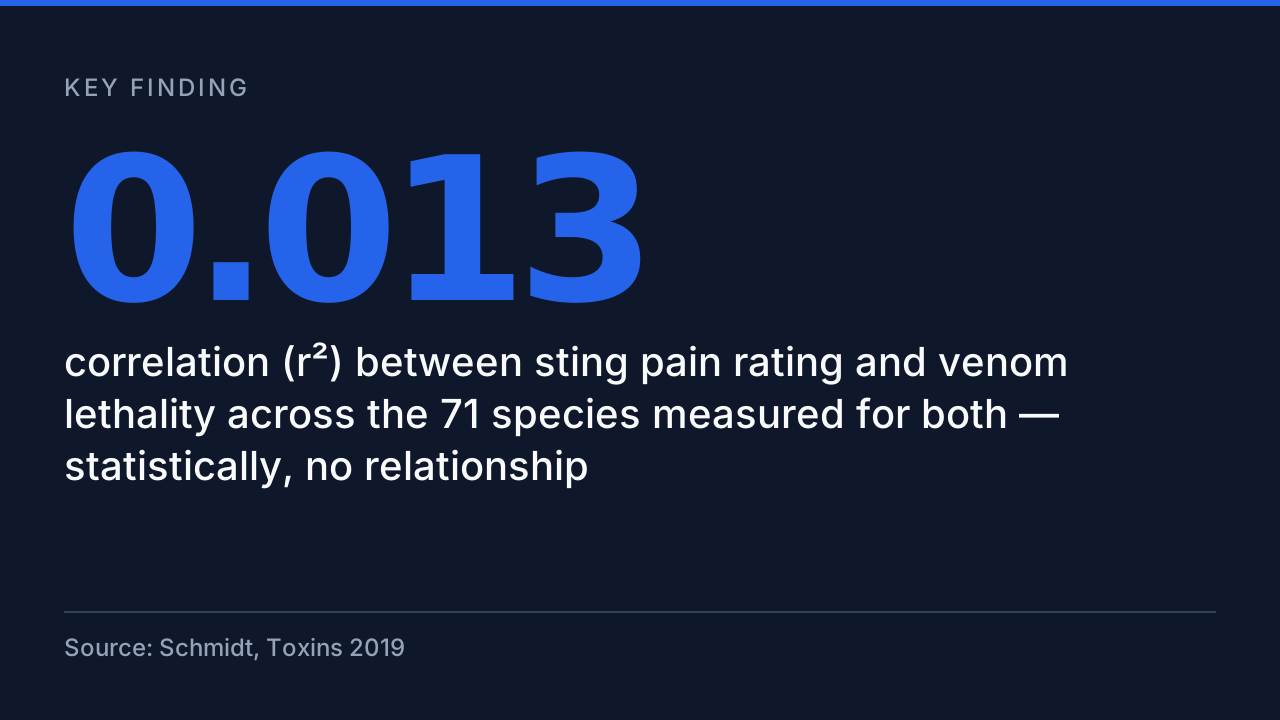
Schmidt rated sting pain for 96 species and venom lethality for 90. Joined, the two rankings are effectively unrelated — the most painful sting carries one of the weakest venoms measured, and the most toxic venoms barely hurt.
What Bit Me? Identification & Comparisons26 min read