Every fall in the Pacific Northwest, the same panic plays out in basements and garages from Seattle to Portland: a big, fast, brown spider darts across the floor, and the question hits before the adrenaline fades — giant house spider vs hobo spider, which one is it, and should you be afraid? The direct answer is reassuring: in most Northwest cities, the spider you just saw is more likely a giant house spider, and research shows neither species is the medical threat its reputation suggests.
Below is how extension entomologists actually tell them apart — size, leg details, web style, and range — plus what the science says about bite risk, first aid after a suspected bite, and keeping funnel-web builders out of your home.
Meet the Two Spiders: Size and Range
The giant house spider (Eratigena atrica, also known as Eratigena duellica) and the hobo spider (Eratigena agrestis) belong to the same genus of funnel-web builders, which is the root of the confusion. Both are European imports that have been established in North America for roughly a century, and both favor the damp, mild climate west of the Cascades in Washington, Oregon, and British Columbia.
Size is the most obvious field difference. A female giant house spider’s body can approach three-quarters of an inch, and the leggy males — though slimmer-bodied at roughly half an inch — carry an imposing leg span. Giant house spiders rank among the fastest-running spiders known, which adds to their alarming presence. Hobo spiders are genuinely smaller: mature females measure about 9.5 to 16.5 millimeters in body length, and males run smaller still. In practice, though, size alone fools people constantly — a young giant house spider can be smaller than a fully grown hobo spider.
Range matters more than most homeowners realize. Research surveys found that in most Pacific coast cities, giant house spiders outnumber hobo spiders anywhere from two-to-one up to nine-to-one; only in Portland did hobos come out ahead. That means the odds favor the harmless giant house spider before you even look at markings. And for narrowing down any suspicious bite, remember that exposure clues — where you were, what you saw, how the mark changed — matter more than the mark’s appearance alone.
Quick Comparison: Giant House Spider vs Hobo Spider
| Clue | Giant house spider (Eratigena atrica) | Hobo spider (Eratigena agrestis) |
|---|---|---|
| Body length | Female up to ~19 mm (¾ in); male ~12–15 mm | Female 9.5–16.5 mm (⅜–⅝ in); male 7–13.5 mm |
| Legs | Often banded or mottled; males very long-legged | Never dark-banded — banding rules it out |
| Abdomen pattern | Chevron-like markings common | Yellowish chevron on gray (clearest in juveniles) |
| Web height | Ground level to high corners and ceilings | Ground level only; poor climber |
| Where common | West of the Cascades, Pacific coast cities | Pacific Northwest and Great Basin |
| Bite concern | Not dangerous to people | Not considered medically significant by current research |
Keep this table as a starting framework, not a verdict — definitive identification of look-alike funnel weavers usually needs expert examination.
Appearance: Chevron Patterns, Leg Banding, and Why Photos Mislead
Here is the uncomfortable truth that extension diagnosticians repeat every fall: these two spiders are so similar that even experienced identifiers often need a microscope. The one definitive method is examining reproductive structures — the male’s palps or the female’s epigynum — which requires a microscope, not a fleeing spider.
That said, a few field marks help rule one or the other out. The hobo spider has a brown cephalothorax (the front body section) with darker brown markings and an abdomen carrying a chevron pattern — a row of yellowish V-shaped markings on a grayish background. But this pattern is unreliable on its own: it is most distinct in immature specimens, fades or varies in adults, and plenty of other brown spiders, including the giant house spider, show chevron-like abdominal markings too.
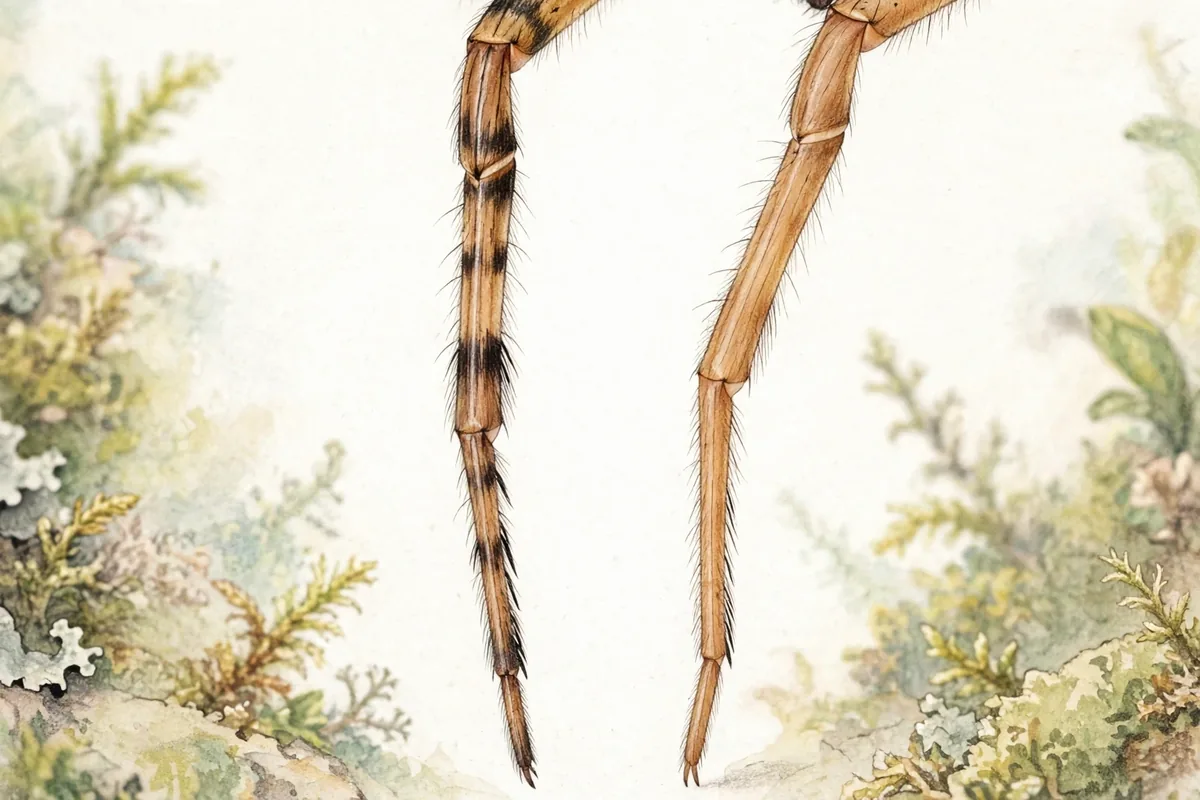
The more practical visual clue is the legs. Hobo spiders do not have dark bands on their legs — Utah State University’s diagnostic key uses this as an explicit elimination rule: if the spider has dark leg banding, it is not a hobo spider. Even this rule has limits, since coloration varies widely, and extension sources are blunt that hobo spiders cannot be identified by color alone. When in doubt, photograph the spider from above with the legs clearly visible and contact your state extension service — that is exactly the kind of photo submission entomologists welcome. As extension entomologists repeat every fall, visual misidentification drives a huge share of unnecessary spider panic.
Webs and Where They Live
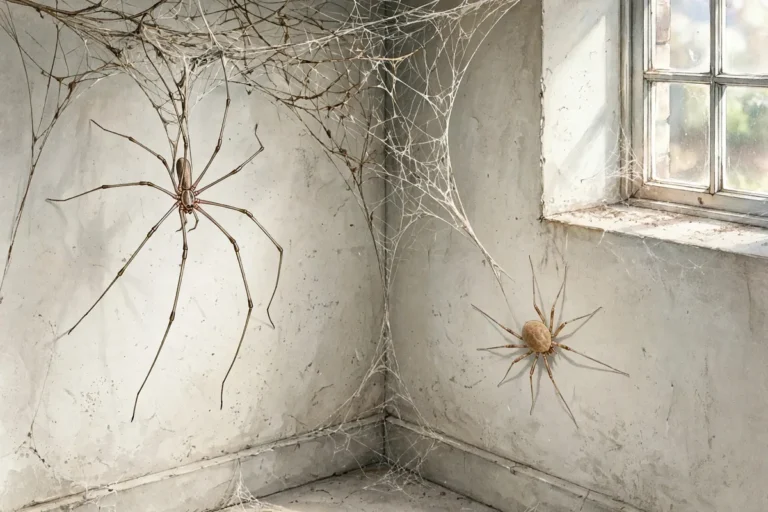
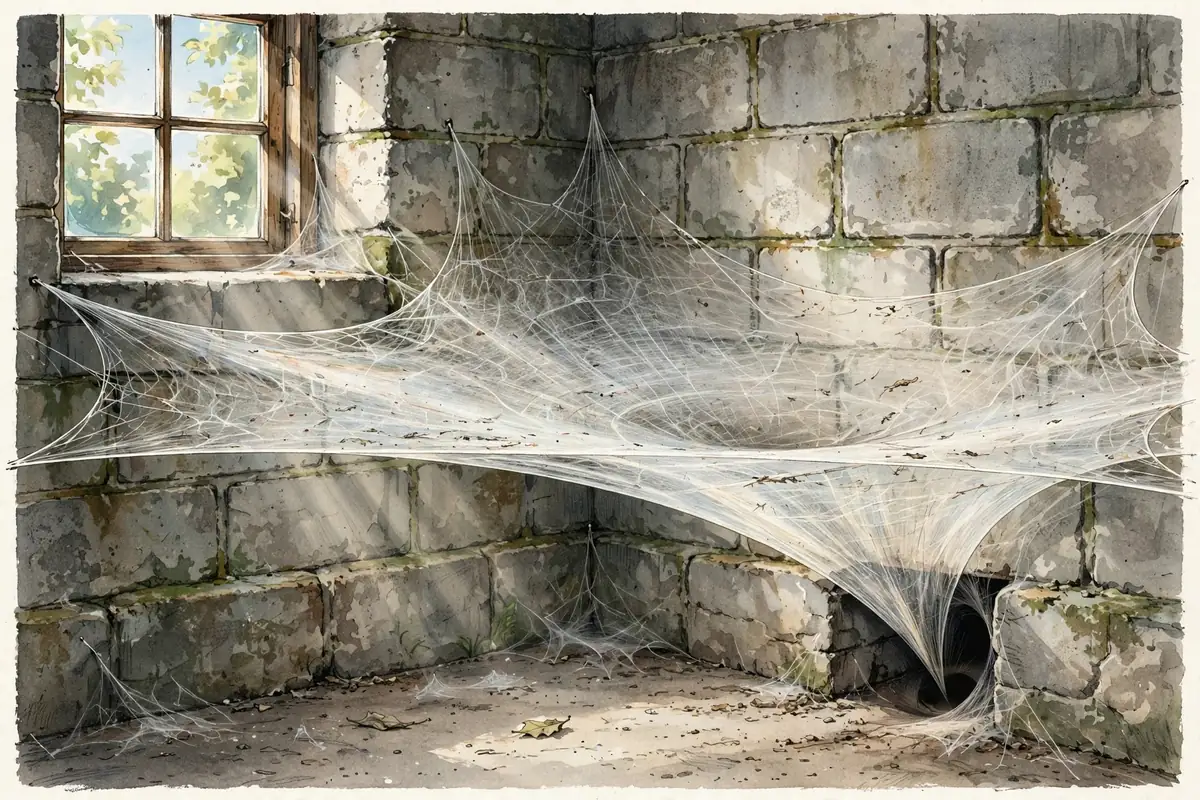
Both spiders are funnel-web builders, which is another shared trait that makes separation tricky. They spin a flat, trampoline-like sheet of silk with a funnel-shaped retreat — the hole where the spider waits for prey to stumble across the sheet. Indoors, you will find these webs in quiet, undisturbed corners: basements, crawl spaces, garages, and behind stored boxes.
Hobo spiders work the ground level and rarely climb, so a web in an upper wall corner is unlikely to be a hobo’s work. Giant house spiders climb readily and build in higher locations — ceiling corners, upper walls, window frames — as well as the same ground-level spots. If the web is eight feet up a wall, you are probably looking at a giant house spider’s home.
Seasonal behavior is the other big tell. From mid-summer into fall, male spiders of both species leave their webs and wander in search of mates. This is when sightings spike — the males you see sprinting across the floor are not hunting you; they are following scent trails with terrible eyesight, so their escape path can look like a charge.
Behavior: The Aggression Myth vs. the Reality
The hobo spider’s old common name — “aggressive house spider” — is a linguistic accident, not a behavioral description. It comes from a misreading of the species name agrestis, which is Latin for “of the field,” describing the spider’s natural European habitat.
Neither species is aggressive toward humans. Utah State University Extension states plainly that hobo spiders will bite in defense when trapped but are not aggressive and are not of significant health concern. Giant house spiders are similarly described as non-aggressive, more likely to flee than to bite. Most documented bites across spider species happen when a spider is accidentally pressed against skin — trapped in clothing, bedding, or a shoe — and a large share of defensive bites are “dry bites” that inject no venom at all. If you want to compare notes with how often bite fears outrun the evidence, our Asian tiger mosquito bite vs hobo spider bite comparison is a good companion read.
Bite Risk: What the Research Actually Says
This is the part that surprises most Northwest homeowners. In the 1990s, the CDC carried case reports linking hobo spider bites to necrotic skin lesions — the “flesh-eating” reputation that still circulates online. But when researchers reviewed the evidence, the connection fell apart: confirmed hobo bites were rare, and the necrotic wounds blamed on them almost always had other causes, most commonly bacterial skin infections like MRSA that can resemble a spider bite.
As of 2017, the CDC no longer lists the hobo spider among venomous spider species of medical concern. The current scientific consensus, echoed by university extension programs, is that hobo venom may cause local pain and redness — roughly comparable to a bee sting or mosquito bite — but is not a serious threat to healthy adults, and there is no significant evidence that it causes tissue necrosis. The giant house spider’s bite, on the rare occasions one occurs, is considered even less of an issue — not dangerous to people.
There is even an ecological irony in the story: giant house spiders actively prey on hobo spiders and other household spiders, so the big spider that startled you may be working as unpaid pest control.
What to Do If You Are Bitten
True spider bites from these species are uncommon, and many suspected “spider bites” turn out to be something else — infections, other insects, or skin conditions. If you do catch one in the act or find the spider, basic first aid applies:
- Wash the area with soap and water, then leave it alone.
- Apply a cold compress in 10- to 15-minute intervals to limit swelling.
- Avoid scratching or squeezing the bite, which breaks the skin and invites infection — our don’t scratch, don’t squeeze guide explains why this matters so much.
- An over-the-counter oral antihistamine can help with itching; follow the package directions.
- Mark the edges of any redness with a pen and note the time so you can tell whether it is spreading.
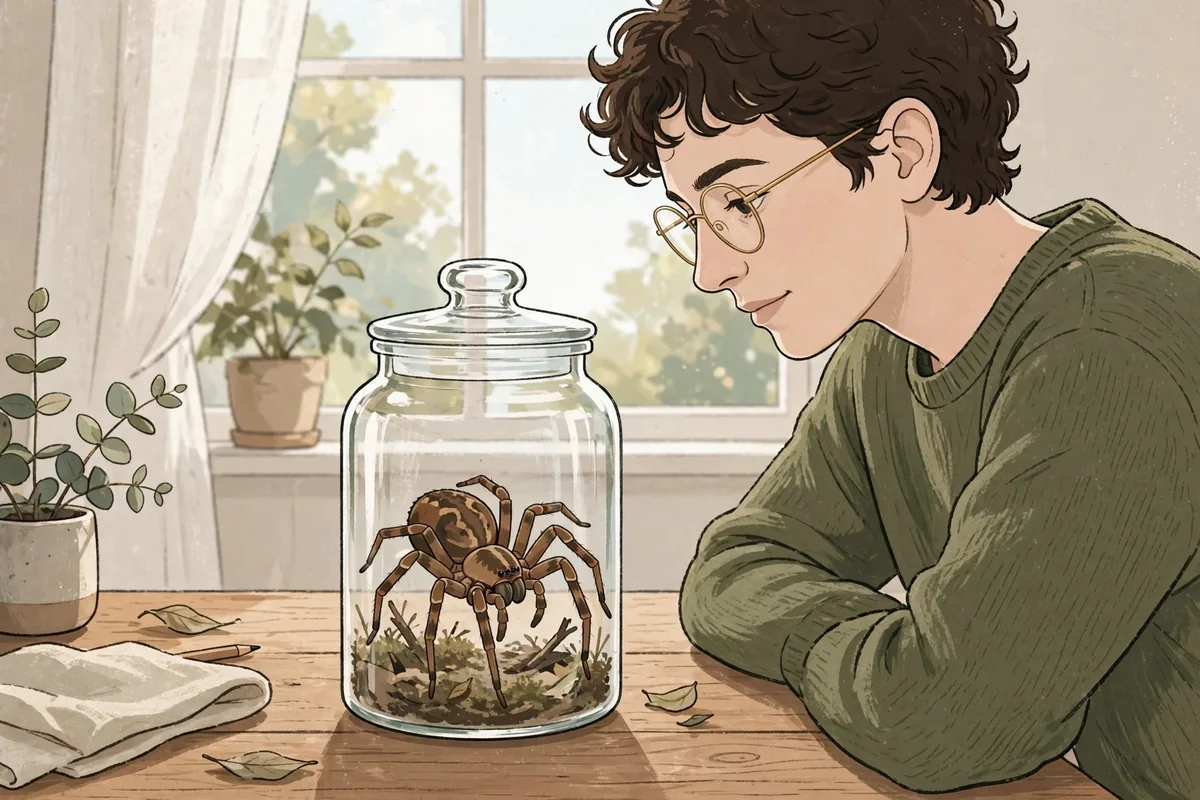
Do not attempt to “draw out venom” with suction devices or cut the bite. If you can do it safely, capture the spider in a jar or take clear photos — identification is the single most useful thing for a clinician.
Keeping Them Out of Your Home
Because these are funnel-web builders that want quiet corners, prevention is mostly housekeeping and exclusion:
- Seal cracks around foundations, windows, and doors, and add weather stripping where you feel drafts.
- Declutter ground-level storage: boxes and firewood against foundation walls are prime spider real estate.
- Keep vegetation and mulch pulled back from the foundation, and move woodpiles away from the house.
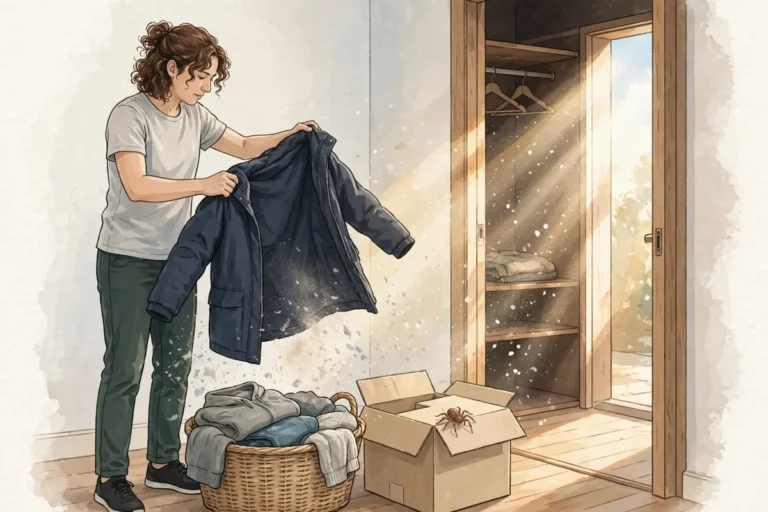
- In August through October, when wandering males are most active, shake out clothing and shoes left on the floor, and consider pulling the bed a few inches from the wall.
- Vacuum webs as you find them — regular vacuuming discourages re-establishment.
- Sticky traps along baseboards can tell you whether activity is ongoing, but they will not control a population on their own.
Avoid pesticide foggers for spiders; they scatter pests deeper into wall voids and leave residue where your family breathes.
When to See a Doctor for a Bug Bite
Most spider bites need nothing more than basic first aid and patience. Seek medical care if any of the following apply:
- Signs of anaphylaxis: trouble breathing, swelling of the lips or face, dizziness, hives spreading across the body, or a feeling of throat tightness — call 911 immediately.
- The bite area develops increasing pain, expanding redness or red streaks, warmth, swelling that worsens after 48 hours, or pus — classic signs of a bug bite infection or cellulitis.
- You develop fever, chills, headache, or nausea that will not quit after a bite.
- A blister, open sore, or dark spot forms and keeps getting larger over several days.
- The bite is near your eye, mouth, or genitals.
- You have diabetes, an immune condition, or take medications that suppress immunity — tell your clinician about the bite early.
- Any bite that is not clearly improving within about two weeks deserves an in-person look.
Frequently Asked Questions
Can a hobo spider bite cause a necrotic, flesh-eating wound?
Current research says this is extremely unlikely. The CDC removed the hobo spider from its list of medically significant spiders in 2017 after reviews found no solid evidence linking confirmed bites to tissue necrosis. Wounds that look necrotic after a suspected bite are more often bacterial infections and need a doctor’s evaluation regardless of the cause.
Is the giant house spider dangerous?
No. The giant house spider is not considered dangerous to people. Its bite, which happens rarely, is generally described as no worse than a mosquito bite. It is not aggressive and prefers to flee.
How can I tell which spider is in my house?
Honestly, you probably cannot do it reliably from a photo alone — even experts need magnification for a definitive ID. Practical clues: larger leg span and higher webs favor the giant house spider; ground-level webs and unbanded legs are consistent with (but not proof of) a hobo. For a firm answer, submit photos to your state extension diagnostic service.
Are hobo spiders only found in the Pacific Northwest?
Mostly, yes. In North America, hobo spiders are established in the Pacific Northwest and the Great Basin (parts of Utah, Montana, Idaho, Colorado, and Wyoming). They are not found in the eastern United States despite frequent misidentification.
Should I kill a giant house spider in my home?
That is your call, but consider the upside first: giant house spiders prey on other spiders, including hobos, plus household insects. Many Northwest homeowners simply capture them in a jar and release them outside. If you have frequent sightings, exclusion work — sealing gaps and decluttering — is more effective long term than spider-by-spider removal.
Sources and Further Reading
- Utah State University Extension, “Hobo Spider” — identification, the leg-banding elimination rule, and current bite guidance: https://extension.usu.edu/planthealth/research/hobo-spiders
- Washington State Department of Health, “Spiders” — state-level summary noting hobo spiders are not considered dangerous and there is no evidence their venom has caused skin necrosis: https://doh.wa.gov/community-and-environment/pests/spiders
This article is for informational purposes only and isn’t medical advice. If you’re worried about a bite or sting, talk to a healthcare professional.