The wispy, long-legged creature in your basement corner goes by “daddy longlegs” everywhere in America, and almost everything people believe about it is wrong. The cellar spider vs daddy longlegs question is not even a comparison between two similar spiders. It is a comparison between a true spider and an animal that is not a spider at all, two creatures that share a nickname and almost nothing else. One spins webs and hangs in them upside down. The other walks around on the ground, has no venom, no fangs, and no silk. And the famous claim that daddy longlegs are the most venomous creatures on earth is false in every direction it can be false.
Sorting this out matters more than trivia. The myth creates real fear: people spray pesticides in basements, kill harmless animals, and sometimes ignore genuinely concerning spiders because they have filed everything long-legged under one harmless-or-deadly label. Once you can tell a cellar spider from a harvestman in about five seconds, both animals stop being scary, and you will know exactly when a long-legged visitor actually deserves a second look.
Three Animals, One Nickname
Before comparing two animals, it helps to know there are three wearing the same name. In American English, “daddy longlegs” gets applied to cellar spiders (family Pholcidae), harvestmen (order Opiliones), and crane flies (family Tipulidae). They look vaguely similar to a casual observer, all legs and little body, but they are not closely related, and the differences that matter for your home are straightforward.
Crane flies are the easiest to eliminate. They are insects, not arachnids: six legs, visible wings, and a clumsy flying habit around porch lights. Most adult crane flies cannot bite at all. If it flies, it is a crane fly, and this article is not about it.
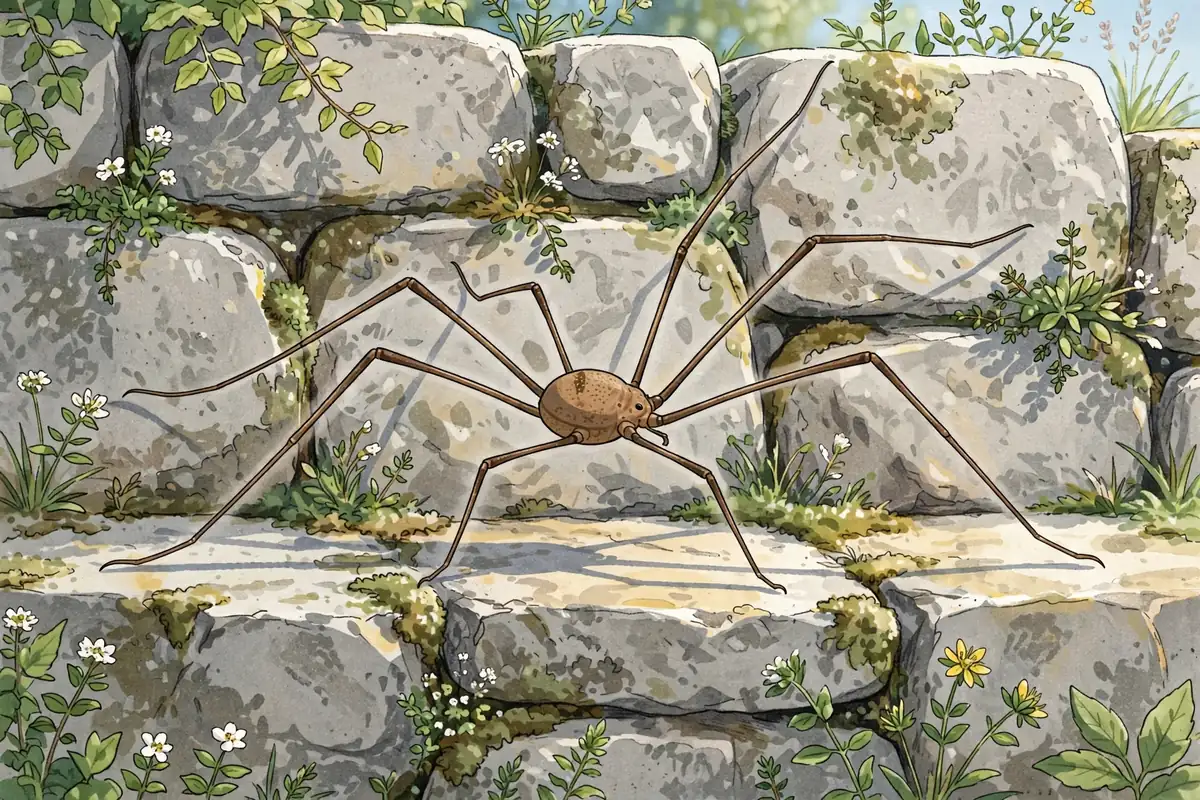
That leaves the two that actually cause the confusion. The cellar spider is a true spider: eight legs, two body segments, fangs, venom glands, and silk. It is the pale, delicate animal hanging in the messy tangle web in your basement corner, the one that bounces crazily when you touch the web. The harvestman is an arachnid but not a spider: one fused body segment with no waist, no venom glands, no fangs, no silk, and no web. It is the round-bodied, usually brownish animal you see walking on siding, stone walls, and basement floors, especially in late summer and fall when they gather in clusters. Same nickname, completely different animal. Everything that follows is about telling these two apart and retiring the myth for good.
Meet the Cellar Spider
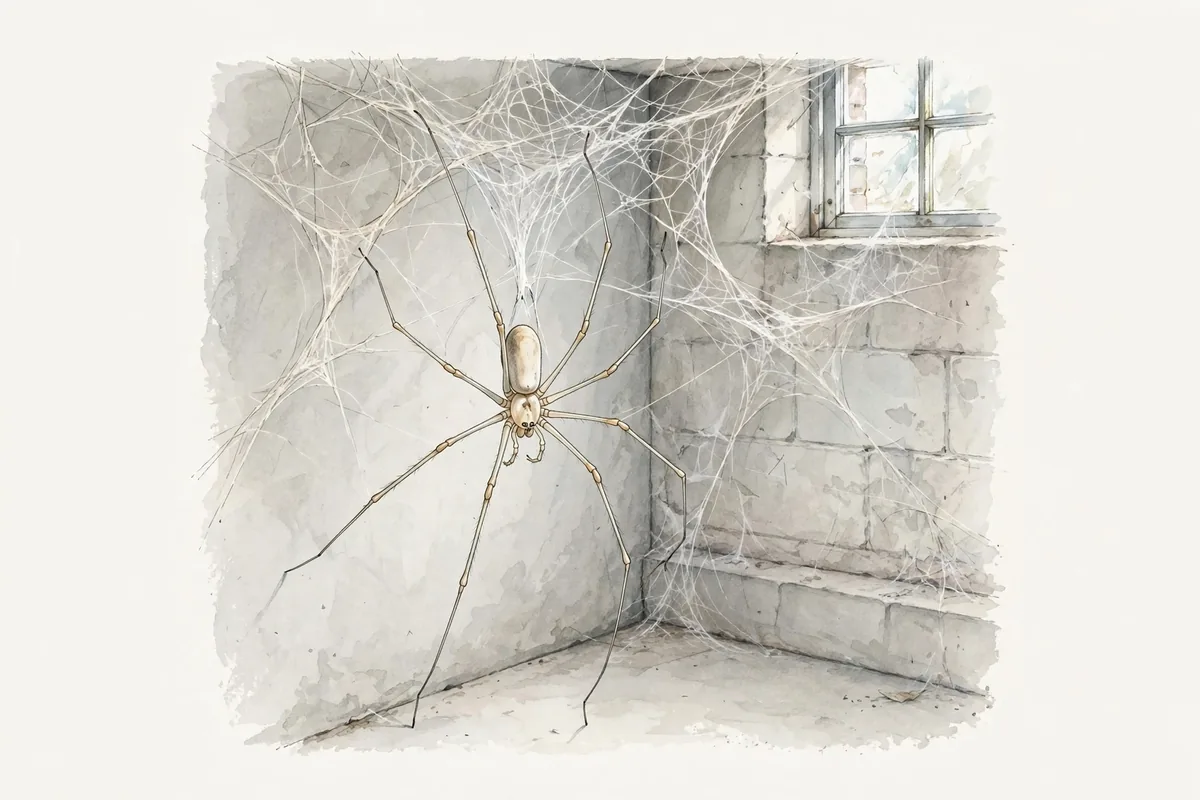
Cellar spiders are among the most common indoor spiders in North America, and they are built for the job. The body is small, usually well under half an inch, pale tan or grayish, with eight extremely long, thin legs that can make the animal look several inches across. They hang upside down in loose, irregular tangle webs built in corners, along ceiling-wall joints, behind furniture, and in the quiet upper reaches of basements and garages.
Their signature behavior is the whirl. Touch the web, and the spider begins bouncing or rotating its body so fast that its outline blurs. This is a defense: a vibrating, blurry target is hard for a bird, a wasp, or another spider to strike accurately, and the shaking also helps the spider distinguish a real trapped insect from a false alarm. It looks alarming the first time you see it. It is the opposite of aggression.
Cellar spiders are genuine predators, and they punch above their weight. They routinely kill other spiders in their webs, including larger house spiders, and some species are known to take black widows. This is the grain of truth that the venom myth grew around: because cellar spiders can kill formidable spiders, folklore upgraded them into the most venomous spiders in the world. In reality, their venom is ordinary spider venom aimed at insects, studied directly and found to be nothing special. According to spider researcher Rick Vetter at the University of California, Riverside, there is no recorded case of a cellar spider bite causing a medically significant reaction in a person, and studies of documented bites show only brief, mild stings with no lasting effects.
Bites are vanishingly rare. A cellar spider’s response to disturbance is to whirl, drop, run, or shed a leg and keep going. Adults missing a leg or two are common and carry on hunting and breeding normally. In the handful of provoked cases on record, the sensation was a brief, mild sting with no swelling, no mark, and no need for treatment. Penn State Extension notes they are not known to bite people or to be medically important. From a household perspective, a cellar spider is closer to a tiny, unpaid pest-control contractor than to a threat: every fly and spider it catches in that corner web is one you do not have to deal with.
Meet the Harvestman
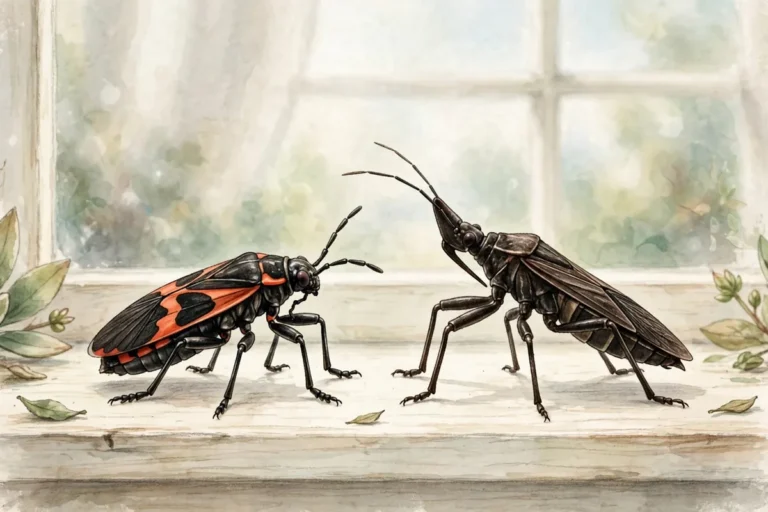
The harvestman is the animal most precisely entitled to the daddy longlegs name, and it is not a spider. Look at one closely and the differences jump out. Where a spider has two body segments joined by a narrow waist, the harvestman has a single fused, oval body like a tiny lentil on legs. It has just one pair of eyes, set on a small raised bump (the ocularium) on top of the body. Its eight legs are enormously long and thin, and it walks on surfaces rather than hanging in silk, because it makes no silk at all. No web, no venom glands, no fangs. When a harvestman catches food, it tears and crushes with its mouthparts like a tiny scavenger, because that is what it is.
Harvestmen are generalist feeders on dead organic matter, small insects, and decaying plant material. They are most visible in late summer and fall, which is how they got the “harvestman” name, and they often gather in dense clusters on siding, under eaves, on stone walls, and around foundations. A cluster of dozens of harvestmen packed together on a house wall can look startling, but the gathering is a moisture and shelter behavior, not an invasion, and the animals are completely harmless.
The harvestman’s defense is chemistry, not venom. When disturbed, many species release or coat themselves in a foul-smelling secretion that deters predators. This secretion is sometimes the source of the claim that harvestmen are “poisonous,” which confuses poison (harmful when touched or eaten) with venom (injected through a bite). The defensive chemical is not toxic to humans and cannot be injected, because the animal has no equipment for injecting anything. It does not bite, it cannot bite in any meaningful sense, and it has no interest in you. If you find harvestmen indoors, they wandered in through a gap and are as eager to be back outside as you are to have them there. A cup and a piece of paper relocate them without drama.
The Venom Myth, Debunked Properly
The claim goes like this: daddy longlegs are the most venomous spiders in the world, but their fangs are too short to pierce human skin, so we are safe. Every clause of that sentence is wrong, and understanding why it is wrong is the fastest way to stop worrying about these animals.
First, the venom is not unusually potent. Cellar spider venom has been studied directly: a 2019 peer-reviewed study of pholcid venom (Binford et al., published in Frontiers in Ecology and Evolution) analyzed the venom of a cellar-spider relative using proteomics and venom-gland transcriptomes. It found typical insect-targeting peptides and proteins, and concluded that the effects of pholcid bites on humans and other mammals are inconsequential: documented bites produced only a mild sting with no long-lasting effects. There is no verified case of medically significant cellar spider envenomation in a human anywhere in the world, and no antivenom exists because none has ever been needed.
Second, the fangs are not too short to bite. The MythBusters television program demonstrated on camera that a cellar spider’s fangs can pierce human skin. The bite produced only a brief, mild burning sensation with no significant medical effect, which is precisely why the supposed proof of the legend fails. If the fangs can reach skin and nothing happens, the “deadly but can’t bite” story collapses on its own terms.
Third, the claim has no source. Entomologists at UC Riverside have addressed the myth directly: it has never appeared in peer-reviewed literature, and there is no scientific evidence supporting it. The most likely origin is the conflation described above. Somewhere in the chain of folklore, the cellar spider (a true spider with ordinary venom) got merged with the harvestman (no venom at all) into a single fictional creature with maximum venom and minimum delivery, and the story stuck because it is memorable.
It is worth stating the bottom line plainly, because fear thrives on vagueness: none of the animals called daddy longlegs is medically significant to humans. Not the cellar spider, not the harvestman, not the crane fly. If you want to worry about a spider in your home, worry about the right ones, which have their own identification guides and warning signs. Our pages on black widow bite treatment and house spider bite treatment cover the species that actually merit attention.
Side-by-Side ID: Five Field Checks
You do not need a magnifying glass or a biology degree. These five checks separate a cellar spider from a harvestman in seconds.
1. Web or no web
A cellar spider hangs in a loose, tangled web in a corner, usually upside down. A harvestman never makes silk, so it is always walking on a surface: a wall, the floor, a stone, a window frame. Silk present means spider, full stop.
2. Body shape
The cellar spider has the classic two-part spider body: a front section and a rounded abdomen joined by a narrow waist. The harvestman is a single fused oval with no waist at all. This is the single most reliable visual check.
3. Where it sits
Cellar spiders are year-round indoor residents of quiet, undisturbed spots: basement corners, garage rafters, crawl spaces, behind stored boxes. Harvestmen are primarily outdoor animals that show up on siding and foundations in late summer and fall, and only wander indoors by accident.
4. How it reacts
Touch a cellar spider’s web and it whirls or drops on a silk line. Disturb a harvestman and it scuttles away on its stilt legs, sometimes releasing a faint unpleasant odor. Neither behavior is aggression. Both are the animal trying to avoid you.
5. Legs and posture
Both have famously long legs, so legs alone do not decide it. But posture helps: the cellar spider dangles from silk with legs spread in the web, while the harvestman holds its body low and walks deliberately, sometimes with the second pair of legs waving ahead like antennae to feel its way.
| Check | Cellar spider (true spider) | Harvestman (not a spider) |
|---|---|---|
| Silk/web | Yes, tangled corner webs | None, ever |
| Body | Two segments with a waist | One fused oval, no waist |
| Eyes | Eight, in groups | One pair on a raised bump |
| Venom/fangs | Mild venom, fangs present, not medically significant | No venom glands, no fangs |
| Where found | Indoor corners, basements, year-round | Outdoors, siding, fall clusters |
| Defense | Web-whirling, dropping, leg-shedding | Fleeing, foul-smelling secretion |
What to Do When You Find Them
The short version: nothing, or next to nothing. Neither animal damages homes, contaminates food, or bites people in any meaningful sense, so there is no control program to run and no pesticide to buy. Spraying a basement for cellar spiders kills a free predator and leaves chemical residue where your family and pets live, which is a poor trade by any measure.
If the webs bother you, a vacuum with a crevice tool or a long-handled duster removes webs and spiders together, and reducing clutter in storage areas gives them fewer anchor points. Sealing obvious gaps around foundations and windows cuts down on wandering harvestmen in fall. That is the entire management plan, and it costs nothing.
The more valuable skill is knowing when a long-legged spider is not one of these two. Wolf spiders are stockier, ground-hunting spiders with a very different build. Brown recluses have a violin marking and six eyes, not eight. Black widows are glossy, round-bodied, and hang in strong, messy webs low to the ground. If you are trying to identify any spider bite or any spider you cannot place, work through a structured ID process like our bite and sting clue checklist rather than guessing from a nickname. And if you ever find a spider you suspect is a black widow or brown recluse, do not handle it: photograph it from a safe distance and call a professional for identification.
One genuinely useful role these animals play deserves a final mention. Cellar spiders are effective predators of other household spiders, and harvestmen are harmless decomposers in the outdoor ecosystem. The fear they inspire is pure folklore. The reality, once you have seen the field checks, is a basement corner with a diligent little hunter in it and a fall evening with harmless wanderers on the siding. Neither one needs your fear, and neither one needs your pesticide.
When to See a Doctor for a Bug Bite
Cellar spiders and harvestmen do not produce medically significant bites, so this section is really about the general rule for any suspected spider bite. Most true spider bites, even from species people worry about, cause only local redness and itching that resolves in a few days. But any bite or sting deserves medical attention if you develop signs of an allergic reaction: difficulty breathing, swelling of the face, lips, or throat, dizziness, or hives spreading beyond the bite site. Call 911 for those symptoms without delay.
See a doctor the same day for a bite with rapidly spreading redness, increasing pain, warmth, swelling that keeps growing after 48 hours, pus, red streaks, or fever, which can indicate a skin infection such as cellulitis. Also seek care for bites near the eye, inside the mouth, or on the genitals, and for any bite on a young child, an elderly person, or someone with a weakened immune system that looks worse than a simple local reaction.
A special note on spider-bite diagnosis: most “spider bites” diagnosed at home turn out to be something else, often a bacterial skin infection or another insect’s work. Doctors diagnose spider bites by excluding other causes, not by the appearance of the mark alone. If you did not see the spider bite you, say so. An honest “I found this mark this morning” gets you better care than a confident misidentification.
Frequently Asked Questions
Are daddy longlegs really the most venomous spiders in the world?
No, and the claim has no scientific source. Harvestmen, the animals most often meant by the name, have no venom glands or fangs at all. Cellar spiders do have venom, but direct studies show it is weak by spider standards, and there is no documented case of a cellar spider bite causing a medically significant reaction in a human. The myth likely started when the two animals’ identities got tangled together in folklore.
Can a cellar spider bite a human?
Almost never, and effectively not in any way that matters. Their fangs can technically pierce skin, as demonstrated on television, but their response to any disturbance is to whirl in the web, drop, run, or shed a leg. The rare provoked bites on record produced only a brief mild sting with no swelling or lasting mark. Penn State Extension notes they are not known to bite people.
Do harvestmen bite?
No. Harvestmen have no fangs and no venom glands, so they have no equipment for biting in the way people mean it. They use small mouthparts to tear and crush dead matter and tiny prey. They cannot inject anything into you and they do not try. If one is on you, it is lost, not attacking.
Should I kill the cellar spiders in my basement?
There is no safety reason to. They do not damage anything, do not bite people, and they prey on flies and other spiders, including species you would like less. If the webs bother you, vacuum them up and reduce clutter. Spraying insecticide for cellar spiders trades a harmless predator for chemical exposure, which is not a good exchange.
Why do harvestmen gather in big clusters on my house in the fall?
Clustering is a shelter and moisture behavior, not a sign of infestation. Harvestmen are prone to drying out, so they pack together in humid, sheltered spots on siding, under eaves, and around foundations during late summer and fall. The clusters disperse on their own. Sealing gaps around doors and windows keeps the wanderers outside, and a broom relocates any that get in.
Medically reviewed by Dr. Sarah Jones, MD.
This article is for informational purposes only and isn’t medical advice. If you’re worried about a bite or sting, talk to a healthcare professional.