The pitch is appealing: a natural white powder, made from fossilized algae, that kills ticks without synthetic chemicals. Garden blogs recommend it, pet forums swear by it, and the mechanism sounds almost too simple to fail. But does diatomaceous earth kill ticks in the real world, in your yard, the way it does in a petri dish? The honest answer is more interesting than a yes or no. Laboratory studies genuinely show that diatomaceous earth kills ticks on contact. The problem is that your yard is not a laboratory, and the gap between those two settings is where most of the marketing falls apart.
This article gives you the actual evidence: what the published studies found, why ticks are harder targets than the insects DE is famous for killing, the safety rules that sellers routinely skip, and what actually works for tick control if DE is not the answer you hoped for. No miracle claims, no fear, just the research and its limits.
What Diatomaceous Earth Is and How It Kills
Diatomaceous earth (DE) is a fine powder made from the fossilized shells of diatoms, microscopic algae that lived in ancient lakes and seas. Under a microscope, the particles are jagged and abrasive. The killing mechanism is mechanical, not chemical: when a small arthropod crawls through the dust, the particles scratch and absorb the waxy coating on its exoskeleton, and the animal then loses water through the damaged cuticle and dies of desiccation. Because the action is physical rather than chemical, insects cannot develop resistance to it the way they do to pesticides, which is a genuine advantage and one of the reasons researchers keep studying it.
For this mechanism to work, two conditions must hold. First, the arthropod must come into direct, prolonged contact with the dust. Second, the dust must stay dry. DE that gets wet clumps, loses its abrasive quality, and stops working until it dries out again, if it ever does in a useful form. Those two conditions are easy to arrange in a petri dish and much harder to arrange across a yard.
There is also a critical product distinction that many sellers blur. Food-grade DE is made from amorphous silica and is the form sold for garden and pest-control use. Pool-grade DE is heat-treated (calcined), which converts much of the silica to a crystalline form that is a recognized lung hazard and is meant for pool filters, not for spreading around homes and yards. If you ever handle DE for pest control, it must be the food-grade product. Pool-grade DE should never be used as a pesticide, around people, or around pets. This is not a fine-print technicality; it is the single most important safety fact about the product.
What the Lab Studies Actually Show
The evidence for DE against ticks is real, published, and worth taking seriously, with the caveat that “published” and “applicable to your backyard” are different things. Here is what the research actually found.
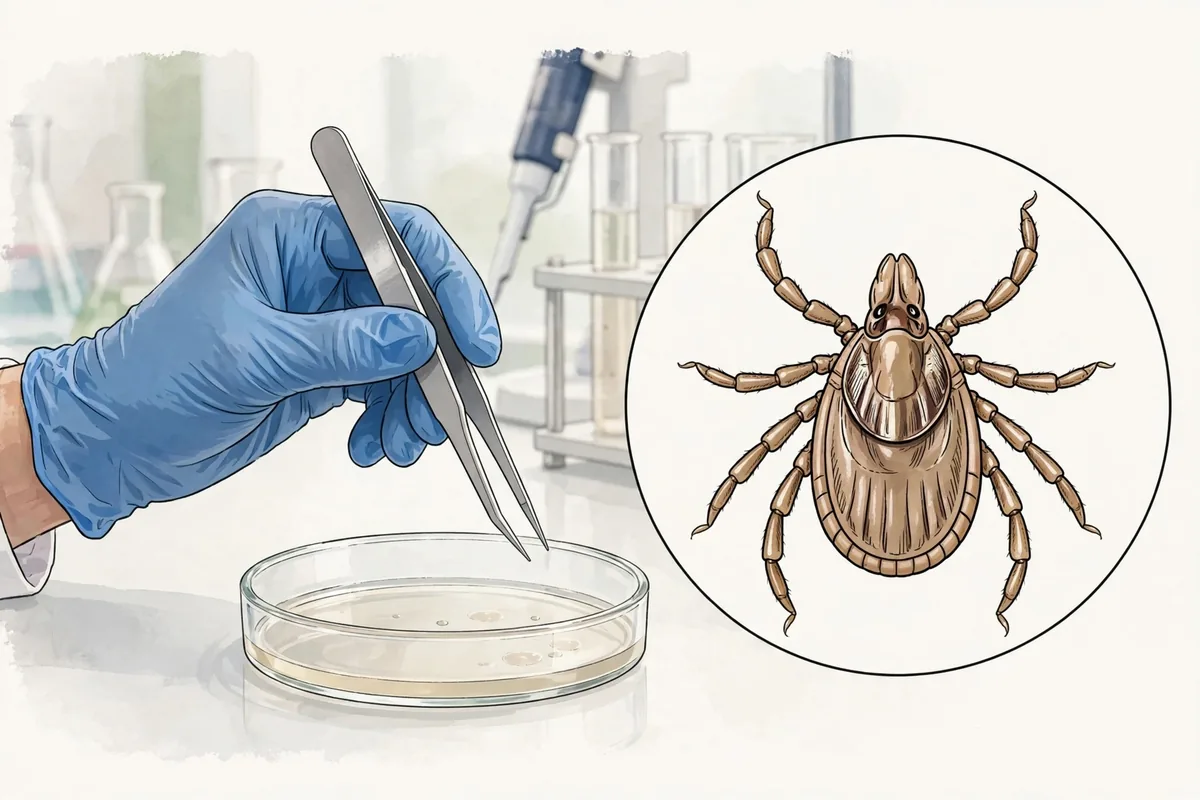
The most relevant study comes from North Carolina State University, published in the journal Insects in 2024. The researchers tested DE against nymphs of the longhorned tick (Haemaphysalis longicornis), an invasive species spreading in North America. When nymphs were dipped in DE for just two to four seconds and then held in petri dishes at 30°C and 70% relative humidity, the median survival time was 4.5 hours, and all ticks were dead by 9 hours. In a field-simulated test, the team spread DE at 5.0 grams per square meter over pine needle litter infested with nymphs: every tick was dead at 24 hours, with no deaths in the untreated control. Scanning electron microscopy confirmed the mineral coating all surfaces of the ticks. The authors concluded DE is effective at killing nymphal longhorned ticks and could serve as an alternative to chemical acaricides, particularly where pesticide resistance is a concern.
A separate laboratory study from Obihiro University in Japan tested DE against all life stages of the same tick species and found 100% mortality in larvae within about 200 minutes, in nymphs after 12 hours of immersion, and in adults within 24 hours. Another research group has shown lethal effects of a commercial DE dust product on larvae and nymphs of the lone star tick (Amblyomma americanum), a major US species. So the lab evidence is not a single result: multiple groups, multiple tick species, and multiple life stages show that direct DE contact kills ticks.
Now the honest framing. Every one of these results comes from direct, controlled contact: dipping, immersion, or a measured dose on a uniform surface in a dish or a prepared litter bed. None of them tested what happens when a homeowner shakes a bag of DE around a suburban yard and waits. The studies prove the mechanism works on ticks. They do not prove that broadcasting DE controls tick populations in real yards. That distinction is the entire story of this product, and most sellers skip it.
Why the Lab Results Don’t Translate to Your Yard
Ticks are harder targets than the soft-bodied insects DE is famous for killing, and yards are harder environments than laboratories. Four problems stack up.
Ticks have tougher armor
Compared with fleas, bed bugs, or cockroaches, ticks carry a thicker, more heavily sclerotized cuticle, especially as adults. The desiccation mechanism that works quickly on a soft insect works more slowly on a tick, which is consistent with the study results: hours to a full day of continuous contact for nymphs, longer for adults. In a yard, “continuous contact” is doing a lot of work in that sentence.
DE must stay dry, and yards get wet
Morning dew, rain, irrigation, and humid leaf litter all deactivate DE. A product that needs to sit dry across the ground to intercept crawling ticks, in the same environment where ticks thrive precisely because it is humid, is fighting the habitat. Reapplication after every rain is the standard advice, which tells you how fragile the effect is outdoors.
Ticks do not obligingly crawl through your dust layer
Many ticks quest: they climb vegetation and wait with outstretched legs for a host to brush past, rather than marching across open ground. A tick sitting on a blade of grass above your DE barrier never touches it. Ticks in leaf litter may be below the layer you applied. The studies that worked applied DE directly to the ticks or to the exact litter they occupied, which is not how a homeowner application behaves.
Reinfestation is constant
Even if a DE application killed every tick in your treated zone, ticks arrive continuously on deer, mice, and other wildlife moving through from untreated areas. Chemical yard treatments face the same problem, but they at least leave a residual toxic effect. DE leaves an inert powder that stops working the moment it gets damp. Evidence for sustained, season-long tick reduction from homeowner DE use is, to put it plainly, not established in the published literature. “Evidence is limited” is the honest phrase here, and it cuts against the marketing.
None of this means DE is useless. It means DE is a contact killer with narrow conditions, not a yard treatment. Used as a supplement in dry, contained spots, such as along a foundation or in a dry crawl space where ticks might shelter, it can contribute. As the centerpiece of a tick-control strategy, it is not supported by the evidence.
The Safety Rules Most Sellers Skip
DE is often marketed as completely harmless because it is “natural,” and that framing skips real hazards. The most important one is inhalation. DE is a fine silica dust, and breathing the dust irritates the nose, throat, and airways. Anyone applying it should wear a dust mask or respirator and avoid creating clouds of the stuff, especially on windy days. This matters most around children and pets, who are closer to the ground where the dust settles and who cannot be told to hold their breath. Occupational guidance on crystalline silica exists because chronic inhalation of silica dust is a genuine lung hazard; food-grade DE is the less hazardous amorphous form, but “less hazardous” is not “safe to breathe,” and routine, repeated applications around a home increase exposure.
The food-grade versus pool-grade distinction from the earlier section deserves repeating as a rule: buy only products labeled food-grade for pest-control use, and never substitute pool filter DE. Keep the product sealed and stored where children and pets cannot get into it. Do not apply it in vegetable gardens right before harvest without washing produce, and avoid dusting flowering plants where it can harm pollinators: DE does not distinguish between a tick and a bee that lands in it. If you have asthma or another respiratory condition, have someone else apply it or choose a different approach entirely.
One more caution that rarely appears on the bag: DE is not a substitute for EPA-registered tick repellents on your body. Dusting your yard, your shoes, or your clothing with DE does not protect you the way a registered repellent does. If you are choosing between DE in the yard and repellent on your skin, the repellent is the evidence-backed choice, and it is not close.
What Works Better for Tick Control

If DE is a supplement at best, what actually reduces tick bites? The evidence-backed toolkit is well established.
On your body: EPA-registered repellents
EPA-registered repellents remain the standard. Products containing DEET or picaridin, used according to the label, are the most studied and most reliable tick repellents for skin. For clothing and gear, permethrin treated onto fabric (never on skin) kills ticks on contact and survives multiple washings. These are not folk remedies; they are the products with actual efficacy data behind them, and no natural powder matches their record.
In your yard: habitat work beats dusting
Ticks need humidity and hosts, so the highest-impact steps are removing leaf litter where ticks shelter, keeping grass short, clearing brush and woodpiles near play and seating areas, and creating a dry barrier, such as a few feet of wood chips or gravel, between lawn and woods. These measures make the yard less hospitable in a way that does not wash away in the rain.
On you, after exposure: the tick check
The tick check is the single most underrated intervention. Shower within a couple of hours of coming indoors, tumble clothes on high heat to kill ticks the washer misses, and do a full-body check, including scalp, behind ears, armpits, waistband, and behind knees. Finding and removing a tick promptly matters enormously because disease transmission risk rises with attachment time. Our guide to removing an attached tick safely covers the tweezers technique, and why folk methods like burning or smothering the tick should be avoided.
Know the warning signs: after any tick bite, watch the site and your general health for the following weeks. Expanding redness, rash, fever, or flu-like symptoms after a tick bite deserve a prompt call to your doctor. Our pages on tick bite warning signs and Lyme disease after a tick bite explain what to watch for and when.
DE vs Other “Natural” Tick Products
DE is not the only natural product with a loyal following and thin field evidence, so a quick comparison helps set expectations honestly.
Cedar oil and essential-oil yard sprays have some lab repellency data but break down quickly outdoors and need frequent reapplication; evidence for sustained tick reduction is limited. Garlic-based yard sprays are widely sold with almost no published efficacy data against ticks specifically. Sulfur dusts have historical use in agriculture but are unpleasant to handle and have limited modern data for residential tick control. Nematodes and fungi (such as Metarhizium products) are active research areas with promising lab results and the same lab-to-yard translation problem as DE.
| Product | What lab studies show | What field evidence shows | Key limitation |
|---|---|---|---|
| Diatomaceous earth (food-grade) | Kills nymphs and adults on direct contact (NC State 2024; Obihiro lab study) | No established season-long yard control; evidence is limited | Must stay dry; questing ticks sit above the dust layer |
| Cedar and essential-oil yard sprays | Some repellency in lab settings | Limited; breaks down quickly outdoors | Needs frequent reapplication |
| Garlic-based yard sprays | Almost no published tick-specific data | Not established | Marketing runs ahead of evidence |
| Sulfur dusts | Historical agricultural use | Limited modern residential data | Unpleasant to handle; thin evidence |
The pattern is consistent: the natural-products shelf is long on mechanism and short on field trials. DE is actually among the better-studied options on that shelf, which is why this article can cite real papers. But “best studied of a weak class” is not the same as “proven yard solution.” If you use DE, use it with the safety rules above, in dry contained spots, as one piece of a strategy built on repellents, habitat work, and tick checks. That is the honest place it occupies.
When to See a Doctor for a Tick Bite

Tick bites deserve a different level of attention than most bug bites because of disease risk. Remove any attached tick promptly with fine-tipped tweezers, grasping as close to the skin as possible and pulling straight out, then clean the area. Save the tick in a sealed bag with the date if you can; identification helps your doctor assess risk.
Call your doctor promptly if you develop a rash around the bite, especially an expanding red area, or if you develop fever, chills, fatigue, muscle aches, or joint pain in the weeks after a bite. These can be early signs of tick-borne illness and are much easier to treat early. Seek same-day care for a tick that was attached for a long time and you cannot remove completely, for signs of infection at the bite site (increasing redness, warmth, swelling, pus), or if you develop facial droop, severe headache with neck stiffness, or heart palpitations after a bite.
Anyone who is pregnant, immunocompromised, or caring for a young child should have a lower threshold for calling after a tick bite. And remember the prevention hierarchy from this article: the repellent on your skin and the tick check afterward prevent more illness than any powder in the yard.
Frequently Asked Questions
How long does diatomaceous earth take to kill ticks?
In laboratory studies, longhorned tick nymphs dipped in DE had a median survival time of about 4.5 hours, with all dead by 9 hours; adults took up to 24 hours. Those are continuous-contact lab conditions. In a yard, where contact is intermittent and moisture deactivates the dust, there is no established timeline, which is part of why DE is unreliable as a yard treatment.
Is food-grade diatomaceous earth safe around pets?
Food-grade DE is less hazardous than pool-grade, but “natural” does not mean risk-free. The dust irritates airways when inhaled, so keep pets away during application until the dust settles, avoid applying where pets sleep or eat, and never use pool-grade DE. If your pet has a respiratory condition, skip DE entirely. For ticks on pets specifically, ask your veterinarian about proven preventives rather than dusting the animal.
Can I put diatomaceous earth on my skin or clothes to repel ticks?
DE is not a repellent; it is a contact killer that needs prolonged contact to work, and dust on skin or clothing does not provide meaningful protection. For personal protection, EPA-registered repellents containing DEET or picaridin on skin, and permethrin-treated clothing, are the evidence-backed options. Do not substitute DE for repellent.
Will rain ruin a diatomaceous earth application?
Yes. Moisture clumps DE and deactivates its desiccant action until it fully dries, and in humid ground-level environments it may never dry into a useful form again. This is one of the main reasons lab results do not translate to yards: the product needs dry conditions, while ticks thrive in humidity.
Does diatomaceous earth kill tick eggs?
There is no solid published evidence that DE reliably kills tick eggs, and the desiccation mechanism is least effective against life stages with protective coatings that limit water loss. The published studies focus on larvae, nymphs, and adults. Do not count on DE for egg control.
Medically reviewed by Dr. Sarah Jones, MD.
This article is for informational purposes only and isn’t medical advice. If you’re worried about a bite or sting, talk to a healthcare professional.