
You are itching, you have red bumps, and you cannot tell whether the culprit is scabies or bed bugs. Here is the direct answer: how to tell scabies from bed bug bites comes down to three signature differences — scabies causes intense itching that gets dramatically worse at night, with thin burrow lines in skin folds like finger webs and wrists; bed bug bites appear as raised red welts in clusters or lines on exposed skin, and the itching has no particular nighttime pattern. Getting this right matters because the treatments are completely different: scabies needs prescription medication for everyone in the household, while bed bugs need the insects eliminated from your home.
This guide compares them side by side, explains each condition in depth, covers how each spreads, tells you exactly what to do for each suspicion, and flags when to get professional help.
Scabies vs Bed Bug Bites: Side-by-Side Comparison #
| Feature | Scabies | Bed Bug Bites | |—|—|—| | Cause | Human itch mite (Sarcoptes scabiei), burrows into skin and lives there | Bed bug (Cimex lectularius), feeds on blood then hides in furniture | | The marks | Thin, raised, irregular burrow lines (whitish-gray or skin-colored) plus pimple-like bumps and blisters | Raised red bumps or welts, often in clusters of 3 or lines | | Itch pattern | Severe; classically worse at night, can prevent sleep | Itchy, but with no consistent time-of-day pattern | | Location | Skin folds: between fingers, inner wrists, elbows, waistline, buttocks, genitals; usually spares head/neck in adults | Exposed skin: arms, legs, neck, face — wherever skin was uncovered during sleep | | Who else itches | Often the whole household, in the same fold locations | Random — one person may be bitten heavily while a bed partner is untouched | | Visibility of culprit | Mites are microscopic (pinpoint size); cannot be seen | Bugs are visible (up to 6mm), plus shed skins and dark spots in mattress seams | | Spread | Prolonged skin-to-skin contact | Hitchhikes in luggage, furniture, bedding; does not live on the body | | Treatment | Prescription medication from a clinician; all close contacts treated simultaneously | Symptom relief for bites; pest elimination for the home | | Timeline | Itching can start 2-6 weeks after first exposure; persists until treated | Bites may take days to appear; resolve in 1-2 weeks once exposure stops |
The three questions that sort it fastest #
1. When is the itching worst? If the itch becomes intense after you get into bed and keeps you awake, that nighttime worsening is the single most classic scabies clue. Bed bug itching does not follow a clock.
2. Where exactly are the marks? Finger webs, wrists, elbows, waistband line, buttocks — folds and snug-clothing areas point to scabies. Arms, shoulders, neck, and legs — exposed during sleep — point to bed bugs.
3. Who else is affected, and where? If several household members are itching in the same fold locations, scabies is the strong favorite — it spreads through prolonged contact. If only one person is bitten, or the marks are scattered randomly, bed bugs fit better. And if you can find actual bugs, shed skins, or dark fecal spots in mattress seams, the debate is over: those are bed bugs.
Scabies Up Close: The Burrowing Mite #
Scabies is caused by the human itch mite, Sarcoptes scabiei var. hominis — a microscopic parasite that burrows into the upper layer of skin, where it lives, feeds, and lays eggs. You will never see the mite itself; at full size it is no bigger than the point of a pin.
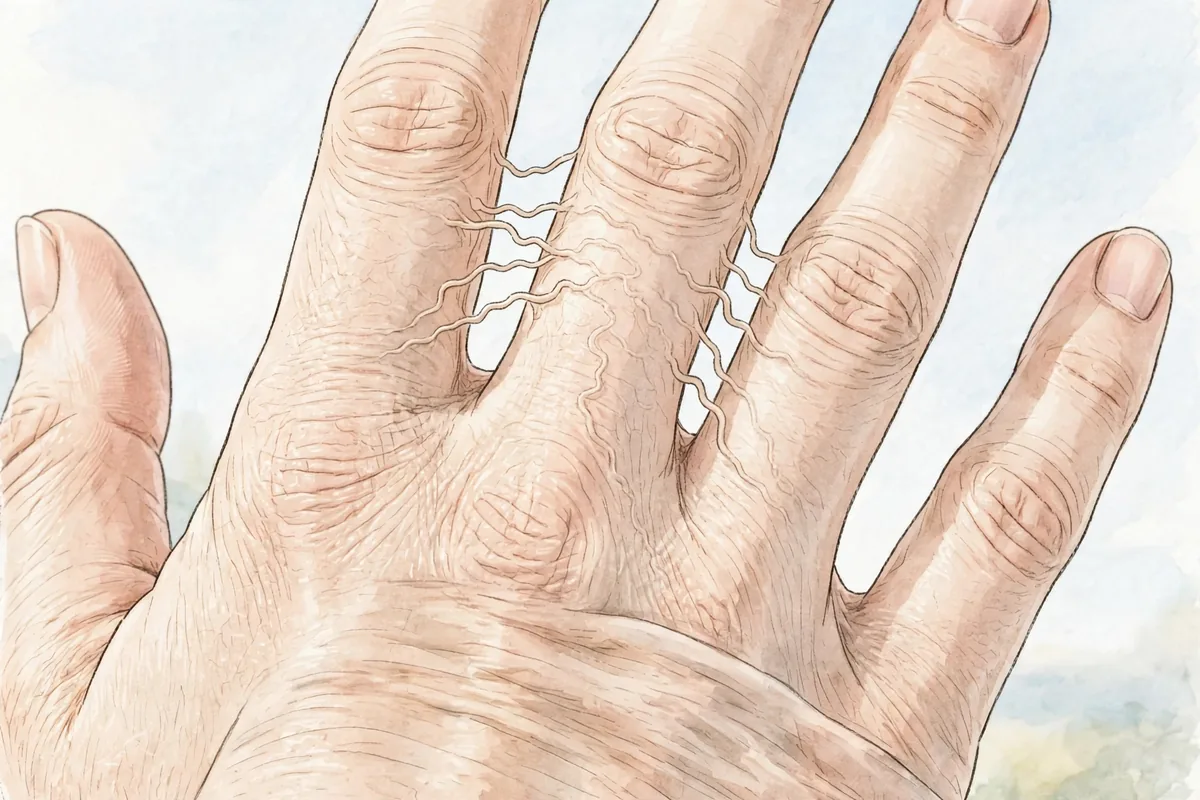
The burrows are the signature. The female mite tunnels through the skin, leaving thin, raised, irregular lines that may look whitish-gray or skin-colored. These burrows are most visible between the fingers, on the inner wrists, around the elbows, and along the waistline. They are subtle — many people miss them at first — but once you know to look for short wavy lines rather than just bumps, they are the most specific visual clue scabies offers.
Why the itch is so severe. The intense itching is an allergic reaction to the mites’ proteins and waste, not to the burrowing itself. That is why there is a delay: after a first exposure, it can take 2-6 weeks for the immune system to develop the allergy and for itching to begin. On re-exposure, symptoms can appear within days because the immune system is already primed.
Why nights are the worst. Scabies itching classically intensifies at night. People describe being unable to sleep, scratching for hours after getting into bed. The exact mechanism is debated — warmth, stillness, and the body’s nighttime immune rhythms all likely contribute — but the pattern itself is so characteristic that clinicians treat severe nighttime itching as a strong diagnostic pointer.
Where scabies prefers. The mites favor warm, protected skin folds: finger webs, inner wrists, inner elbows, armpits, waistline and beltline, buttocks, and the genital area. In adults, the head, face, neck, palms, and soles are usually spared — though in infants, young children, and immunocompromised people, the rash can appear more widely, including on the scalp, palms, and soles.
Crusted (Norwegian) scabies. In people with weakened immune systems, or when infestation goes untreated for a long time, a severe form can develop with thick, crusted skin containing huge numbers of mites. This form is highly contagious — even brief contact or shared bedding can spread it — and it needs prompt medical treatment.
Scabies does not spread disease. The mites themselves do not transmit infections. The main complication is secondary bacterial infection from scratching — impetigo and, rarely, deeper skin infections — which is why controlling the itch and treating promptly matters.
Bed Bug Bites Up Close: Clusters on Exposed Skin #
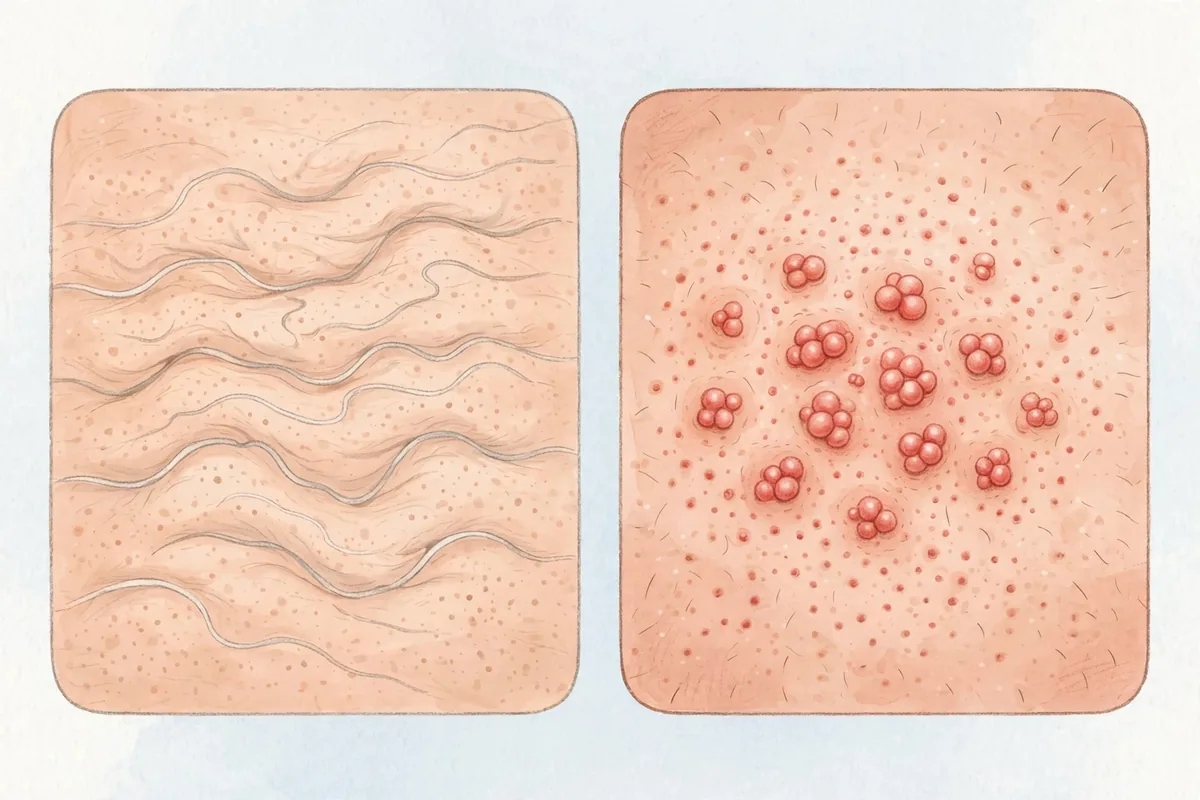
Bed bugs (Cimex lectularius) are small, reddish-brown, oval insects, visible to the naked eye at up to about 6 millimeters. They do not live on your body. They hide in mattress seams, box springs, bed frames, headboards, and nearby furniture, emerging at night to feed on sleeping people for a few minutes before retreating.
The bite pattern. Bed bug bites often appear in groups — the famous “breakfast, lunch, and dinner” pattern of three bites in a row or a small cluster. This happens because a single bug may probe several times as it feeds, or several bugs feed along the same exposed area. The bites show up on skin that was uncovered during sleep: arms, shoulders, neck, face, and legs. Areas under tight clothing are usually spared; areas under loose clothing may still be bitten.
What the bites look like. Raised, red, itchy bumps or welts — essentially indistinguishable from many other insect bites on appearance alone. Some people develop no reaction at all, which is why one bed partner can be covered in welts while the other has nothing. Bite marks can take hours to days to appear after feeding, and in some cases up to two weeks, which makes connecting the bites to the bedroom difficult.
The itch has no clock. Unlike scabies, bed bug itching does not reliably worsen at night. The bites itch when they itch — often noticed in the morning because that is when the fresh welts are discovered, not because of a true nighttime pattern.
Confirming evidence. Bed bugs leave signs: the bugs themselves (flat, reddish-brown, apple-seed-sized), shed translucent skins, and dark rust-colored fecal spots along mattress seams, behind headboards, and in furniture cracks. Finding this evidence confirms bed bugs definitively — no equivalent physical evidence exists for scabies, which is diagnosed by the rash pattern and, when needed, a skin scraping examined under a microscope.
Bites resolve on their own. Once exposure stops, bed bug bites typically fade within 1-2 weeks. The bites themselves need only symptom relief — the real work is eliminating the infestation, which usually requires professional pest control for anything beyond the earliest catch.
How Each One Spreads — And Why It Matters #
The transmission difference is one of the most useful distinguishing features, and it dictates completely different responses.
Scabies spreads person to person. It requires prolonged, direct skin-to-skin contact — the kind of contact within households, between caregivers and patients, among children playing closely, or during intimate contact. Brief contact like a handshake rarely transmits it. Crowded living conditions, nursing homes, childcare facilities, and prisons are classic settings for spread. Because transmission is about contact, treating only the itchy person fails: everyone in close contact needs treatment at the same time, even those not yet itching, or the mites simply cycle back.
Bed bugs spread place to place. They hitchhike in luggage, backpacks, used furniture, and clothing. You get bed bugs from an infested hotel, a used mattress, a guest’s bag — not from hugging someone who has bites. The bugs live in the environment, so the response is environmental: inspection, laundering, and usually professional extermination.
The practical test. Think about your recent history. New itching after travel, a hotel stay, or bringing home used furniture points toward bed bugs. Itching that started in one household member and spread to others over weeks, with everyone scratching the same fold areas, points toward scabies. Neither history is conclusive alone, but each sharpens the picture considerably.
What to Do If You Suspect Scabies #
See a clinician — do not try to treat this with over-the-counter products alone. Scabies requires prescription medication, and the diagnosis should be confirmed because several other itchy conditions (eczema, dermatitis, other mite reactions) can mimic it. A clinician can confirm scabies with a skin scraping and prescribe the appropriate treatment.
Treat everyone at once. This is the step people most often skip, and skipping it is why scabies “keeps coming back.” All household members and close contacts need treatment simultaneously, even if they are not itching yet — remember the 2-6 week delay before first-exposure symptoms appear. An untreated contact is a reservoir that reinfests everyone.
Manage the environment, lightly. Scabies mites cannot survive long away from human skin — generally no more than a couple of days. Wash bedding, clothing, and towels used in the few days before treatment in hot water and dry on high heat. You do not need to fumigate the house or throw out the mattress — that is a bed bug response, not a scabies response, and confusing the two wastes money and effort.
Expect itching to linger. Here is what surprises people: itching can continue for 2-4 weeks after successful treatment as the skin clears the dead mites and the allergic reaction winds down. Lingering itch does not automatically mean treatment failed. Your clinician can advise on soothing the residual itch and on when a second look is warranted.
Do not scratch. As with every itchy condition, scratching breaks the skin and invites bacterial infection. Keep nails short, use cool compresses, and ask your clinician or pharmacist about safe itch relief during treatment.
What to Do If You Suspect Bed Bugs #
Confirm before you panic. Strip the bed and inspect mattress seams, the box spring, the bed frame, and the headboard with a flashlight. Look for live bugs, shed skins, and dark fecal spots. Check nightstands and nearby furniture. Early confirmation saves weeks of uncertainty — and an early infestation is far easier to eliminate than an established one.
Contain, do not scatter. Do not drag the mattress through the house or move infested furniture to other rooms — that spreads the bugs. If you must move items, seal them in plastic first. Avoid sleeping on the couch; you will simply carry the problem to a new room.
Launder on hot. Wash bedding and nearby clothing in hot water and dry on the highest heat setting that the fabric allows — heat kills bed bugs at all life stages. Bag items before carrying them to the laundry to avoid dropping bugs along the way.
Treat the bites symptomatically. The bites themselves need only itch relief: cold compresses, calamine, or an oral antihistamine per label directions. They will fade in 1-2 weeks once the feeding stops. Scratching them open risks infection, so the usual no-scratch rules apply.
Get professional help for the infestation. Over-the-counter sprays rarely eliminate bed bugs — the bugs hide deep in cracks and have widespread resistance to common insecticides. A licensed pest professional with heat treatment or targeted methods is the reliable route. Be wary of anyone who promises a single-spray miracle.
After travel, inspect before you unpack. The best bed bug strategy is prevention: when you get home from a trip, inspect luggage outdoors or in the garage, launder everything on hot, and check the suitcase seams. For hotel-specific precautions, see bed bug bites in a hotel: what to do.
Warning signs: when to seek care #

Call 911 immediately if you develop trouble breathing or swallowing; swelling of the face, lips, tongue, or throat; widespread hives; dizziness or fainting; or a racing heartbeat. If you carry epinephrine, use it first, then call 911. Severe allergic reactions can occur with any bite, though they are uncommon with bed bugs and scabies.
Seek prompt medical care if: the itching is severe enough to prevent sleep for multiple nights; you see signs of skin infection — increasing pain, spreading redness, warmth, pus, or fever; the rash is spreading rapidly or involves large areas; you suspect crusted scabies (thick, scaly, crusted skin); home measures have not helped after 2-3 weeks; or you are immunocompromised, pregnant, or caring for an infant with a suspicious rash. For scabies specifically, do not delay the clinician visit — prescription treatment is the only reliable cure, and every week of delay is another week of household spread. Our bite and sting warning signs guide covers the general red flags that apply to any bite reaction.
Frequently asked questions #
Can I have scabies and bed bugs at the same time? #
It is possible but uncommon. The two have different sources — scabies comes from prolonged contact with an infested person, bed bugs from an infested environment — so simultaneous infestation would require both exposures. If you have been treated for one and the itching pattern does not match recovery (for example, burrow-like lines persist after bed bugs are eliminated), tell your clinician. Do not assume a single explanation must cover every symptom; get each suspicion evaluated on its own evidence.
How long does it take for scabies symptoms to appear? #
After a first exposure, it typically takes 2-6 weeks for the allergic reaction — and therefore the itching — to develop. This long delay is why scabies spreads so effectively through households before anyone realizes what is happening. On re-exposure, symptoms can appear within 1-4 days because the immune system is already sensitized. If your household’s itching started weeks apart in different people, that staggered timeline actually fits scabies well.
Do bed bug bites always appear in lines of three? #
No — the “breakfast, lunch, and dinner” pattern is common but not universal. Bed bug bites can appear as single welts, scattered bumps, or larger clusters depending on how many bugs fed and where they probed. The line-of-three is a helpful hint, not a rule, and its absence does not rule out bed bugs. The stronger evidence is always physical: bugs, shed skins, or fecal spots found during inspection.
Can scabies go away on its own? #
No. The mites continue to live, feed, and reproduce in the skin indefinitely without treatment — this is one of the key differences from bed bug bites, which fade once exposure stops. An untreated scabies infestation persists for months or years, spreads to contacts, and risks secondary infection and, in vulnerable people, crusted scabies. Prescription treatment from a clinician is necessary, along with simultaneous treatment of close contacts.
I treated for bed bugs but I am still itching. What now? #
First, verify the bed bugs are actually gone — a follow-up inspection 2-3 weeks after treatment, since eggs can hatch after the initial extermination. Bite reactions can also linger for 1-2 weeks after the last feeding, so some residual itching is normal. But if intense itching persists for weeks with no evidence of bed bugs, reconsider the diagnosis: nighttime-worsening itch with burrow lines in skin folds points to scabies, which needs a completely different treatment. Bring the full timeline to your clinician rather than repeating the bed bug treatment.
Medical and editorial note #
This guide provides general information about scabies and bed bug bites and is not medical advice. Skin conditions with itching and bumps have many possible causes, and only a clinician can diagnose scabies or confirm the source of bite-like lesions. If itching is severe, persistent, or spreading through your household, seek professional evaluation rather than attempting to diagnose or treat the condition yourself.


