
Can You Get Fleas Without Pets?
# Can You Get Fleas Without Pets? It is one of the most bewildering household mysteries: you have no dog, no cat, no pets…
Walk down the pet-care aisle and you'll see two very different products sharing one shelf: the $60-plus Seresto collar with its eight-month protection claim, and a row of $8 bargain…

Walk down the pet-care aisle and you’ll see two very different products sharing one shelf: the $60-plus Seresto collar with its eight-month protection claim, and a row of $8 bargain collars promising much the same thing. Online, the argument is even louder — devoted fans swear by their collars while others post photos of flea-covered pets wearing them. With that much contradiction, it’s no wonder pet owners keep asking the same question.
Do flea collars work? It depends entirely on which collar. The honest answer is a split verdict: Seresto — the imidacloprid-plus-flumethrin collar — has genuine published evidence of effectiveness, while most cheap over-the-counter collars have little credible evidence and frequently disappoint. The collar category also carries a real safety record you should know about, including an EPA review and one non-negotiable rule about cats.
This article breaks down how the effective collar works, why cheap ones fail, what the EPA incident history actually shows, the cat-safety warning every owner must know, and how collars compare with topical and oral options.
Let’s start with the bottom line, because the category doesn’t deserve a single grade. Flea collars fall into two tiers with a gulf between them.
In the top tier sits Seresto (made by Elanco, originally Bayer), the only flea collar with substantial published efficacy data. Its two active ingredients — the neonicotinoid imidacloprid and the pyrethroid flumethrin — release slowly from a polymer matrix over up to eight months. A European multicenter field study found flea counts reduced by at least 95% and tick counts by at least 90% in treated dogs and cats. That’s real evidence, not marketing copy — though one caveat worth knowing: that study was funded by Bayer, Seresto’s original manufacturer. The field-trial design and results are the relevant evidence either way, but independent confirmation from non-industry studies is thinner than marketing suggests.
In the bottom tier are the inexpensive over-the-counter collars sold at discount and grocery stores. These typically rely on older, lower-potency chemistry at doses that often can’t maintain effective levels across the whole animal for the claimed duration. Independent vets and entomologists consistently report that these collars underperform — many pet owners find live fleas within weeks. ## How Seresto Collars Actually Work
Understanding the mechanism explains both the effectiveness and the controversies. The Seresto collar is impregnated with imidacloprid (10%) and flumethrin (4.5%) locked into the collar’s polymer matrix. Body heat and friction release tiny, continuous doses that spread through the oils on your pet’s skin and coat.
Imidacloprid targets fleas: it’s a neonicotinoid that attacks the insect nervous system, killing adult fleas on contact. Flumethrin adds tick killing plus a repellent effect that discourages ticks from attaching in the first place. The label claims up to eight months of flea and tick protection, and the collar also protects the pet’s immediate surroundings against flea larvae development, which matters because most of a flea infestation lives in the environment, not on the animal.
Correct use matters. The collar must sit snugly — just fit two fingers underneath — because the ingredients transfer through coat contact. A loose collar won’t distribute properly, and removing it for baths or weekends interrupts the steady dosing. It must also be the right size and species version — cat, small-dog, and large-dog collars aren’t interchangeable.
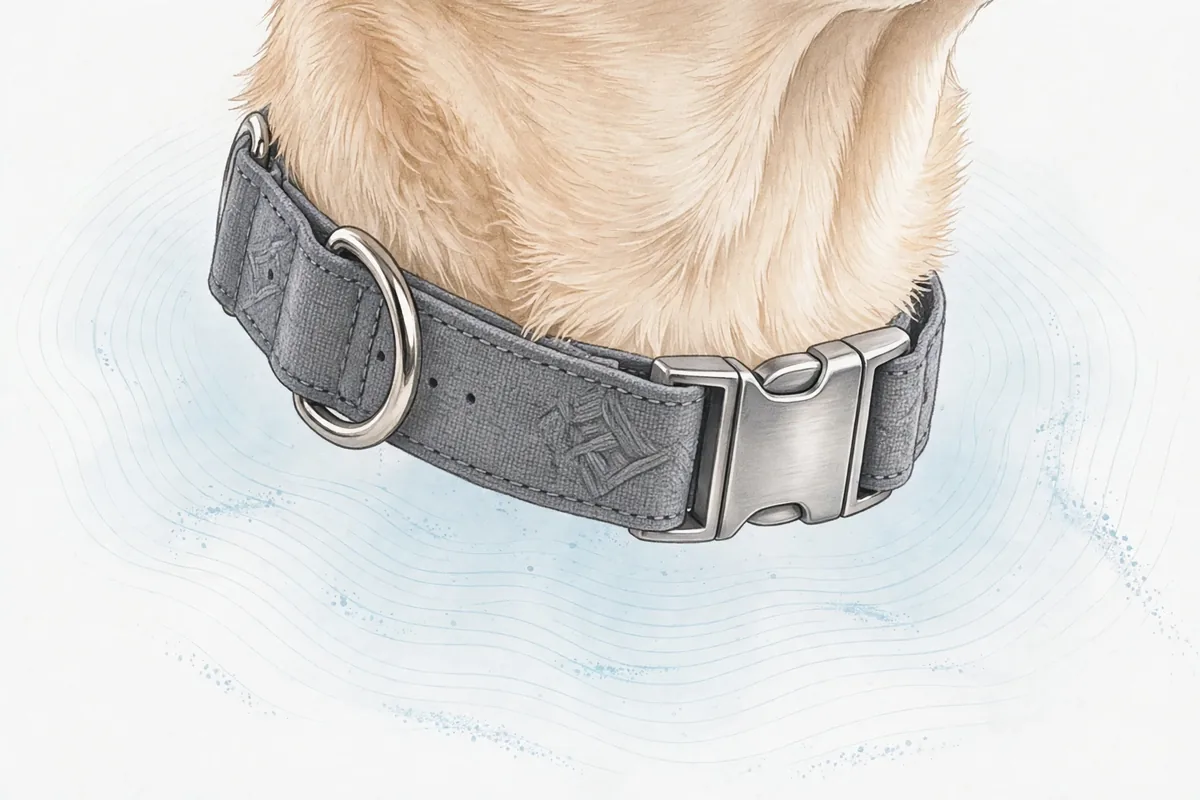
The bargain collars fail for predictable, physical reasons — not because the concept is impossible, but because the execution is weak. Most use older active ingredients at lower concentrations, and their release mechanisms are cruder: instead of a steady metered dose, they tend to dump more active ingredient early and fade fast, leaving the pet essentially unprotected for much of the claimed multi-month lifespan.
Coverage is the other problem. A collar’s chemistry travels from the neck across the body via skin oils, and the hindquarters and tail base — where fleas congregate — receive it last. Premium collars are engineered to maintain effective levels body-wide; cheap ones rarely demonstrate this. The classic result: fleas gone from the neck, thriving everywhere else.
There’s also the water problem. Many low-end collars lose effectiveness rapidly with bathing or swimming, and few owners realize they need to account for it. Add in counterfeit collars sold through third-party marketplaces — a genuine problem in this category, with fakes that may contain nothing at all — and the bargain tier’s reputation is well earned. If a collar costs less than a month of a vet-recommended preventive, skepticism is the rational response.
No honest article can skip this: Seresto has one of the most scrutinized safety records of any pet pesticide product. Here’s what happened, without spin from either side.
In March 2021, reporting by Investigate Midwest and USA Today revealed that the EPA had received tens of thousands of incident reports associated with Seresto collars — including, at that time, nearly 1,700 reported pet deaths — with no warning label on the product. The Center for Biological Diversity petitioned the EPA to cancel the collar’s registration. A House subcommittee investigation followed, and in 2022 it called for a recall, noting that Canada had restricted the product and other countries required warnings.
The EPA completed its review in July 2023: the collars stay on the market — they meet federal safety standards — but with new conditions. Elanco must add warning labels describing commonly reported effects (skin, behavioral, and neurological signs) with instructions to remove the collar if they occur, split the registration into separate cat and dog products, improve the release mechanism to reduce strangulation risk, and submit more detailed incident data. The registration period was shortened from the normal 15 years to 5.
Critics note incident reports exceeded 100,000 including roughly 2,700 deaths, and the EPA acknowledged its old reporting rules couldn’t establish causation in most cases. Elanco and many veterinarians counter that with over 41 million collars sold, the 2022 adverse-event incidence was about 0.116% — roughly one reported event per 1,000 collars — and reports don’t prove causation. The EPA noted deaths linked to the collar were often associated with strangulation from a faulty release mechanism rather than the chemistry.
The fair takeaway: Seresto is neither a proven menace nor above questioning. Buy from reputable sources (counterfeits are a real hazard), fit it correctly, watch your pet — especially in the first days — and remove the collar and call your vet if you see skin reactions, lethargy, tremors, or behavior changes. That’s exactly what the new labels now tell you to do.

This is the single most important safety rule in the flea-collar conversation, and it extends beyond collars to all flea products: never use a dog flea product on a cat. Many dog flea collars and spot-ons contain permethrin, a synthetic pyrethroid that dogs tolerate but cats cannot properly metabolize. In cats, permethrin exposure can cause tremors, seizures, and death — and it doesn’t take much. The ASPCA’s Animal Poison Control Center warns that even casual contact with a recently treated dog can sicken a sensitive cat.
Seresto itself makes a cat-specific collar (using flumethrin, not permethrin, at cat-appropriate dosing) — but a large-dog Seresto on a cat is still wrong, and a permethrin-based dog collar on a cat can be fatal. The rule is absolute: match the product to the species, the weight range, and the label. In multi-pet homes, keep cats away from dogs wearing dog-only products until you’re certain of the ingredients.
If a cat is ever exposed to a dog flea product, don’t wait for symptoms — wash the cat with warm water and mild dish soap to remove as much product as possible and call your veterinarian or poison control immediately. Fast action saves lives here. For guidance on spotting trouble in cats generally, watch for excessive scratching, redness, scabbing, or hair loss — and call your veterinarian.
Even the best collar isn’t automatically the best choice for your pet — it’s one option among three major formats, and vets increasingly favor the others for many animals.
Oral preventives (isoxazoline-class chews) are the current gold standard in many practices: given monthly, they kill fleas fast, aren’t affected by bathing or swimming, and eliminate collar-related concerns entirely. Trade-offs are cost and the usual need for a veterinary prescription.
Topical spot-ons sit in the middle: applied to the skin monthly, effective, widely available — but they can be washed off, some pets dislike application, and in multi-pet homes there’s a window where a housemate could ingest the product by grooming.
Collars win on convenience and duration — eight months of not thinking about it, no monthly dosing to forget, often lower annual cost. They lose on the incident-history concerns above, the fit requirements, and the fact that a collar is always present, always releasing.
The right choice depends on your pet’s lifestyle, your household mix, and health history — a conversation for your veterinarian, not the pet-store aisle, especially for pets with seizure histories. And whichever route you choose, treat the environment too: the pet is only half the battle, since most of an infestation hides as eggs, larvae, and pupae in bedding and carpets. If anyone in the family is getting bitten, wash the bites gently, avoid scratching, and see a doctor if they worsen.

Flea collars are a pet topic, but flea infestations bite people too — and that’s where human medical guidance applies. See a doctor if:
Do flea collars work as well as pills or spot-ons?
The best collar (Seresto) has solid efficacy data, but most veterinarians consider modern oral preventives more reliably effective and convenient, since they aren’t affected by bathing, fit, or water exposure. Cheap OTC collars don’t compare well with any vet-recommended option.
How long does a Seresto collar last?
The label claims up to eight months of continuous flea and tick protection. It must be worn continuously and fit snugly to maintain the slow-release dosing — removing it frequently or fitting it loosely reduces effectiveness.
Are Seresto collars safe after the EPA review?
The EPA’s 2023 decision kept them on the market with new warning labels, finding they meet federal safety standards, while requiring better incident reporting and a shorter 5-year registration. Buy genuine product from reputable sellers, fit it correctly, monitor your pet, and remove it if adverse signs appear.
Can I use a dog flea collar on my cat in an emergency?
No — never. Many dog flea products contain permethrin, which can be fatal to cats. Use only products specifically labeled for cats, and in an exposure emergency, wash the cat with mild soap and call your vet immediately.
My pet still has fleas while wearing a collar. What now?
Check the fit (two fingers underneath), confirm it’s a genuine product within its active lifespan, and remember the environment holds most of the infestation — vacuum thoroughly and wash bedding. If fleas persist, talk to your vet about switching to an oral or topical preventive rather than stacking products on your own.
Medically reviewed by Dr. Sarah Jones, MD.
This article is for informational purposes only and isn’t medical advice. If you’re worried about a bite or sting, talk to a healthcare professional.
Dr. Jones oversees StingHelp’s clinical verification process. Every guide is systematically evaluated against active Centers for Disease Control and Prevention (CDC), Environmental Protection Agency (EPA), and American Academy of Allergy, Asthma & Immunology (AAAAI) medical consensus standards to ensure symptom distinctions and care recommendations are clinically sound.
Explore physician-reviewed first-aid procedures, identification clues, and symptom comparisons for other common outdoor bites and stings.

# Can You Get Fleas Without Pets? It is one of the most bewildering household mysteries: you have no dog, no cat, no pets…

Scroll any natural-pet-care forum and you will find the claim: rub coconut oil on your dog and the fleas stay away. The question does…

The Short Answer Technically yes, but you should never use it that way. When you ask does tea tree oil kill fleas, the honest…