If you spend warm evenings dodging mosquitoes on your patio, the promise sounds irresistible: hang a wooden box on a pole, bats move in, and mosquitoes vanish. Bat houses are marketed as chemical-free, all-natural mosquito control. But do bat houses reduce mosquitoes enough to notice fewer bites? The honest answer is: probably not. Bats do eat mosquitoes — nobody disputes that. But mosquitoes are a tiny fraction of their diet, and no solid evidence shows a bat house measurably lowers backyard mosquito numbers.
Bat houses are not useless, though. Bats are genuinely valuable for ecosystems and agriculture, and a well-placed bat house supports local bat populations that, in many regions, need the help. The mosquito-control pitch is mostly marketing. Here is what the science actually says, so you can decide with realistic expectations.
Where the “1,000 Mosquitoes an Hour” Claim Came From
The claim that a single bat eats 1,000 mosquitoes per hour appears everywhere — product pages, gardening blogs, even news segments. It traces back to a single 1960 laboratory study, and the real story is far less impressive than the headline.
That study, by Donald Griffin and colleagues at Harvard, was not a diet study at all — it examined how bats use echolocation to find prey. The researchers released little brown bats into a small room packed with about 2,000 mosquitoes and nothing else to eat. The best-performing bat caught roughly 10 mosquitoes per minute, but only for a few minutes; other bats caught as few as 2 per minute, and fewer than 10 percent showed capture behavior at all.
The famous number came from a handful of “champion catchers” in conditions no wild bat experiences: a confined room, an artificially dense swarm of prey, and no alternative food. A bat locked in a room with nothing to eat but mosquitoes will eat mosquitoes — it cannot skip meals. Extrapolating that burst into “1,000 per hour, all night” assumes the champion rate holds for hours and applies to all bats, with no other prey involved. None of that is true. Marketers ran with the best-case value, not the realistic one — a textbook case of how a cherry-picked lab number becomes a marketing myth.
What Bats Actually Eat at Night
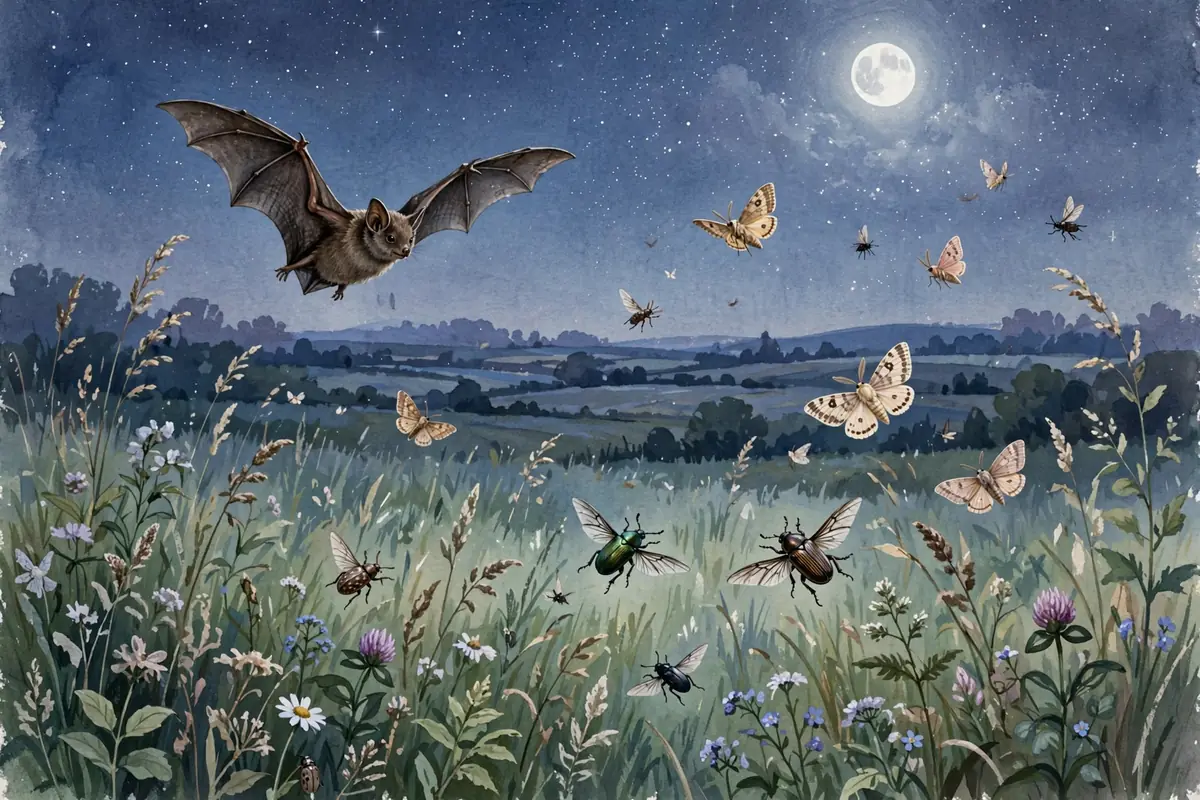
Bats are opportunistic, generalist feeders. They eat what is abundant and profitable on a given night — and mosquitoes, which are tiny, soft-bodied, and low in calories, usually lose out to bigger prey. Guano-based diet studies consistently find the same pattern: moths, beetles, flies, and caddisflies dominate, while mosquitoes are a side dish at best.
The American Mosquito Control Association has stated that in all studies to date, mosquitoes have made up less than 1% of the gut contents of wild-caught bats. A PLOS ONE study of five Australian bat species found mosquitoes only in the feces of the two smallest species — and even there, moths dominated. The math explains why: a small bat needs roughly 600–660 mosquitoes versus just 160–180 similar-sized moths to meet its nightly energy needs. More calories per catch wins, so larger bats skip mosquitoes almost entirely.
A University of Wisconsin–Madison study did find mosquitoes — including nine known West Nile carriers — at 100% of little brown bat colony sites. But the researchers were explicit: the study did not show bats suppress mosquito populations. Detecting mosquito DNA in guano proves bats ate mosquitoes; it does not prove fewer mosquitoes in the yard.
Why a Bat House Is Not a Mosquito Trap
The most direct answer comes from the University of California’s pest experts. UC IPM states plainly: “there is no clear evidence that their installation will significantly reduce garden insect problems.” A California mosquito-control overview adds that setting out bat boxes “will not affect the local mosquito population.” These are not anti-bat statements — both sources call bat boxes beneficial for conservation. They simply reflect what the evidence supports.
A bat house is a daytime roost — a bedroom, not a guard post. At dusk, bats commute to feeding grounds that can be several kilometers from the roost, so there is no guarantee they feed over your yard at all. Bats also switch among roosts frequently during summer. And mosquitoes are weak fliers that rarely travel far from where they hatch — the mosquitoes biting you were likely born within a block or two, while “your” bats may be feeding miles away.
Put it together: you are installing a roost for a mobile predator whose diet is mostly moths and beetles, hoping it eats enough local mosquitoes — a tiny fraction of its diet — to reduce your bites. The scale does not work, which is why comparisons to bug zappers keep coming up: bats catch many of the same insects that bug zappers catch, and bug zappers do not reduce biting rates either.
Bats and Mosquito-Borne Disease: The Honest Answer
Some marketers go further than mosquito annoyance and claim bat houses help prevent West Nile virus, Zika, or other mosquito-borne diseases. There is no evidence to support this at the home or neighborhood level.
Bats do eat mosquito species that carry disease — the Wisconsin study documented nine West Nile vectors in bat diets. But eating infected mosquitoes is not the same as breaking a transmission cycle, and the researchers cautioned their work did not demonstrate population suppression, let alone disease reduction. No field study has shown bat houses lower West Nile or Zika risk around a home.
A University of Florida extension specialist gave the most honest expert take on this back in 2001: “there are no guarantees a bat house will reduce their risk, but it can’t hurt.” A quarter century of research has not produced the guarantee. If disease-carrying mosquitoes are your concern, proven steps — eliminating standing water, treating unavoidable water with larvicide, and using EPA-registered repellents outdoors — have far more evidence behind them.
If You Still Want a Bat House, Do It Right

Install a bat house for the right reason: conservation. Many North American bat species have declined from white-nose syndrome, habitat loss, and pesticides, and well-built bat houses provide safe roosts — especially maternity colonies. A bat house is wildlife habitat first; any insect-eating is a possible bonus, not a promised outcome.
If you go ahead, placement matters enormously, and extension sources are consistent on the basics:
- Sun: 6–8 hours of direct sun, facing east or south (hotter climates: morning sun with afternoon shade). Interior 80–100°F encourages nursery colonies.
- Height: at least 12 feet up; 15–20 feet is better.
- Clearance: 20–30 feet from branches or obstacles — clear flight paths, less predator access.
- Water: within a quarter mile of a pond, stream, or lake, along natural bat flyways.
- Vegetation: mixed natural vegetation nearby; the most successful spots blend habitat types.
One safety note UC IPM flags: mount the house away from play areas and doors, because sick bats can fall from the roost where children and pets can pick them up. Never handle a bat with bare hands — if one gets inside your home, contact your local health department or animal control for guidance on safe capture and rabies testing.
Also set your calendar expectations: occupancy often takes a year or more. A bat house that sits empty its first summer has not failed; it just has not been discovered yet.
What Actually Reduces Backyard Mosquitoes
If the goal is fewer bites, spend your effort on measures with real evidence. Mosquitoes breed in standing water and most species do not travel far, so source reduction is the single highest-impact thing a homeowner can do:
- Dump standing water weekly. Saucers, buckets, tarps, clogged gutters, toys, and birdbaths are all breeding sites — a bottle cap of water is enough for some species.
- Treat water you cannot drain. Mosquito dunks containing Bti (Bacillus thuringiensis israelensis), a bacterial larvicide sold at hardware stores, are considered safe for birds, pets, and pollinators when used as labeled. Drop one in rain barrels, ponds, or sump pits.
- Use a fan. A simple oscillating fan on the patio disrupts mosquitoes’ weak flight and disperses the carbon dioxide plume they use to find you.
- Fix screens and seal gaps. Fine-mesh screens on windows, doors, and porches matter far more than any backyard gadget.
- Use EPA-registered repellents outdoors. At dusk, a repellent with DEET, picaridin, or oil of lemon eucalyptus is proven personal protection.
For more prevention ideas, see our outdoor bite-prevention checklist. Before buying gadgets, judge by evidence, not marketing.
When to See a Doctor for a Bug Bite

Most mosquito bites resolve on their own within a few days. Get medical care promptly if you notice:
- Anaphylaxis signs — call 911: difficulty breathing or wheezing, swelling of the lips, tongue, or throat, dizziness, rapid pulse, or widespread hives. Review the full anaphylaxis sting warning signs so you can recognize them fast.
- Infection or cellulitis signs: spreading redness, increasing warmth or swelling after the first day, red streaks radiating outward, pus, fever, or worsening pain.
- Timeline violations: swelling or pain that keeps worsening after 48–72 hours instead of improving, or no improvement within a week.
- Systemic symptoms: high fever, severe headache, body aches, or rash after bites in an area with active mosquito-borne disease.
- Any bat contact: if a bat may have bitten or scratched you — or you woke to find one in your bedroom — seek medical care the same day and contact your local health department about rabies evaluation. Do not wait for symptoms.
Frequently Asked Questions
Will the bats in my bat house eat all the mosquitoes in my yard?
No. Diet studies put mosquitoes at under 1% of wild bat gut contents (American Mosquito Control Association), with moths, beetles, and flies dominating — and UC IPM states there is no clear evidence bat houses reduce yard mosquito numbers. Think of a bat house as wildlife habitat, not pest control equipment.
How many mosquitoes does a bat actually eat per night?
The “1,000 an hour” figure comes from a 1960 lab study: bats placed in a small room with about 2,000 mosquitoes and no other food. The best “catcher” managed about 10 per minute for a few minutes — most bats caught nothing. Wild bats eat what is available, which on most nights means larger, calorie-dense insects. No credible wild figure exists; it varies by species, season, and prey.
Where should I place a bat house for the best chance of success?
Mount it at least 12 feet high (15–20 is better), 20–30 feet from branches, facing east or south for 6–8 hours of direct sun. Keep it within a quarter mile of water, near mixed natural vegetation, and away from heavy human and pet traffic. Occupancy often takes a year or more — that is normal.
Are bat houses safe around kids and pets?
A properly mounted bat house is generally safe with standard precautions: mount it out of reach and away from play areas, since sick bats can fall from the roost (UC IPM flags this). Never handle a bat with bare hands. If one gets inside, call animal control or your health department, and seek same-day care if anyone may have been bitten or scratched.
Could a bat house near my home increase my rabies risk?
A bat house itself does not create rabies risk — bats do not seek out people. The risk comes only from direct contact. Rabies in wild bats is uncommon (typically under 1% test positive), but bat bites can be tiny and hard to detect, so any bite, scratch, or sleeping-person exposure should be evaluated by a health professional promptly. Mount the house well away from doors and play areas.
Medically reviewed by Dr. Sarah Jones, MD.
This article is for informational purposes only and isn’t medical advice. If you’re worried about a bite or sting, talk to a healthcare professional.