The hayride was perfect, the cider donuts were warm, and your kids found the ideal pumpkins. Then, back home, you spot it: a tiny dark speck attached behind your daughter’s knee. Ticks pumpkin patch outings are a real combination — those charming working farms with their tall grass borders, leaf-litter edges, and vine-covered fields are prime habitat for adult ticks in October, right when families visit in the biggest numbers.
This is a family safety guide, not a scare piece. Pumpkin patches are wonderful, and a few simple habits — what everyone wears, where kids roam, and a ten-minute check at home — keep the outing exactly as fun as it should be. Here is the complete playbook.
Why a Pumpkin Patch Is Tick Habitat
A pumpkin patch is a farm, not a park — and that distinction matters for ticks. The classic patch layout includes exactly the features blacklegged (deer) ticks love: field edges bordered by tall grass and brush, leaf litter accumulated along fences and tree lines, vine-covered ground that stays damp underneath, and wooded borders where deer and mice (the ticks’ hosts) travel. October is peak season for adult blacklegged ticks across the Northeast, Midwest, and much of the South, so the calendar aligns perfectly with pumpkin season.
Parenting press has covered real incidents — including cases of tick-borne illness contracted during farm visits — which is why this guide exists. The risk is not theoretical, but it is also not a reason to cancel the tradition. Ticks quest from vegetation at ground level; the center of a well-maintained patch, with its trampled vines and open rows, is far less risky than the weedy edges, tall grass, and leaf piles where kids love to explore. Understanding the geography of risk lets you say “yes” to the patch and “let’s stay out of that tall grass” with confidence.
One more piece of context: pumpkin patches in October can also host wasps and bees around cider stands and food areas — a different hazard with different prevention, covered in our orchard and farm-visit sting guidance. For this guide, ticks are the focus, because they are the hazard most families overlook.
Before You Go: The Family Briefing

A two-minute conversation in the car prevents most problems. Keep it upbeat and matter-of-fact — the goal is awareness, not fear:
“We stay on the paths and in the pumpkin rows.” The edges — tall grass, brush, leaf piles, stone walls — are where ticks wait. Make it a game for younger kids: the rows are the safe zone, the wild edges are out of bounds. Most patches have mowed paths; use them.
“We check for ticks when we get home, like checking for glitter.” Framing the tick check as routine hygiene rather than a scary medical event keeps kids cooperative. Older kids can learn to check themselves; younger ones just need to know to stand still for the check.
Dress everyone deliberately. This is the highest-impact step and it happens before you leave the house (see the next section). A family that arrives in shorts and sandals has already used up most of its protection budget.
Pack the kit: EPA-registered repellent for exposed skin, a fine-tipped tweezer and a small sealed bag or tape in your bag (for the unlikely event of an attached tick found at the patch), and a change of clothes for the ride home. Our outdoor bite prevention checklist has the full packing version if you want a printable routine.
Dressing Kids for the Patch
Children are lower to the ground, more likely to sit or roll in vegetation, and less likely to notice a tick — so their clothing matters most. The uniform: long pants tucked into socks, closed shoes or boots (no sandals, no matter how cute), and a long-sleeved shirt. Light colors help you spot ticks during and after the visit. For toddlers who will inevitably sit in the dirt, this matters doubly.
Treat the family’s patch clothes with permethrin ahead of the season if you visit farms, trails, or wooded areas regularly — it is the most effective tick protection available for clothing, killing ticks on contact with fabric. One treatment session in early October can cover the whole family’s fall outings. For exposed skin, use an age-appropriate EPA-registered repellent: follow the label for young children (applied by an adult, not on hands that go in mouths), and skip repellent entirely on infants under two months — physical barriers and carriers do the work there instead.
The costume consideration: many families combine the patch visit with costume previews or fall photo shoots. Flowy costumes, capes, and bare legs are tick invitations. If costumes are part of the day, put the protective layers underneath and do the tick check with extra care afterward — costume fittings are no excuse to skip it.
At the Patch: Smart Roaming

Once you are there, a few in-the-moment choices keep risk low without dampening the fun:
Favor the middle of the patch. The open, trampled rows where pumpkins are displayed are the lowest-tick zone. The weedy perimeter, the brush pile by the fence, the leaf drift under the big oak — those are the high-tick zones. Steer the adventure toward the middle.
Skip the leaf piles. This is the hard one, because leaf piles are irresistible to children. But a leaf pile at a farm edge is essentially a tick nursery — moist, insulated, full of questing adults. If the patch has a designated, clean play area with fresh straw (many do), redirect there. Save leaf-pile jumping for your own raked, known yard pile at home.
Use the farm’s cleared areas for snacks and sitting. Picnic tables, the cider stand patio, the hay-bale photo spot — cleared, trampled, sunny areas are fine. Sitting on the ground at the field edge is not.
Keep dogs on paths too, if the patch allows pets. Dogs sweep up ticks from vegetation efficiently and bring them to the car — and to you. A quick brush-down before loading up helps.
Reapply repellent if you are there for hours, per the product label — especially after the kids have been running and sweating.
The Post-Patch Tick Check
This is the step that actually catches everything, and it takes ten minutes. Do it the same day — ticks that have not yet attached are easily removed, and attached ones are easier to deal with promptly:
Clothes first. When you get home, put everyone’s patch clothes straight into a hot dryer for 10 minutes before washing. Dryer heat kills ticks; the wash alone does not reliably do it. This single habit intercepts the majority of hitchhikers.
Shower within two hours. A shower washes off unattached ticks and sets up the body check naturally. Make it part of the post-outing wind-down, not a chore.
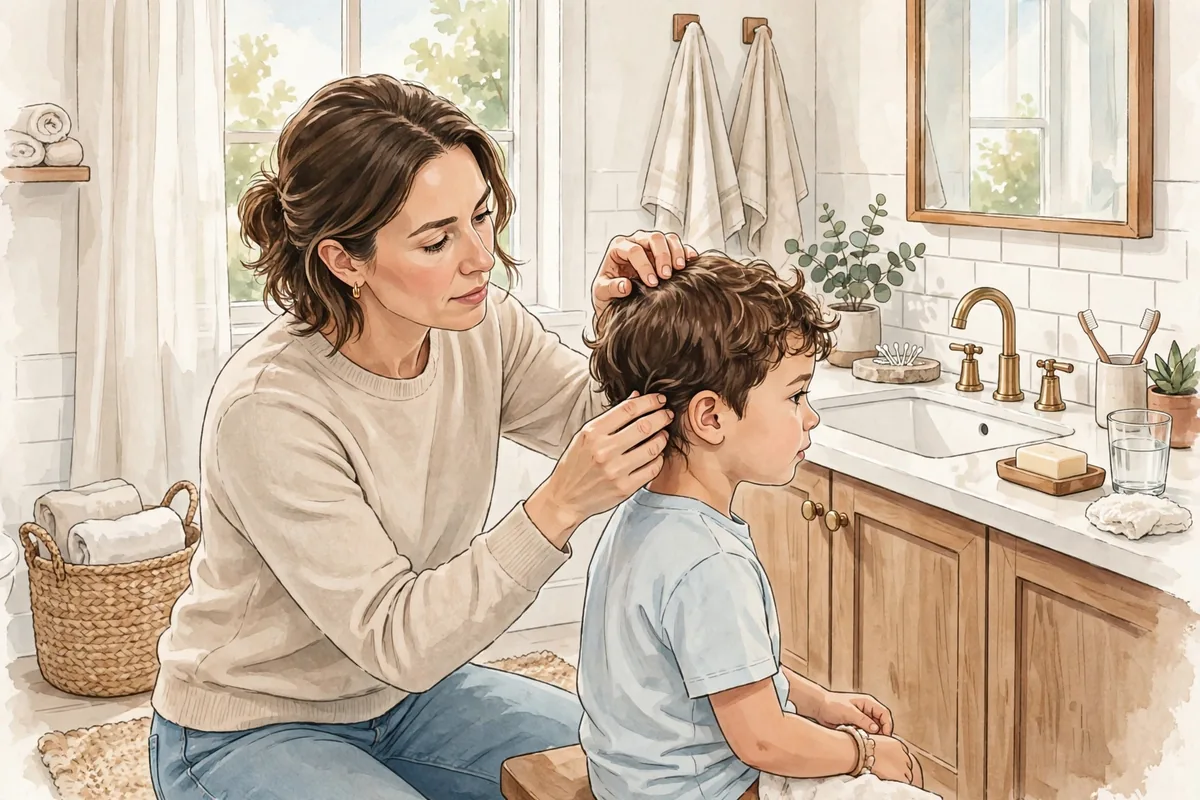
The full-body check, kid by kid. Ticks favor warm, hidden spots: behind the knees, the groin area, armpits, waistline and underwear elastic, the belly button, behind the ears, along the hairline, and through the scalp. For long-haired kids, fingers through the scalp at the roots work better than eyes alone. Check the dog too — ears, between toes, under the collar.
If you find an attached tick: remove it promptly with fine-tipped tweezers — grasp as close to the skin as possible and pull steadily upward without twisting — following proper tick removal technique. Save the tick in a sealed bag or taped to a card, note the date, and review our tick bite aftercare guide for what to watch in the coming weeks. Do not use folklore methods (nail polish, petroleum jelly, heat) — they do not work and can make things worse.
When to See a Doctor for a Bug Bite
After a pumpkin patch visit, call your doctor or pediatrician if:
- Any tick was attached and you are unsure how long — attachment-time questions affect medical decisions, so call rather than guess.
- A rash develops around the bite site in the days to weeks after — especially an expanding circular redness.
- Fever, fatigue, headache, or body aches appear within a month of the outing — mention the farm visit and possible tick exposure.
- The tick could not be fully removed, or the bite area becomes increasingly red, swollen, or painful.
- Multiple family members had attached ticks — worth a call for guidance even if everyone feels fine.
- Your child is very young — pediatricians take a more cautious approach to tick bites; a quick call is always reasonable.
Bring the saved tick and the date of the visit to the conversation. And remember: the purpose of the call is professional risk assessment, not self-diagnosis — describe what you found and let the clinician guide next steps.
Frequently Asked Questions
Are ticks really a problem at pumpkin patches, or is this overblown?
It is a genuine, documented risk — parenting outlets have reported tick-borne illness cases linked to farm visits, and October is peak adult-tick season in much of the country. But “genuine risk” and “reason to stay home” are very different things; the precautions in this guide reduce the risk to a very low level.
Can my kids still play in the leaves at the patch?
It is better to skip farm-edge leaf piles, which concentrate ticks. Many patches have clean play areas with fresh straw — use those. Save leaf-pile play for your own yard, where you control the leaf source and can check the area.
What if we find a tick on the drive home?
If it is crawling (not attached), just remove and discard it — no medical concern. If it is attached, remove it properly with tweezers at your earliest stop, save it, and call your pediatrician or doctor for guidance. Do not try to burn it off or smother it.
Do ticks fall from trees onto kids?
No — this is a persistent myth. Ticks quest from ground level and low vegetation; they do not drop from trees. The risk comes from brushing against grass, vines, leaf litter, and low brush, which is why legs, waistlines, and scalps (from ducking under branches) are the check priorities.
Should we treat the pumpkins we bring home?
No treatment needed. Ticks do not live on pumpkin skins — they need vegetation and hosts. Give pumpkins their normal wash before carving or displaying, and you are done. The check that matters is on people and pets, not produce.
Medically reviewed by Dr. Sarah Jones, MD.
This article is for informational purposes only and isn’t medical advice. If you’re worried about a bite or sting, talk to a healthcare professional.