
Chickenpox vs Bug Bites: A Parent’s ID Guide
Your child wakes up covered in itchy red spots and the questions start immediately: is this chickenpox vs bug bites, an allergic reaction, or…
You wake up with itchy red marks, and the internet offers two suspects: bed bugs or eczema. The question of bed bug bites vs eczema is one of the most…
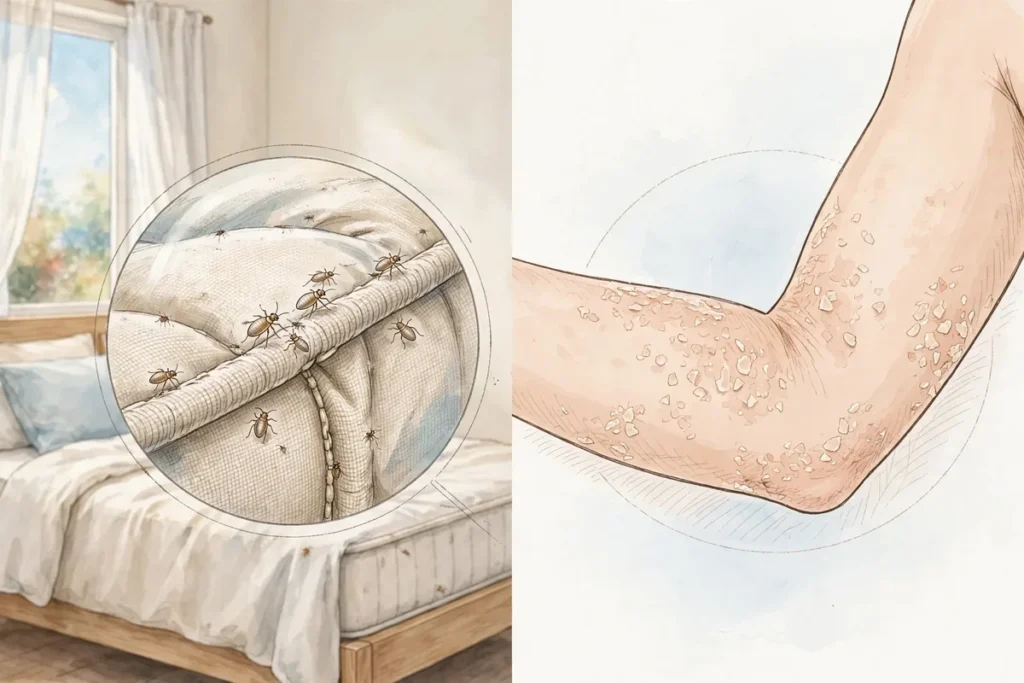
You wake up with itchy red marks, and the internet offers two suspects: bed bugs or eczema. The question of bed bug bites vs eczema is one of the most common skin puzzles people try to solve at home, and it is also one of the easiest to get wrong. One is an infestation that feeds on you at night; the other is a chronic inflammatory skin condition that flares for entirely internal reasons. Treating the wrong one wastes weeks, and in the case of bed bugs, those wasted weeks let the infestation grow.
The good news is that the two conditions leave different fingerprints. Bed bug bites arrive suddenly, cluster in lines or groups, and show up on exposed skin after sleep. Eczema is a long-running story of dry, scaly, inflamed patches that come and go over months or years. This article compares the pattern, timing, look, and feel of each, explains why the mix-up happens, and shows how dermatologists sort it out. Nothing here diagnoses you, only a clinician examining your skin can do that, but it will help you walk into that appointment with the right observations.
Both conditions produce red, itchy skin, and both can appear on the arms, neck, and torso. When bed bug bites are scratched, they can develop into excoriated, eczema-like patches. When eczema flares, it can produce raised, inflamed bumps that look bite-like. Add the fact that both can disturb sleep with itching, and you have a genuinely tricky differential, dermatology clinics see it regularly.
The confusion has a real cost in both directions. People with eczema sometimes tear their bedrooms apart hunting for bed bugs that are not there, spending money on exterminators and mattress encasements for a skin condition. People with bed bugs sometimes spend months applying eczema creams while the infestation grows, because each new crop of welts gets folded into the “my eczema is flaring” story. The harm angle of the second error is sharper: every week of misattribution is a week the bugs keep feeding and multiplying.
Bed bug bites are events. Something happened to you last night: insects emerged from hiding, fed for a few minutes, and retreated. The marks appear in crops, often overnight, on skin that was exposed during sleep. Eczema is a condition. It is your skin’s inflammatory response misfiring over time, with flares triggered by dry air, stress, irritants, sweat, or allergens. Events have a before and after; conditions have a history. When you frame the question as “did something happen to me, or is something happening in me,” the investigation gets much clearer.
Bed bug bites are the feeding marks of small, flat, oval insects that hide in mattress seams, box springs, bed frames, and nearby cracks by day and emerge to feed on sleeping people at night. A single bug typically feeds for three to ten minutes, and because bugs often get disturbed mid-feed, they bite, move a short distance, and bite again. That interrupted feeding is what creates the famous pattern: small red welts arranged in lines of three or in tight clusters, sometimes called the “breakfast, lunch, and dinner” sign.
The welts themselves are usually small, raised, reddish bumps, sometimes with a darker red spot in the center where the bite occurred. They itch, and the itch often starts hours after the bite, many people notice nothing at the moment of feeding and wake up to the marks. Reactions vary enormously between people: some develop large, dramatic welts, others get barely a pink dot, and a minority seem not to react at all. That variability is why “my partner has no marks” does not rule out bed bugs.
New marks that appear overnight or in the morning, on skin that was uncovered during sleep, face, neck, arms, hands, legs, fit the bed bug story. Bites rarely appear under tight clothing or pajamas, because the bugs feed on accessible skin. If the marks show up after travel, a hotel stay, or having guests, the timeline strengthens the case. Bed bug marks also tend to arrive in waves: a quiet week, then a fresh crop of welts, matching the bugs’ feeding cycle of every few days.
Eczema does not respect the sleep schedule this way. It flares when it flares, often in the same anatomical neighborhoods repeatedly over months, and it does not care whether you just got back from a hotel. A brand-new crop of welts the morning after a trip is a bed bug clue; a familiar patch flaring in its familiar spot is an eczema clue.
Individual bed bug welts are usually 2 to 5 millimeters across, raised, and redder than the surrounding skin. Scratching can enlarge them and create crusts. Unlike eczema patches, which are typically dry and scaly across a broader area, bite welts are discrete bumps with normal skin between them, at least until scratching merges them. The linear or clustered arrangement is the strongest visual hint: eczema distributes according to its own logic (more on that below), while bed bug bites map the bug’s interrupted walk across your skin.
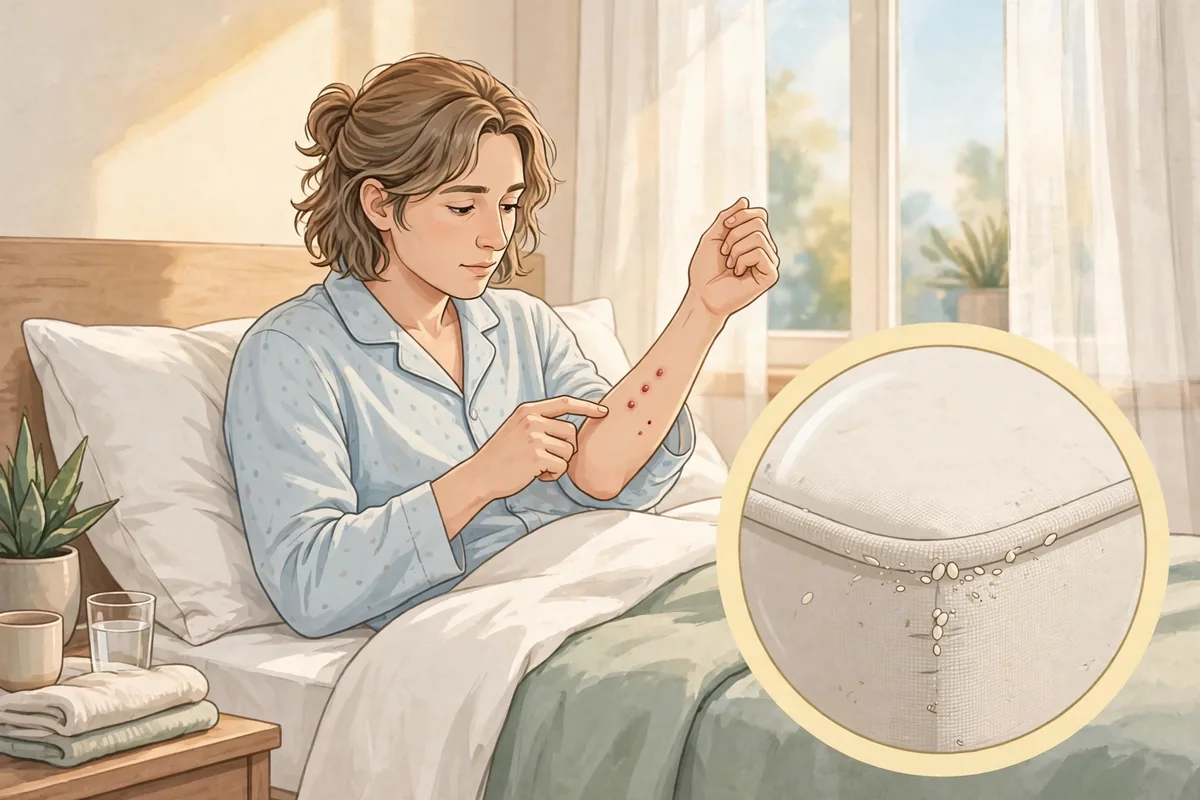
Eczema, most commonly atopic dermatitis, is a chronic inflammatory skin condition, often summarized as “the itch that rashes.” It usually begins in childhood but can start or persist in adults. The skin barrier does not hold moisture well, the immune system overreacts to triggers, and the result is dry, scaly, inflamed patches that itch intensely. Scratching damages the barrier further, which invites more inflammation: the classic itch-scratch cycle.
Eczema favors specific territories. In children, it loves the face and the outer elbows and knees; in adolescents and adults, it moves to the flexural surfaces, the insides of the elbows, behind the knees, the neck, wrists, and ankles. The patches are typically ill-defined areas of dryness, redness, and scaling rather than discrete bumps. Over time, chronic scratching thickens the skin into leathery plaques called lichenification. None of this matches the bed bug pattern of fresh, discrete welts appearing overnight on exposed skin.
Eczema flares follow triggers: dry winter air, harsh soaps, fragrances, sweat, stress, wool fabrics, and sometimes food or environmental allergens. Flares build over days and fade over days to weeks. They do not produce a new set of marks each morning. If your “bites” have been coming and going in the same spots for months, flaring when the weather turns dry or work gets stressful, you are looking at a condition with a history, not a nightly event.
Eczema travels with a recognizable entourage: a personal or family history of asthma, hay fever, or food allergies, the atopic triad. If you had eczema as a child, have seasonal allergies, and your parent has asthma, new itchy patches are likelier to be eczema returning than a first-ever bed bug encounter. Bed bugs, by contrast, have no respect for your medical history; they bite atopics and non-atopics alike. Your history is one of the first things a dermatologist will ask about, so having it ready helps.
| Feature | Bed Bug Bites | Eczema (Atopic Dermatitis) |
|---|---|---|
| Nature | Feeding marks from nocturnal insects | Chronic inflammatory skin condition |
| Onset | Sudden, new marks appear overnight | Gradual flares over days; history over months/years |
| Arrangement | Lines or tight clusters (“breakfast, lunch, dinner”) | Diffuse patches; favors flexural areas |
| Individual lesion | Discrete raised welts, often with central spot | Dry, scaly, ill-defined inflamed patches |
| Location | Exposed skin during sleep: face, neck, arms, hands | Flexures: inner elbows, behind knees, neck, wrists |
| Timing | Worse in the morning; waves every few days | Flares with triggers: dry air, stress, irritants |
| History | Often starts after travel or new exposure | Often childhood onset; atopic family history |
| Between episodes | Skin clears between waves of bites | Background dryness/sensitivity persists |
| Others affected | Household members may develop similar marks | Not contagious; family may share the tendency |
| What fixes it | Finding and eliminating the infestation | Long-term skin-barrier care, clinician-guided plan |

Honest medicine requires admitting the gray areas. Heavily scratched bed bug bites can lose their tidy linear pattern and look like excoriated eczema. Eczema with a bumpy, papular variant can look like a scattering of bites. Some people have both: eczema-prone skin that also gets bitten, with each problem amplifying the other. And bed bug bites on eczema-prone individuals can trigger a more dramatic inflammatory response that mimics a severe flare.
Secondary infection blurs things further. Both scratched bites and scratched eczema can develop crusting, oozing, and spreading redness that signal bacterial infection rather than the original condition. At that point the question stops being “bites or eczema” and becomes “infected or not,” which is a clinician’s call the same day.
Here is a specific mistake to avoid: using a steroid cream as a diagnostic test. The reasoning goes, “if the cream clears it, it must be eczema.” But steroid creams reduce inflammation from any cause, including bite reactions, so improvement proves nothing about the underlying condition, and meanwhile the bed bugs keep feeding. Conversely, if the marks keep coming despite the cream, people assume they need a stronger cream rather than considering bugs. Medication choices belong in a clinician’s plan for your specific case, not in a home experiment. If you are already using prescribed topicals, tell your dermatologist exactly what you have tried; that history is useful, but it is not a substitute for the inspection.
A dermatologist starts where you should too: the story. When did the marks start? Do new ones appear overnight? Any recent travel? Where exactly are they? What is your personal and family history of eczema, asthma, and allergies? What have you already tried? Bring photos with dates if you can, a time series of “new marks Monday morning, faded by Thursday, fresh ones Friday” is enormously informative.
The exam looks for the pattern logic described above: linear or clustered fresh welts on exposed skin versus chronic dry scaly patches in flexural distribution. The dermatologist will also look for the things you cannot see: with your permission, they may suggest you inspect the bed, because the tiebreaker in this differential is often not on the skin at all. Finding live bugs, shed skins, or dark fecal spotting in mattress seams settles the question faster than any skin exam. Our bite-sting clue checklist walks through what those signs look like.
Most of the time, history plus exam plus a bedroom inspection resolves it. Occasionally a dermatologist will take a small skin biopsy when the picture is genuinely ambiguous, the microscopic pattern of a bite reaction differs from eczema, or refer to an allergist if an atopic workup seems warranted. Do not be discouraged if the first visit ends with “let’s inspect the bedroom and follow up.” That is thorough medicine, not indecision. What you should not do is keep cycling through stronger creams while new morning welts keep appearing; that pattern deserves the infestation investigation.
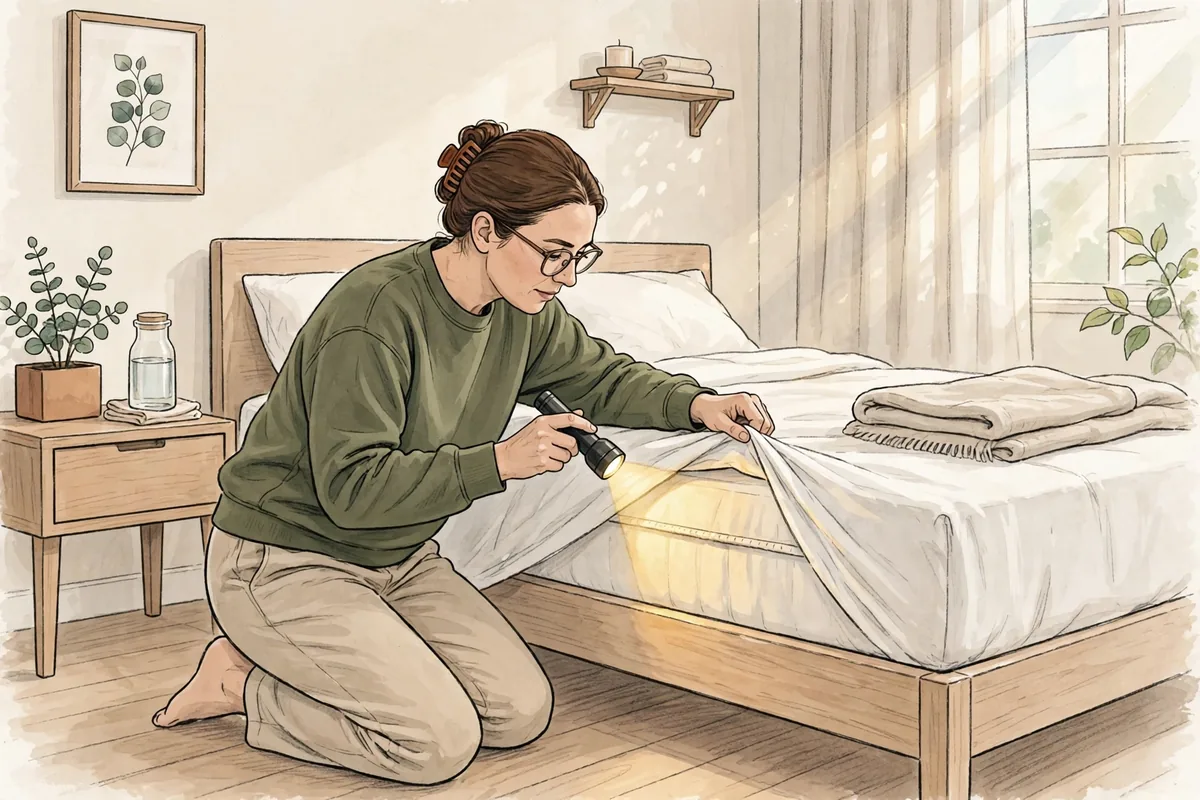
If the evidence points to bed bugs, the next move is inspection and elimination, not skin care. Pull back the sheets and check mattress seams, tufts, the box spring, bed frame joints, and the headboard with a flashlight. Look for live apple-seed-sized bugs, translucent shed skins, and clusters of dark ink-like fecal spots. Confirm before you treat: misidentifying carpet beetle irritation or flea bites as bed bugs leads to expensive, useless extermination, while confirmed bed bugs usually need professional treatment because DIY efforts scatter them deeper into hiding. For what the timeline of bite marks looks like while you sort this out, see how long insect bites last, and for keeping them out once handled, our home and yard bite prevention guide covers the practical steps.
If the evidence points to eczema, the next move is barrier repair and trigger management under a clinician’s guidance: gentle fragrance-free moisturizers applied to damp skin, lukewarm short showers, identifying personal flare triggers, and a treatment plan calibrated to severity. Eczema is managed, not cured, and the goal is fewer, milder flares, a completely different project from hunting insects. Either way, resist the urge to scratch: broken skin invites infection regardless of the cause, and our docs on not scratching bites explain why that rule is universal.
See a clinician promptly if you notice:
A dermatologist is the right specialist when the bites-vs-eczema question will not resolve. Bring your dated photos, your trigger notes, and a list of everything you have tried. If bed bugs are confirmed, the bugs get treated by a pest professional and the skin gets treated by your clinician, two separate jobs, both worth doing properly.
Can eczema look exactly like bed bug bites?
It can come close, especially the bumpy papular variant of eczema or heavily scratched bites that lose their pattern. The differentiators are timing and arrangement: bed bug welts arrive overnight in lines or clusters on exposed skin and come in waves, while eczema is a chronic story of dry, scaly patches in flexural areas with identifiable flare triggers. When the skin alone will not settle it, inspecting the mattress seams for bugs or fecal spotting is the tiebreaker.
I have eczema and now I have new welts. Can I have both?
Yes, and it is not rare. Eczema-prone skin can react more dramatically to bites, and having eczema does not protect you from bed bugs. The clue that something new has joined the picture is a change in the pattern: fresh discrete welts appearing overnight in lines, in places your eczema does not usually go, especially after travel. Mention both conditions to your dermatologist so neither gets treated in isolation.
Will eczema cream make bed bug bites go away?
Anti-inflammatory creams can calm the redness and itch of bite reactions temporarily, which is exactly why they are a misleading test. The welts fade, you conclude it was eczema, and the bugs feed again the next night. If new marks keep appearing in the morning despite treatment, stop escalating the cream and start inspecting the bed. Persistent new welts deserve an infestation check, not a stronger prescription.
Do bed bug bites leave scars like eczema can?
Both can leave temporary dark marks after healing, especially in darker skin tones, and both can scar if deeply scratched and infected. Bed bug welts themselves usually fade over one to two weeks without scarring if left alone. Eczema’s chronic scratching can thicken skin over time. The shared lesson is the same: do not scratch, keep nails short, and get infected-looking areas checked promptly.
How quickly should I see a dermatologist about this?
If you see linear or clustered welts appearing overnight, inspect the bed first and book a prompt appointment, a growing infestation is time-sensitive. If you have a stable, familiar eczema pattern, routine scheduling is fine unless it is spreading rapidly, oozing, or not responding to your usual plan. Any sign of infection or severe allergic reaction jumps the queue to same-day or emergency care.
Medically reviewed by Dr. Sarah Jones, MD.
This article is for informational purposes only and isn’t medical advice. If you’re worried about a bite or sting, talk to a healthcare professional.
Dr. Jones oversees StingHelp’s clinical verification process. Every guide is systematically evaluated against active Centers for Disease Control and Prevention (CDC), Environmental Protection Agency (EPA), and American Academy of Allergy, Asthma & Immunology (AAAAI) medical consensus standards to ensure symptom distinctions and care recommendations are clinically sound.
Explore physician-reviewed first-aid procedures, identification clues, and symptom comparisons for other common outdoor bites and stings.

Your child wakes up covered in itchy red spots and the questions start immediately: is this chickenpox vs bug bites, an allergic reaction, or…

Your child comes in from the yard clutching a caterpillar they thought looked cool, and now their hand is burning. Or you brush a…

For weeks, you have woken up with fresh, fiercely itchy bumps — around your waistband, across your abdomen, along your shoulders. You stripped the…