The Fall Chore That Meets Peak Wasp Season
October gutter cleaning puts you on a ladder, at eave height, with your hands in the exact places wasps nest, during the weeks when colonies are at their largest and most defensive. Wasp stings cleaning gutters fall incidents follow a painfully consistent pattern: a homeowner climbs up to clear leaves, bumps a paper wasp nest tucked under the gutter lip or disturbs yellowjackets nesting in a downspout elbow, and gets stung multiple times while trying to get down safely. Bald-faced hornet nests, which hang in trees all summer, only become visible when the leaves drop, so October is also when people discover large nests they never knew were there.
This guide explains why gutters attract wasps, how to inspect from the ground before you climb, ladder safety around nests, what to do if you are stung at height, and the prevention steps that keep next fall safer. One rule governs everything: never attempt to remove or spray a wasp nest while you are on a ladder.
Why Gutters Attract Wasps
Gutters and rooflines offer wasps nearly everything a colony needs.
Sheltered nest sites. Paper wasps build their open-comb nests under eaves, behind shutters, and along gutter lips, anywhere with an overhang that sheds rain. Cornell extension notes that aerial yellowjackets and bald-faced hornets also nest on eaves and in similar elevated spots. These sites are protected from weather and predators, which is why a single eave can host nests year after year.
Hidden entrances. Clogged gutters full of wet leaves create damp cavities and gaps that yellowjackets exploit. Downspout elbows and the gaps behind fascia boards make excellent concealed nest entrances. You may never see the nest itself, only the steady traffic of wasps coming and going.
The October reveal. Many large aerial nests are invisible all summer, hidden by foliage. When leaves fall, football-sized bald-faced hornet nests suddenly appear in trees near the house, and homeowners cleaning gutters find themselves working within feet of colonies they did not know existed. Pest professionals report this pattern every fall: people first notice the big nests only when the leaves come down.
Peak colony size. By October, surviving colonies are at maximum strength. A paper wasp nest holds its largest worker population, and defensive behavior peaks because the colony has the most to protect. Pest sources confirm that routine fall yard work, including ladder work, turns into sting emergencies when ladders bump low or hidden nests.
The combination is what makes gutter cleaning uniquely risky: height, hidden nests, peak colony size, and hands working inches from nest sites.
The Ground-First Inspection Routine
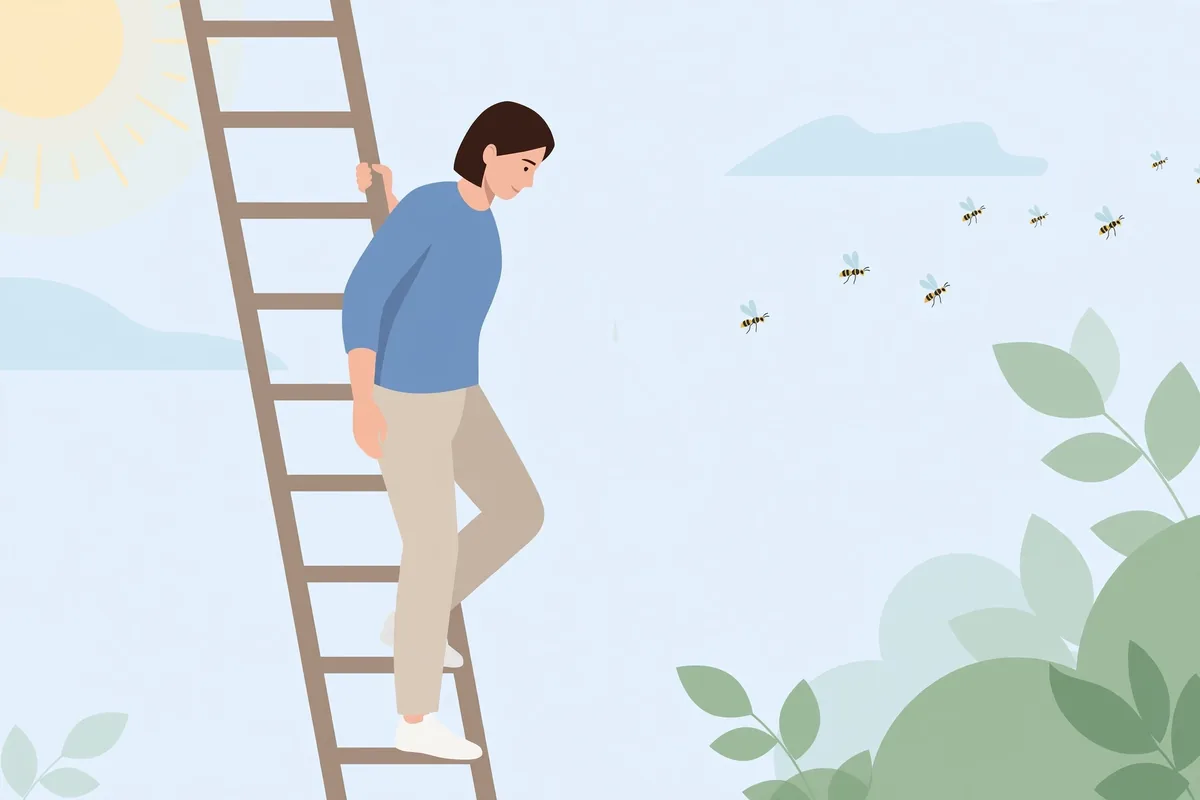
Never climb the ladder as your first step. Inspect from the ground, in daylight, before you touch a rung.
Watch the eave line for 10 minutes. Stand back and watch where wasps are flying. Foraging wasps fly straight, purposeful lines to and from the nest entrance. If you see repeated traffic converging on one spot under the gutter, behind a shutter, or at a downspout, there is a nest there. Note the exact location.
Inspect in the morning. Wasp activity is lowest in the cool early morning. Do your ground inspection then, and plan the actual gutter work for a cool morning too, when fewer foragers are active.
Look for the nest, not just the wasps. Scan under eaves, inside open downspout tops, behind shutters, and under deck rails near the house. Paper wasp nests look like small gray umbrellas of papery comb. Aerial yellowjacket and hornet nests are enclosed gray paper balls or teardrops.
Check the ground nests too. While you are looking up, watch where you step. Yellowjackets also nest in the ground, and the ladder’s feet may land near a ground entrance. A hole in the lawn with steady wasp traffic is a nest; mark it and keep the ladder and yourself well clear.
If you find an active nest near the gutters, stop. Do not clean those gutters yourself this season. Call a licensed pest professional to treat the nest first, then clean the gutters after the colony is eliminated. This is not overcaution; it is the correct sequence. A professional has protective equipment and the right products, and they work from the ground or with proper safety gear, not from a consumer ladder while holding a trowel.
Ladder Safety Around Wasp Territory
If your ground inspection finds no nests and no suspicious traffic, you can proceed, but treat the ladder work itself as wasp-aware.
Set the ladder securely and plan your retreat. Place the ladder on firm, level ground, extend it well past the gutter line, and know exactly how you will climb down quickly. In the unlikely event wasps appear, a panicked descent is how ladder falls happen, so rehearse the path in your head before you climb.
Work smoothly and quietly. Bumping the gutter, banging tools, or shaking the ladder is what disturbs hidden nests. Move deliberately. Keep tools in a bucket hung from the ladder rather than dropping them into the gutter.
Wear protective clothing. Long sleeves, long pants, closed shoes, and work gloves. Light-colored, smooth fabrics are less likely to trap a wasp than dark, textured ones. This will not make you sting-proof, but it reduces exposed skin.
Never spray a nest from a ladder. This is the critical safety rule. Spraying an active nest triggers a defensive swarm, and a swarm at ladder height leaves you with two emergencies: stings and a fall. If you discover a nest mid-job, climb down calmly and slowly, move away, and call a professional. Do not try to finish the gutters first.
Keep children and pets inside. Bystanders near the ladder base can get caught in a defensive swarm if a nest is disturbed. Clear the area before you climb.
Do not work alone if you have a sting allergy. If you carry an epinephrine auto-injector, make sure someone is home, knows where the injector is, and knows the signs of anaphylaxis. Better yet, hire the gutter cleaning out entirely.
What to Do If You Are Stung on the Ladder

Getting stung at height is frightening, and the fall risk can be worse than the sting. Priorities, in order:
Get down first. Descend the ladder as calmly and steadily as you can. Do not swat at wasps while on the rungs; flailing causes falls. Cover your face with your free hand if wasps are swarming it, and keep moving down.
Move away from the nest area. Walk briskly away from the house, ideally indoors or into a vehicle. Wasps defend a zone around the nest; leaving that zone usually ends the attack. Do not jump into water; wasps will wait.
Treat the stings. Once you are safe, clean each sting with soap and water and apply a cold compress. Wasps do not leave stingers behind, so there is nothing to remove. Our yellowjacket sting guide covers aftercare in detail.
Watch for multiple-sting effects. Several stings at once can cause nausea, headache, and widespread swelling even without an allergy. If you took many stings, call your doctor or urgent care for advice.
Call 911 for any anaphylaxis signs. Difficulty breathing, throat tightness, dizziness, fainting, or hives spreading across the body after a sting is an emergency at any height. If you carry epinephrine, use it. See our anaphylaxis warning signs so you can recognize the symptoms fast.
Prevention: Fewer Nests Next Fall
Gutter maintenance is wasp prevention, and spring work prevents fall emergencies.
Clean gutters in spring too. A spring cleaning removes the debris that makes gutters attractive nest sites and lets you spot early nest construction when colonies are tiny. A paper wasp nest the size of a golf ball in May is easy for a professional to handle; the same nest in October is a hazard.
Install gutter guards. Guards that keep leaves out also deny wasps the damp cavities they nest in. They do not eliminate eave nesting, but they remove one major attractant.
Seal gaps in fascia and soffits. Small openings behind gutters and under eaves are prime nest entrances. Caulk and screening in spring close off real estate before queens claim it.
Watch in early summer. Queens found new nests in spring. A few minutes of eave-watching in June tells you where colonies are starting, when they are still small enough for easy professional treatment.
Keep the professional’s number handy. If you find a nest during the season, the fastest safe path is a licensed pest pro, not a hardware-store spray and a ladder. The cost of a service visit is trivial compared to an ER visit after a ladder fall.
When to See a Doctor for a Sting

Get emergency care immediately if you experience:
- Signs of anaphylaxis: trouble breathing, throat tightness, dizziness or fainting, rapid pulse, swelling of the face or lips, or hives spreading beyond the sting sites. Call 911.
- A large number of stings at once, which can cause toxic systemic effects even in non-allergic people.
- A sting inside the mouth or throat, or a sting near the eye with significant swelling.
- Signs of infection in the days after stings: increasing pain, spreading redness, warmth, pus, or red streaks.
- Any fall or head strike that happened during the incident, even if you feel fine; ladder falls warrant evaluation.
For ordinary single stings with only local pain and swelling, home care with cold compresses and monitoring is usually sufficient. But never downplay a sting that happened at height; the combination of venom and a fall deserves a clinician’s judgment.
Frequently Asked Questions
Can I spray a wasp nest myself if it is small?
Small, early-season nests are sometimes treated by homeowners working from the ground, in the evening, with proper protective gear and a labeled wasp spray. But nests found during fall gutter cleaning are mature colonies at peak defensiveness, and anything involving a ladder should go to a professional. When in doubt, hire it out.
What time of day is safest for gutter cleaning?
Cool early mornings, when wasp activity is lowest. Avoid midday heat, when foraging peaks, and never work gutters at dusk near an active nest, since disturbed wasps will still defend it.
Do gutter guards stop wasps from nesting?
They help by keeping debris out of the gutter channel, removing one nest site. Wasps can still nest under eaves and behind fascia, so guards are one layer of prevention, not a complete solution.
Why are there suddenly wasps around my gutters in October?
Colonies are at peak size, leaves are falling and revealing hidden nests, and workers are aggressively foraging. Your gutters were probably hosting or neighboring a colony all summer; October is just when you notice.
I found a huge hornet nest in a tree while cleaning gutters. What now?
Leave it alone and keep everyone away. Bald-faced hornet nests are most defensive in fall. Call a pest professional; do not attempt to knock it down or spray it yourself, especially from a ladder or with a pole.
Medically reviewed by Dr. Sarah Jones, MD.
This article is for informational purposes only and isn’t medical advice. If you’re worried about a bite or sting, talk to a healthcare professional.