
Sunscreen or Bug Spray First? Correct Order (CDC)
It is the most common summer layering question in America: sunscreen or bug spray first? Get the order wrong and you either dilute your…
Every summer, a new "hack" makes the rounds: skip the bug spray, just slick on baby oil. This year's version blew up on TikTok, with hundreds of thousands of likes…

Every summer, a new “hack” makes the rounds: skip the bug spray, just slick on baby oil. This year’s version blew up on TikTok, with hundreds of thousands of likes and a thousand-comment thread of believers calling a baby product their “holy grail” mosquito solution. It’s cheap, it’s already in the house, it smells like childhood — and it feels gentler than anything from the repellent aisle.
Does baby oil repel mosquitoes? No. Baby oil is mineral oil with fragrance — it contains no EPA-registered repellent ingredient, has no proven ability to keep mosquitoes from biting, and using it outdoors carries a genuine sunburn risk on top of the false confidence. The viral trend is a myth with a sunburn chaser.
This article traces where the trend came from, explains why oil can’t function as a repellent, lays out the little-discussed UV danger, and points you to the protection options that actually work — including the safest picks for kids.
Let’s put it plainly: baby oil does not repel mosquitoes in any meaningful, reliable sense. For a product to be a mosquito repellent in the United States, it goes through EPA registration — standardized testing of whether it actually keeps mosquitoes from biting, for how long, and at what dose. Baby oil has never been through that process because it’s not a repellent; it’s a skin moisturizer made mostly of mineral oil.
That doesn’t mean nobody has ever sat outside greased up and gotten fewer bites. Anecdotes cluster around the trend for ordinary reasons: people apply it in the evening when mosquito pressure is already falling, or they sit on a breezy patio, or they simply don’t notice the bites they do get. Without controlled testing, personal stories can’t distinguish “it worked” from “nothing would have bitten me anyway.” The plural of anecdote is not data — and in this case, the data we do have points the other way.
The deeper problem isn’t just that baby oil fails to protect. It’s that believing you’re protected changes behavior: you skip real repellent, stay out longer at dusk, and in sunny settings you add a sunburn accelerator to the mix. A useless repellent you trust is worse than no repellent at all, because at least with no repellent you know you’re exposed.
The current wave traces to TikTok, where a creator’s video recommending Johnson’s baby lotion as a mosquito solution collected well over 200,000 likes and more than a thousand comments from enthusiastic followers. Here’s the detail most reposts leave out: the video is actually about the brand’s aloe baby lotion — and the creator explicitly said she had tried the aloe baby oil and other versions without getting the same results. The internet flattened “this specific lotion seemed to help me” into “baby oil repels mosquitoes,” which isn’t even what the original video claimed.
An older, separate thread comes from Caribbean and tropical travel forums, where visitors have long discussed baby oil as a barrier against no-see-ums — tiny biting midges, not mosquitoes. The theory is purely physical: coat the skin in oil and the minuscule biters can’t get through the slick layer to bite. Some travelers swear by it for sand flies on the beach. Even if there’s a grain of truth for near-microscopic midges in a thick oil layer, it doesn’t transfer to mosquitoes, which are far larger, stronger, and bite through the oil film without difficulty.
Both threads share the same flaw: no controlled testing, no identified active mechanism against mosquitoes, and enthusiastic testimonials doing the work that evidence should do. A product going viral is a measure of marketing dynamics, not of efficacy.
Real repellents work through chemistry that mosquitoes’ senses can’t ignore. DEET, picaridin, IR3535, and oil of lemon eucalyptus each interfere with the olfactory receptors mosquitoes use to detect carbon dioxide, lactic acid, and skin odors — they jam the guidance system. Baby oil contains none of these and nothing like them. Mineral oil is essentially odorless to a mosquito’s purposes; it doesn’t mask your CO2 plume, doesn’t confuse host-seeking, and doesn’t taste bad to a biting insect.
The “barrier” theory fails on physics too. A wiped-on layer of baby oil is micrometers thin — it doesn’t form a meaningful physical obstacle to a mosquito’s piercing mouthparts, which evolved to punch through animal hide. Mosquitoes routinely bite through thin clothing; a film of mineral oil is nothing to them. And unlike a true repellent, which keeps working as long as the active ingredient persists at effective concentration, oil just sits there being slippery — it rubs off on clothes, sweats off, and washes off, with no active chemistry doing any work at any point.
There’s also a regulatory signal worth heeding: if mineral oil repelled mosquitoes, repellent manufacturers — who compete fiercely on efficacy claims — would have registered and marketed it decades ago. The absence of any EPA-registered mineral-oil repellent, in a market worth hundreds of millions, tells you what the testing showed. When an entire industry leaves an idea on the table, it’s usually because the idea doesn’t work.
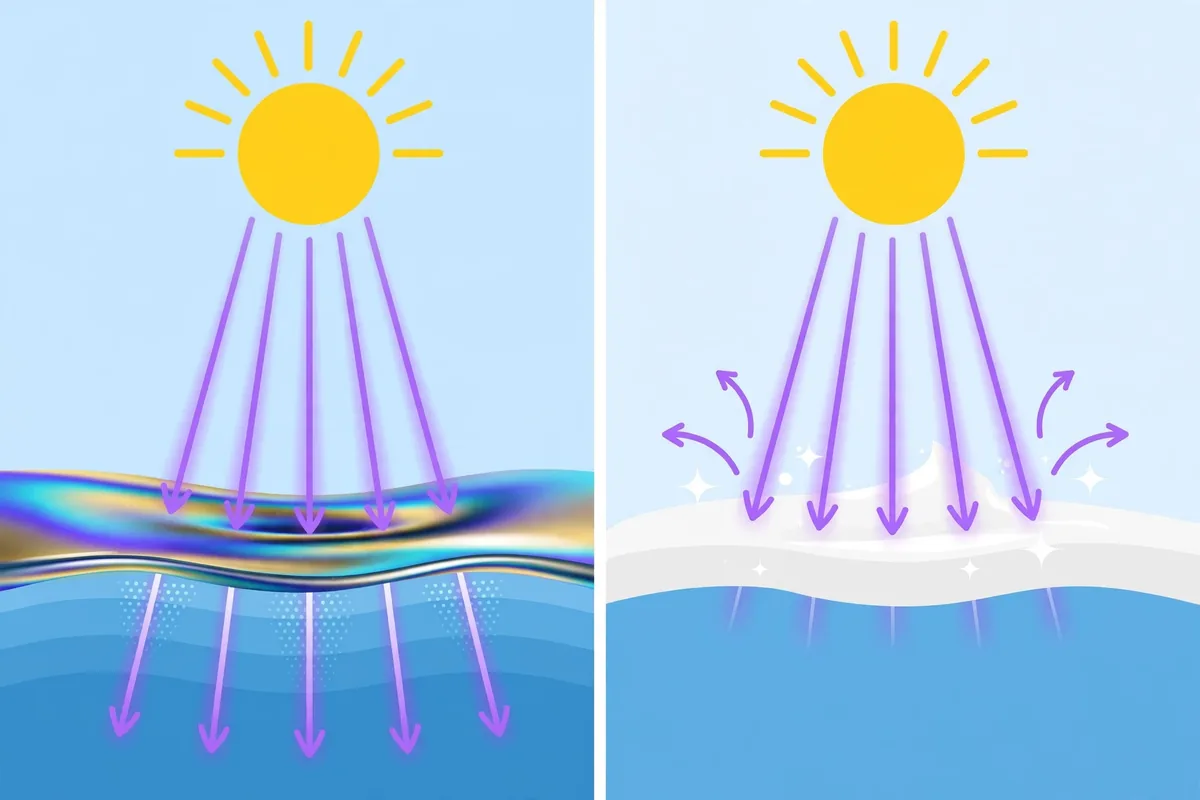
Here’s the risk the TikTok comments don’t mention: baby oil on skin in sunlight accelerates burning. Dermatologists have warned about this for years, and the mechanism is well understood. Your skin’s outer layer of dead cells has a high refractive index — it reflects a meaningful share of incoming ultraviolet. Oil lowers that refractive index, letting more UV penetrate instead of bouncing off. As board-certified dermatologist Dr. Elizabeth Hale, a senior vice president of the Skin Cancer Foundation, has noted, tanning oils effectively attract UV to the skin — accentuating tans, but also deepening burns and raising the risk of both melanoma and non-melanoma skin cancers.
Translation: baby oil is effectively a tanning accelerant with zero SPF. Baby oil offers no UV protection whatsoever while actively increasing the UV dose your skin receives. Using it as a daytime “repellent” at the beach or pool — exactly where the no-see-um forum advice suggests it — combines zero bite protection with amplified sun damage.
This is the rare case where the hack is worse than doing nothing. Plain unprotected skin at least burns at its natural rate; oiled skin burns faster. If you’re applying baby oil before sun exposure for any reason, stop — use a proper broad-spectrum sunscreen instead, and handle mosquitoes with a real repellent. The two products solve two different problems, and neither substitutes for the other.
Beyond the twin failures of no repellency and extra sunburn, baby oil brings a handful of lesser drawbacks that add up. It’s comedogenic for many people — the occlusive mineral-oil film traps sweat, bacteria, and sunscreen against the skin, which can trigger breakouts and heat rash in warm weather, exactly when you’d be using it. It transfers to everything: clothes, car seats, patio furniture. And on children, an oil-slicked kid is a slipping, staining, sunburn-prone kid with no actual bite protection.
There’s also the disease-risk dimension. In areas with West Nile virus, dengue, or Zika activity, repellent isn’t cosmetic — it’s the primary personal defense public health authorities recommend. Substituting an unproven oil for a registered repellent in those settings isn’t just ineffective; it discards the one layer of protection backed by testing. A fan on the patio, protective clothing, and dumping standing water all help — see our home and yard bite-prevention guide for the indoor side — but none of them replaces repellent where disease circulates.
Finally, a note on the “natural is safer” instinct driving much of this trend’s appeal. Baby oil isn’t meaningfully “natural” — it’s a petroleum derivative — and the instinct misfires in both directions: it overestimates the danger of tested repellents and underestimates the danger of untested hacks. Safety comes from evidence and registration, not from a nursery-shelf aesthetic.
The good news: effective protection doesn’t require anything exotic. EPA-registered repellents with DEET, picaridin, IR3535, or oil of lemon eucalyptus have standardized, verified protection times measured in hours, not wishful minutes. Picaridin is odorless and non-greasy if you dislike DEET’s feel; oil of lemon eucalyptus is the plant-based option with genuine CDC-recognized performance. Any of them beats baby oil by orders of magnitude — because any real number beats zero.
For children and pregnancy, the safety picture for registered repellents is reassuring when labels are followed — and far better than the alternative of unprotected bites. Our guide to insect repellent safety for children and pregnancy walks through age-appropriate choices, and if a bite happens anyway, keep the area clean, avoid scratching, and ask your doctor about pregnancy-safe relief options.
Pair repellent with the free layers: run a fan on the patio to shred your CO2 plume, wear light long sleeves at dusk, and time outdoor plans away from peak biting hours. That’s a complete, honest protection stack — no viral hacks required.
Most mosquito bites resolve on their own, but get medical care if you notice:
Does baby oil repel mosquitoes?
No. Baby oil is mineral oil with fragrance — it contains no EPA-registered repellent ingredient and has no proven ability to prevent mosquito bites. The viral trend is based on testimonials, not testing.
But the TikTok video had hundreds of thousands of likes — doesn’t that mean it works?
Popularity measures virality, not efficacy. Notably, the original viral video was about a specific baby lotion, and the creator said the baby oil version didn’t work as well for her — a detail lost as the claim mutated into “baby oil repels mosquitoes.”
Can baby oil work as a barrier against no-see-ums?
Some travelers report that a thick oil layer deters tiny biting midges on beaches, but this is anecdotal and doesn’t transfer to mosquitoes, which easily bite through thin oil films. It also does nothing about the sunburn risk.
Is it dangerous to wear baby oil in the sun?
It increases risk. Oil lowers your skin’s refractive index so more UV penetrates, accelerating burning and raising skin cancer risk — with zero SPF protection. Dermatologists advise against using baby oil for tanning or sun exposure.
What’s safe to use on kids instead?
EPA-registered repellents used according to the label — see our repellent safety guide for children and pregnancy. For babies under two months, physical barriers (nets, clothing) are the recommended route rather than any repellent.
Medically reviewed by Dr. Sarah Jones, MD.
This article is for informational purposes only and isn’t medical advice. If you’re worried about a bite or sting, talk to a healthcare professional.
Dr. Jones oversees StingHelp’s clinical verification process. Every guide is systematically evaluated against active Centers for Disease Control and Prevention (CDC), Environmental Protection Agency (EPA), and American Academy of Allergy, Asthma & Immunology (AAAAI) medical consensus standards to ensure symptom distinctions and care recommendations are clinically sound.
Explore physician-reviewed first-aid procedures, identification clues, and symptom comparisons for other common outdoor bites and stings.
It is the most common summer layering question in America: sunscreen or bug spray first? Get the order wrong and you either dilute your…

If you spend warm evenings dodging mosquitoes on your patio, the promise sounds irresistible: hang a wooden box on a pole, bats move in,…

You've probably seen the video: someone pours coffee grounds into a jar, lights them, and claims mosquitoes vanish for hours. It looks like the…