If you just moved to Texas, Louisiana, Florida, Georgia, Alabama, Mississippi, or the Carolinas, here is the safety briefing nobody gave you at the closing table. Fire ants build distinctive mounds in lawns, parks, playgrounds, and campgrounds across the South, and stepping on a mound can mean dozens of painful stings within seconds. Texas A&M AgriLife runs annual fire-ant awareness campaigns for a reason: newcomers encounter these insects for the first time every year, and the first encounter is usually the worst one.
The essentials of fire ant safety newcomers moving to the South need to know: learn what a mound looks like, never disturb one, wear closed shoes on grass, supervise small children outdoors, and if you do get stung — remove the ants, cool the skin, and leave the resulting blisters alone. Most stings are painful but manageable at home; a small minority of people have severe allergic reactions, and knowing the warning signs is the part that can save a life.
This guide is your orientation: what fire ants are, how to spot a mound, what happens when you get stung, first aid that actually helps, the red flags for allergic reactions, and the everyday habits that make fire ant country livable.
Your First Fire Ant Lesson: What They Are and Where They Live
The insect in question is the red imported fire ant, Solenopsis invicta — an invasive species accidentally introduced through the port of Mobile, Alabama, in the 1930s, now established across the southern tier of the country. If you moved from the Northeast, Midwest, or West Coast, you have likely never dealt with them; the ants in your old yard did not behave like this.
What makes fire ants different is their defensive behavior. When a mound is disturbed — a footstep, a lawn mower, a curious child’s stick — workers swarm out by the hundreds, climb onto the intruder, and sting in a coordinated attack. Each ant grips the skin with its jaws, then stings repeatedly. The venom produces the signature burning sensation — the “fire” in the name — followed by a distinctive skin reaction.
How to Spot a Mound Before You Step in One
Mound recognition is the single most valuable fire ant skill, and it takes about thirty seconds to learn:
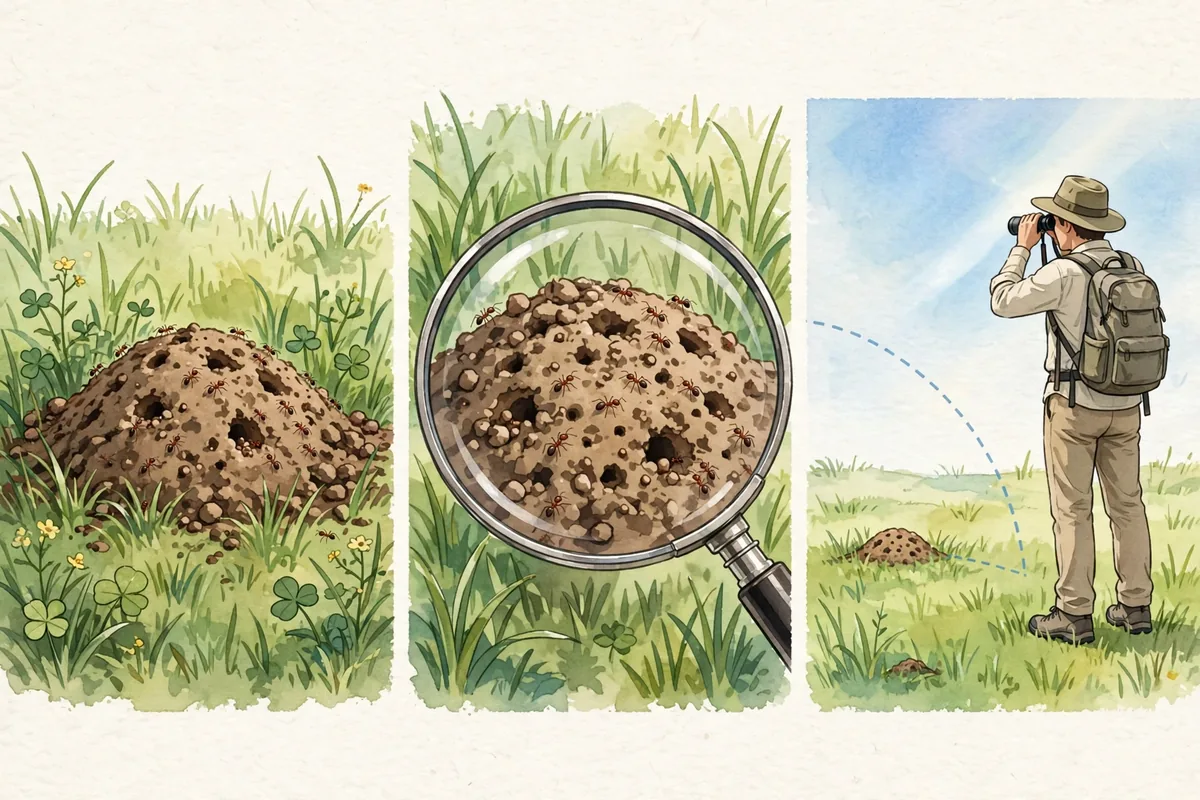
Shape and texture. Fire ant mounds are fluffy, irregular piles of excavated soil — no central entrance hole on top, which distinguishes them from many other ant mounds. After rain, fresh mounds are especially obvious; in dry spells they flatten and blend in, so stay alert in all weather.
Size and location. Mounds range from a few inches to over a foot across. They favor open, sunny areas: lawns, pastures, playground edges, sidewalk strips. They also appear in less obvious spots — under landscape timbers, at tree bases, along fence lines, in potted plants and mulch beds. Check before you sit, kneel, or let children play.
Activity. On a warm day you may see workers streaming over the surface. Do not poke the mound to check — disturbing it triggers the defensive swarm. Observe from a few feet away. If you are unsure whether a dirt pile is a fire ant mound, treat it as one.
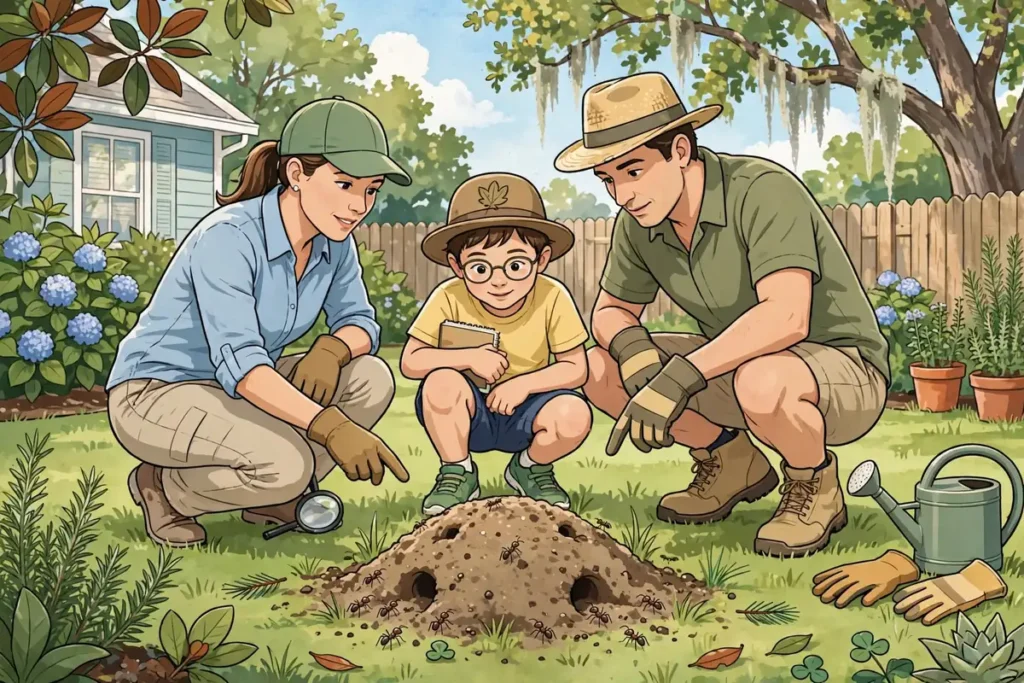
Teach the whole household. Children are the most frequent victims: they play on the ground and investigate interesting dirt piles. Show kids what mounds look like, set the rule — never touch, poke, or step on a mound — and supervise outdoor play in unfamiliar yards and parks until the habit is set.
What about the yard? You cannot fire-ant-proof the outdoors, but you can reduce mound density. Texas A&M AgriLife’s extension guidance describes the standard approach: broadcast bait products applied when ants are actively foraging, which workers carry back to the colony, plus individual mound treatments for high-traffic areas. Baits work slowly — they are colony killers, not instant knockdown. Follow every label exactly, keep children and pets off treated areas until the label says it is safe, and consider coordinating with neighbors, since colonies re-invade from untreated adjacent yards.
What Happens When You Get Stung
Knowing the timeline takes the fear out of it — and stops you from making the classic newcomer mistake. Here is the normal course of a fire ant sting:
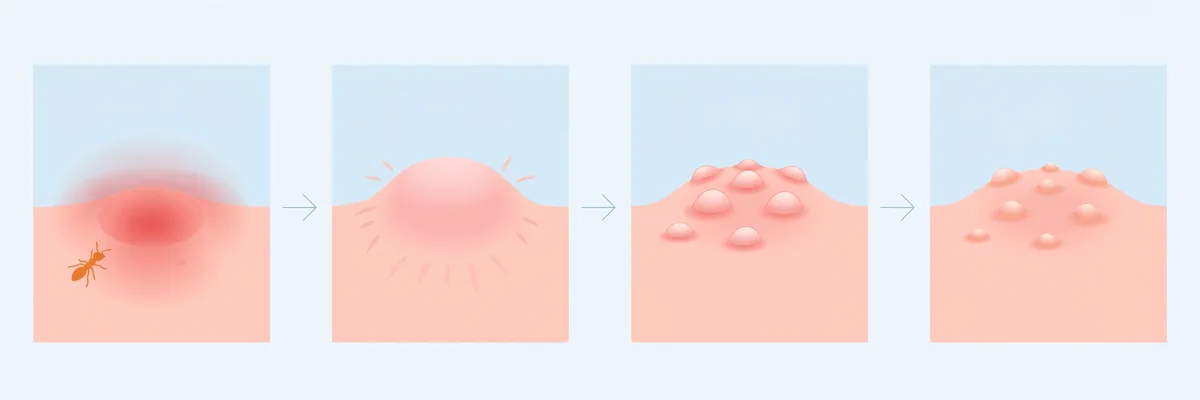
Immediately: sharp burning pain. The sting feels like a hot needle prick. Intense pain typically lasts five to ten minutes, then eases. If you stepped on a mound, you may have dozens of stings — get away from the mound first, deal with the pain second.
Within minutes to hours: redness and swelling. Each sting site becomes a red, raised welt. Swelling from the venom can increase for up to 24 hours. This is a normal venom reaction, not an infection.
Within 24 hours: the pustule forms. This is the hallmark of a fire ant sting — a small white blister at each sting site. It looks like a whitehead, and every newcomer asks: is it infected? No. The pustule is a sterile reaction to the venom itself. It is supposed to look like that.
Days 3 to 7: drying and scabbing. Left alone, the pustules dry up — typically within about four days — and form small scabs. Itching is the main symptom and can persist for a week or longer. Up to two weeks: healing. The scabs fall off; some people are left with small dark spots that fade over weeks.
The critical rule: do not pop, squeeze, or scratch open the pustules. Breaking them converts a sterile venom reaction into an open wound vulnerable to bacterial infection. If a pustule breaks on its own through friction, keep it clean and covered. Our fire ant sting pustules guide covers this in detail.
First Aid That Actually Helps
1. Get away and get the ants off. Move away from the mound immediately. Remove ants still on your skin individually, with your hand or a cloth — do not brush with sweeping motions, which agitates them into stinging more.
2. Wash the area with soap and water.
3. Cold compress. Apply a cold pack or ice wrapped in cloth to reduce pain and swelling. The most effective immediate comfort measure, with no downside.
4. Manage itching. Over-the-counter options used as their labels direct — oral antihistamines for itching, hydrocortisone cream for local inflammation — are the standard recommendations.
5. Leave the pustules alone. Restated because it is the step everyone wants to skip: do not open them, do not scratch them, and wear loose clothing if friction is breaking them.
6. Watch the timeline. Normal: pain fades in minutes, itching peaks over days, pustules dry within about four days, full resolution in one to two weeks. Abnormal: redness expanding after 48 hours, increasing warmth or swelling, pus, red streaks, or fever — see a doctor.
Multiple Stings and Allergic Reactions: Know the Red Flags
Two situations turn a routine encounter into a medical matter: a very large number of stings, and an allergic reaction.
Multiple stings. Stepping on a mound often means dozens of stings. Even without allergy, many stings at once can cause significant swelling, nausea, and dizziness. Children and older adults are generally considered at higher risk. Anyone who takes many stings should be monitored and evaluated medically if symptoms go beyond local pain and itching.
Allergic reactions. A small fraction of the population is allergic to fire ant venom, and for these individuals stings can trigger anaphylaxis. Warning signs mirror bee and wasp allergies: difficulty breathing or throat tightness, swelling of the face, lips, or tongue, widespread hives, dizziness or fainting, nausea, and a sense of impending doom. If any appear after fire ant stings, call 911 immediately. If the person has an epinephrine auto-injector, use it without waiting to see whether symptoms worsen.
The newcomer-specific risk: you may not know you are allergic until the first sting. Severe reactions are uncommon, but after any first-time multiple-sting event, watch for systemic symptoms for at least an hour and make sure someone else knows what happened. With any history of severe insect-sting reactions, talk to an allergist about testing and carrying epinephrine — before your first barefoot walk across a southern lawn, not after.
Everyday Habits for Fire Ant Country
Footwear. Closed shoes on grass, always — including quick trips to the mailbox and letting the dog out. Flip-flops and bare feet are the classic newcomer error.
Scan before you sit or stand still. Before spreading a picnic blanket or releasing kids onto a playground, do a ten-second mound check. It becomes automatic.
Yard work with awareness. Closed shoes, socks, and gloves for gardening and mowing. Check the work area for mounds before starting equipment — mowers and string trimmers are premier mound-disturbing devices. Treat or flag mounds in the work zone before proceeding.
Supervise and teach children. The rules: closed shoes outside, never touch dirt piles, tell an adult about any mound, come inside immediately if ants are on you. Rehearse the “ants on me” response — stand still, call for help, let the adult remove them.
Protect pets. Keep dogs from digging in unfamiliar dirt, check paws and faces after outdoor play in new areas, and ask your veterinarian about ant-sting distress signs.
Seasonal awareness. Fire ants are active whenever temperatures are mild — in the Deep South, much of the year. They forage most actively in spring and fall and retreat deeper underground during the hottest afternoons and cold snaps.
Millions of people live, work, and play in fire ant country without incident. The difference between a newcomer who gets stung repeatedly and one who does not is rarely luck — it is footwear, attention, and the ten-second mound check.
When to See a Doctor for a Bug Bite

Most fire ant stings heal without medical care. Contact your healthcare provider if:
- Redness keeps expanding more than 48 hours after the sting
- Broken pustules develop pus, worsening pain, or red streaks
- Swelling is extreme or spreads well beyond the sting site (for example, past the wrist or ankle)
- Itching is severe and not relieved by over-the-counter measures used as directed
- You have any history of severe insect-sting reactions — discuss an allergy action plan with your doctor
Call 911 immediately for any anaphylaxis signs: difficulty breathing, throat tightness, facial or lip swelling, widespread hives, dizziness, or fainting after a sting. The full emergency signs are in our anaphylaxis sting warning signs guide.
Frequently Asked Questions
I just moved to Georgia and found dirt mounds in my yard. Are they fire ants?
Quite possibly. Fire ant mounds are fluffy, irregular piles of loose soil with no central entrance hole, usually in sunny open areas. Do not poke the mound to test it — observe from a few feet away on a warm day for ant activity. Your county extension office can confirm identification from a photo.
Should I pop the white blisters from fire ant stings?
No. The pustules are a sterile reaction to the venom, not an infection — popping them creates an open wound and invites bacterial infection. Leave them alone; they dry up on their own, usually within about four days. If one breaks accidentally, keep it clean and covered.
Are fire ant stings dangerous to dogs?
They can be, especially for small dogs that disturb a mound. Signs include sudden yelping, pawing at the face, and swelling. Move the dog away from the area, brush the ants off, and call your veterinarian for many stings or any breathing difficulty.
Can you get rid of fire ants in your yard permanently?
Not permanently — the honest answer extension services give. Bait products suppress colonies and mound treatments handle hot spots, but re-invasion from neighboring untreated areas is constant. Think ongoing management, like mowing: a spring bait application plus spot treatments through the season keeps populations livable. Coordinating with neighbors improves results for everyone.
Medically reviewed by Dr. Sarah Jones, MD.
This article is for informational purposes only and isn’t medical advice. If you’re worried about a bite or sting, talk to a healthcare professional.