Insomnia May Blunt the Brain’s Ability to Learn a Threat Is Gone: Study
For many people who live with insomnia, the hardest part of the night is not only falling asleep. It is the feeling that the mind stays on alert long after the day is over. A small worry from earlier in the day can keep replaying, a sound in the house can feel larger than it is, and the body can feel tense even when nothing dangerous is happening. A new study published in October 2026 suggests there may be a measurable reason why that alert feeling can be so hard to switch off, and why learning that something is safe again may work differently when sleep is disrupted.
The study, published on October 14, 2026, in PLOS Mental Health, is titled “Disrupted fear regulation in insomnia disorder revealed by arousal estimation from skin conductance.” Its lead author is Tianyu Hwang, and its co-authors include Dr. Edward Pace-Schott, Dr. Ryan Bottary, and Dr. Saman Khazaei. The senior author is Dr. Rose Faghih. The researchers studied 24 adults with insomnia and 24 good sleepers, a total of 48 people, and used a new way of reading signals from skin conductance, the tiny changes in sweat activity on the skin, to estimate arousal during a fear-learning task.
The central finding was not that people with insomnia simply felt more stressed at every moment. In fact, the pattern was more specific, and more interesting. When the task moved from learning a fear association to learning that the association no longer applied, the average high-arousal index increased in people with insomnia, while it slightly decreased in good sleepers. That difference was detected only when the researchers included a particular part of the skin-conductance signal, known as the tonic background signal, in their model. Other differences in the same direction, including lower average arousal during the first fear-learning phase and higher average arousal when fear and safety memories were recalled on a second day, did not reach statistical significance in this study.
This article explains what the researchers did, what they found, what they did not find, and what their interpretation does and does not mean for everyday life. It is educational information, not medical advice, and it does not offer a diagnosis or a treatment recommendation for any individual reader.
Why Fear Learning Matters for Sleep and Anxiety
Learning about threat and safety is something the brain does every day, often without conscious effort. A person learns, for example, that a particular street is busy at rush hour and quiet later, that a dog behind a fence is loud but contained, or that a presentation that once felt frightening went well in the end. Over time, the brain updates its predictions. When an old warning no longer applies, the healthy response is to gradually let go of the alarm.
Scientists call the first part of this process fear conditioning. A neutral stimulus, something that starts out harmless, becomes linked in the mind with an unpleasant event. The second part is called extinction learning. During extinction, the same stimulus appears again, but the unpleasant event does not follow. With repetition, the brain can learn a new, competing memory: this stimulus is now safe. A third part, tested later, is recall. After time has passed, does the brain remember the original fear, the newer safety learning, or some mixture of the two?
These processes matter for anxiety because many anxiety-related difficulties involve a safety memory that does not hold as strongly as the fear memory. A person may know, rationally, that a situation is safe, and still feel a surge of arousal when they encounter it. That gap between knowing and feeling is familiar to many people who live with both poor sleep and anxiety, and it is one reason researchers study fear regulation in insomnia.
The Link Between Insomnia and Hyperarousal
Insomnia is often described as difficulty falling asleep, staying asleep, or waking too early and being unable to return to sleep, together with daytime effects such as fatigue, low mood, or difficulty concentrating. But researchers also study a feature called hyperarousal. Hyperarousal means the body’s alert systems stay more active than usual, even at times when rest would be expected. It can show up as a racing mind, muscle tension, a faster heartbeat, or a feeling of being wired and tired at the same time.
Hyperarousal is relevant to fear learning because learning that something is safe may require the arousal system to settle. If arousal stays high, the brain may have a harder time registering the new information that the threat has passed. The authors of the new study offer this as an interpretation of their results, not as a proven fact about every person with insomnia. They suggest that hyperarousal may oppose learning that a stimulus has become safe, and that this may help explain a pattern seen in other research: anxiety treatments based on exposure, in which a person gradually faces a feared situation in a safe setting, tend to work better in people with good sleep.
That interpretation should be read carefully. The study itself did not test exposure therapy, did not compare treatment outcomes, and did not show that improving sleep would change fear learning for a particular person. It studied a laboratory task in a small group and found an association between insomnia and a particular pattern of arousal during that task. Associations of this kind can point researchers toward useful questions, but they do not, on their own, prove cause and effect.
What Skin Conductance Can, and Cannot, Tell Us
Skin conductance is a measure of how well the skin conducts a tiny electrical current, which changes with sweat gland activity. Even when a person does not notice sweating, small fluctuations can reflect activity in the sympathetic nervous system, the branch of the nervous system involved in alertness and stress responses. For that reason, skin conductance has long been used in psychology and neuroscience laboratories as a window into arousal.
What was new in this study was the way the researchers read that window. Rather than relying only on the most obvious spikes in the signal, they used what they describe as sympathetic arousal virtual sensors, based on microfluctuations in sweat activity. In plain language, they used a mathematical model to estimate underlying arousal from very small, detailed changes in the skin-conductance trace. The researchers compared models with and without a tonic component, the slower, background level of the signal, as distinct from faster, event-related changes.
That detail turned out to matter. Only the model that included the tonic background signal detected a significant group difference in how the high-arousal index changed from conditioning to extinction. This does not mean the other models were wrong, and it does not mean skin conductance is a diagnostic test for insomnia or anxiety. It means that, in this dataset, the background level carried information that the faster changes alone did not. Future work would need to test whether the same approach holds in larger groups, in different laboratories, and in everyday settings before any broader conclusion could be drawn.
What the Study Did
The study recruited two groups of adults: 24 people with insomnia disorder and 24 good sleepers. Both groups took part in a laboratory task spread over two days. On the first day, participants were temporarily conditioned to fear a visual stimulus. The stimulus was paired with a mild shock, so that the brain began to associate the image with an unpleasant outcome. Later on the same day, participants went through extinction learning, in which the same stimulus appeared without the shock, giving them the chance to learn that it was no longer dangerous.
On the second day, fear and safety memories were recalled. Participants were exposed again to the relevant stimuli, and the researchers examined whether the fear association, the safety learning, or both were evident in their arousal patterns. Throughout the task, skin conductance was recorded, and the researchers applied their arousal-estimation models to the signal.
The use of a mild shock in a laboratory fear-conditioning task is a standard research method. It is designed to create a temporary, controlled association that can be studied and then extinguished, and it is not the same as a real-world traumatic experience. The value of the method is that it lets researchers observe learning and unlearning under controlled conditions, where the timing and the stimuli are known. The limitation is that laboratory learning is simpler than the complex, personal fears people face in daily life.
A Closer Look at the Task, Day by Day
Day one had two main phases. In the conditioning phase, the visual stimulus and the mild shock were paired, establishing the fear association. In the extinction phase, the stimulus was presented without the shock, so participants could begin to learn that the danger had passed. The researchers were especially interested in the change between these two phases, because that change captures whether arousal settles as safety learning takes place, stays the same, or rises.
Day two focused on recall. After a night had passed, the researchers tested which memory appeared stronger: the original fear memory or the newer safety memory. This second-day test is important because sleep itself is thought to play a role in consolidating memories, including emotional memories. By testing on a second day, the study could look beyond immediate learning and ask what remained after time had passed.
It is worth noting what the study did not include. It did not follow participants for weeks or months, did not test a sleep intervention, and did not measure real-world anxiety symptoms in daily life over time. Its strength is the detailed, moment-by-moment arousal measurement during a controlled task. Its scope is deliberately narrow, and that narrowness is part of why its findings should be seen as a step in a longer research process rather than a final answer.
What the Researchers Found
The headline result concerns the change from conditioning to extinction. In the insomnia group, the average high-arousal index increased across that transition. In the good-sleeper group, the same index slightly decreased. The researchers found this difference to be statistically significant, but only in the model that included the tonic background signal.
Two other patterns pointed in a similar direction but did not reach statistical significance. During conditioning, average arousal was lower in the insomnia group than in the good-sleeper group. At second-day recall, average arousal was higher in the insomnia group. Because these differences were not statistically significant, they cannot be treated as established findings from this study. They are best described as patterns that followed a similar direction and that might be worth examining in larger studies, rather than as confirmed group differences.
Statistical significance, in this context, means that the observed difference was larger than would be expected by chance alone under the study’s analysis, given its sample size and methods. It does not mean the effect is large, clinically important, or true for everyone with insomnia. With only 48 participants in total, the study had limited power to detect smaller effects, and small studies can sometimes produce results that look stronger than they turn out to be when tested again in larger groups. Replication, in independent samples, is how a finding of this kind earns confidence over time.
Insomnia Group vs. Good-Sleeper Group: What Was Measured
| Measure or Phase | Insomnia Group (24 adults) | Good-Sleeper Group (24 adults) | What the Study Reported |
|---|---|---|---|
| Change in average high-arousal index from conditioning to extinction | Increased | Slightly decreased | Significant group difference, but only in the model including the tonic background signal |
| Average arousal during conditioning | Lower on average | Higher on average | Pattern in the same direction, but did not reach statistical significance |
| Average arousal at second-day recall of fear and safety memories | Higher on average | Lower on average | Pattern in the same direction, but did not reach statistical significance |
| Task completed | Fear conditioning, then extinction on day one; recall on day two | Fear conditioning, then extinction on day one; recall on day two | Both groups completed the same two-day laboratory task |
| Arousal measurement | Skin conductance, analysed with sympathetic arousal virtual sensors based on microfluctuations in sweat activity | Skin conductance, analysed with the same virtual-sensor approach | Same measurement method for both groups |
Reading the table as a whole, the clearest signal is the change during extinction, not a simple story of higher arousal at every stage. During conditioning, the insomnia group was, on average, lower rather than higher, although that difference was not significant. At recall, the insomnia group was higher on average, again without reaching significance. The significant result is about the direction of change when safety learning was supposed to take hold: arousal rose rather than fell in the insomnia group, while it eased slightly in good sleepers.
That nuance matters for how the study is described. It would be inaccurate to say the study proved that people with insomnia are always more aroused, or that their fear responses are always stronger. The study found a specific difference in how an arousal index changed across one transition in one laboratory task, using one modelling approach. Broader claims would go beyond what 48 participants and one task can support.

What the Study Did, and Did Not, Show
| Question | What the Study Showed | What the Study Did Not Show |
|---|---|---|
| Does insomnia relate to fear regulation? | An association in this laboratory task: the high-arousal index moved in opposite directions from conditioning to extinction for the two groups, in the tonic-inclusive model. | That insomnia causes poor fear regulation, or that treating insomnia would change fear learning for any individual. |
| Can skin conductance reveal this pattern? | In this dataset, only the model including the tonic background signal detected the significant group difference. | That skin conductance is a diagnostic tool, a treatment, or a reliable everyday measure of insomnia or anxiety. |
| Do the results apply to treatment? | The authors interpret the pattern as consistent with the idea that hyperarousal may oppose safety learning, which may help explain why exposure-based anxiety treatments tend to work better in good sleepers. | That any specific therapy, medication, or supplement works better or worse for a particular person, or that sleep treatment improves therapy outcomes. |
| Can wearables use this approach? | The authors suggest skin-conductance signatures may motivate future research on wearables for everyday sleep. | That any current wearable can diagnose insomnia, measure fear regulation, or guide treatment today. |
| How firm is the evidence? | A single study, published October 14, 2026, with 48 participants, using a controlled laboratory task. | A settled, replicated finding that applies to all people with insomnia or anxiety. |
How the Authors Interpret the Findings
The authors’ interpretation, as reported from the study, is that insomnia is not only about poor sleep. In their view, it relates directly to the body’s ability to learn and remember that a threat is gone. If arousal remains high while safety learning is taking place, the new safety memory may compete less effectively with the older fear memory, and the alarm may be harder to switch off later.
This interpretation connects with a wider idea in sleep and anxiety research: sleep and emotional learning influence each other. Poor sleep can leave a person more reactive the next day, and heightened anxiety can make sleep harder the next night. The new study adds a detailed, physiological piece to that picture, by showing a moment-by-moment arousal pattern during the exact transition when safety learning should occur. It does not, however, untangle which came first, or show that changing one side of the cycle would fix the other.
Why Extinction Learning Is Hard to Study, and Hard to Live Through
Extinction is sometimes misunderstood as erasing a fear. In most accounts, it does not erase the original memory. Instead, it builds a new memory that competes with it. That is why a fear that seemed gone can return in a new context, after a stressful period, or after time has passed. The return of fear does not mean the safety learning failed completely, and it does not mean the person did something wrong. It reflects how memory competition works.
For people who sleep poorly, this competition may feel especially uneven. A night of fragmented sleep can leave the mind less settled, less able to sort the day’s experiences, and more likely to hold on to threat-related information. The study’s second-day recall results, although not statistically significant, point in a direction consistent with that experience: higher average arousal at recall in the insomnia group. Again, because that difference did not reach significance, it should be treated as a suggestion for future research, not as a proven effect.
Understanding extinction as new learning, rather than erasure, can also be reassuring in a modest way. It reframes the goal: not to force a fear to vanish instantly, but to give the brain repeated, safe experiences that gradually strengthen the safety memory. That process takes time, repetition, and often support, and it is not something a single laboratory session can capture fully.
What This Could Mean for Future Research, Including Wearables
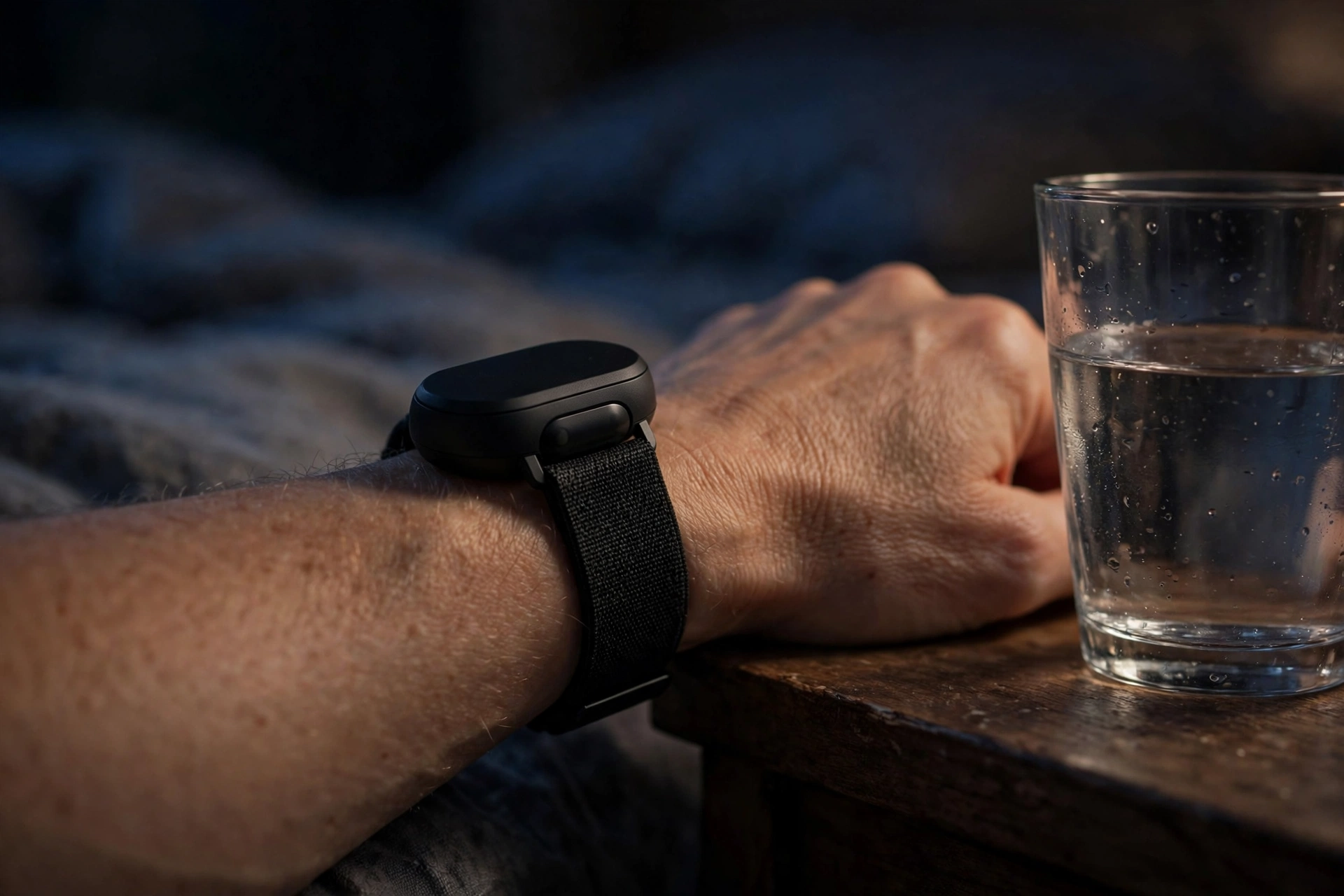
One of the more forward-looking parts of the authors’ discussion concerns wearables. Because skin conductance can, in principle, be measured by a device worn on the wrist, the researchers suggest that skin-conductance signatures of the kind studied here may motivate future research on wearables for everyday sleep. The key word is future. The study was conducted in a laboratory, with controlled stimuli, a specific modelling approach, and a small sample. Moving from that setting to a wrist-worn device used at home would require extensive validation: testing in larger and more diverse groups, across different sleep conditions, and against established sleep and clinical measures.
For readers who already use a sleep-tracking wearable, this distinction is important. Current consumer devices can estimate sleep duration and patterns, and some report stress-related measures, but they are not the same as the laboratory virtual-sensor method used in this study, and they are not diagnostic tools for insomnia, anxiety, or fear regulation. A wearable reading that looks worrying on one night does not diagnose a disorder, and a reassuring reading does not rule one out. The study’s contribution is to suggest a direction for research, not to endorse a product or a home measurement.
Future studies could also address the limitations of this one. Larger samples would give a clearer picture of whether the conditioning and recall patterns, which did not reach significance here, are real and meaningful. Studies in people with different kinds of sleep difficulty, different ages, and different anxiety profiles would test how general the pattern is. Studies that measure sleep at home, over multiple nights, rather than relying on group classification alone, could examine whether night-to-night sleep quality relates to next-day fear learning within the same person. Each of these steps would move the field from a promising laboratory signal toward something with clearer everyday relevance.
Living With the Nighttime Alert Feeling: Supportive Perspectives
For readers who recognise the study’s description in their own nights, the findings may feel validating. Feeling alert when you want to rest is not a failure of willpower, and struggling to let go of a worry does not mean you are not trying hard enough. The study suggests that, at least in a laboratory setting, the arousal system can behave differently during safety learning when insomnia is present, which may make the process of settling feel harder, even when a person understands rationally that they are safe.
That validation is not the same as a solution, and it is important not to over-read a small laboratory study into personal advice. What helps one person sleep better or feel calmer can vary widely, and general wellness information is not a substitute for professional guidance tailored to an individual’s health history. Readers who find that nighttime alertness regularly disrupts their sleep, their daytime functioning, or their sense of wellbeing may find it helpful to discuss their experiences with a healthcare professional, who can consider the full picture, including medical conditions, medications, stressors, and sleep patterns, and discuss options appropriate to that person.
In everyday life, many people find that a consistent wind-down period, a regular sleep schedule, and a bedroom kept mainly for sleep and rest help signal to the body that the day is ending. Others find that writing down worries earlier in the evening, rather than carrying them into bed, or getting up for a short period if they cannot sleep and returning to bed when sleepy, helps break the association between the bed and wakefulness. These are general, widely discussed sleep habits, not treatments tested by this study, and they are not suitable for everyone. If sleep difficulties persist, worsen, or come with other symptoms, professional advice is the appropriate next step, rather than relying on general information alone.
When to Talk to a Healthcare Professional
Consider talking to a healthcare professional if insomnia or anxiety persists over time, rather than easing after a short stressful period. Specific reasons to seek advice include difficulty falling asleep or staying asleep most nights for several weeks, waking much earlier than intended and being unable to return to sleep, daytime sleepiness or difficulty functioning at work, school, or home, or anxiety that feels frequent, intense, or hard to manage. Also seek advice promptly if sleep problems occur alongside low mood, panic symptoms, breathing pauses during sleep, loud snoring with daytime sleepiness, or any symptom that worries you.
A healthcare professional can help distinguish insomnia from other sleep disorders, review factors that may contribute to poor sleep, and discuss support options in the context of your overall health. If you are already receiving care for a sleep or mental health condition, changes in symptoms, or questions about your current care, are also worth raising with the clinician who knows your history. This article cannot replace that conversation, and it does not recommend any specific medication, supplement, or therapy protocol.
Study Limitations Readers Should Keep in Mind
The most important limitation is size. Forty-eight people, split evenly between two groups, is a small sample for drawing broad conclusions. Small samples are more vulnerable to chance variation, and their results need replication before they can be treated as firm. The study is one contribution to a larger literature, not a final verdict.
A second limitation is setting. A laboratory fear-conditioning task, with a visual stimulus and a mild shock, is a simplified model of fear. Real fears involve personal history, context, relationships, and meaning, none of which a laboratory image can capture. The study shows what happened in that controlled setting, and researchers must be cautious about generalising to everyday fears and anxieties.
A third limitation is measurement. Skin conductance reflects sympathetic arousal, but arousal is not the same as fear, and a high-arousal index is a modelled estimate, not a direct reading of a person’s thoughts or feelings. The fact that the significant result depended on including the tonic background signal is itself a finding worth noting, because it shows how sensitive the result is to the choice of model. Independent researchers, using the same or different methods, will need to test whether the pattern holds.
Finally, the study is observational in the sense that it compared two existing groups, people with insomnia and good sleepers, rather than randomly assigning sleep conditions. Group differences could reflect other factors that differ between the groups, not insomnia alone. That is a normal feature of this kind of research, and it is why the authors’ interpretation is framed as a possible explanation, not as proof of causation.
Frequently Asked Questions
1. What did the insomnia study actually find?
The study found that, from fear conditioning to extinction learning, the average high-arousal index increased in the insomnia group and slightly decreased in the good-sleeper group. This group difference was statistically significant only in the model that included the tonic background signal from skin conductance. Other patterns, including lower average arousal during conditioning and higher average arousal at second-day recall in the insomnia group, did not reach statistical significance.
2. Does this study prove insomnia causes anxiety or poor fear learning?
No. The study found an association in a small laboratory sample of 48 people. It compared existing groups rather than experimentally changing sleep, and it did not test treatments. Its authors interpret the pattern as consistent with the idea that hyperarousal may oppose safety learning, but that interpretation is not proof of causation, and it does not mean any individual with insomnia will have the same pattern.
3. How was arousal measured in the study?
Arousal was estimated from skin conductance, the tiny changes in sweat activity on the skin, using sympathetic arousal virtual sensors based on microfluctuations in the signal. Participants completed a two-day task: fear conditioning with a visual stimulus paired with a mild shock, extinction learning in which the stimulus appeared without the shock, and recall of fear and safety memories on the second day.
4. Will this research lead to a wearable test for insomnia or anxiety?
Not at present. The authors suggest skin-conductance signatures may motivate future research on wearables for everyday sleep, but that is a research direction, not a current tool. No current consumer wearable based on this study can diagnose insomnia, measure fear regulation, or guide treatment, and laboratory results need extensive validation before any everyday application could be considered.
5. What should I do if I have persistent insomnia or anxiety?
If insomnia or anxiety persists, affects your daytime functioning, or worries you, talk to a healthcare professional. A clinician can consider your full health picture and discuss options appropriate to you. This article is educational information, not medical advice, and it does not diagnose any reader or recommend a specific medication, supplement, or therapy protocol.
Source: Hwang, T., Pace-Schott, E., Bottary, R., Khazaei, S., and Faghih, R., “Disrupted fear regulation in insomnia disorder revealed by arousal estimation from skin conductance,” PLOS Mental Health, published October 14, 2026. DOI: 10.1371/journal.pmen.0000720. This article is educational information, not medical advice.