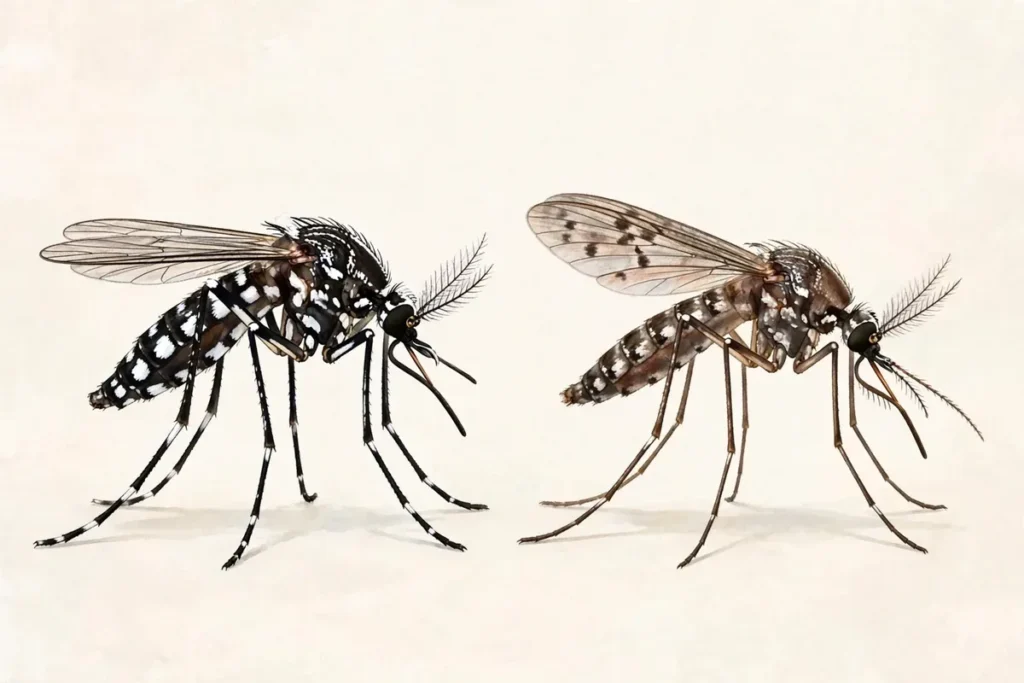
Most people say “mosquitoes” as if there were only one enemy. Across much of the United States, though, the mosquitoes ruining your backyard afternoons belong to two closely related species with different markings, different habits, and different ranges. Learning to tell them apart takes about a minute — and it changes how you protect yourself, because the usual dusk-only advice doesn’t fit mosquitoes that bite in broad daylight.
When people search for asian tiger mosquito vs yellow fever mosquito, they usually want one thing: which one is biting me, and should I be worried? Short version: the Asian tiger mosquito (Aedes albopictus) is the aggressive outdoor daytime biter with a single white stripe down the middle of its thorax. The yellow fever mosquito (Aedes aegypti) has white lyre-shaped markings on its thorax and white-banded legs, and prefers biting in and around homes in warmer, more tropical parts of the country. Both can transmit dengue, Zika, and chikungunya — but locally acquired transmission in the US remains uncommon, and prevention for both is nearly identical.
Below: visual identification, US range and habitat, daytime biting behavior, honest disease-risk context, and the prevention measures that work against both species.
Quick ID Guide: Tell Them Apart Without a Lab
You don’t need a microscope to get a reasonable read on which Aedes mosquito you’re looking at — just a close look, because both are small, dark mosquitoes with banded legs. A phone photo with the flash on usually captures enough detail.
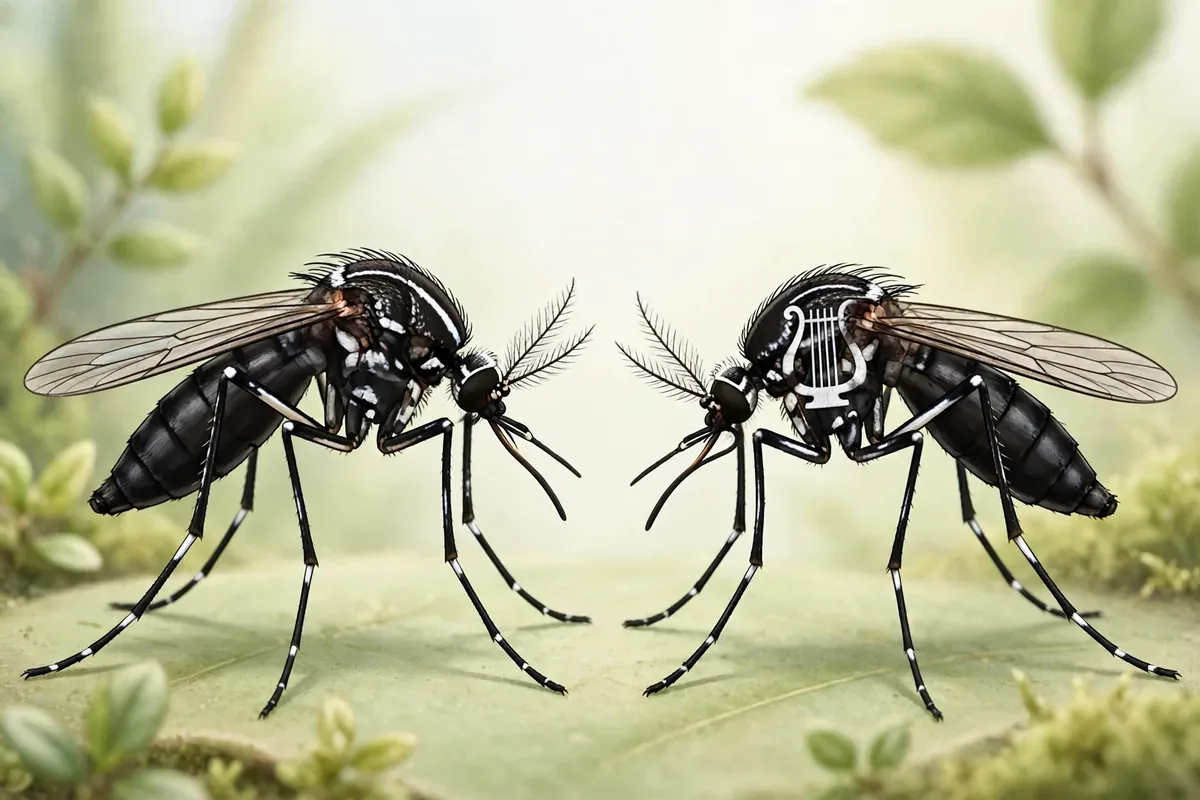
Check the thorax first. This is the most reliable field mark. The Asian tiger mosquito has a single silvery-white stripe running straight down the center of its thorax, the segment right behind the head — a white racing stripe on a black body. The yellow fever mosquito instead shows white lyre-shaped markings: curved white lines resembling a lyre. One clean center stripe means tiger mosquito; curved paired lines mean yellow fever mosquito.
Then look at the legs. Both species have white-banded legs, so leg banding alone won’t settle it. But combined with the thorax markings, it completes the picture: one bold center stripe means tiger mosquito; curved paired lines mean yellow fever mosquito.
When in doubt, capture the evidence. Other mosquito species also carry white markings, so misidentification is common. If you need certainty — for example, to report an unusual mosquito to your local health department — capture the specimen intact in a jar and contact them. Professionals identify Aedes species under magnification, and most county mosquito programs welcome public reports.
Range and Habitat: Where Each Bites in the US
The Asian tiger mosquito is native to Southeast Asia and is now established across much of the eastern and southern United States, with its range steadily expanding northward. Researchers tracking Aedes mosquitoes in the US — including work reported via ScienceDaily from a study in Scientific Reports — have documented this northward and inland expansion, driven by the species’ adaptability and its talent for breeding in artificial containers.
The yellow fever mosquito holds a more tropical and subtropical footprint: Florida, the Gulf Coast states, southern Texas, and parts of Arizona. It is the more heat-dependent of the two and less tolerant of cold winters, which is why its map stays pinned to the warmer states while the tiger mosquito keeps pushing north.
Habitat is where the practical difference shows up. The tiger mosquito is the backyard mosquito. It breeds in small, shaded containers outdoors: plant saucers, discarded tires, clogged gutters, birdbaths, children’s toys left in the yard, even a bottle cap holding rainwater. The yellow fever mosquito is the household mosquito. It prefers living in close association with people, breeding in water storage containers, flower vases, and containers in and immediately around homes, and it readily bites indoors — resting in closets, under furniture, and behind curtains.
Both species share one trait that makes them hard to fight: they don’t need swamps or ponds. A tablespoon of water in a forgotten saucer is a nursery. That is why container cleanup around your own property matters more than any neighborhood-wide spraying program, and why our outdoor bite-prevention checklist starts with the unglamorous work of tipping and tossing.
Daytime Biting Behavior
Here’s what makes both of these mosquitoes unusual: they bite during the day. Most Americans are used to mosquitoes as a dusk-and-evening problem, driven by species like Culex that feed after sunset. Aedes albopictus and Aedes aegypti flipped that script. They feed in daylight, which means the “just avoid dusk” advice leaves you exposed during exactly the hours these two are hunting.
The tiger mosquito is the more aggressive of the pair outdoors. It bites throughout the day — typically peaking in the early morning and late afternoon — and will follow a person around a yard, biting multiple times in one outing. Gardeners, joggers, and anyone on a shaded patio are its classic targets. Its bite is often noticed only after the fact: a quick, quiet feed, then itching that builds over the next day.
The yellow fever mosquito also bites during the day, with similar morning and late-afternoon peaks, but largely indoors and around the home. It bites low — ankles, feet, and lower legs — which is why people sometimes blame fleas or chiggers when the real culprit is aegypti feeding under a table. Like the tiger mosquito, it can take multiple small blood meals, moving from person to person.
The practical takeaway: if you’re getting bitten in bright daylight, especially around the ankles and lower legs, an Aedes mosquito is the likely suspect. Timing your repellent use for daytime outdoor hours — not just evening cookouts — is one of the simplest adjustments you can make.
Disease Risk Comparison

This section needs care, because it sits exactly where facts meet fear. Both the Asian tiger mosquito and the yellow fever mosquito are capable of transmitting dengue, Zika, and chikungunya viruses, and the yellow fever mosquito is additionally the primary vector of yellow fever virus. Those are established facts about what these species can carry — not what they are carrying. A mosquito can only transmit a virus if it first bites an infected person during the window when that host’s blood carries the virus, survives the incubation period, and then bites someone else. In most of the United States, that chain of events is rare.
That doesn’t mean the risk is zero, and it doesn’t mean prevention is pointless. It means proportion. Locally acquired dengue does occur in the US — periodic dengue headlines out of Florida keep these mosquitoes in the news — but the overwhelming majority of US cases are travel-associated. If you’ve recently traveled to a region where dengue or Zika circulate and you develop fever, rash, or joint pain afterward, that travel history matters more than the species of mosquito in your yard — tell your healthcare provider about the trip. If you live in an area with documented local transmission, your county health department or mosquito-control district is the best source for current risk levels, and their guidance should take priority over any general article.
Between the two species, public-health agencies generally regard Aedes aegypti as the more efficient vector — it feeds more often, prefers humans, and lives in closer contact with people. The tiger mosquito is a competent vector too, but its broader feeding habits make it a less efficient bridge for human-to-human transmission. Neither species transmits disease through every bite, and neither is a reason for panic — but both are a reason for repellent and container cleanup.
Bite Prevention That Works Against Both
Because these two species share breeding habits and daytime feeding, the same prevention playbook covers both. The measures below are the ones with real evidence behind them.
Use an EPA-registered repellent. Products containing DEET, picaridin, IR3535, or oil of lemon eucalyptus are registered with the US Environmental Protection Agency for mosquito protection. Apply according to the label directions — especially for children and during pregnancy — and reapply as directed. “Natural” alternatives like citronella have far thinner evidence, and bug zappers barely dent mosquito populations, so skip the gadgets and stick with the basics above.
Dress to deny access. Long sleeves, long pants, and socks reduce the skin available to bite. For heavy-mosquito areas, clothing can be treated with permethrin — applied to clothing only, never to skin — which survives several washes. This is standard practice for hikers, gardeners, and outdoor workers in Aedes territory.
Tip, toss, and scrub weekly. Walk your property once a week and empty every container holding water: saucers, buckets, toys, tarps, gutters. Scrub the insides, because Aedes eggs stick to container walls and can survive drying. This single habit does more against both species than any gadget.
Seal the house. Intact window and door screens keep the indoor-biting yellow fever mosquito out; repair tears promptly. For the tiger mosquito’s outdoor pressure, a fan on the patio helps — mosquitoes are weak fliers, and moving air disrupts their approach.
None of these steps requires identifying the exact species first. If you’re being bitten in daylight around your home, assume Aedes, apply the playbook above, and you’ll be covered against both.
When to See a Doctor for a Bug Bite

Most mosquito bites resolve on their own within a few days. Seek prompt medical care if you notice any of the following:
- Signs of a severe allergic reaction — call 911: trouble breathing or swallowing, swelling of the lips, tongue, or throat, widespread hives, dizziness, fainting, or a rapid heartbeat. These are anaphylaxis warning signs and need emergency treatment.
- Signs of infection: redness, warmth, or swelling that spreads or worsens after 48 hours, red streaks extending from the bite, pus or cloudy drainage, increasing pain, or fever.
- Timeline violations: a bite that keeps getting bigger, harder, or more painful after several days instead of improving, or symptoms that return after fading.
- Bites near the eyes, mouth, or throat, where swelling can threaten vision or breathing.
- Special situations: infants with many bites, anyone who is immunocompromised, or bites during pregnancy that come with fever or rash.
Frequently Asked Questions
Which is worse, the Asian tiger mosquito or the yellow fever mosquito?
The tiger mosquito is the more aggressive outdoor daytime biter and is spreading across more of the US, so most Americans will encounter it first. The yellow fever mosquito is considered the more efficient disease vector and prefers biting indoors. For prevention, the distinction barely matters — the same repellents, clothing, and container cleanup work against both.
Do both mosquitoes bite during the day?
Yes. Unlike many species that feed at dusk or night, both Aedes albopictus and Aedes aegypti are daytime biters, typically peaking in the early morning and late afternoon. Bites on a sunny afternoon in the garden are often the work of one of these two species.
Can you get dengue from a mosquito bite in the United States?
Locally acquired dengue does occur, most notably in Florida, but it remains uncommon; the large majority of US cases are travel-associated. Both species can transmit dengue, but transmission requires the mosquito to have bitten an infected person first. Check your local health department for current local risk.
How do I keep these mosquitoes out of my yard?
Empty standing water weekly — saucers, buckets, toys, gutters — and scrub containers, since Aedes eggs cling to the walls. Both species breed in tiny amounts of water, so thoroughness matters more than any single product. Use EPA-registered repellent outdoors during the day, and run a fan on the patio. Our outdoor bite-prevention checklist has the full rundown.
Medically reviewed by Dr. Sarah Jones, MD.
This article is for informational purposes only and isn’t medical advice. If you’re worried about a bite or sting, talk to a healthcare professional.