A red patch is spreading across your skin, and the clock in your head is ticking: is this the rash of early Lyme disease, or a bacterial skin infection? The honest answer to erythema migrans vs cellulitis is that the distinction matters enormously — and it is not something to settle at home. Both conditions need a clinician’s evaluation, urgently. This article explains how doctors think about the differences, why the two get confused (even in clinics), and exactly what to tell your doctor so you get the right care fast.
A word of framing before anything else: this is red-flag education, not a diagnostic tool. No article can diagnose a rash from descriptions. What you can do is learn the timing clues, the lookalike traps, and the urgency triggers that help you act quickly — and then hand the decision to a medical professional. That is the entire point.
What Erythema Migrans Looks Like
Erythema migrans — often abbreviated EM — is the characteristic early rash of Lyme disease, which is caused by Borrelia bacteria transmitted through the bite of an infected blacklegged tick (also called the deer tick). It appears in roughly 70-80% of people with Lyme disease and shows up at the site of the tick bite, typically 3 to 30 days after the bite, most often around one to two weeks later.
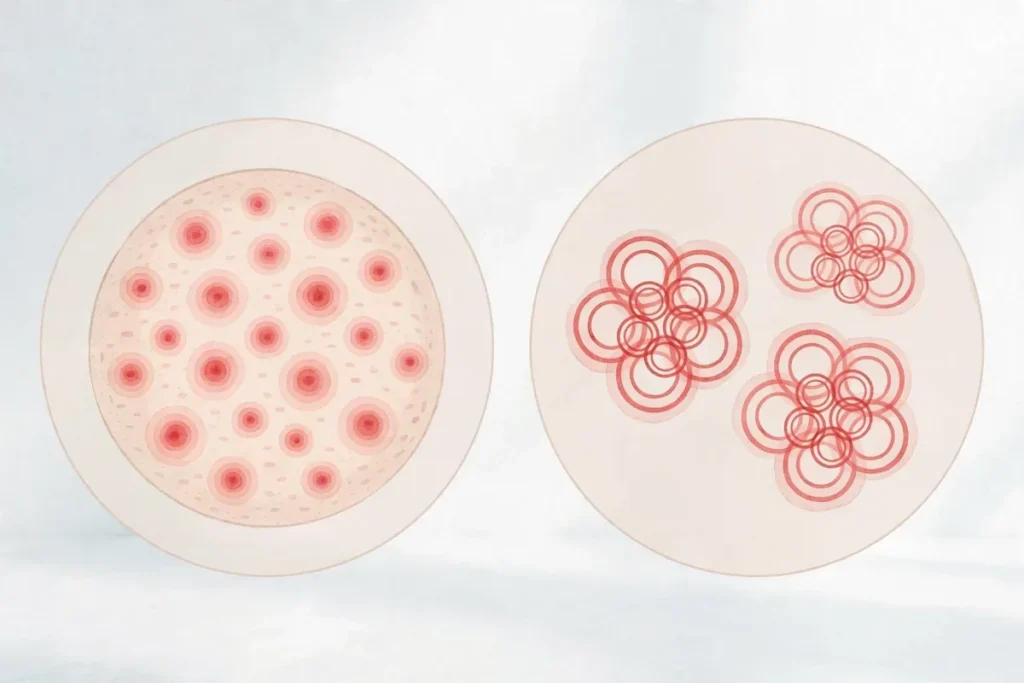
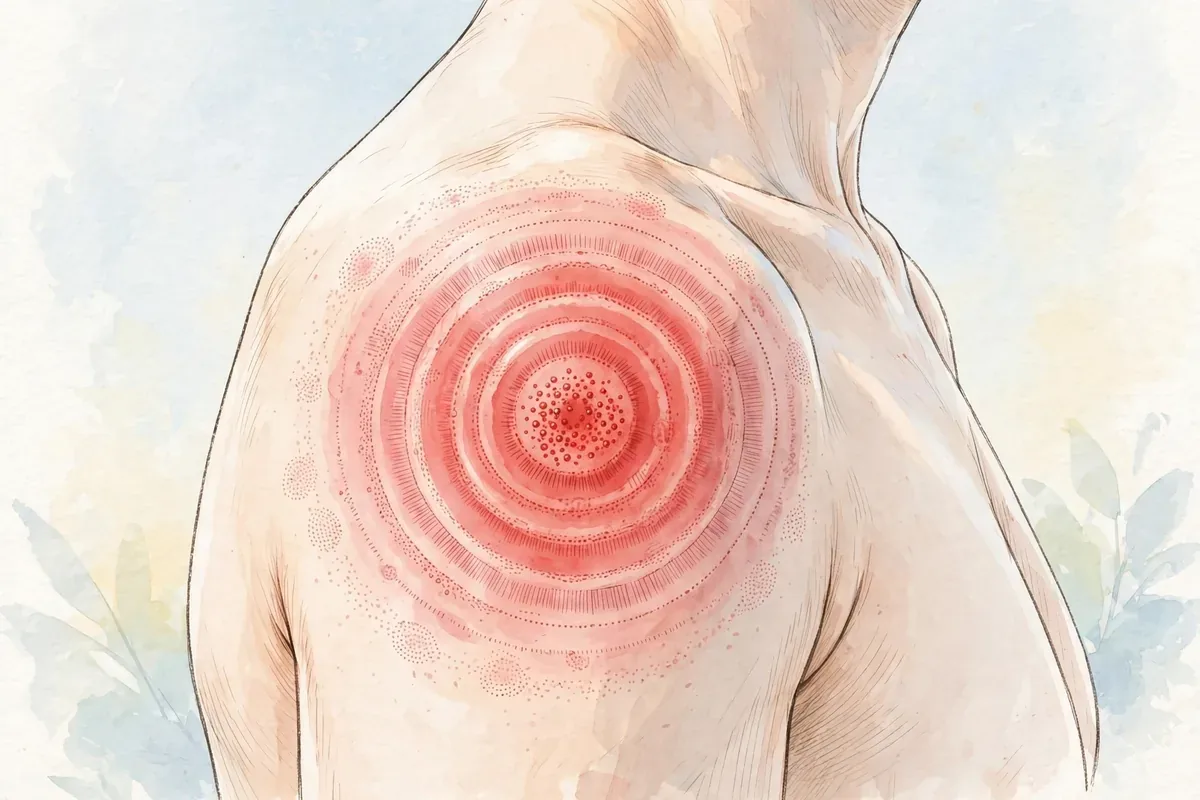
Clinicians describe a few signature features. The rash expands over days, growing outward by roughly 2-3 centimeters per day, and it can reach impressive sizes — commonly larger than 5 centimeters across, sometimes much larger. The center often fades as the edges advance, producing the famous “bull’s-eye” or target pattern. Important nuance: the bull’s-eye shows up in only a minority of US cases. Most erythema migrans rashes are actually a fairly uniform pink-red oval or circle without the target rings. Relying on the bull’s-eye as the only sign is one of the biggest reasons real cases get missed.
Another signature: the rash is usually not very painful and not very itchy. It may feel warm, but it is rarely tender. Many people describe feeling almost nothing at the rash site. Flu-like symptoms — fatigue, headache, body aches, mild fever — can accompany it, though they can also appear without any rash at all. The rash commonly appears in warm, hidden spots where ticks like to feed: the armpit, groin, behind the knee, along the waistband, or in a child’s hairline or neck. Most people never saw the tick.
The reason timing matters so much: erythema migrans is the early, localized stage. If untreated, the infection can disseminate through the bloodstream within days to weeks, sometimes producing additional smaller rashes at other sites, and later affecting joints, the heart, or the nervous system. Early evaluation is the window where treatment is simplest and outcomes are best.
What Cellulitis Looks Like
Cellulitis is a bacterial skin infection — most often caused by streptococci or staphylococci entering through a break in the skin. That break can be a bite, a scratch, a crack between toes, or something so minor you never noticed it. Unlike erythema migrans, which is the visible edge of a tick-borne infection spreading outward, cellulitis is the skin’s reaction to bacteria multiplying in the tissue itself.
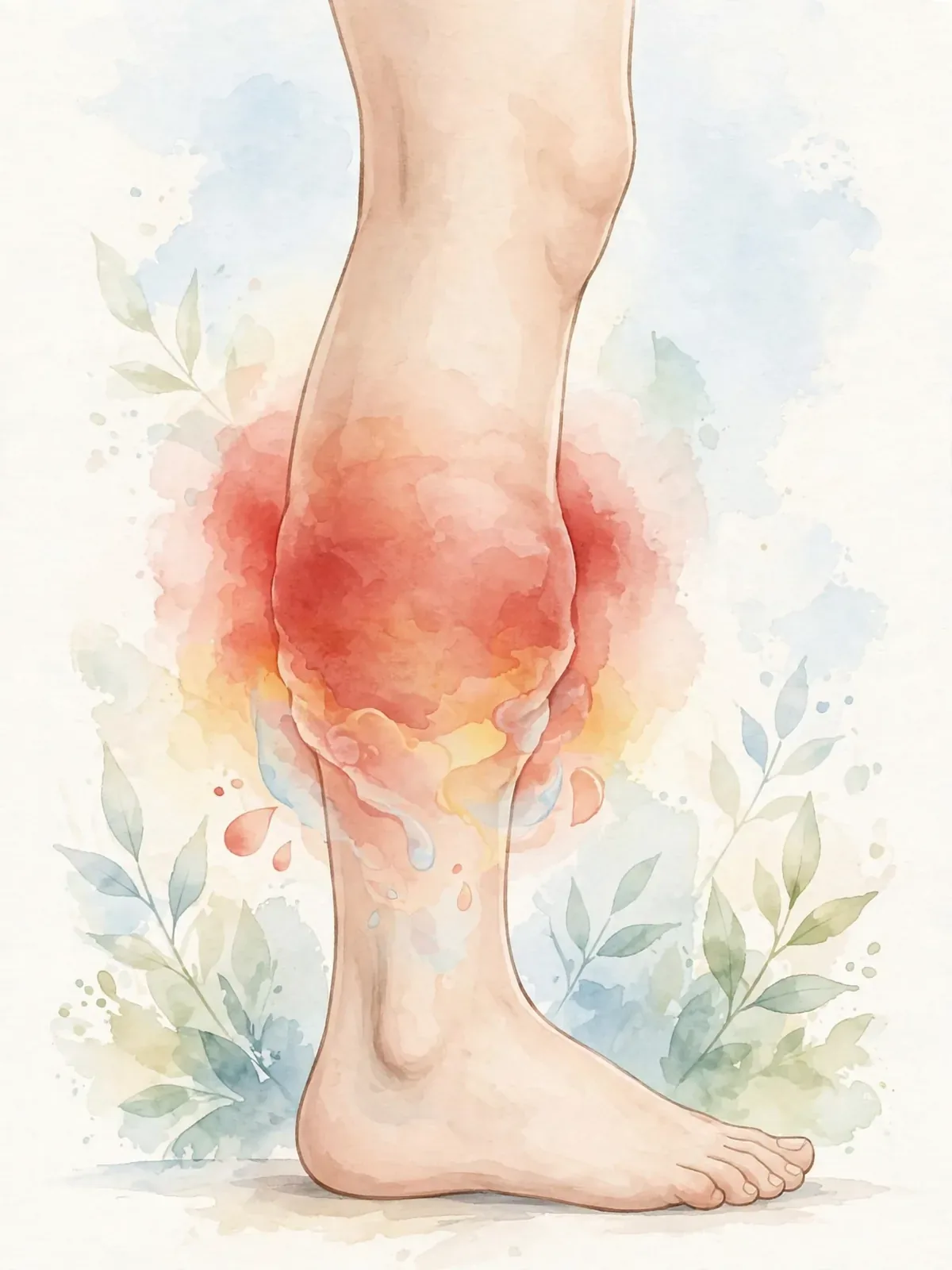
The clinical picture clinicians look for: an area that is red, warm, swollen, and tender or painful. That tenderness is one of the sharpest contrasts with erythema migrans — cellulitis usually hurts when touched, while EM usually doesn’t. The redness of cellulitis is often more uniform (no central clearing, no bull’s-eye) and the border can look diffuse. Swelling and a feeling of tightness in the skin are common, and fever and chills frequently ride along. In more developed cases you may notice red streaks extending from the area (lymphangitis) or swollen nearby lymph nodes.
Timing is the other big contrast. Cellulitis typically develops and worsens over hours to a couple of days — faster than the days-long expansion of erythema migrans. And cellulitis has no tick-bite anchor: it can start anywhere the skin barrier broke, with the lower legs and forearms being classic locations. It does not “migrate” outward in the slow, ring-like fashion of EM; it spreads as a hot, painful, inflamed zone.
Cellulitis is not a wait-and-see condition either. It can progress rapidly, and severe cases can lead to abscesses or bloodstream infection. That is why this article’s core message covers both conditions equally: a spreading, hot, painful red area is an urgent-care or same-day-clinic matter, full stop.
Why the Two Get Confused — Even by Doctors
If the descriptions above sound distinct, here’s the uncomfortable truth: misdiagnosis happens in both directions, and published cases document the fallout. Case reports in the medical literature describe patients whose erythema migrans was treated as cellulitis — sometimes for weeks — while the Lyme infection progressed. Clinician-facing sources like BMJ Best Practice list cellulitis as a key differential for Lyme disease, and consumer-health explainers consistently name it the closest EM lookalike.
Why does this happen? Several traps:
- The bull’s-eye expectation. When doctors and patients both expect a target pattern, a plain expanding red oval gets filed under “cellulitis.”
- Partial treatment. If someone with an EM rash receives antibiotics prescribed for cellulitis, the rash may partially improve, seeming to confirm the wrong diagnosis — while the underlying Lyme infection persists.
- Overlapping features. Both can be red, warm, and expanding. Both can come with fever. In the early hours, even experienced eyes can hesitate.
- The missing tick. Most people with Lyme disease never saw or remember a tick bite, so the “tick context” that would point toward EM is absent from the history.
- Geography assumptions. Lyme is associated with the Northeast and upper Midwest, but blacklegged ticks and Lyme risk exist more broadly than many assume — and a clinician in a “low-risk” area may default to cellulitis.
Understanding these traps doesn’t make you the diagnostician. It makes you a better historian — the person who walks into the clinic able to say “it started here, it grew this fast, it does/doesn’t hurt, and here’s the timeline.” That information is genuinely valuable to the person making the call.
Timing Clues That Help Doctors Decide

Clinicians weigh several features together — no single one is decisive, which is exactly why self-diagnosis is unreliable. But knowing the clues helps you communicate:
Onset after exposure. Erythema migrans appears days to weeks after a tick bite (range 3-30 days, typically 1-2 weeks). Cellulitis usually declares itself within hours to days of a skin break. A rash appearing two weeks after a hiking trip fits EM’s timeline; one blowing up the morning after you scratched a bug bite fits cellulitis better.
Pain and tenderness. Cellulitis is typically tender or painful to touch; erythema migrans usually is not. Itchiness points more toward an allergic reaction to the bite itself (which appears within hours and fades within a day or two) than toward either condition.
Expansion speed and pattern. EM expands slowly outward over days, often with central clearing. Cellulitis spreads faster, as a uniformly hot and painful zone, without the ring-like migration.
Systemic symptoms. Both can cause fever and achiness, so fever alone doesn’t settle it — but the pattern of illness plus the rash’s behavior gives the clinician more to work with.
Response to treatment. Clinicians sometimes learn from how a rash responds — but this is their tool, not yours. Never start leftover antibiotics “to see if it helps.” Partial treatment is one of the documented ways EM cases get mislabeled as cellulitis, delaying proper care.
One more practical note: photograph the rash with a coin for scale, and note the date. Serial photos showing expansion speed are genuinely useful to clinicians and take thirty seconds.
What to Tell Your Doctor (and What Not to Do)
When you seek care for a spreading red rash, bring a tight, factual history:
- When you first noticed it and how fast it has grown (photos with dates help enormously).
- Whether it hurts, itches, or feels like nothing.
- Any tick exposure: hiking, camping, gardening, time in tall grass or woods in the past month — even if you never saw a tick.
- Fever, headache, joint aches, or fatigue.
- Any recent skin breaks, scratches, or bites at the site.
- Medications and allergies, since treatment choices differ.
What not to do while waiting for care:
- Don’t apply steroid creams to a rash you can’t identify; they can mask inflammation and muddy the clinical picture.
- Don’t squeeze, scratch, or lance it. Breaking the skin over a possible infection invites worse infection. Our general rule on why not to scratch or squeeze a bite applies doubly here.
- Don’t wait for the bull’s-eye. Most EM rashes never form one.
If you develop expanding redness with fever, severe pain, red streaks, or rapid spread, treat it as urgent — same-day care or the emergency department, not a “let’s see how it looks tomorrow” situation. Our guide to bite and sting warning signs covers the broader red-flag list, and if there is any pus or rapidly worsening pain, see our guide on bug-bite infection, cellulitis, and antibiotics.
When to See a Doctor for a Bug Bite
For a spreading red rash after possible tick exposure or a skin break, the threshold for seeking care should be low. Get evaluated promptly — same day — if:
- A red area is expanding over hours or days, whether or not it hurts.
- The area is hot, swollen, and tender or painful, especially with fever or chills — classic cellulitis features that need same-day treatment.
- You had a known tick bite and a rash appears at the site days to weeks later, even without pain — possible erythema migrans.
- Red streaks extend from the rash, or nearby lymph nodes are swollen and tender.
- The rash is spreading fast, blistering, or you feel systemically ill (fever, severe headache, joint pain, facial droop, heart palpitations).
Call 911 or go to the emergency department for trouble breathing, confusion, or a rapidly spreading painful rash with fever.
Do not “watch and wait” on an expanding rash to see if it becomes a bull’s-eye. Early evaluation is the entire ballgame for both conditions.
Frequently Asked Questions
Can I tell erythema migrans from cellulitis at home?
Not reliably — and you shouldn’t try. The features overlap enough that even clinicians misdiagnose in both directions. Learn the timing and pain clues so you can describe them well, then get evaluated promptly.
Does a Lyme rash always look like a bull’s-eye?
No. The target pattern appears in only a minority of US cases. Most erythema migrans rashes are uniform pink-red ovals that expand outward over days. Waiting for a bull’s-eye is a common reason real cases get missed or mislabeled as cellulitis.
How fast does cellulitis spread compared to erythema migrans?
Cellulitis typically worsens over hours to a couple of days as a hot, painful, swollen zone. Erythema migrans expands more slowly — roughly 2-3 cm per day over days to weeks — and is usually painless. Speed and pain together are useful clues for your doctor, not a home diagnosis.
I was prescribed antibiotics for cellulitis but the rash isn’t improving. What now?
Go back to your clinician promptly and mention the lack of improvement, any tick exposure, and the rash’s timeline. Non-response to cellulitis treatment is one of the documented pathways by which erythema migrans gets recognized late — your follow-up visit matters.
Should I save the tick if I find one?
Yes. If you find an attached tick, remove it properly (fine-tipped tweezers, steady upward pull), save it in a sealed bag or container with the date, and tell your doctor. Tick identification and testing can inform the clinical picture — but never delay care while waiting on tick-test results.
Medically reviewed by Dr. Sarah Jones, MD.
This article is for informational purposes only and isn’t medical advice. If you’re worried about a bite or sting, talk to a healthcare professional.