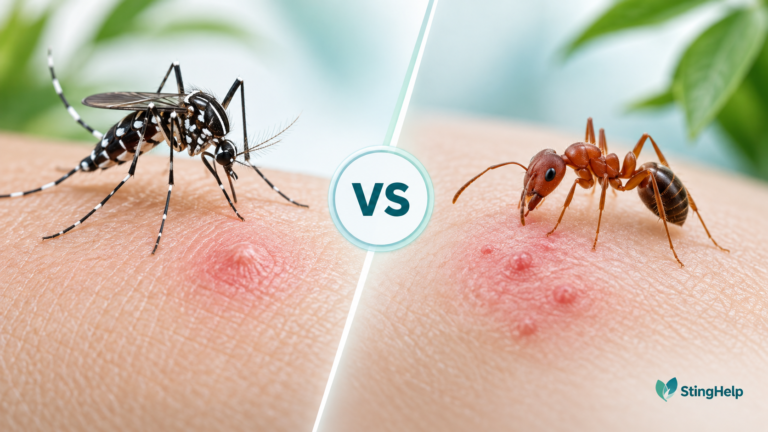
Direct answer: The main asian tiger mosquito bite vs house spider bite treatment differences are exposure certainty, symptom pattern, and what not to assume. Asian tiger mosquito bites are common outdoor blood-feeding events that usually become itchy. Verified house-spider bites are uncommon, and a skin lesion alone should not be labeled a spider bite without seeing or identifying the spider.
Both mosquito bites and suspected spider bites can leave a red, swollen, itchy area, which is why people often compare them from photos. The safer approach is to start with the arthropod and the setting. A black-and-white mosquito seen feeding gives strong evidence for Asian tiger mosquito exposure. A “house spider bite” is much less certain when no spider was seen, because many skin infections, irritated follicles, and other arthropod bites can look similar.
Fastest practical clue
If the reaction appeared after outdoor mosquito activity and mainly became itchy, mosquito exposure is plausible. If a spider was actually seen biting or found trapped against the skin, a spider bite becomes more plausible. If no spider was seen and the lesion is hot, increasingly painful, draining, ulcerating, or rapidly spreading, get medical advice instead of assuming “house spider bite.”
Asian tiger mosquito bite vs house spider bite: quick comparison
| Clue | Asian tiger mosquito | “House spider” |
|---|---|---|
| What the name means | A specific mosquito species: Aedes albopictus | A common name that can refer to different indoor spiders depending on country |
| How often humans are bitten | Common blood-feeding behavior | Verified bites are uncommon for typical house spiders |
| Typical sensation | May be a tiny prick or unnoticed; itching often becomes prominent later | If a verified bite occurs, local pain, redness, or swelling may occur |
| Best identification clue | Seeing the black-and-white mosquito feed | Actually seeing or safely identifying the spider |
| Skin-photo reliability | Low for species identification | Low; appearance alone does not confirm a spider bite |
| Main medical priority | Symptom care, prevent more bites, consider disease context if relevant | Basic wound care and evaluation of worsening or infection-like lesions |
The biggest lesson is that “house spider bite” is not a diagnosis based on a picture. A visible spider, a clear exposure event, geography, and the clinical course matter more than whether a red bump looks similar to an internet image.
What an Asian tiger mosquito looks like
The Asian tiger mosquito, Aedes albopictus, is a small dark mosquito with bright white bands on the legs and distinctive white markings on the body. It commonly breeds in small containers of standing water around homes and can be active in yards, gardens, vegetation, patios, and other outdoor spaces.
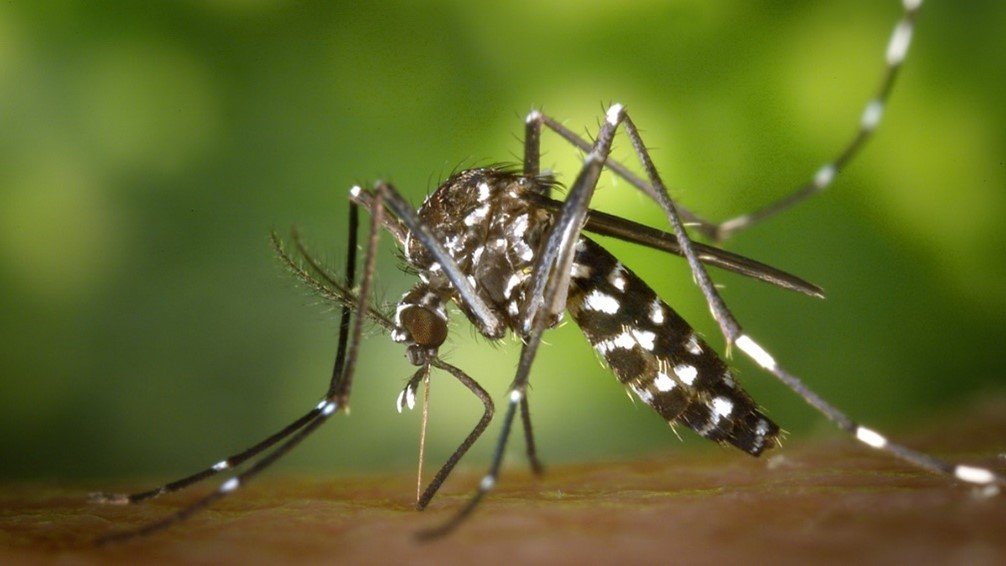
A bite may feel like a tiny prick or may not be noticed at all. Itching, redness, and localized swelling often become more obvious after the mosquito has already left. Some people develop a small papule while others form a larger itchy wheal.
What does “house spider” actually mean?
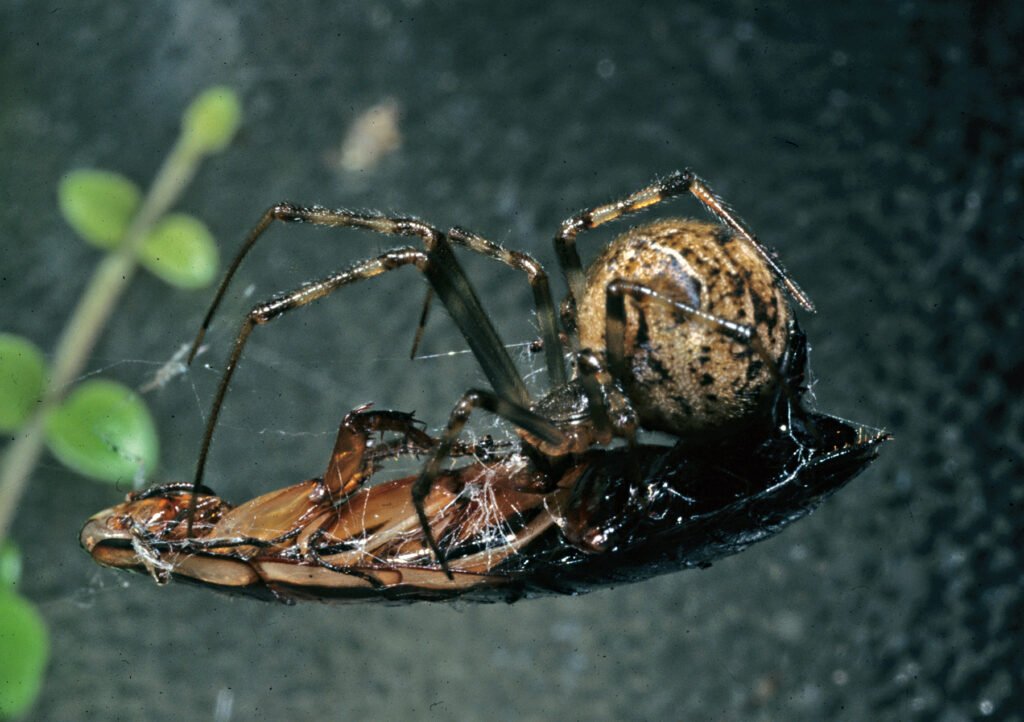
The phrase “house spider” is ambiguous. In North America, one common species carrying that name is Parasteatoda tepidariorum, also called the common or American house spider. Penn State Extension’s 2026 fact sheet describes it as a widespread cobweb-weaving spider commonly found in houses, barns, basements, crawl spaces, corners, and window areas.
In the UK and parts of Europe, “house spider” often refers instead to species in the Tegenaria and Eratigena groups. The Natural History Museum notes that multiple species are commonly found in homes there, including the common house spider Tegenaria domestica and larger giant-house-spider relatives.
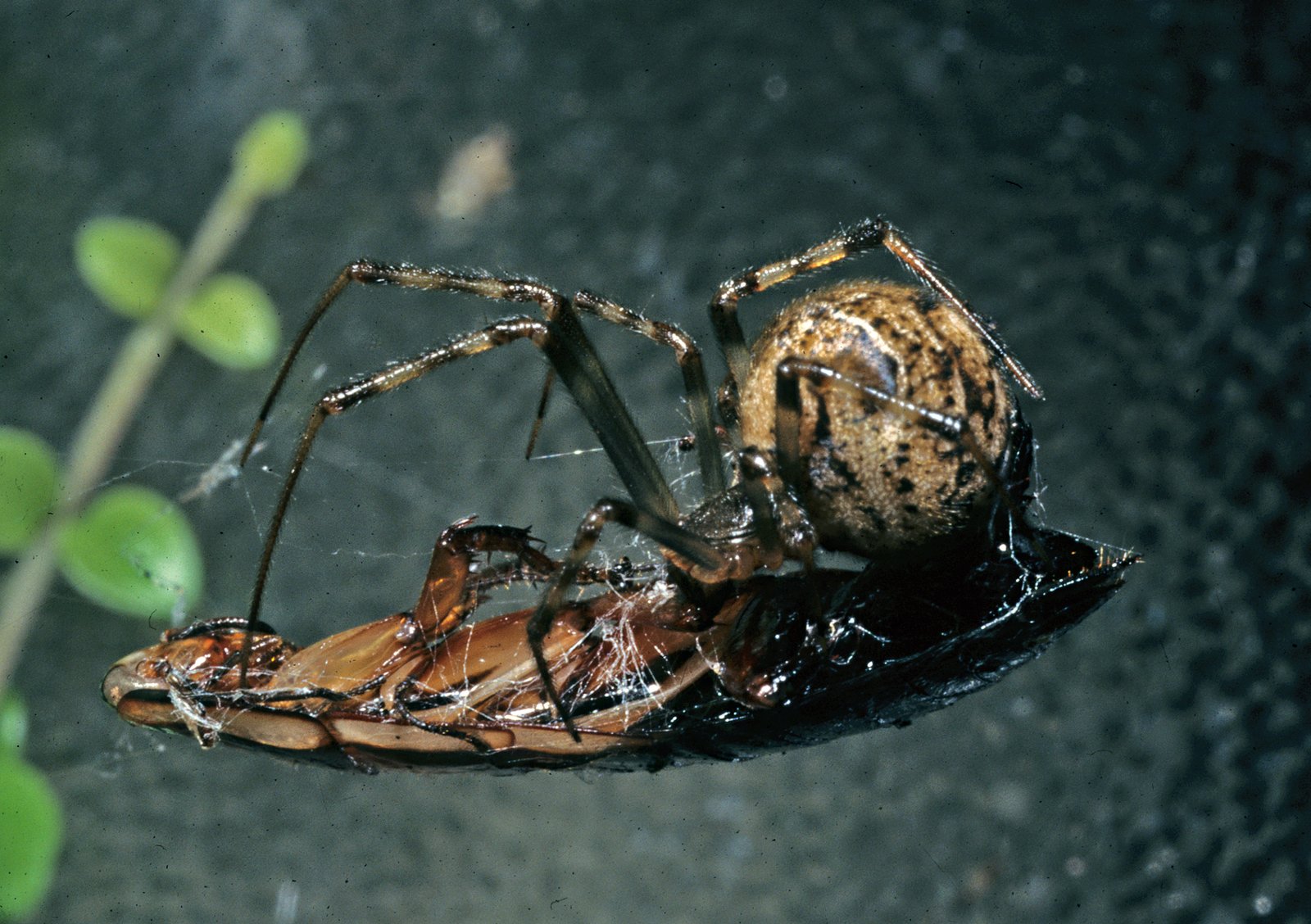
This geographic naming difference matters. A U.S. article showing Parasteatoda tepidariorum does not prove that every European reader’s “house spider” is the same species, and a UK giant house spider should not automatically be treated as the American common house spider.
Are common house spiders medically dangerous?
For the North American common house spider, Penn State Extension states that Parasteatoda tepidariorum is not regarded as medically important. Given how frequently it lives around people, verified bites are notably uncommon. The few reported verified bites have involved local pain, redness, or a red mark rather than a well-established severe necrotic syndrome.
For UK house spiders, the Natural History Museum similarly notes that spider bites are rare. Among the hundreds of UK spider species, only a small number have been recorded biting people, and significant or unpleasant bites are limited to very few species. Typical reported symptoms are localized pain and swelling.
That does not mean every spider is harmless or that every skin reaction should be ignored. It means a generic “house spider” label should not be used to explain a worsening wound without better evidence.
Why many “spider bites” are not actually spider bites
CDC’s 2026 Yellow Book warns that reports of spider bites are often unreliable because people frequently mistake skin wounds and infections for spider bites even when no spider was seen. In another Yellow Book section on dermatologic conditions, CDC notes that tender boils and abscesses are commonly misattributed to spiders, while bacterial infection can be the true cause.
This is especially important if a lesion becomes progressively hot, increasingly painful, drains pus, forms an abscess, or is accompanied by fever. Those features should prompt medical evaluation for infection or another cause instead of trying to match the lesion to online spider-bite pictures.
Do not diagnose from “fang marks” alone
Two tiny dots, a central punctum, a blister, a dark center, or a red ring are not specific enough to prove a house-spider bite. Other insects, irritated hair follicles, bacterial infections, pressure injuries, and scratching can produce overlapping skin changes.
Asian tiger mosquito bite vs house spider bite symptoms
Asian tiger mosquito bites have a much more predictable general pattern because mosquitoes routinely feed on people. House-spider bites are less standardized because verified bites are uncommon and “house spider” refers to different species in different regions.
Typical Asian tiger mosquito reaction
- Small itchy papule or wheal.
- Localized redness and swelling.
- Multiple lesions may appear on exposed skin.
- Itching often becomes more noticeable after the mosquito has left.
- Scratching can break the skin and increase irritation or infection risk.
Typical verified house-spider reaction
- Local pain may occur at the time of the bite.
- Redness or localized swelling can develop.
- Symptoms are usually limited to the bite area for common non-medically important house spiders.
- A severe or progressive wound should not automatically be blamed on a house spider.
If severe muscle cramping, marked systemic symptoms, rapidly worsening tissue injury, or other serious signs develop after a definite spider exposure, the question may no longer be “house spider or mosquito?” A medically important spider species or another medical condition may need to be considered.
Pictures: can you tell the difference from the skin?
Usually not with confidence. For asian tiger mosquito bite vs house spider bite pictures, images of the actual arthropod are far more useful than images of the skin. A clear photograph of a black-and-white mosquito or an identifiable spider can narrow the possibilities substantially.
Skin photographs are useful for documenting change over time, especially if swelling, redness, blistering, drainage, or ulceration is progressing. They are much less reliable for naming the exact arthropod species.
If the culprit was not seen, start with the StingHelp What Bit Me? identification guide rather than forcing a spider diagnosis from appearance.
Asian tiger mosquito bite vs house spider bite treatment differences
For mild local reactions, first aid overlaps: gently wash the skin, use a cool compress, avoid scratching, and use an appropriate over-the-counter itch or pain product only if it is safe for you and used according to the label. The main difference is what you monitor afterward.
What to do after a likely Asian tiger mosquito bite
- Wash the area gently with soap and water.
- Apply a cool compress for itching or swelling.
- Avoid scratching and keep broken skin clean.
- Use an appropriate OTC anti-itch treatment only if safe for you and according to the label.
- Prevent additional bites with EPA-registered repellent, protective clothing, screens, and standing-water control.
- If significant systemic illness develops, consider recent travel and local mosquito-borne disease activity when speaking with a clinician.
What to do after a verified or suspected house-spider bite
- Wash the site with soap and water.
- Apply a cool compress or wrapped cold pack for local discomfort or swelling.
- Do not cut, squeeze, burn, or attempt to “draw out” venom.
- If the spider is available, photograph or preserve it safely without risking another bite.
- Monitor for spreading redness, increasing warmth, drainage, worsening pain, blistering, fever, or other systemic symptoms.
- Seek medical care if the lesion is worsening, atypical, or difficult to explain.
For broader wound and symptom-care guidance, use the StingHelp bite and sting first-aid guide.
Decision guide: what should you do next?
Small itchy bump after seeing a black-and-white mosquito: routine mosquito-bite care and bite prevention are usually reasonable.
Spider was definitely seen biting and symptoms stay mild/local: basic wound care, cooling, and observation are usually appropriate.
No spider was seen and the wound is hot, very painful, draining, ulcerating, or rapidly expanding: seek medical evaluation instead of labeling it a house-spider bite.
Breathing difficulty, fainting, severe dizziness, rapidly spreading swelling, confusion, or collapse: seek emergency care.
When should you seek medical care?
Medical evaluation is appropriate when redness keeps spreading, pain is getting worse rather than better, the area becomes increasingly hot, pus or drainage develops, fever appears, a blister or ulcer is progressing, or the person feels systemically unwell.
Seek emergency care for trouble breathing, swelling of the tongue or throat, fainting, severe dizziness, confusion, collapse, or another severe rapidly worsening reaction.
If a spider was actually seen, bring a clear photograph or securely contained specimen only if that can be done without another bite. Do not handle an unknown spider with bare hands solely for identification.
What if the lesion looks necrotic or “flesh-eating”?
Necrosis is not proof of a generic house-spider bite. CDC cautions that many lesions attributed to spiders are actually bacterial infections or other dermatologic conditions. Medically important necrotic spider bites are associated with specific spiders such as Loxosceles recluse species, not with a validated syndrome caused by every spider found indoors.
If skin becomes dark, ulcerated, blistered, unusually painful, or rapidly damaged, professional assessment is important. Treatment should target the actual condition rather than an unverified spider label.
USA: what “common house spider” usually means
In U.S. pest and extension literature, Parasteatoda tepidariorum is commonly called the common house spider. Penn State describes it as cosmopolitan and extremely common in buildings, especially corners, windows, basements, crawl spaces, and similar sheltered sites.
Despite living close to people, it is not considered a major medical spider. That mismatch—very common spider, very few verified bites—is useful evidence against assuming that every unexplained indoor lesion was caused by the common house spider.
Europe: “house spider” often means something different
European and UK readers should not assume that “house spider” means Parasteatoda tepidariorum. The Natural History Museum describes several common house spiders in the Tegenaria and Eratigena groups, ranging from the smaller Tegenaria domestica to much larger giant house spiders.
The Museum also emphasizes that spider bites in the UK are rare and are generally not a reason for concern merely because a spider is present in the home. That makes witnessed exposure more important than the common name alone.
How mosquito-borne disease risk changes the comparison
Asian tiger mosquitoes matter medically for a different reason: infected Aedes albopictus can transmit dengue, chikungunya, and Zika where those viruses are circulating. A routine itchy mosquito bite does not mean infection occurred, but travel history, local transmission, season, and systemic illness can change the level of concern.
Typical house spiders are not a comparable vector for those mosquito-borne viral diseases. Their main relevance is local bite injury when a bite truly occurs—and, just as importantly, avoiding misdiagnosis of another skin condition as a spider bite.
How to prevent Asian tiger mosquito bites
Use EPA-registered insect repellent, wear protective clothing when practical, maintain window and door screens, and remove standing water from small containers around the home. Asian tiger mosquitoes can breed in buckets, plant saucers, toys, gutters, tires, and other small water-holding items.
How to reduce unwanted house-spider encounters
Reduce clutter in storage areas, seal gaps around windows and doors where practical, use screens, vacuum old webs, move boxes and stored items carefully, and wear gloves when handling materials where spiders may hide. Outdoor lighting and insect prey can also influence where spiders build webs near homes.
If the spider looks like a large funnel-weaver, compare the hobo-spider comparison for updated evidence on that commonly confused species. If the skin reaction followed an obvious ant mound or bee encounter, the fire-ant guide or honey-bee comparison may fit the exposure better. More spider information is available in the Spider Bites hub.
Frequently asked questions
How can you tell an Asian tiger mosquito bite from a house spider bite?
The strongest clue is a witnessed exposure. Seeing a black-and-white mosquito feeding supports Asian tiger mosquito exposure. A house-spider bite is much harder to confirm if no spider was seen. Skin appearance alone is not reliable enough to identify either arthropod with certainty.
Are common house spiders dangerous to people?
The North American common house spider, Parasteatoda tepidariorum, is not regarded as medically important, and verified bites are uncommon. UK house spiders also rarely bite people. Severe or progressive symptoms should be medically evaluated rather than assumed to be a routine house-spider bite.
What are the most useful differences to compare?
Compare whether the arthropod was actually seen, whether the event occurred outdoors or inside, whether the main symptom is itching versus progressive pain, the geographic meaning of “house spider,” and whether the lesion behaves like a mild local reaction or a worsening wound.
What should you do if you catch the spider?
Do not handle it with bare hands. Take clear photographs or keep it safely contained only if this can be done without another bite. An identifiable spider is more useful than trying to diagnose the species from the skin reaction.
Which warning signs matter most?
Seek medical care for rapidly spreading redness, increasing warmth, worsening pain, drainage, fever, blistering, ulceration, or significant systemic symptoms. Breathing difficulty, throat or facial swelling, fainting, confusion, collapse, or a rapidly worsening severe reaction requires emergency evaluation.
When should someone seek medical care after a mosquito or suspected spider bite?
Seek medical advice when symptoms are severe, worsening, infected-looking, systemic, or diagnostically uncertain. After mosquito exposure, also mention recent travel and local mosquito-borne disease activity if fever, rash, severe headache, marked joint pain, or other significant illness develops.
Authoritative references
- Penn State Extension — Common House Spider, updated January 19, 2026
- CDC Yellow Book 2026 — Poisonings, Envenomations, and Toxic Exposures During Travel
- Natural History Museum — House Spider Identification
- American Academy of Dermatology — When Bug Bites Need Medical Care
- CDC — Asian Tiger Mosquito
Bottom line
The safest way to understand asian tiger mosquito bite vs house spider bite treatment differences is to focus on the exposure and the clinical course rather than the bump alone. Mosquito bites usually need itch relief and bite prevention. A suspected house-spider bite needs basic wound care plus caution against misdiagnosis; worsening, infected-looking, ulcerating, or systemic symptoms deserve medical evaluation.
Educational information for a U.S.- and Europe-focused audience. This article cannot diagnose a spider species, infection, allergic reaction, or mosquito-borne illness from a photograph and does not replace professional medical care.