Oak Mite Bites vs. Chigger Bites: The Body-Map Test That Tells Them Apart
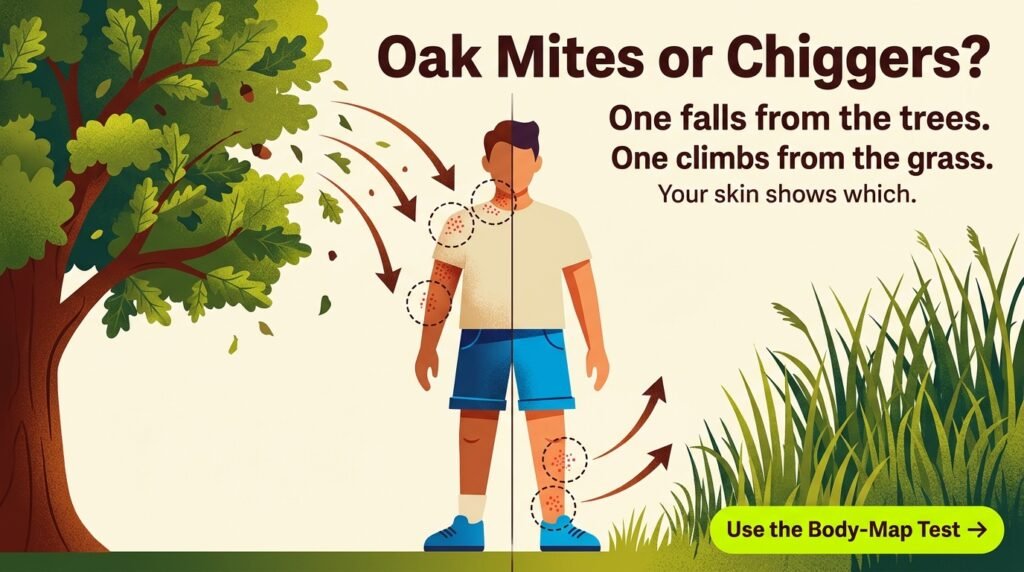
The fast answer: Look at where the bites are. Oak leaf itch mites fall on you from the tree canopy, so their bites land top-down: face, neck, shoulders, arms, and upper torso. Chiggers climb up from grass and leaf litter, so their bites collect bottom-up: ankles, the sock line, and the waistband, where clothing presses tight. Both biters are invisible, both produce fiercely itchy red welts that get mistaken for each other constantly, and both strike after time outdoors — but they come from opposite directions, and your own body map is the single best clue to which one got you.
Why Everyone Mixes These Two Up
The confusion is understandable. Neither biter can be seen in the act: oak itch mites are microscopic, and chiggers are larvae so tiny they are barely visible dots. Both leave itchy red welts rather than an obvious puncture. Both show up after yard work, gardening, or an afternoon outside. And the itch from either can be wildly out of proportion to the size of the bump.
Even public health guidance notes the resemblance — Illinois Department of Public Health material on itch mites describes oak mite welts as ones that “look like chigger bites,” with the crucial difference being location: on the neck, face, arms, and upper body, not typically on the legs where chigger bites are found. Location, plus when the bumps appeared and how long they stay, will separate the two almost every time.
The Body-Map Comparison
| Clue | Oak itch mites (top-down) | Chiggers (bottom-up) |
|---|---|---|
| Where bites appear | Face, neck, shoulders, upper arms, chest, back — skin exposed to the sky or where mites crawl down from hair and collar | Ankles, sock line, behind knees, waistband, underwear elastic, bra line — where clothing fits tight |
| Where the biter lives | Oak tree canopy, feeding in leaf galls; falls or blows down onto people below | Grass, leaf litter, garden edges, berry patches — low vegetation |
| How it reaches you | Drops from above or is carried on the wind; can drift through window screens | Waits on vegetation and climbs onto shoes and legs as you brush past |
| When bumps show up | Delayed — welts form into pimple-like bumps about 12 hours after exposure | Often within a few hours of being outdoors |
| What the bumps look like | Red welts, frequently with a tiny blister or pimple-like head at the centre | Red welts or bumps, often with a bright red centre dot; may crust if scratched |
| How long they last | Up to about 2 weeks — noticeably longer than a mosquito bite | Several days to 1–2 weeks, worst in the first few days |
| Season | Late summer into fall, with outbreak years after big cicada emergences | Late spring through early fall, whenever grass and larvae are active |
| Does repellent help? | Unreliable — mites arrive on the wind and from above, and may never touch treated skin or clothing long enough | Generally yes — repellent on shoes, socks, and pant legs targets exactly where they climb aboard |
If you want the shorter creature-by-creature rundown after using the map, our existing comparison of chigger bites vs. oak mite bites covers the basics — this article goes deeper on the detective work: direction, timing, and context.
Oak Itch Mites: The Biters That Fall on You
The oak leaf itch mite (Pyemotes herfsi) is about 0.2 millimetres long — far too small to see, roughly the thickness of two sheets of paper. It doesn’t want you. Its real prey is the larva of a tiny midge that lives inside galls — crusty-edged growths — on oak leaves. All summer, the mites hunt in the canopy. Then, in late summer and fall, when their food runs out, they drop. A single large oak can shed staggering numbers of mites in a day, and because the mites are nearly weightless, the wind carries them well beyond the drip line of the tree. You do not need to touch an oak to be bitten; sitting on a porch downwind can be enough. The mites are small enough to pass through ordinary window screens, which is why some people swear they were bitten indoors.
Public health guidance from Illinois, which has dealt with repeated outbreaks, notes that a mite generally needs a few hours on your body before it bites — often crawling down from the hair or collar until it reaches skin. You feel nothing when it happens. About 10 to 16 hours later, the welts declare themselves: red, raised, and frequently topped with a tiny fluid-filled blister, concentrated on the neck, face, arms, and upper body. The itch is intense and famously long-lived — up to two weeks, far outlasting a mosquito bite.
The cicada connection
Oak mite outbreaks surge in cicada years. When periodical cicadas emerge in huge numbers, mite populations boom along with the sudden abundance of food in the canopy, and the following late-summer drop produces headline-making bite outbreaks — as happened around Chicago after the 2024 double-brood cicada emergence, when clinics and school nurses fielded waves of patients with itchy upper-body welts. If your neighbourhood had a big cicada year and it’s now late summer, oak mites should be near the top of your suspect list. Gardeners handling armloads of oak branches and fallen leaves during fall cleanup are classic victims — the forearms and neck take the hit.
Chiggers: The Biters That Climb Up
Chiggers are the larvae of harvest mites, waiting in grass, weeds, leaf litter, and garden edges for a warm-blooded passer-by. They climb onto shoes and ankles and wander upward until clothing stops them — which is why the classic chigger map is a ring of bites around the sock line, a cluster at the waistband, and scattered bites behind the knees and in other warm, tight-clothing spots. They do not roam the upper body the way oak mites do.
One myth deserves a clear burial: chiggers do not burrow under your skin, and they are not still inside the bump days later. A chigger attaches at a pore or hair follicle, feeds on liquefied skin cells for a few days at most, and drops off. The welt that remains is your skin’s reaction to the feeding tube it left behind — which is why the itch can rage on after the chigger is long gone, and why painting the bump with nail polish (an old remedy meant to “suffocate” a buried mite) does nothing useful. Bites usually appear within a few hours of exposure, itch hardest over the first day or two, and settle over several days to about two weeks.
The Four-Question Detective Checklist
- Draw the map. Mostly above the chest, or mostly below the waist? Top-down points to oak mites; bottom-up points to chiggers.
- Reconstruct the day. Were you sitting, working, or raking under oak trees — or walking through grass, gardening at ground level, sitting on the ground? Canopy time favours oak mites; ground and grass time favours chiggers.
- Check the clock. Did bumps materialise the next morning, roughly half a day after being outside? That ~12-hour delay fits oak mites. Bites itching the same evening fit chiggers better.
- Check the calendar. Late summer or fall after a cicada year, with crusty brown edges on oak leaves nearby, is oak-mite season par excellence. Peak grass-and-garden season with bites at the ankles is chigger territory.
Treatment: Mostly Shared, With One Difference
For both biters, the goals are the same: calm the itch, protect the skin, and wait out the reaction.
- Shower and change as soon as you come in from a suspect outing — a soapy shower and fresh clothes remove mites and chiggers still wandering your skin before they bite. Wash the worn clothes in hot water.
- Apply an anti-itch treatment: calamine lotion or 1% hydrocortisone cream on the bumps, following label directions.
- Take an oral antihistamine such as cetirizine or loratadine if itching is widespread or keeping you awake, per label directions.
- Use cool compresses for short-term relief on the itchiest clusters.
- Do not scratch. This is the one instruction every public health source repeats, because scratched-open welts are an open door to bacterial skin infection. Keep nails short; cover children’s hands at night if needed.
The difference is expectation: set your calendar by the biter. Chigger bites usually peak fast and fade within about a week; oak mite welts can itch for up to two weeks without anything being wrong. For creature-specific care details, see our guides to oak mite bite treatment and chigger bite treatment.
Prevention: Two Different Playbooks
Against chiggers (ground-up)
- Apply repellent to shoes, socks, and pant legs before grassy or wooded outings — this is exactly their boarding zone.
- Wear long pants tucked into socks in tall grass and leaf litter.
- Shower and change promptly after coming indoors; wash outdoor clothes hot.
- Avoid sitting directly on grass or logs in chigger season.
Against oak mites (top-down)
- During an outbreak, avoid sitting or working under oak trees — especially trees with brown, crusty leaf edges — and move outdoor seating away from the canopy.
- Cover up for yard work: long sleeves, gloves, and a hat when raking or carrying branches, then shower and change immediately after.
- Shower after any prolonged time under oaks in late summer and fall; launder work clothes before rewearing them.
- Don’t count on repellent alone. Because oak mites arrive on the wind and drop from above, repellent is unreliable against them — public health guidance is explicit on this point. Physical barriers and the shower-and-change routine do the real work.
- Keep windows closed on windy days during a known local outbreak if bites seem to be happening indoors; mites can drift through screens.
When to See a Doctor
- Redness that spreads after the second day, increasing pain or tenderness, noticeable heat, pus, or red streaks — the pattern of skin infection rather than a bite reaction.
- Fever, chills, or swollen lymph nodes.
- Itching so intense that over-the-counter treatment doesn’t touch it, or that destroys sleep night after night — a clinician can offer stronger prescription options.
- Bites on an infant, or in someone with a weakened immune system, that look angry or are slow to settle.
- The rash doesn’t fit either map in this article and keeps spreading or recurring for weeks — other causes of itchy welts exist, and an in-person look sorts them out faster than guesswork.
Frequently Asked Questions
Do oak mites infest my house or bed?
No. Oak itch mites are outdoor, tree-canopy mites. They bite people incidentally after dropping or blowing in, but they don’t live in bedding, don’t breed indoors, and don’t set up a household infestation. If bites keep happening in bed over weeks, oak mites are the wrong suspect — that’s a pattern worth investigating for other causes.
Why didn’t my bug spray stop the oak mite bites?
Because oak mites don’t crawl up your legs past treated shoes and socks the way chiggers do. They fall from above or arrive on the wind, often landing on your neck, hair, or shoulders — places most people never treat — and public health agencies note repellent may simply not be effective against them. Barriers, timing, and the shower-and-change routine work better.
How long do oak mite bites last, really?
Up to about two weeks is the figure public health sources consistently give — much longer than the few days of a mosquito bite. The pimple-like welts form roughly 12 hours after the bite, itch intensely for the first several days, and then gradually flatten. A single bite still improving slowly at day ten is within the normal pattern for this mite.
Are chiggers still under my skin?
No. Chiggers attach to the surface, feed for a few days at most, and drop off. The lingering itchy welt is your skin reacting to their feeding, not a mite still living in you. Remedies aimed at suffocating a buried mite — nail polish is the classic — treat a creature that isn’t there.
I have bites in both places — ankles AND shoulders. Now what?
Mixed maps usually mean mixed exposures: a weekend of hiking (chiggers from the grass) plus an afternoon under the oak (mites from the canopy). Treat the itch the same way, run both prevention playbooks, and use the checklist questions day by day rather than trying to force one culprit for every bump.
Can my dog bring oak mites or chiggers inside?
Pets can carry both biters in their fur after outdoor time, and mites can transfer to people from a pet that has been under infested trees. A pet bath after heavy outdoor exposure, and keeping pets off beds during an outbreak, reduces the hand-off. Neither biter lives on pets the way fleas do — they are hitchhikers, not residents.
This article is general information to help identify likely biters and judge urgency; it can’t confirm which mite bit you. Worsening, spreading, or infected-looking bites deserve in-person care.
By Dr. Sarah Jones