
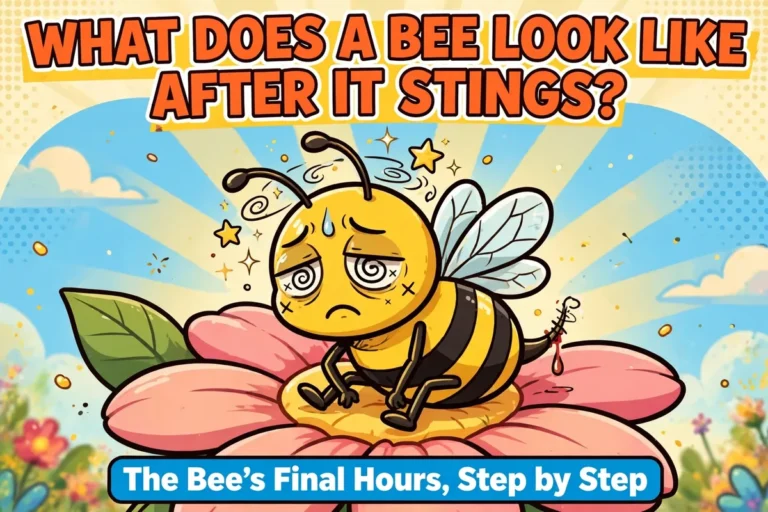
What Does a Bee Look Like After It Stings? The Bee’s Final Hours
Dr. Sarah Jones, MD is still reviewing this article, and her sign-off is awaited before publication. Almost every page that ranks for this question…
Dr. Sarah Jones, MD is still reviewing this article, and her sign-off is awaited before publication. A honey bee stinger is tiny — only a few millimetres long — and…
Dr. Sarah Jones, MD is still reviewing this article, and her sign-off is awaited before publication.
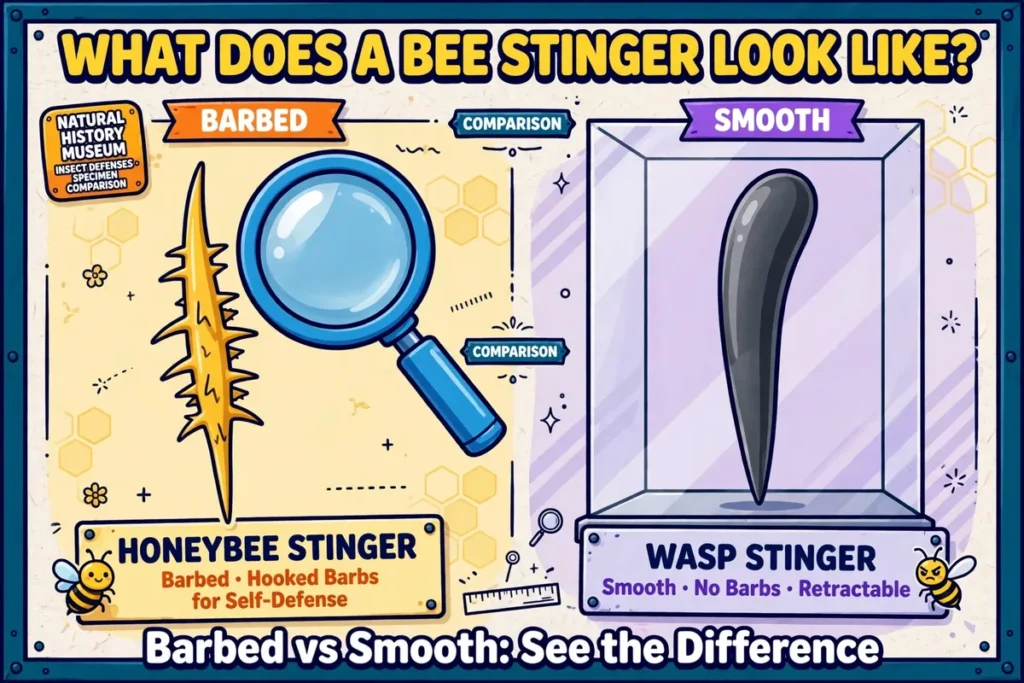
A honey bee stinger is tiny — only a few millimetres long — and most people never really see it. What you can see, if you look at a fresh sting site, is a small black dot or splinter-like speck sitting in the centre of the sting, sometimes with a tiny pale sac attached to it. That speck is the whole sting apparatus: a central stylet with two barbed lancets, plus the venom sac that was torn out of the bee along with it.
That black speck matters more than it looks. The detached venom sac keeps pumping venom into the skin for several minutes after the bee has flown away, which is why removing the stinger quickly — the right way — is the single most useful first-aid step for a bee sting. This page shows you exactly what the stinger looks like up close, how it differs from a bumble bee’s and a wasp’s stinger, and what each one leaves behind in your skin.
Under magnification, a honey bee’s sting is not a single needle. It is a three-part tool:
That tearing is why a honey bee dies after stinging, and it is also why the sting keeps working after she is gone: the detached sac goes on contracting, pumping venom down the stylet for several minutes. University of Minnesota Extension gives the practical version of the same fact: honey bees have tiny barbs on their stinger that stay hooked in the skin, the stinger is torn out of the abdomen, and you should get the stinger out as quickly as possible to lessen the irritation.
To the naked eye, all of this machinery is almost comically small next to the bee herself. A honey bee is about half an inch long; the part left in your skin is a speck a few millimetres long — easy to mistake for a tiny splinter, a fleck of dirt, or nothing at all.

If a honey bee has just stung you, look at the centre of the sting site in good light. MedlinePlus describes what to look for: a small black dot at the sting point. That dot is the end of the sting apparatus. Depending on the angle and how cleanly it tore away, you may also see:
If you see none of this — just a red bump — the sting may have missed anchoring, or you may have been stung by something else entirely. Our dedicated checker walks through the signs step by step: how to tell if a bee stinger is still in your skin. It is the page to use in the moment; this page is the anatomy behind it.
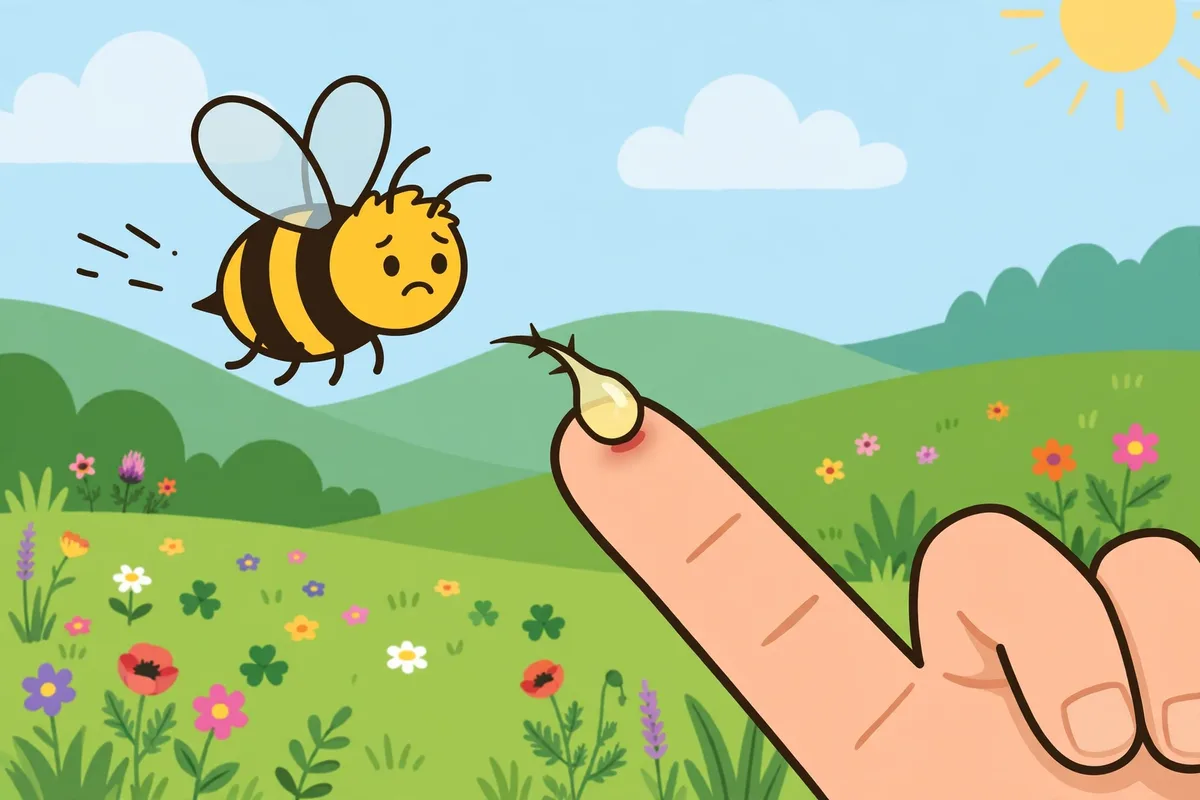
Understanding the sequence explains both what the stinger looks like and why it stays behind:
Every stage of that sequence is why the advice in this article works: the black dot you see is the anchored apparatus (step 3), the urgency about removal is the still-pumping sac (step 5), and the scraping method exists because squeezing the sac with tweezers repeats step 4 by hand.

Most bee stings need nothing beyond the first aid above. MedlinePlus’s guidance adds three watch-outs that are worth stating plainly:
And the emergency rule that overrides everything else: trouble breathing, swelling of the face or mouth, tightness in the throat, difficulty swallowing, weakness, or turning pale or blue means call 911 now. Those are the signs of anaphylaxis, and minutes matter.
The question behind most searches is really “whose stinger is this?” Here is the comparison in one place:
| Honey bee | Bumble bee | Wasp / yellowjacket | |
|---|---|---|---|
| Stinger surface | Barbed — two lancets with fish-hook barbs | Comparatively smooth | Smooth |
| Left in the skin? | Yes — apparatus tears out of the bee | No — withdrawn with the bee | No — withdrawn with the wasp |
| What you see at the sting site | Small black dot/splinter, sometimes a pale venom sac | A puncture and a bump; nothing left behind | A puncture and a bump; nothing left behind |
| Can it sting again? | No — the bee dies after one sting | Yes — repeatedly | Yes — repeatedly |
| First aid difference | Remove the stinger fast (scrape it out) | No stinger to remove; wash and ice | No stinger to remove; wash and ice |
University of Minnesota Extension states the dividing line plainly: yellowjackets, paper wasps, and bumble bees can sting more than once because they can pull their stinger out without injuring themselves, and their stinger is not left in your skin. The honey bee is the exception — and the black dot is how you know.
One more look-alike worth knowing: a splinter or thorn can mimic a stinger almost perfectly. If the “sting” happened while gardening or handling wood and there was no bee seen, treat it as a splinter — and if redness spreads or pain worsens over the next few days, get it checked, because a retained fragment of any kind can become infected.
MedlinePlus’s guidance is specific, and it goes against most people’s first instinct:
Speed matters more than technique debates: every minute the sac sits in the skin, it can keep delivering venom. For the full walkthrough, see how to remove a bee stinger.
Medical disclaimer: This article is general information, not medical advice. Call 911 immediately if a sting is followed by trouble breathing, swelling of the face or mouth, tightness in the throat, difficulty swallowing, weakness, or turning pale or blue — these are signs of a severe allergic reaction (anaphylaxis). Seek medical care for stings inside the mouth or on the eye, for signs of infection (spreading redness, warmth, pus, fever), or whenever you are unsure.
What does a bee stinger look like in the skin? Like a small black dot or a tiny dark splinter at the centre of the sting, sometimes with a small pale venom sac attached on top. It is only a few millimetres long, so look closely in good light.
What does a bee stinger look like under a microscope? A central hollow stylet flanked by two lancets, each edged with backward-facing barbs like a fish hook. The lancets slide alternately to ratchet the sting deeper, and the barbs prevent it from backing out — which is why the apparatus tears free from the bee.
Is the black dot always a stinger? Not always. Dirt, a splinter, or a thorn can look identical. The context is your best clue: a witnessed honey bee sting plus a black dot at the exact sting centre is a stinger until proven otherwise, and scraping it out is safe either way.
Do wasp stingers look different from bee stingers? Yes. A wasp’s stinger is smooth, without the honey bee’s anchoring barbs, and the wasp pulls it back out — so after a wasp sting there is nothing left in the skin to find. See do wasp stings leave a stinger for the full comparison, and our yellowjacket vs honeybee guide if you are not sure which insect stung you.
How long can a bee stinger keep pumping venom? The detached venom sac can keep contracting for several minutes after the bee leaves. That is why “scrape it out now” beats “find the perfect tool first” — a credit card edge used immediately is better than tweezers used five minutes later (and tweezers can squeeze more venom in besides).
Can you see a bee stinger without a magnifying glass? Yes, usually — but you have to look properly. In bright light, ideally with a phone torch held at an angle, the stinger shows as a dark speck that casts a tiny shadow and sits exactly at the sting’s centre, sometimes with the pale sac on top of it. Run a fingertip very lightly over the spot: a retained stinger often feels like a tiny splinter or grit that catches. If the site is smooth, red, and tender with no speck and no catch, there is most likely nothing left in it.
What if I can’t see a stinger but the sting still hurts? Pain, redness, and swelling are the venom already delivered, and they happen whether or not anything remains in the skin. Wash, ice, and monitor. Local reactions can include burning, itching, redness, tenderness, and swelling lasting up to a week. If symptoms spread or you develop any of the emergency signs in the disclaimer above, seek care promptly.
Dr. Jones oversees StingHelp’s clinical verification process. Every guide is systematically evaluated against active Centers for Disease Control and Prevention (CDC), Environmental Protection Agency (EPA), and American Academy of Allergy, Asthma & Immunology (AAAAI) medical consensus standards to ensure symptom distinctions and care recommendations are clinically sound.
Explore physician-reviewed first-aid procedures, identification clues, and symptom comparisons for other common outdoor bites and stings.
Dr. Sarah Jones, MD is still reviewing this article, and her sign-off is awaited before publication. Almost every page that ranks for this question…
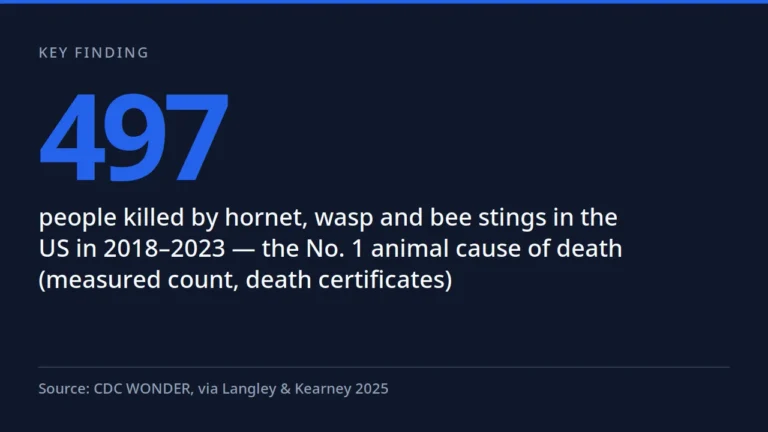
The joined US sting burden: 72 deaths a year on death certificates, an estimated 221,718 ER visits a year in hospital samples, 9,041 admissions across 2010–2014, and 2,648 poison-center cases in 2024 — every figure with its system, period and label.
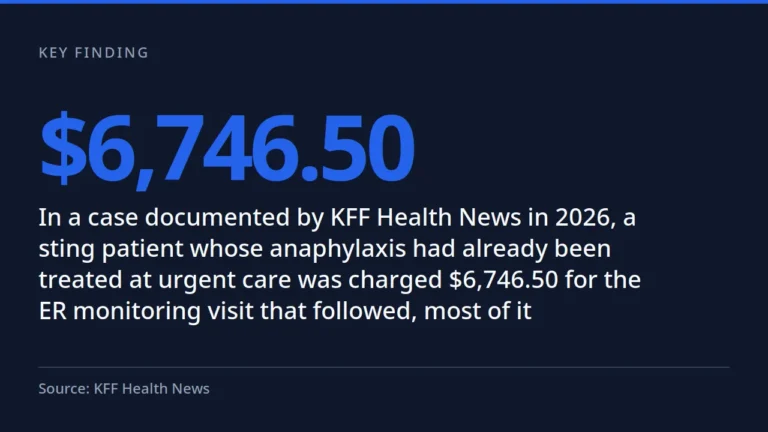
What a bee or wasp sting visit actually bills at urgent care and in the emergency room, by severity, from itemised case bills and national cost data.