Disc golf looks like one of the safest outdoor sports — no contact, no tackling, just you and a basket in the woods. But the game’s defining feature is also its hidden hazard: nearly every round takes you through rough, leaf litter, and wooded edges where ticks quest by the thousands. One of the sport’s biggest stars learned that lesson the hard way.
The short version: ticks disc golf courses go together because wooded courses are ideal tick habitat, and the way the game is played — wandering into the rough to find errant throws, setting bags down on the ground, playing in shorts through brush — multiplies the exposure. This guide explains why courses are tick territory, the cautionary story every player should know, and a practical prevention and post-round routine.
A Cautionary Tale From the Pros
Two-time disc golf world champion Ricky Wysocki — “Sockibomb” to fans — contracted Lyme disease in 2019 after a tick bite during the European tour season. The telltale bullseye rash didn’t appear until weeks after the bite, and by the time he was diagnosed, the illness had taken hold. He sat out the rest of the season, became bedridden, and at his lowest point wasn’t sure he’d ever compete again. In interviews with the Global Lyme Alliance and Muscle & Fitness, he’s described the mental battle as the worst part of the whole experience.
Wysocki fought his way back to elite play — winning back-to-back DGPT Championships in 2022 and 2023 — but he now actively warns other players about tick protection, partnering with Insect Shield to promote permethrin-treated clothing. His story matters because it demolishes the comfortable assumption that tick-borne illness happens to other people. A world-class athlete in peak condition was sidelined for months by a single bite he barely noticed at the time. If you’re playing disc golf in wooded areas, you’re playing in tick habitat — treat every round accordingly.
Why Disc Golf Courses Are Tick Territory
Most disc golf courses are carved through exactly the landscape ticks love: mixed woods with leaf litter, brushy rough along fairways, and grassy edges where forest meets field. Blacklegged ticks, lone star ticks, and American dog ticks all quest from low vegetation, waiting with front legs extended for a warm host to brush past. A disc golf round is essentially hours of brushing past low vegetation.
The rough is the danger zone. Fairways are usually mowed, but the moment your drive sails into the woods, you’re pushing through the undergrowth where tick density is highest. Tournament players who throw far off-line can spend half a round in the rough. Leaf litter deserves special respect: a study published in the Journal of Medical Entomology, highlighted by Cornell’s tick education program, found that piling leaves at lawn-woodland edges tripled blacklegged tick counts, and many courses let leaves accumulate in the woods through the season.
Season matters too. Spring and early summer bring nymph-stage ticks — poppy-seed sized and easy to miss — while fall rounds coincide with adult blacklegged ticks actively questing whenever temperatures are above freezing. There is no month of the disc golf calendar in most of the US when some tick species isn’t active. Players who only think about ticks in June are missing most of the risk window.
Your Gear: The Overlooked Ride Home
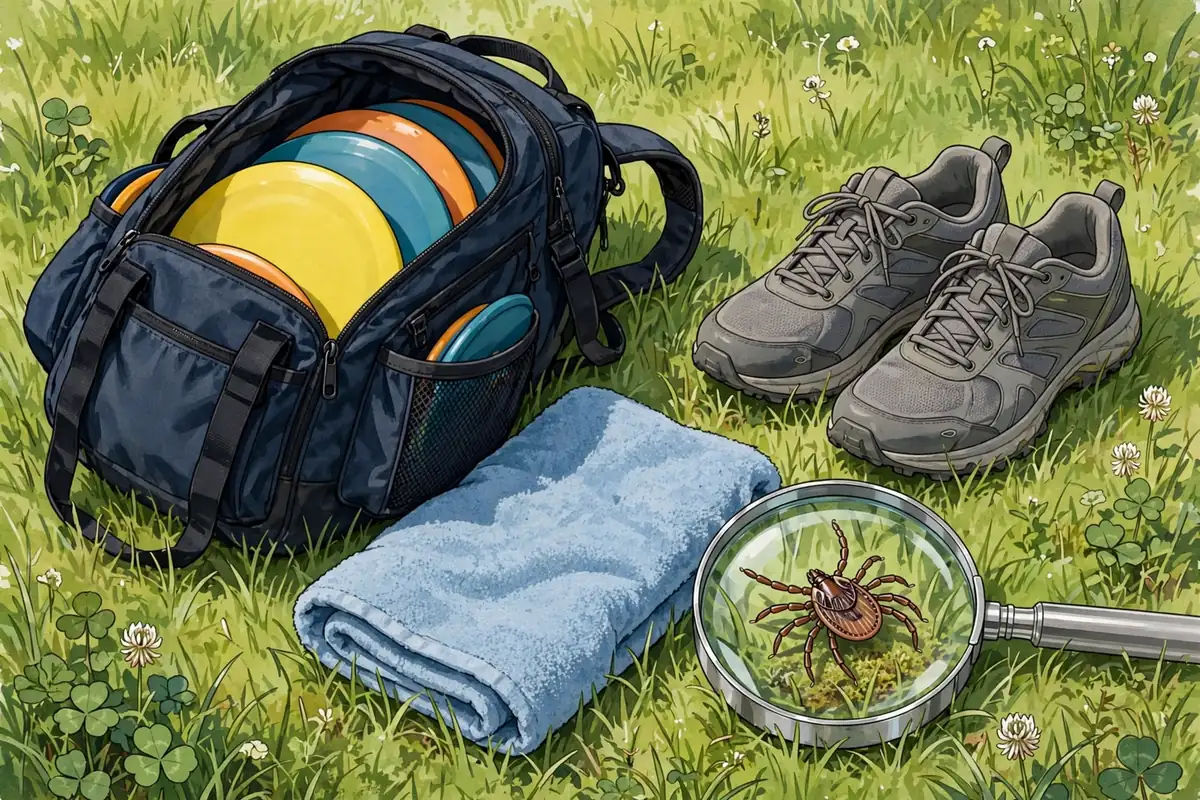
Here’s the exposure vector unique to disc golf: your bag. Players set their bags on the ground at every tee and leave them there while throwing — often in the rough, at the wooded edge of the fairway, or on leaf litter. A bag sitting in questing habitat for four hours is a tick collection device. Ticks that climb onto the bag ride home in your trunk and can transfer to you, your clothes, or your car seats later.
Build a bag habit: set it on the tee pad or a mowed area whenever possible, not in the brush. Between rounds, shake it out outdoors and inspect the straps, pockets, and base. Your towel, which drapes over the bag and drags through grass, deserves the same treatment. Shoes are another vector — ticks climb on low and crawl up, so give your shoes and socks a look before you get in the car, and change out of your round clothes promptly at home rather than lounging in them.
Consider treating your bag itself. A light application of 0.5% permethrin spray to the bag’s exterior (outdoors, allowed to dry fully) turns your gear from a taxi into a trap — permethrin kills ticks on contact and stays effective through multiple washings and weeks of use. It’s a clothing-and-gear treatment only, never for skin, but gear is exactly what the label is designed for.
Prevention That Works on the Course
The standard tick-prevention toolkit works well for disc golf because a round is long and the exposure is continuous. Start with clothing: long pants tucked into socks may clash with the sport’s shorts-and-tee culture, but on wooded courses in tick season, covered legs are the single biggest reduction in bites you can make. Light-colored clothing makes ticks easier to spot during the round, and a hat keeps them out of your hairline on wooded holes.
Permethrin-treated clothing is the gold standard for players. Treat your round-day outfit — pants, socks, shoes — with 0.5% permethrin spray before the season and re-treat per the label (typically effective through about six washings). Wysocki’s own partnership with Insect Shield exists because pre-treated clothing removes the hassle factor: you just get dressed. The treatment kills ticks on contact rather than merely repelling them, which matters when you’re walking through questing habitat for hours.
For exposed skin, use an EPA-registered repellent labeled for ticks, applied exactly as the label directs. During the round, do a quick self-check at the turn — glance at your socks, waistband, and arms. It takes thirty seconds and catches ticks that latched on during the front nine before they’ve had time to settle in and feed.
The Post-Round Routine: Checks, Showers, Laundry

The post-round routine is where most tick encounters get intercepted. Do a full-body tick check as soon as practical after the round — in the parking lot if you’re thorough, or at home in good light. Work through the warm, hidden spots: scalp and hairline, in and around the ears, under the arms, around the waistband, behind the knees, between the toes, and the groin area. Nymphs are poppy-seed sized, so don’t rush.
Shower within two hours of coming off the course. Showering washes off ticks that are still crawling and haven’t attached, and it’s one of the most evidence-supported habits in tick prevention. Toss your round clothes directly into the dryer on high heat for 10–15 minutes — heat kills ticks that survive a cold wash, so the dryer is doing the real work.
Check your gear too: bag, towel, shoes, and anything else that sat on the ground. If you played with a dog, check them around the ears, neck, and legs — dogs pick up ticks readily and bring them into the house. Make this routine as automatic as washing your discs: round ends, check starts.
If You Find an Attached Tick
If the check turns up an attached tick, remove it promptly with clean, fine-tipped tweezers: grasp as close to the skin’s surface as possible and pull straight upward with steady, even pressure. Don’t twist or jerk, and don’t use folk remedies like nail polish, petroleum jelly, or heat — the CDC warns those can irritate the tick and may force infected fluid into the skin. Clean the bite area and your hands afterward.
Save the tick in a small sealed container or zip-top bag with rubbing alcohol, labeled with the date and the course where you played. Species, stage, and likely feeding time all help inform medical decisions if symptoms develop. Dispose of crawling ticks by wrapping them in tape, flushing them, or putting them in alcohol — never crush one with bare fingers.
Watch the bite site for several weeks and note the date of the bite. A small bump fading in a few days is common, but an expanding rash or flu-like symptoms afterward warrant a call to your doctor — mention the tick bite and where it happened. Our bite-and-sting first-aid checklist covers the general after-bite routine, and if swelling behaves oddly in the days after a bite, the guide to why bug bites swell more the next day explains what’s normal and what isn’t.
When to See a Doctor for a Bug Bite

Most tick bites on the course never cause illness, but get medical advice promptly for any of these:
- Call 911 for signs of anaphylaxis: trouble breathing, swelling of the face, lips, or throat, dizziness, or a racing heartbeat after any bite or sting.
- An expanding rash around the bite site, especially one that grows over days — tell the doctor when and where you were bitten.
- Fever, chills, headache, fatigue, or joint and muscle aches developing within weeks of a tick bite, even if you don’t remember the bite.
- Signs of infection: increasing redness, warmth, swelling, or pus at the bite site — possible cellulitis, which needs treatment.
- A tick attached a long time or engorged, or one you couldn’t remove cleanly — mention it, ideally with the saved tick.
- Pregnancy, immune suppression, or a young player with a bite — call your healthcare provider rather than waiting.
For severe reactions to any sting, review the anaphylaxis warning signs so you can act fast.
Frequently Asked Questions
Do I really need to worry about ticks while playing disc golf?
Yes. Wooded courses with leaf litter and brushy rough are prime tick habitat, and the game puts you in that habitat for hours. Ricky Wysocki’s 2019 Lyme disease — contracted during the tour season, leaving him bedridden for months — is the most famous example, but everyday players face the same exposure every round.
What should I do with my disc golf bag to avoid bringing ticks home?
Set it on tee pads or mowed areas rather than in the rough, shake it out and inspect straps and pockets between rounds, and consider treating the exterior with 0.5% permethrin spray (outdoors, dried fully). At home, store it in the garage rather than the bedroom, and run your towel and round clothes through the dryer on high heat.
Are ticks worse in the rough or on the fairway?
The rough, by a wide margin. Mowed fairways are low-risk; the unmowed woods, brush, and leaf litter where errant throws land hold the highest tick densities. The further off-line your game, the more exposure you get — one more reason to work on accuracy.
How soon after a round should I check for ticks?
As soon as practical — ideally right after the round, and no later than a shower within two hours. Ticks often wander before attaching, so prompt checks and showers catch most of them before they bite. Transmission risk rises with feeding time, so earlier is always better.
Can I get Lyme disease from a tick bite on a disc golf course?
A bite from an infected blacklegged tick can transmit Lyme disease wherever it happens, including on a course — but most bites don’t cause illness, and prompt removal sharply reduces risk. Save the tick, note the date and course, and call your doctor if a rash or flu-like symptoms develop in the following weeks. Never try to diagnose yourself from a bump.
Medically reviewed by Dr. Sarah Jones, MD.
This article is for informational purposes only and isn’t medical advice. If you’re worried about a bite or sting, talk to a healthcare professional.