Bed Bug Bites vs Eczema: How to Tell Apart
You wake up with itchy red marks, and the internet offers two suspects: bed bugs or eczema. The question of bed bug bites vs…
Every school year, the same scene plays out in kitchens across the country: a parent parts a child's hair, spots white specks, and feels a jolt of panic. Is it…
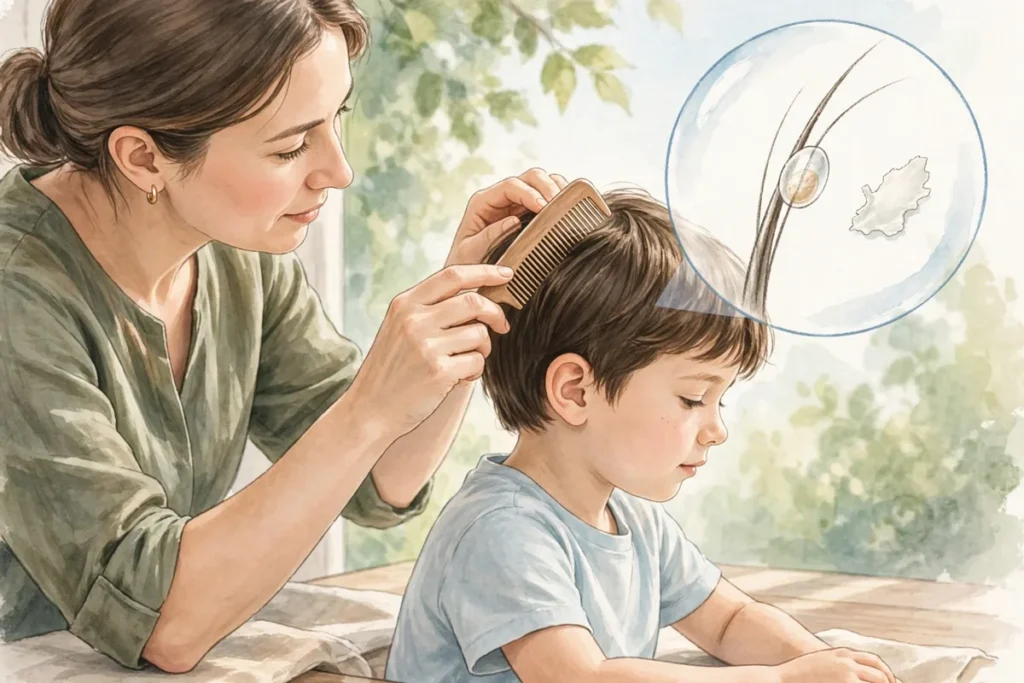
Every school year, the same scene plays out in kitchens across the country: a parent parts a child’s hair, spots white specks, and feels a jolt of panic. Is it head lice, or just dandruff? The two look alike at a glance, both show up as small white or grayish bits in the hair, but they are completely different problems with completely different solutions. Getting the head lice vs dandruff question right matters, because treating dandruff with lice shampoo (or ignoring lice as “just flakes”) both lead to frustration.
The good news is that telling them apart is straightforward once you know what to look for. The single most reliable home check takes less than a minute, and a school nurse can confirm the answer in moments. This article walks through the differences in appearance, feel, location, and itch pattern, explains the right way to check, and covers what to do for each condition, including when a clinician should be involved.
Head lice and dandruff share the same stage: the scalp and hair. Both produce visible specks. Both can cause itching. And both are common in school-age children, which is where most of the confusion happens. Parents checking hair after a classroom lice notice are primed to see lice everywhere, while parents who have never dealt with lice may dismiss real nits as dry scalp for weeks.
The confusion has real consequences in both directions. Treating dandruff as lice means unnecessary pesticide exposure for a child and a household thrown into laundry overdrive for nothing. Missing real lice as dandruff means the infestation spreads, to siblings, classmates, and back again, while the child scratches for weeks. A calm, methodical check beats panic in either direction. As a general rule in any itchy-scalp situation, avoid aggressive scratching that breaks the skin; our guide on why you should never scratch or squeeze a bite explains how broken skin invites infection, a principle that applies to an irritated scalp too.
Head lice are tiny parasitic insects (Pediculus humanus capitis) that live on the human scalp and feed on blood. Adult lice are about 2 to 3 millimeters long, roughly the size of a sesame seed, with elongated, wingless bodies in tan, gray, or brownish tones. They cannot hop, jump, or fly; they spread through direct head-to-head contact, which is why school-age children, who play closely together, are the most affected group. Contrary to stubborn myth, lice do not care whether hair is clean or dirty, and having lice says nothing about hygiene.
Female lice lay eggs called nits, cementing each one to an individual hair shaft with a glue-like substance. Nits are tiny, under a millimeter, oval, and white, yellowish, or translucent, and they are typically laid close to the scalp where it is warm. This cement is the whole story of the head lice vs dandruff question: nits are glued on and do not come off easily, while dandruff flakes are loose. An active infestation usually involves relatively few adult lice, often 20 or fewer, so you may never see a live louse even when nits are present.
Itching is the primary symptom, but it is an allergic reaction to louse saliva, which means it can take two or more weeks to develop in a first infestation. By the time a child starts scratching, the infestation is usually well established. The itch tends to concentrate behind the ears and at the nape of the neck, where lice prefer to feed, and it is often worse at night. Some children, however, barely itch at all; the absence of itching does not rule out lice.
Dandruff is not a parasite at all. It is simply dead skin cells shedding from the scalp faster than usual, often driven by dry skin, sensitivity to hair products, or a common yeast-like fungus (Malassezia) that lives on everyone’s scalp. The flakes are irregular in shape and size, white or yellowish, and they sit loosely on the hair and scalp. Dandruff is extremely common, harmless, and not contagious in any way, you cannot catch it from another person.
Dandruff flakes are flat, irregular, and vary in size. They brush, shake, or blow off the hair easily, you will often see them on shoulders, collars, and dark clothing, which is one of the most reliable distinguishing features. They may be accompanied by a dry, tight-feeling scalp, and in some people the scalp looks slightly red or irritated. Unlike nits, flakes have no fixed position on the hair shaft and no uniform shape.
Dandruff can itch, especially when the scalp is dry or irritated, but the itch is usually milder and more diffuse than the intense, localized itching of lice. It does not typically concentrate behind the ears and at the nape of the neck. If the scalp is very red, greasy, or scaly with thick yellowish patches, that may be seborrheic dermatitis rather than simple dandruff, worth a clinician’s look, but still not lice.
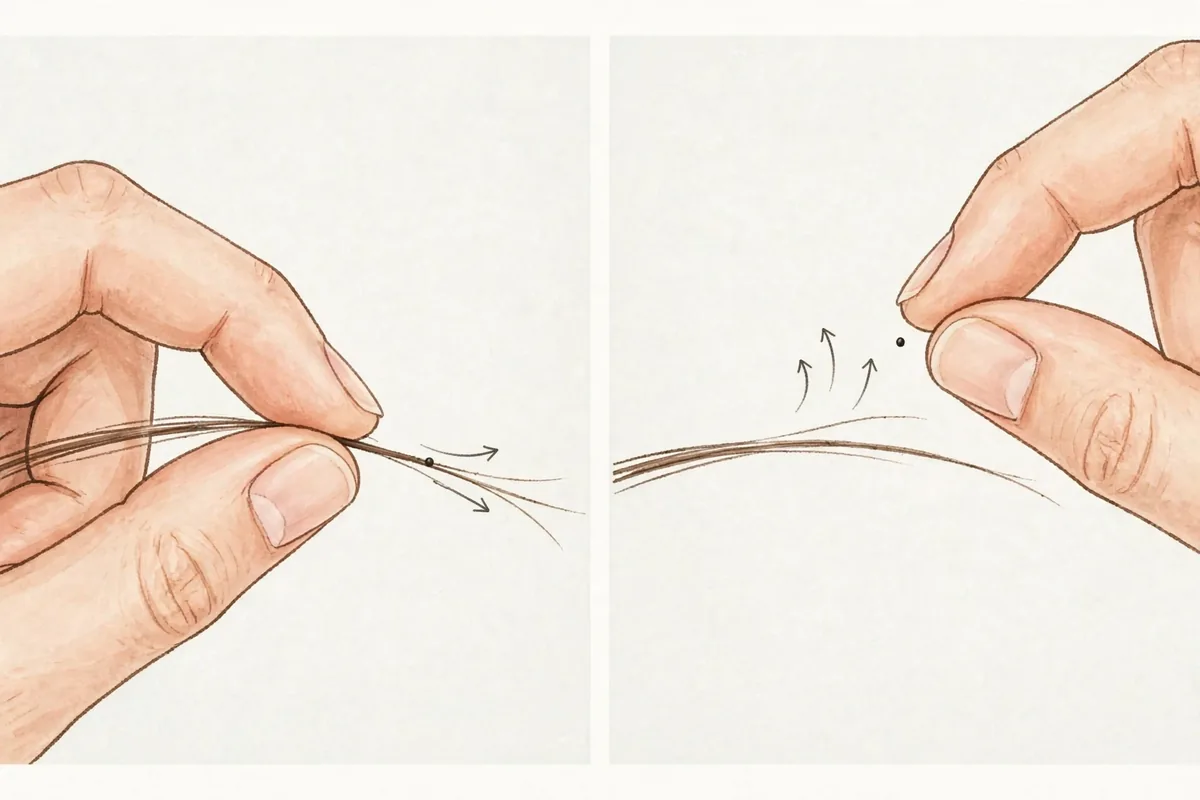
If you remember one thing from this article, make it this: try to move the speck along the hair shaft with your fingertip.
This test works because it targets the one structural difference that never overlaps. Shape, color, and size can look similar in poor light, but attachment behavior does not lie. Work in bright natural light or under a strong lamp, part the hair in sections, and test several specks, a mix is possible, since a child can have both dandruff and lice at the same time.
For suspected lice, concentrate on the warm zones: behind the ears and along the nape of the neck, where nits are most often laid. Use your fingers to part the hair close to the scalp rather than scanning the lengths, since nits sit near the root. For suspected dandruff, look at the part line, the crown, and the shoulders of dark clothing, widespread loose flaking across the whole scalp points to dandruff.
A simple magnifying glass transforms the check. Under magnification, nits show their teardrop or oval shape and the angle at which they grip the shaft; dandruff shows flat, irregular edges with no attachment point. If you are checking a squirmy child, wet the hair slightly first, it calms flyaways and makes parting easier.
| Feature | Head Lice / Nits | Dandruff |
|---|---|---|
| What it is | Parasitic insect eggs (nits) glued to hair | Loose dead skin flakes |
| Attachment | Cemented to shaft; hard to slide or remove | Loose; brush, shake, or blow off easily |
| Shape | Uniform tiny ovals/teardrops | Irregular, flat, varying sizes |
| Location | Near scalp, behind ears, nape of neck | Across whole scalp; falls on shoulders |
| Color | White, yellowish, or translucent | White or yellowish |
| Itch | Often intense, localized behind ears/nape, worse at night | Usually mild, diffuse across scalp |
| Contagious | Yes, head-to-head contact | No |
| Live insects | Adults 2-3 mm may be seen moving (fast, avoid light) | Never |
| Key home test | Speck resists sliding along the hair shaft | Speck flicks off or slides freely |
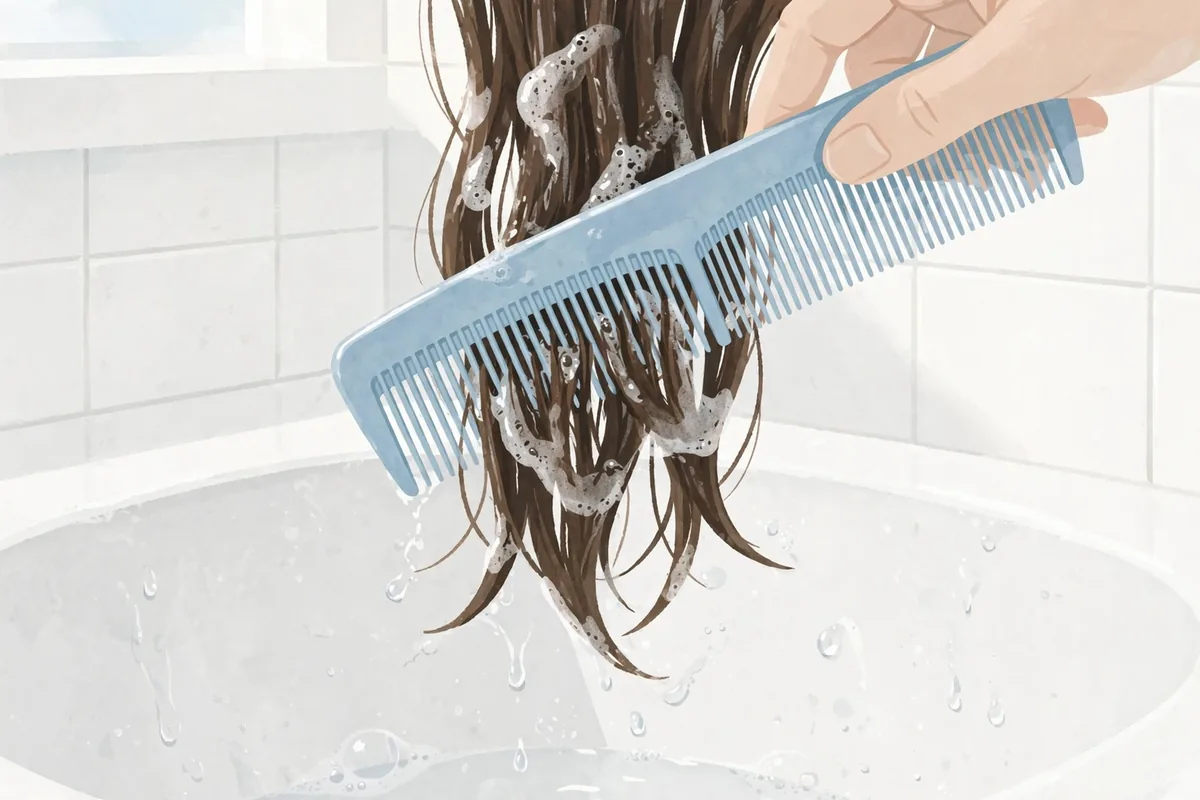
Wet combing, working through damp, conditioned hair with a fine-toothed nit comb, is both a detection method and a treatment approach. The conditioner temporarily immobilizes lice, and the fine teeth (spaced to trap nits and lice while letting hair pass) pull them out. Wiping the comb on a white paper towel after each stroke lets you see exactly what came out: nits appear as tiny specks that smear or stick, while dandruff wipes away as loose flakes.
For a thorough check: wash and condition the hair, then, while it is still wet and slippery, comb from root to tip in small sections with the nit comb, wiping the comb after every stroke. Examine what collects on the towel. Finding even one live louse confirms an active infestation; finding nits alone, especially more than a quarter inch from the scalp, is less conclusive, since empty nit casings can remain glued to hair long after an infestation is gone.
Repeated wet combing every few days for a couple of weeks is a legitimate, pesticide-free way to manage lice: each session removes newly hatched nymphs before they can mature and lay eggs. It is labor-intensive but avoids chemical treatments entirely, which is why many families and some school health programs prefer it as a first step. Patience matters more than force, comb gently to avoid hurting the child and turning the process into a battle.
Before reaching for any product, know that combing and nit-picking are effective on their own when done thoroughly and repeatedly. Many cases resolve with diligent wet combing alone. This matters because the research brief for this article specifically cautions against pesticide overuse: reaching for the strongest chemical option first, or applying lice shampoos “just in case,” is not good practice, especially for children.
Over-the-counter lice treatments are pesticides, and they should be used exactly as directed, never more often, longer, or in larger amounts than the label says. Do not combine multiple lice products, do not use them on eyebrows or eyelashes, and do not use them preventively on children who do not have lice. If a first treatment does not work, the likely explanations are reinfestation from an untreated contact or resistance, not a need for stronger chemicals applied at home. Talk to a clinician or pharmacist before trying a different product, and be aware that some older ingredients (such as lindane) carry serious safety concerns and are not first-choice options.
Lice die within a day or two without a human host, so the household response can stay proportionate: machine-wash bedding, hats, scarves, and recently worn clothing in hot water and dry on high heat; soak combs and brushes in hot water; vacuum upholstered furniture and car seats. There is no need to bag every stuffed animal for weeks, spray the house with insecticide, or keep children home for extended periods, most school policies allow return after the first treatment. Check all household members and treat only those with evidence of lice. For families heading to summer programs, our guide on whether mosquito repellent stickers work for kids helps sort the genuinely useful kid-safe options from the gimmicks.
Dandruff responds well to regular washing with an anti-dandruff shampoo containing an active ingredient such as zinc pyrithione, selenium sulfide, salicylic acid, or ketoconazole. Lather, leave on for the time the label directs, rinse thoroughly, and use consistently for a few weeks, dandruff shampoos work through regular use, not one dramatic wash. Alternate with a gentle regular shampoo if the scalp feels dry.
If flakes are thick, yellowish, and greasy, if the scalp is very red or inflamed, if there are scaly patches extending beyond the hairline onto the forehead or behind the ears, or if anti-dandruff shampoo makes no difference after a few weeks, see a clinician. Seborrheic dermatitis, scalp psoriasis, and contact dermatitis from hair products can all mimic stubborn dandruff, and each has its own treatment. A dermatologist can sort these out quickly.
Gentle habits help regardless of the diagnosis: avoid scratching with fingernails (which breaks skin and can lead to infection), rinse shampoo thoroughly, go easy on heavy styling products that build up on the scalp, and manage stress and dry winter air, which both worsen flaking. Teach children to report itching early rather than scratching silently, early detection makes both lice and dandruff easier to handle.
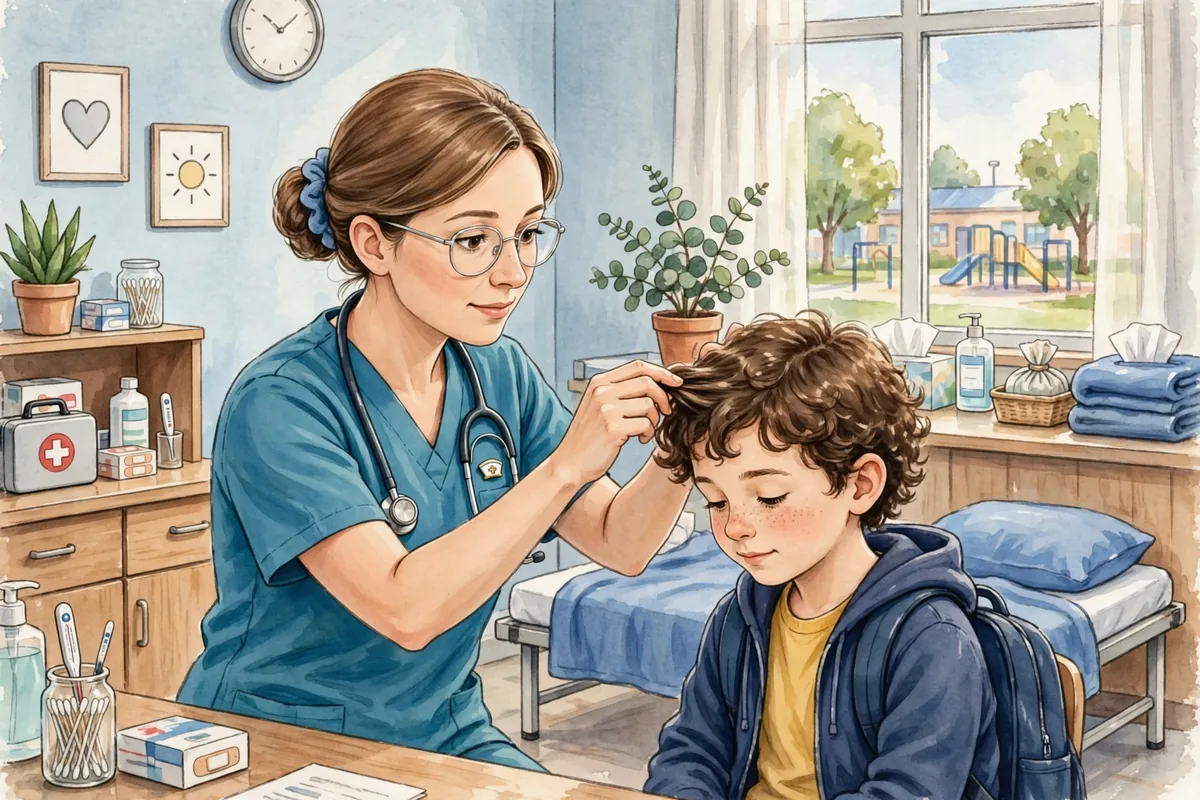
School nurses see this exact question constantly and can usually settle it in a minute or two with good light and experience. A nurse’s confirmation carries weight in both directions: it stops unnecessary treatment when the specks are dandruff, and it triggers the right response, discreet notification, checking siblings, treating the child, when it is lice. Many schools have “no-nit” or “return after treatment” policies, so knowing the school’s rules before you go in saves a second trip.
If lice are confirmed, notify the school promptly and matter-of-factly, lice are a routine childhood nuisance, not a hygiene failure, and schools handle notifications discreetly. Ask about the school’s exclusion policy so you know exactly when your child can return. There is no need to announce it to every parent yourself; the school nurse manages classroom notifications. Keep the tone normal with your child, too, embarrassment makes children hide itching, which delays the next detection.
When one child has lice, check everyone in the household with the wet-combing method, and recheck a week later. Treat only those with live lice or viable nits near the scalp. Siblings who share beds, brushes, hats, or headphones are the highest-risk contacts. A calm, routine “lice check Sunday” during an outbreak in the classroom catches new cases before they spread.
Can you have both head lice and dandruff at the same time?
Yes. The two are unrelated, and a flaky scalp does not protect against lice. If the attachment test shows some specks glued on (nits) and others brushing off freely (dandruff), treat the lice first with thorough wet combing or an appropriate product, and manage the dandruff separately with regular anti-dandruff shampoo once the lice are resolved.
How far from the scalp can nits be and still mean an active infestation?
Nits are laid close to the scalp, and viable ones are generally found within about a quarter inch of the root. Nits found farther out on the hair shaft are often empty casings left over from an old, resolved infestation, hair grows about half an inch per month, carrying old nits outward. A live louse found during wet combing is the definitive sign of an active infestation.
Do I need to wash everything in the house if my child has lice?
No, keep it proportionate. Wash bedding, hats, scarves, jackets, and clothing worn in the last couple of days in hot water and dry on high heat; soak combs and brushes in hot water; vacuum sofas and car seats. Lice die within a day or two off the scalp, so there is no need to fumigate, bag toys for weeks, or treat pets. Focus effort on the child’s head, not the house.
Can adults get head lice from their children?
Yes, though it is less common than child-to-child spread. Adults get lice through the same route: prolonged head-to-head contact. Checking parents and caregivers with the wet-combing method when a child is infested is sensible, and adults with long hair that regularly contacts the child’s head are at higher risk. Treat only those with evidence of lice.
My child’s school has a no-nit policy. What does that mean?
A no-nit policy means the child cannot return to school until no nits remain in the hair, even after treatment. These policies are controversial, many health authorities note that nits alone, without live lice, do not spread infestation, but if your school enforces one, meticulous nit removal with a fine-toothed comb is the way to comply. Ask the school nurse exactly what standard they apply so you are not making extra trips.
Medically reviewed by Dr. Sarah Jones, MD.
This article is for informational purposes only and isn’t medical advice. If you’re worried about a bite or sting, talk to a healthcare professional.
Dr. Jones oversees StingHelp’s clinical verification process. Every guide is systematically evaluated against active Centers for Disease Control and Prevention (CDC), Environmental Protection Agency (EPA), and American Academy of Allergy, Asthma & Immunology (AAAAI) medical consensus standards to ensure symptom distinctions and care recommendations are clinically sound.
Explore physician-reviewed first-aid procedures, identification clues, and symptom comparisons for other common outdoor bites and stings.
You wake up with itchy red marks, and the internet offers two suspects: bed bugs or eczema. The question of bed bug bites vs…
Your child wakes up covered in itchy red spots and the questions start immediately: is this chickenpox vs bug bites, an allergic reaction, or…
Your child comes in from the yard clutching a caterpillar they thought looked cool, and now their hand is burning. Or you brush a…