You spotted a black-and-yellow wasp gliding around your porch and your first thought was “yellowjacket.” That guess is wrong more often than most people realize, because European paper wasp vs yellowjacket is one of the most common misidentifications in American backyards. The European paper wasp (Polistes dominula) is a near-perfect mimic of the yellowjacket: same bold black-and-yellow pattern, same size range, same habit of showing up wherever people eat outside. But it belongs to a different branch of the wasp family, builds a different kind of nest, behaves differently, and stings for different reasons.
Getting the ID right matters for practical reasons. A yellowjacket nest in the ground near your walkway is a stinging hazard that often needs professional removal, while an early-season paper wasp comb under your deck railing may be a watch-and-wait situation. Mistaking one for the other leads people to spray the wrong nest, disturb the wrong colony, or panic over a wasp that was never going to bother them. It also matters medically: both can sting repeatedly and both can trigger allergic reactions, so anyone with a sting allergy needs to take either insect seriously.
This guide walks you through the field marks that separate them, the nests they build, how they behave through the season, what their stings do, and what to do when a nest shows up near your home. One clarification on scope: this article is about the invasive European paper wasp specifically. Native North American paper wasps, which tend to be darker and reddish-brown, are a different comparison and a different conversation.
Why These Two Wasps Get Confused
The confusion starts with color. Both insects wear the high-contrast black-and-yellow uniform that humans instinctively read as “danger,” and from a few feet away the resemblance is strong enough that even experienced gardeners mix them up. Penn State Extension notes plainly that European paper wasps are frequently mistaken for yellowjackets, and pest-control writers at Colonial Pest Control have run the headline “Sometimes paper wasps look like yellowjackets!” for years because homeowners keep asking about it.
The mimicry is not a coincidence of one summer. The European paper wasp is an invasive species that arrived in North America around 1978, when a sighting was reported at a shipyard in Boston, Massachusetts. From that foothold it spread across eastern North America within about two decades and reached California by 2001 or 2002, displacing native paper wasps along the way. If you live in a city or suburb, the paper wasp working your eaves is quite likely this species rather than one of the native ones.
What makes the European species a special case, even among paper wasps, is its temperament. Paper wasps of any species are generally less aggressive than yellowjackets, but Colonial Pest Control notes that the European paper wasp behaves more like the yellowjacket it mimics: it is more aggressive than our native paper wasps, nests in exposed areas like roof overhangs, and will also use building voids and crevices, just like yellowjackets do. That combination of mimicry plus yellowjacket-adjacent behavior is exactly why this comparison trips people up. You are not looking at a mild-mannered native and you are not looking at a true yellowjacket. You are looking at something in between, and the ID tells you how to act.
At a Glance: The Field Marks That Matter
When the wasp is in front of you, four features give you the answer. None requires catching the insect. A calm look from a safe few feet away, ideally while it is at rest or in slow flight, is enough.
Antennae: the single best field mark
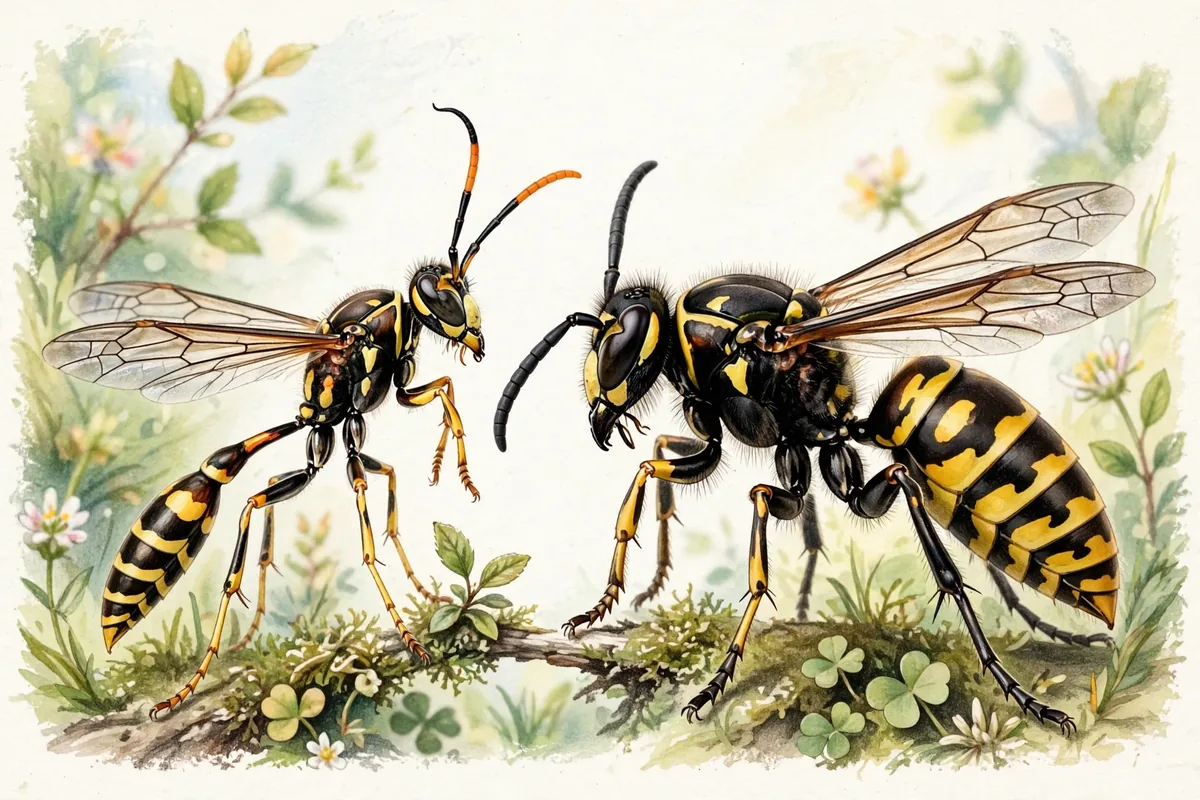
The European paper wasp has orange or rust-orange antennae, often brightest at the tips. Yellowjacket antennae are solid black. Colorado State University’s invasive-species description puts it memorably: the bright orange antennae are something no native wasp possesses, which makes them the quickest positive ID available to a homeowner. If you see orange antennae, you are looking at a European paper wasp, not a yellowjacket.
Flight posture: the second giveaway
Paper wasps fly with their long legs dangling loosely beneath them, trailing behind the body like landing gear. Yellowjackets tuck their legs tight against the body in flight. Penn State Extension’s comparison photography shows this clearly, and it is the kind of thing you can check from across the yard while the wasp works a flower bed.
Body shape: the third story
The European paper wasp is more slender, with a thin, thread-like waist connecting the thorax and abdomen. Yellowjackets are slightly more robust, blunter, and more compact, with a waist that is less dramatic. The paper wasp also runs a little larger overall.
Wings and color pattern: finishing the ID
The European paper wasp’s wings carry an orange tint that echoes its antennae, and its black-and-yellow pattern sits on that slender frame. Yellowjackets show cleaner, crisper banding on a stockier body with smoky, translucent wings. One more subtle clue: paper wasps of this species have noticeably longer legs in general, which is part of why the dangling flight posture looks so distinctive.
| Feature | European Paper Wasp (Polistes dominula) | Yellowjacket (Vespula spp.) |
|---|---|---|
| Antennae | Orange or rust-orange, brightest at tips | Solid black |
| Legs in flight | Dangle loosely, trail behind | Tucked tight against body |
| Body shape | Slender, very thin waist | Robust, compact, blunter |
| Wing tint | Orange-tinged | Smoky, translucent |
| Legs | Long and conspicuous | Shorter, less noticeable |
| Size | Slightly larger | Slightly smaller, stockier |
Run through the table the next time one lands on your railing. If two or three of these point the same direction, your ID is solid.
Nests: Open Umbrella vs Paper Envelope
If you have found the nest, you may not even need to see the wasp. The architecture gives it away.
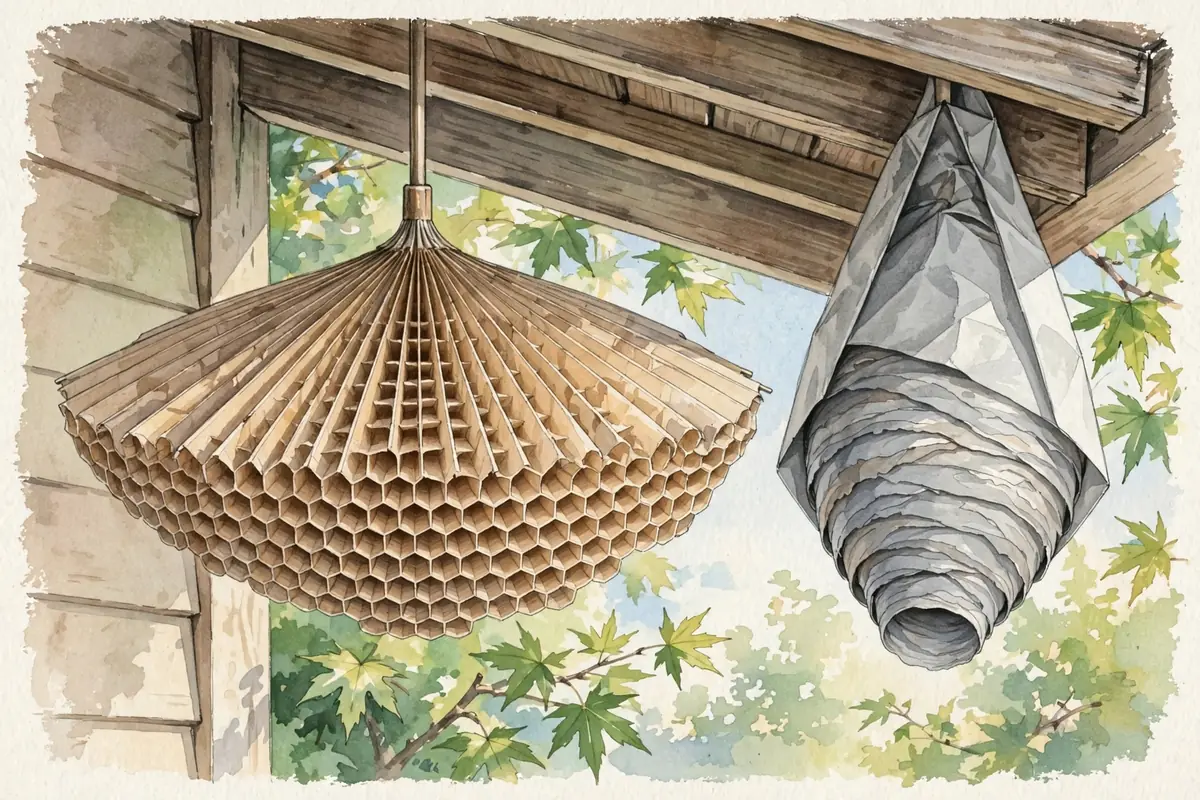
European paper wasp nests are a single open comb, shaped like an upside-down umbrella, with the hexagonal cells fully visible from below. You will find them attached to sheltered spots: overhangs and eaves, window frames, under deck railings, inside open garages, on fence rails, and sometimes tucked into outdoor equipment, grills, vehicles, or bird boxes. The texture is gray-brown paper made from chewed wood mixed with saliva, but there is no envelope around the comb. From a distance it looks like a small gray parasol hanging from whatever it is attached to. Early in the season these combs can be tiny, just a few cells with a single queen working them, and they grow through the summer as workers emerge.
Yellowjacket nests are enclosed. Whether built underground, which is the classic yellowjacket setup, or in a wall void, an attic corner, or a hollow tree, the nest is made of multiple layered combs wrapped in a papery envelope. When a yellowjacket nest is in the ground, you never see the structure at all, only the entrance hole with a stream of traffic going in and out. Aerial yellowjacket nests look like gray footballs or teardrops hanging from a branch or tucked into a structure, and the surface is smooth and sealed.
This difference has practical consequences. An open comb means you can see how large the colony is and where the wasps are. An enclosed or underground nest means you are dealing with a structure you cannot inspect and an entrance where defenders can pour out quickly. It also explains why one nest can sit quietly under your eave all summer while another one ruins your August: visibility and access shape the risk. If you are comparing what you found to paper wasp sting treatment guidance or wondering about yellowjacket-specific care, our yellow jacket sting treatment guide covers the enclosed-nest scenario in more detail.
Behavior: An Invasive Opportunist vs a Picnic Raider
Behavior is where the European paper wasp earns its reputation as the yellowjacket’s understudy. Most native paper wasps are live-and-let-live foragers that only defend the immediate nest. The European species is pushier. It wakes up earlier in spring than many native species, which lets it claim the best nesting sites first, and it outcompetes native wasps for food. It hunts caterpillars and other insects, which makes it useful in a garden, but it also has yellowjacket-like tastes: it will work over your soda can, your fallen fruit, and your barbecue with an enthusiasm that native paper wasps rarely show.
Yellowjackets take this to the extreme. They are the insects that ruin picnics, swarm garbage cans in late summer, and investigate every open drink. Their colonies are much larger than paper wasp colonies, often thousands of workers by late summer, and their temper scales with colony size and the dwindling food of fall. A yellowjacket foraging at your plate is aggressive about holding its ground in a way a paper wasp usually is not.
Around the nest, both species defend, but the stakes differ. A European paper wasp colony is small, usually dozens of wasps rather than thousands, and its defense is focused on the nest itself. Disturb the comb and they will defend it vigorously, as one pest-control guide warns. But they do not have the sheer numbers or the hair-trigger swarming response of a late-season yellowjacket colony, where one sting releases alarm pheromones and the whole nest pours out. That said, never assume a small nest is harmless. Multiple stings from any wasp species are a medical concern, and European paper wasps, unlike most native paper wasps, will nest in building voids and crevices where encounters happen at close range.
Seasonality matters too. Paper wasp colonies are annual: the queen starts fresh each spring, workers build through summer, and the colony dies off in fall, with only mated queens overwintering in sheltered spots. By late fall the nest under your eave is empty and will not be reused next year. Yellowjackets follow the same annual cycle, but their late-season colonies are at peak size and peak irritability right when you want to be outside. Fall is when most yellowjacket stings happen, and it is when a misidentified European paper wasp nest gets the most attention.
Sting Comparison: What Happens If You Get Stung
Both insects sting with a smooth stinger, which means both can sting repeatedly without losing the stinger the way a honey bee does. The immediate experience is similar: sharp, burning pain at the moment of the sting, followed by redness, swelling, and itching that typically peaks within a day or two. Neither species’ venom is considered unusual among wasps, and a single sting from either one is, for most people, a painful but self-limited event.
The meaningful differences are about context rather than chemistry. Yellowjackets are more likely to deliver multiple stings in one encounter because they swarm, they are quicker to interpret your presence as a threat, and they are the species most often involved when someone disturbs an underground nest with a mower. European paper wasps typically sting singly or in small numbers, usually when someone gets too close to the comb or tries to knock it down. For the person on the receiving end, five yellowjacket stings hurt more than one paper wasp sting for the obvious reason of arithmetic, not because of some special property of the venom.
Allergy is the great equalizer. If you have a known allergy to wasp or bee stings, either insect can trigger anaphylaxis, and the species of wasp does not change your emergency plan. Carry your epinephrine auto-injector if your doctor has prescribed one, use it at the first sign of a systemic reaction, and call 911. People who have had a severe reaction to one type of wasp sting should discuss the full picture with an allergist, because wasp venoms share enough similarity that sensitivity often crosses species lines. Our anaphylaxis sting warning signs page lists exactly which symptoms mean the reaction has gone beyond a normal local response.
For a normal, non-allergic sting from either insect, the home care is the same: wash the area, apply a cold compress, and avoid scratching. Antihistamines and over-the-counter pain relievers help many people, but check with a pharmacist or your doctor about what is appropriate for you, especially for children.
What to Do About a Nest Near Your Home
Your response should match the nest, and that is exactly why the ID work above pays off.
An early-season comb in a low-traffic spot
An early-season European paper wasp comb in a low-traffic spot is the most flexible case. A small umbrella comb under a far deck railing or on a shed overhang, well away from doors and play areas, can often be left alone for the season. The colony will die off naturally in fall, and the empty nest will not be reused. The trade-off is awareness: note where it is, tell the household, and keep an eye on its growth through summer.
A nest near a doorway, grill, or play area
A European paper wasp nest near a doorway, grill, or play area is a different matter. These are high-traffic zones where an accidental bump into the comb is likely, and this species defends its nest more readily than native paper wasps. If someone in the home has a sting allergy, the threshold for action should be much lower: no nest near a doorway is acceptable when anaphylaxis is in the family. For nests in wall voids or crevices, do not attempt DIY removal. A nest inside a structure can have wasps entering through gaps you cannot see, and disturbing it can push them indoors.
A yellowjacket nest, especially underground or in a wall void
A yellowjacket nest, especially underground or in a wall void, is a professional job in most cases. The colony is large, the structure is enclosed, and late-season colonies are at their most defensive. The classic mistake is discovering the entrance while mowing and then trying to deal with it in the moment. Mark the spot from a distance, keep people and pets away, and call a pest management professional. Ground nests near walkways, play equipment, or anywhere people move quickly are the highest priority.
What never works
Swatting at foragers: killing individual wasps does nothing to the colony and, with yellowjackets especially, crushed wasps release alarm pheromones that draw more defenders. Spraying an enclosed nest yourself often just seals the entrance and redirects angry wasps through interior wall gaps. And attempting to knock down an active paper wasp comb with a broom is how most single-nest sting incidents happen: the wasps survive the fall and defend the queen. If you must act, do it in the evening when foragers have returned and activity is low, wear full coverage, and have an escape route planned. Or, more sensibly for anything larger than a starter comb, let a professional handle it.
When to See a Doctor for a Sting

Most wasp stings heal on their own, but certain signs mean you need medical care rather than home treatment. Call 911 immediately if you or someone near you develops any sign of anaphylaxis: difficulty breathing, swelling of the lips, tongue, or throat, dizziness or fainting, a rapid or weak pulse, or hives spreading well beyond the sting site. These symptoms can escalate within minutes, so do not wait to see whether they improve.
Seek prompt medical care, same day, for multiple stings (roughly a dozen or more), stings inside the mouth or throat, or a sting near the eye that affects vision. Watch any sting for signs of infection over the following days: increasing redness that spreads outward, warmth, swelling that keeps growing after 48 hours, pus, red streaks leading away from the site, or fever. These can indicate cellulitis, which needs antibiotics and will not resolve with home care.
People with known sting allergies, heart conditions, or immune-suppressing conditions should have a lower threshold for calling their doctor after any sting. Parents should watch children closely: a large local reaction that covers most of a limb is common and usually not dangerous, but swelling that crosses a joint and limits movement, or any systemic symptom, deserves a call to the pediatrician.
Frequently Asked Questions
Can a European paper wasp sting more than once?
Yes. Like yellowjackets, European paper wasps have smooth stingers that are not barbed, so they can sting repeatedly without injuring themselves. This is one reason to give an active nest a wide berth rather than trying to swat individual wasps near the comb.
Are European paper wasps more dangerous than yellowjackets?
Not exactly. Yellowjackets are generally the bigger hazard because their colonies are far larger, they are more aggressive foragers, and they swarm more readily. But the European paper wasp is more aggressive than native paper wasps, defends its nest vigorously, and can sting repeatedly, so it deserves respect. For someone with a sting allergy, either insect is dangerous.
Do European paper wasps reuse their nests?
No. Like all paper wasps and yellowjackets in temperate regions, the colony is annual. Workers and the old queen die in fall, and only mated new queens overwinter in sheltered spots to start fresh colonies in spring. An empty nest in November will stay empty. You can remove old nests in winter without any risk.
Why are there so many more of these wasps than when I was a kid?
You may be noticing the invasion. Since arriving in Massachusetts around 1978, the European paper wasp has spread across the continent and displaced many native paper wasps, especially in urban and suburban areas. Its habit of waking earlier in spring lets it claim the best nesting sites first. If your childhood paper wasps were dark reddish-brown, those were likely natives; the black-and-yellow ones on your eaves now are probably the newcomers.
Will a European paper wasp sting me at a picnic?
Probably not, but do not count on it. This species is less food-aggressive than yellowjackets, which are the true picnic pests. But European paper wasps do scavenge sweets and proteins, especially in late summer, and one investigating your drink can sting if it gets trapped against your skin or you swat at it. Keep drinks covered and stay calm around foragers.
Medically reviewed by Dr. Sarah Jones, MD.
This article is for informational purposes only and isn’t medical advice. If you’re worried about a bite or sting, talk to a healthcare professional.