
Straw Itch Mite vs Oak Mite Bites: Fall Rash ID
October is the peak month for one of the most baffling skin complaints of the year. You rake leaves under the big oak in…
You wake up itchy, your skin is red and blotchy, and someone mentions the word "mites." Your mind jumps to the worst option: scabies. But hold on. The phrase dust…
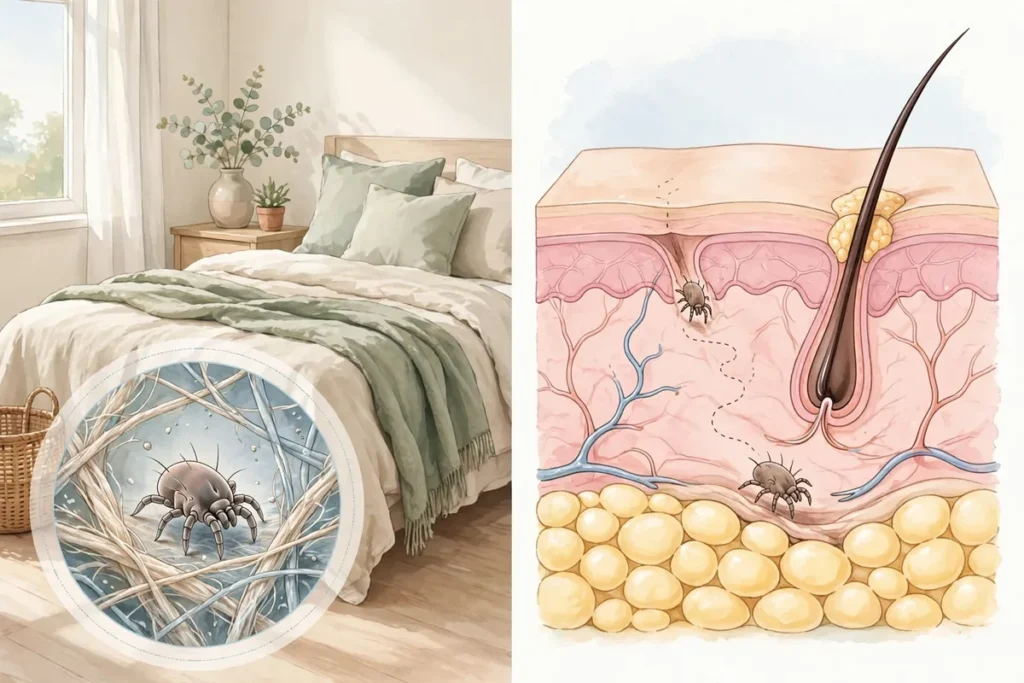
You wake up itchy, your skin is red and blotchy, and someone mentions the word “mites.” Your mind jumps to the worst option: scabies. But hold on. The phrase dust mite rash vs scabies actually describes two completely different problems, one is an allergy, the other is a contagious skin infestation. Mixing them up matters, because the fixes are nothing alike. Antihistamines and mattress covers will not treat scabies, and prescription scabicides are not needed for dust mite allergy.
This article walks through the core difference most comparison pages blur: dust mites do not bite people at all. A “dust mite rash” is your immune system reacting to microscopic waste and fragments, while scabies is a living mite burrowing through your skin. We will cover how each one looks and feels, the burrow-track sign that points toward scabies, the bedding-and-morning pattern that points toward dust mite allergy, how clinicians tell them apart, and what to do for each. Only a clinician can diagnose you, so treat everything here as education to bring to your appointment, not a verdict.
The confusion starts with the shared word “mite” and the shared setting: your bed. Both conditions make you itchy at night or in the morning, both involve microscopic creatures associated with bedding, and both get blamed whenever someone finds an unexplained rash. A patient on a justanswer thread described being told “dust mites” by one dermatologist and “scabies” by another, which shows even professionals can land on different answers at first glance. When the patient cannot see the cause with the naked eye, the mind fills in the gap, and the gap gets filled with anxiety.
Both also produce red, itchy skin that worsens with scratching. Eczema-like patches, small bumps, and excoriations from fingernails look similar from across the room. Without knowing the mechanism underneath, a reasonable person could easily call one the other. That is why understanding the mechanism is the whole game here.
Dust mites (mainly Dermatophagoides pteronyssinus and Dermatophagoides farinae) are harmless decomposers. They eat shed human skin flakes in bedding, carpets, and upholstery. They are arachnids, related to spiders and ticks, but they have no interest in living on you. The scabies mite (Sarcoptes scabiei variety hominis) is a parasite that must live on human skin to survive and reproduce. Same class of creature, opposite relationship with your body. Lumping them together is like lumping together a spider on your ceiling and a tick embedded in your skin because both have eight legs.
You spend a third of your life in bed, surrounded by warmth and shed skin. That makes bedding the prime habitat for dust mites, which is why dust mite allergy symptoms often feel worst in the morning. Scabies, meanwhile, itches worst at night because the mites are most active when you are warm and still under the covers. The timing overlap, “I itch in bed”, is real, but the underlying clock is different: an allergic reaction peaking after hours of exposure versus a parasite becoming active under blankets. Knowing which clock you are hearing changes everything about what to do next.
Here is the correction that competing pages often blur: dust mites cannot bite you. They have no biting mouthparts and no feeding relationship with living skin. A “dust mite rash” is an allergic reaction, not a bite reaction. The true culprits are microscopic: the mites’ droppings and the fragments of their decomposed bodies. These contain potent allergen proteins, such as Der p 1 and Der p 2, that trigger an immune response in sensitive people. Your skin and airways react to dust that is, essentially, mite waste mixed with your own shed skin.
This matters because it reframes the entire problem. You are not being attacked in the night. You are having an immune overreaction to an environmental allergen, in the same family as pollen or pet-dander allergy. The fix is exposure reduction and allergy management, not pest extermination on your body.
In sensitive people, dust mite allergen exposure can cause itchy, red, inflamed skin, sometimes resembling eczema: dry patches, small bumps, and general irritation. It tends to appear where skin had prolonged contact with bedding, upholstery, or carpet, arms, neck, torso, and it often flares in the morning after hours of exposure. Many people also get the classic dust mite allergy trio alongside the skin symptoms: sneezing, a runny or stuffy nose, and itchy or watery eyes. Scabies does not cause sneezing fits and watery eyes. When your “rash” travels with morning congestion, allergy is the likelier lane.
The reaction also tends to be diffuse rather than dotted with distinct bite-like puncta. Because nothing is piercing the skin, you see irritation patterns rather than individual bite marks. Scratching can add excoriations and even secondary irritation, which muddies the picture, so try to note what the skin looked like before you scratched.
Dust mites thrive in warm, humid bedding: mattresses, pillows, blankets, and stuffed toys. They also live in carpet and upholstered furniture. They do not live on your body, in your hair, or under your skin. That is why dust mite allergy is a house problem with a skin symptom, while scabies is a body problem that happens to itch in bed. If moving to a different room or sleeping elsewhere changes nothing about the rash, that tells you something; if the itch follows your body wherever you sleep, that tells you something else. Bring those observations to your clinician, because pattern history is genuinely useful diagnostic information.
One more practical difference: dust mite allergy cannot spread from person to person. Everyone in a dusty bedroom is exposed to the same allergen load; only sensitive individuals react. Scabies is contagious through prolonged skin-to-skin contact, which is why the standard medical guidance is that close contacts get evaluated and treated at the same time. If only one person in the household itches while everyone shares the same bed and air, that leans toward allergy. If several people develop intense nighttime itching within weeks of each other, a clinician will think about scabies. This household pattern is one of the first things doctors ask about.
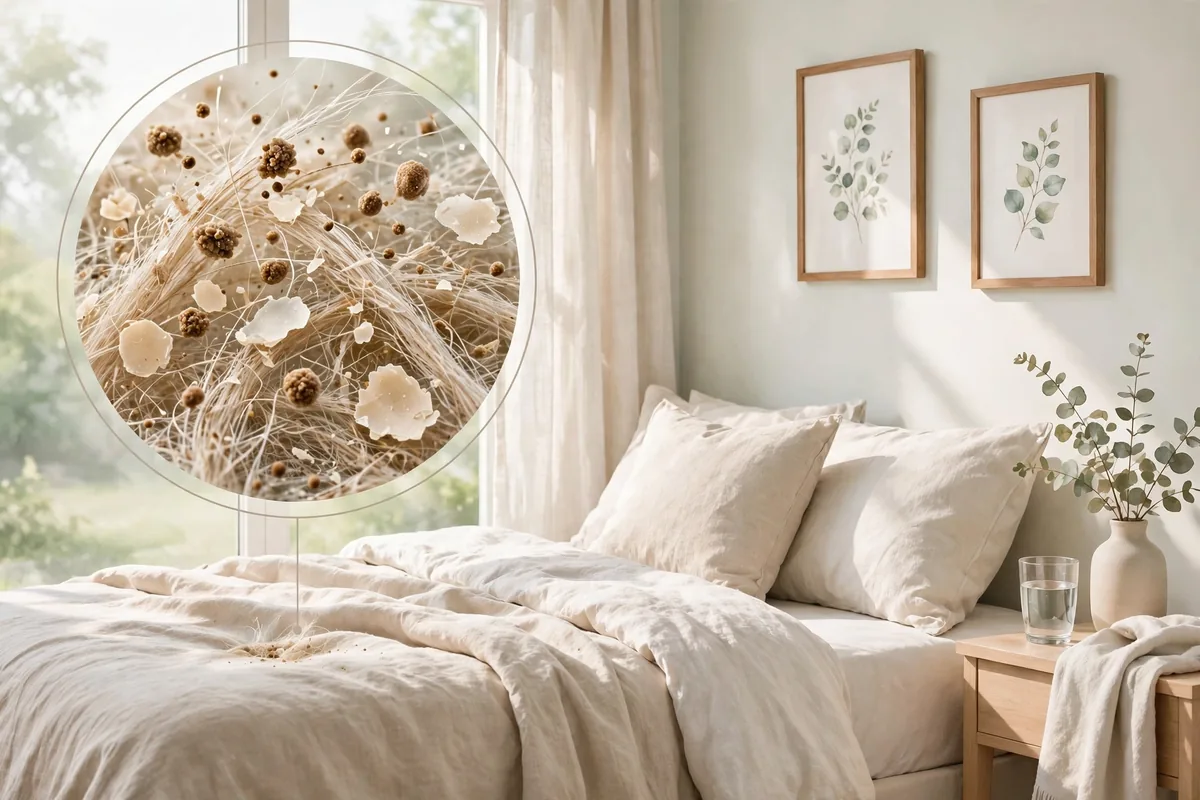
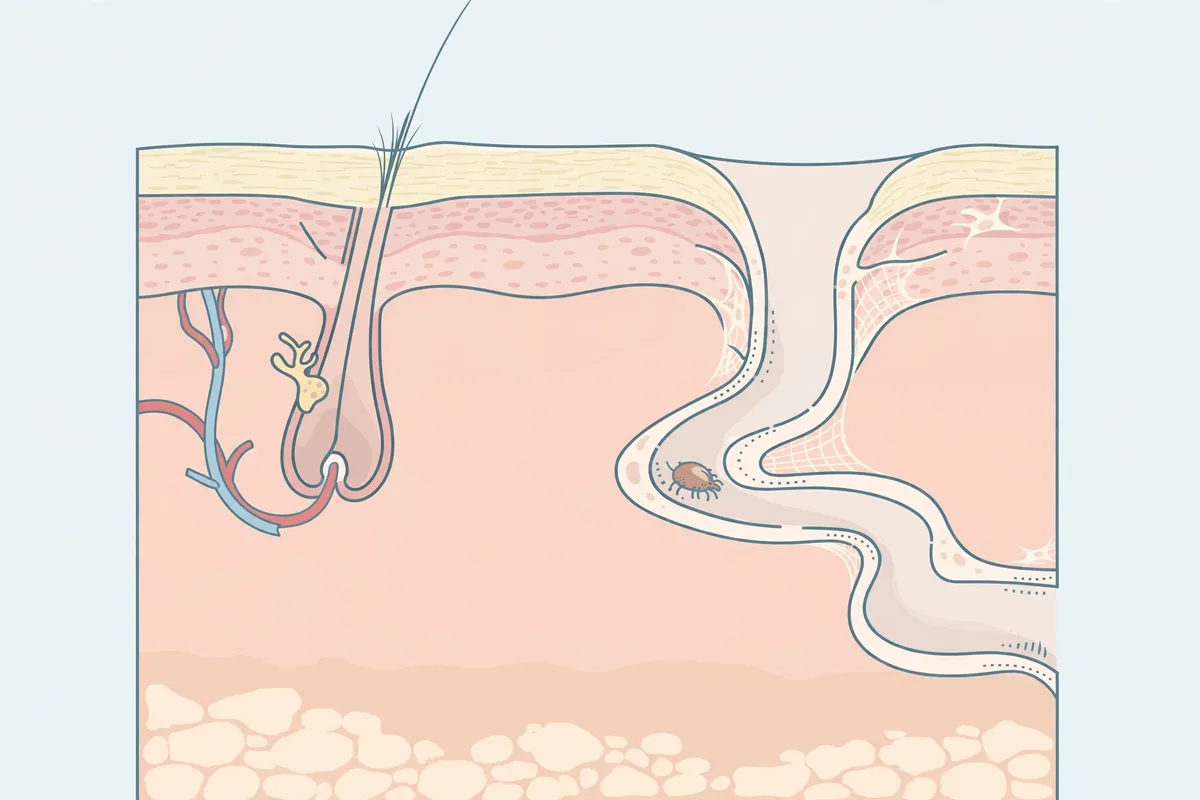
Scabies is caused by Sarcoptes scabiei, a mite roughly 0.2 to 0.45 millimeters long, at the edge of what a sharp eye might catch as a speck. After mating on the skin surface, the fertilized female burrows into the outermost skin layer, the stratum corneum, tunneling a few millimeters a day and laying eggs as she goes. The intense itching is largely an allergic reaction to the mites, their eggs, and their waste inside those tunnels. In a first-ever infestation, symptoms typically take two to six weeks to appear because the immune system needs time to sensitize; in a repeat infestation, itching can start within a day.
This is a living infestation of your skin, and it persists until treated. It does not resolve with antihistamines, oatmeal baths, or new pillows. That persistence is itself a clue: an allergy rash improves when exposure drops, while scabies marches on regardless of how clean your sheets are.
The classic sign of scabies is the burrow: a thin, slightly scaly, grayish or skin-colored line, a few millimeters to about a centimeter long, sometimes with a tiny dark dot at one end where the mite sits. Burrows favor thin skin: the webs between fingers, the inner wrists, elbows, waistline, buttocks, genitals, and around the nipples. In infants and small children, the palms, soles, and scalp can be involved too.
Burrows are the single most useful visual clue in this comparison, because dust mite allergy never produces burrow tracks. If you see fine, winding, thread-like lines in those characteristic locations, that is a strong reason to see a clinician promptly rather than trying another round of allergy measures. That said, burrows are not always visible, scratching destroys them, so their absence does not rule scabies out. Only a clinician’s exam, sometimes with a skin scraping or dermoscopy, can settle it.
Scabies itching is famously worse at night and can be severe enough to disturb sleep. The warmth of bed increases mite activity, and the quiet of the night leaves nothing to distract from it. Dust mite allergy can also feel worse in bed, but the quality differs: scabies itch is often described as deep, relentless, and resistant to scratching, while allergy itch tends to ease somewhat once you are away from the allergen source for a while. Neither description is diagnostic on its own, bodies vary, but the pattern is worth reporting to your doctor.
Scabies spreads through prolonged direct skin-to-skin contact, which is why it moves through households, dorms, nursing homes, and childcare settings. It is not a sign of poor hygiene; crowded living conditions and close contact are the real risk factors. Medical guidance emphasizes evaluating close contacts because treating one person while a partner or housemate remains infested leads to reinfestation. Dust mite allergy needs no contact tracing at all. If your clinician suspects scabies, expect questions about everyone you have had prolonged skin contact with.
| Feature | Dust Mite “Rash” (Allergy) | Scabies (Infestation) |
|---|---|---|
| What it is | Allergic reaction to mite waste and body fragments | Living Sarcoptes scabiei mites burrowing in skin |
| Do the mites bite or burrow? | Neither, they do not feed on you at all | Females burrow tunnels and lay eggs in the skin |
| Signature skin sign | Diffuse redness, eczema-like patches, small bumps | Thin burrow tracks, intense papules in typical spots |
| Itch timing | Often worst in the morning after bed exposure | Classically worse at night, can disturb sleep |
| Contagious? | No, only sensitive people react | Yes, spreads via prolonged skin-to-skin contact |
| Other symptoms | Often sneezing, runny nose, itchy watery eyes | No respiratory symptoms; skin-only |
| Onset | Gradual with ongoing exposure | 2–6 weeks after first exposure; ~1 day on reinfestation |
| Who else is affected | Anyone sensitive in the same dusty environment | Close contacts develop itching within weeks |
| Treatment lane | Allergen reduction + allergy management | Prescription scabicide, clinician-directed |
| Diagnosis | Clinical + allergy history/testing | Clinical exam; skin scraping or dermoscopy confirms |
You cannot diagnose yourself, but you can gather useful observations before your appointment. Think of this as detective work you hand to the clinician, not a verdict you deliver yourself.
The morning test. Notice when the itch peaks. A rash that is clearly worst within an hour or two of waking, eases as the day goes on, and returns the next morning points toward an exposure that happens in bed, consistent with dust mite allergy. Itching that ramps up after you have been in bed a while at night and keeps you awake points more toward scabies. Keep a simple note for three or four nights: time the itch starts, severity from 1 to 10, and where on the body.
The location map. Sketch or photograph where the rash appears. Allergy-type irritation clusters where skin meets bedding and upholstery. Scabies favors the finger webs, wrists, elbows, waistline, and genital area. A rash concentrated in scabies’ favorite thin-skin zones deserves a prompt clinician visit.
The household census. Ask the people you live with, honestly and without embarrassment, whether anyone else has started itching. One itchy person in a dusty house suggests allergy. Several people itching within the same few weeks is the pattern clinicians associate with scabies, and it changes the urgency.
The exposure experiment. If you sleep two or three nights somewhere with different bedding, a hotel, a relative’s guest room with fresh linens, and the morning symptoms clearly improve, that supports an environmental allergy trigger. If the itch follows you regardless of the bed, that supports something living on you rather than in the room. This is not conclusive, but it is informative.
What you should not do at home: start prescription creams meant for someone else, use pesticides on your skin, or “test” the diagnosis by trying random treatments. Those experiments can irritate the skin, mask the real signs, and delay proper care. Observation is free and safe; self-treatment with the wrong product is not. If burrow-like lines are visible, skip the experiments and book the appointment.
A clinician starts with the history you bring: onset, timing, locations, who else itches, and what you have tried. Then comes the skin exam, often with a dermatoscope, a handheld magnifier with polarized light that can reveal burrows and sometimes the mite itself at the end of a tunnel. When scabies is suspected, the confirmatory step is a skin scraping: the clinician scrapes an unscratched burrow, places the material on a slide, and looks under the microscope for mites, eggs, or droppings. Finding them confirms scabies; not finding them does not fully exclude it, because burrows are easy to miss in scratched skin.
For dust mite allergy, the workup looks completely different: an allergy history, and sometimes skin-prick testing or blood tests for dust mite specific IgE, usually handled by an allergist. There is no scraping because there is nothing living on the skin to find. The two diagnostic paths barely overlap, which is exactly why the initial distinction matters so much. Getting the right referral, dermatologist versus allergist, saves weeks.
Treating scabies as an allergy means weeks of antihistamines and new pillows while the infestation spreads to close contacts and the skin gets more excoriated and secondarily infected. Treating an allergy as scabies means applying a prescription scabicide you did not need, with its own skin irritation, while the actual allergen load in your bedroom goes unaddressed. Both errors waste time and money, and the first one has a contagion cost. When in doubt, the burrow check and the household census are the two observations that most quickly point the clinician in the right direction.
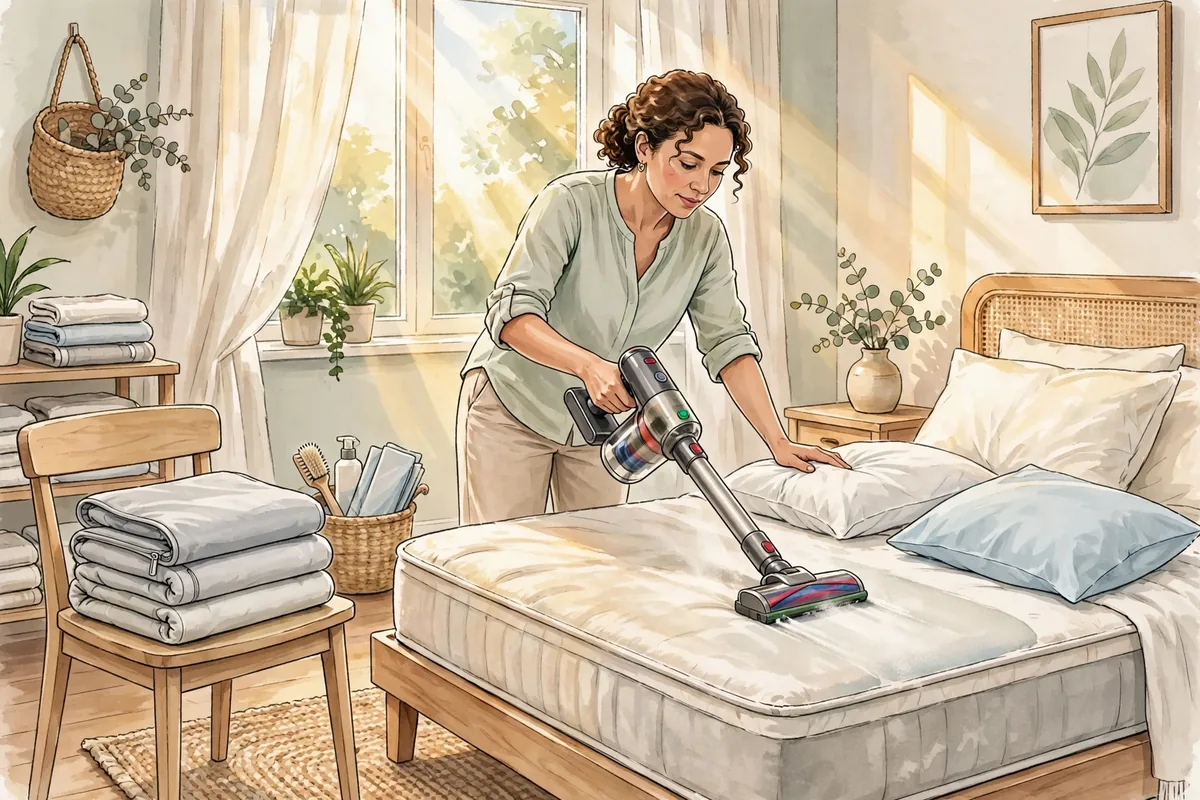
If dust mite allergy is the working diagnosis, the strategy is exposure reduction plus symptom management guided by your clinician or allergist. No single step eliminates dust mites entirely; the evidence supports stacking several measures.
Bedding is the highest-yield target. Wash sheets, pillowcases, and blankets weekly in hot water, at least 130°F (about 55°C), which kills mites and removes allergen. Encase the mattress, box spring, and pillows in allergen-proof covers with a pore size small enough to block mites and their waste. These covers are one of the better-supported interventions because the mattress is the largest reservoir closest to your airways and skin for eight hours a night.
Control humidity. Dust mites need moisture from the air to survive; keeping indoor relative humidity below about 50 percent makes the environment hostile to them. A hygrometer costs little and tells you whether your dehumidifier or air conditioning is actually doing the job. This is a slow lever, mite populations fall over weeks, not days, so judge it on a monthly timescale.
Reduce reservoirs. Vacuum carpets and upholstery regularly with a machine fitted with a HEPA filter, and consider washable throw rugs instead of wall-to-wall carpet in the bedroom if symptoms are stubborn. Stuffed toys can go through the hot wash or spend time in the freezer, since freezing kills mites even though it does not remove the allergen already present. Dust with a damp cloth so you capture allergen rather than launching it airborne.
Symptom management is the clinician’s lane. Antihistamines, nasal sprays, and eye drops used for dust mite allergy are allergy medications with their own indications and cautions; which ones fit your situation is a conversation with your clinician or pharmacist, not a decision to make from a blog post. If skin symptoms dominate, a dermatologist can sort out whether you are dealing with allergy-exacerbated eczema or something else entirely. And if any sign points toward scabies, burrow tracks, nighttime itch spreading through the household, stop the allergy project and get evaluated for infestation promptly, because scabies needs prescription treatment and contact management that no amount of vacuuming replaces. For general guidance on sorting bite-like clues, see our bite-sting clue checklist, and if you are sorting mite myths from facts, our what-bit-me guide walks through the usual suspects behind mysterious marks like these.
Skin symptoms that could be scabies deserve prompt medical attention rather than watchful waiting, because scabies spreads and will not resolve on its own. See a clinician promptly if you notice:
Call 911 or seek emergency care for signs of a severe allergic reaction: trouble breathing, swelling of the lips, tongue, or throat, dizziness, or fainting. Those are anaphylaxis signs and need immediate help, our anaphylaxis sting warning signs page covers what to watch for. For help judging whether a mark is healing normally or becoming infected, see the docs on normal healing vs infection.
Can dust mites burrow into your skin like scabies?
No. Dust mites cannot burrow, bite, or live on human skin. They feed on shed skin flakes in the environment, bedding, carpet, upholstery, and the “rash” attributed to them is an allergic reaction to their waste and body fragments. Burrowing is exclusive to the scabies mite in this comparison. If you see burrow-like tracks, that points away from dust mites and toward a prompt clinician visit.
How can I tell whether my nighttime itching is scabies or an allergy?
Look at timing, location, and company. Scabies itching classically worsens at night and disturbs sleep, favors thin skin like finger webs and wrists, may show burrow tracks, and often appears in close contacts within weeks. Dust mite allergy tends to peak in the morning after bed exposure, looks more like diffuse eczema-like irritation, often comes with sneezing or a stuffy nose, and does not spread person to person. These are clues, not a diagnosis, a clinician’s exam settles it.
Is scabies a sign of poor hygiene?
No. Medical sources are explicit that poor hygiene is not a risk factor for scabies. Crowded living conditions and prolonged skin-to-skin contact are the actual risk factors, which is why it moves through households, dorms, and care facilities regardless of cleanliness. There is no reason for shame in seeking care, and prompt treatment protects the people around you.
If one dermatologist said dust mites and another said scabies, what should I do?
Get a tie-breaking evaluation that includes the definitive test: a skin scraping examined under the microscope, or dermoscopy looking for burrows. The two conditions have completely different treatments, so the diagnosis matters. Bring a timeline of your symptoms, note who else itches, and mention exactly what each clinician observed. A third opinion with a scraping is reasonable when the first two disagree.
Can I treat scabies with antihistamines or oatmeal baths?
Those measures may take the edge off itching, but they do not kill the mites, so the infestation continues and can spread. Scabies requires clinician-directed prescription treatment, and close contacts typically need evaluation and treatment at the same time to prevent reinfestation. Symptom relief without mite eradication is a holding pattern, not a cure, see a clinician for the actual treatment plan.
Medically reviewed by Dr. Sarah Jones, MD.
This article is for informational purposes only and isn’t medical advice. If you’re worried about a bite or sting, talk to a healthcare professional.
Dr. Jones oversees StingHelp’s clinical verification process. Every guide is systematically evaluated against active Centers for Disease Control and Prevention (CDC), Environmental Protection Agency (EPA), and American Academy of Allergy, Asthma & Immunology (AAAAI) medical consensus standards to ensure symptom distinctions and care recommendations are clinically sound.
Explore physician-reviewed first-aid procedures, identification clues, and symptom comparisons for other common outdoor bites and stings.

October is the peak month for one of the most baffling skin complaints of the year. You rake leaves under the big oak in…

The Short Answer The difference between straw itch mite bites vs chigger bites is mostly a difference of where you were and what you…

Oak Mite Bites vs. Chigger Bites: The Body-Map Test That Tells Them Apart The fast answer: Look at where the bites are. Oak leaf…