The logic feels airtight. Salt kills slugs in the garden by drawing the moisture out of them, so sprinkling salt around the bed should dehydrate bed bugs the same way. It is one of the most repeated bed bug myths on DIY forums and social media. But does salt kill bed bugs, or does the slug analogy collapse the moment you look at insect biology?
It collapses. Salt does not kill bed bugs. A bed bug is not a slug, and the difference is a thin layer of wax that makes the entire theory fall apart. Salt has no meaningful effect on bed bugs or their eggs, and the weeks people spend salting their mattresses are weeks the infestation spends growing. This article walks through the physics of why the analogy fails, what salt actually does on a mattress, how real desiccant dusts differ, and what genuinely works.
The Slug Analogy That Started It
Every myth needs an origin story, and this one is easy to trace. Gardeners have long known that salt kills slugs. Pour salt on a slug and it visibly shrivels as water is pulled out of its body by osmosis. The demonstration is dramatic, memorable, and completely real. From there, folk logic takes one step: bed bugs are small soft creatures too, so salt should shrivel them the same way.
The analogy spreads because it asks nothing of the believer. Salt is already in the kitchen. It is non-toxic, cheap, and easy to sprinkle along baseboards and mattress seams. The advice feels like clever insider knowledge: the pest control industry does not want you to know about the 50-cent fix. Posts describing salt “barriers” and “salt traps” accumulate likes, and each share lends the idea credibility it never earned.
What the analogy never accounts for is the single most important difference between the two animals. A slug is essentially a bag of water wrapped in a permeable membrane. It has no waterproofing, which is why slugs only come out at night and in damp weather, and why salt destroys them so efficiently. A bed bug is an insect wearing armor specifically engineered to prevent water loss. Comparing the two is like comparing a paper boat to a submarine because both float.
A Bed Bug Is Not a Slug: The Cuticle Physics
To understand why salt fails, you need a short tour of the bed bug’s outer shell, the cuticle. This is the structure the entire myth ignores, and it is worth understanding because it also explains why several other folk remedies fail.
The Waxy Shield
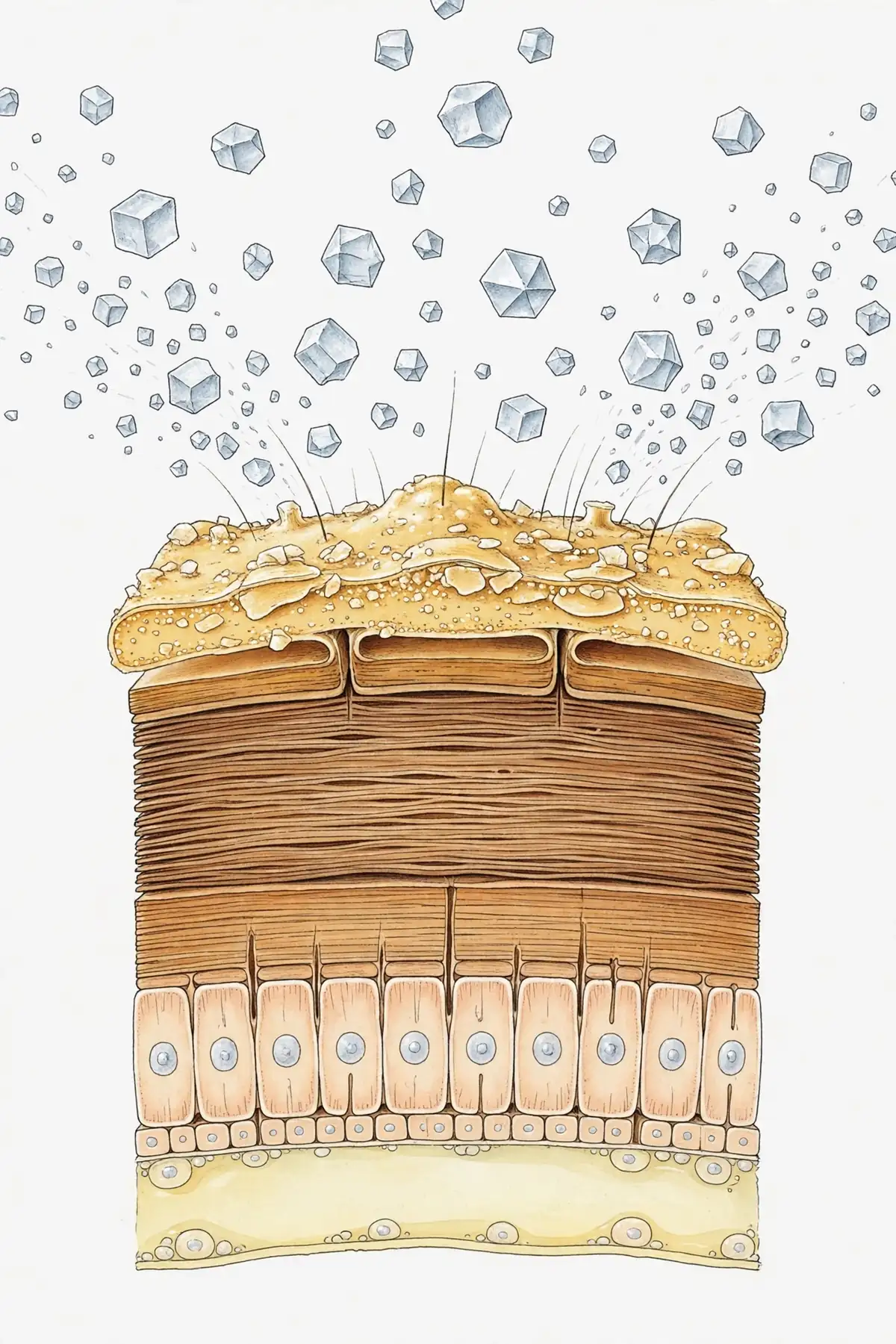
An insect’s cuticle is a layered composite, and its outermost layer is the epicuticle: an ultra-thin coating of waxes and lipids. This wax layer is the insect’s primary defense against dehydration. It is so effective that a bed bug can survive for months without feeding in a dry room, losing water only very slowly through a barrier measured in nanometers. Desert insects take this further, but even a bed bug’s wax layer is a formidable waterproofing system.
Salt kills slugs because there is nothing between the salt and the slug’s wet tissues. On a bed bug, salt crystals sit on top of a wax layer that water cannot easily cross. Osmosis requires water to move across a permeable membrane toward the salt. The epicuticular wax is specifically built to be impermeable. The salt draws nothing because the water cannot reach it.
Why Desiccants Need to Be Abrasive or Absorptive
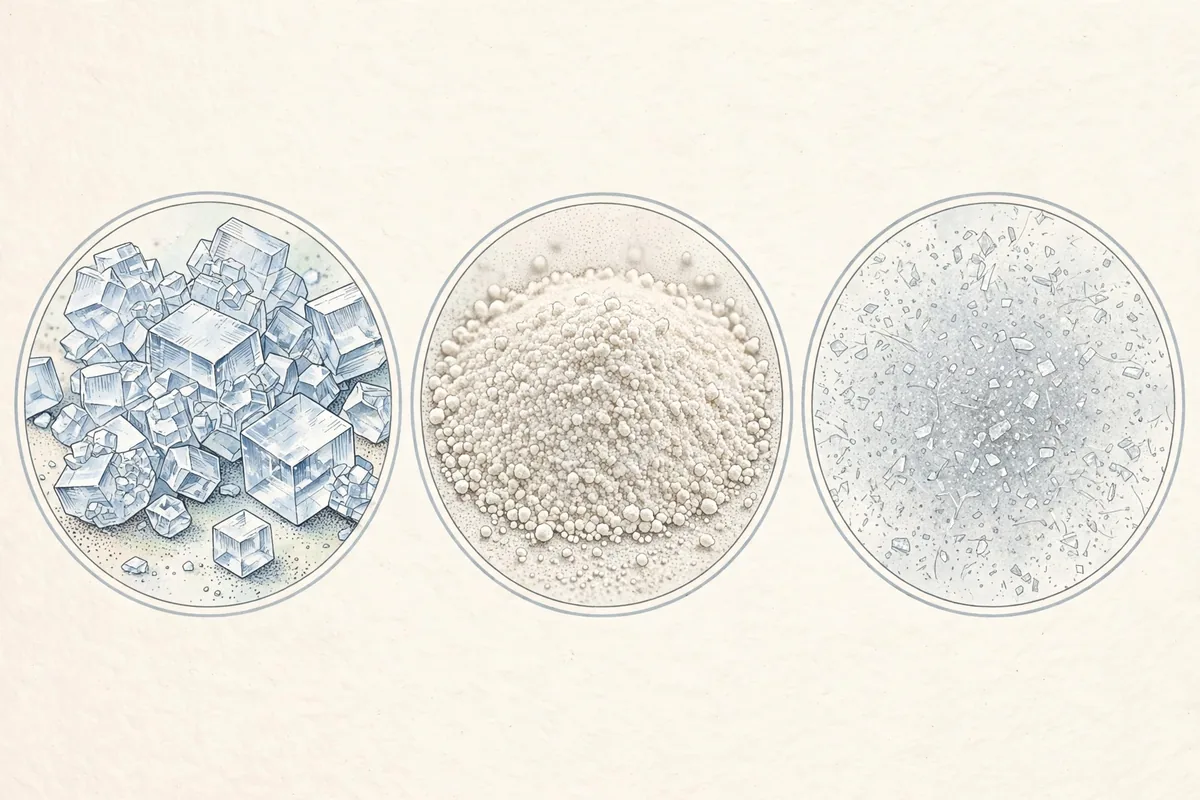
This is also why genuine desiccant dusts work differently from salt. Diatomaceous earth, the desiccant most often recommended for bed bugs, does not kill by sitting next to the insect the way salt does. Its microscopic particles are abrasive and absorptive: they scratch and adsorb the waxy layer itself, physically damaging the waterproofing so the insect then loses water through the breach. Silica-based dusts work similarly, stripping lipids from the cuticle.
Salt does neither of these things. Table salt crystals are large, smooth, and cubic compared to the fine, jagged particles of diatomaceous earth. They do not abrade wax, and they do not adsorb lipids. Sprinkling salt near a bed bug is, from the insect’s perspective, like scattering gravel near a person in a raincoat. It is simply there.
The Honest State of the Evidence
It is worth stating plainly: I could find no published study testing salt against bed bugs. No university extension program recommends it, no entomologist endorses it, and no product containing table salt is registered as a bed bug treatment. The evidence for salt is not weak; it is nonexistent. When a remedy has no mechanism consistent with insect biology and no testing behind it, the rational verdict is that it does not work.
What Salt Actually Does on a Mattress
So what happens in the real bedrooms where people try this? The accounts are consistent, and they describe everything except dead bed bugs.
First, the salt sits there. Bed bugs walking across a salted surface experience it as rough terrain, not as a threat. Some may detour around heavy piles, which leads to the second observation: people sometimes report fewer bites for a few nights and conclude the salt is working. What is actually happening is behavioral avoidance of an unpleasant surface, not mortality. The bugs reroute, feed from a different angle, or wait. They do not die; they adapt within days.
Meanwhile, the salt creates its own problems. It absorbs moisture from the air and cakes into fabrics, mattress ticking, and carpet fibers. It can corrode metal bed frame components over time and leaves a residue that is difficult to vacuum out completely. None of this affects the infestation, which continues in the seams and cracks where no salt was ever sprinkled, because those are the places that matter and the places salt cannot reach.
Most importantly, the eggs are untouched. Bed bug eggs are glued into narrow seams, protected by their shells, and entirely indifferent to salt crystals sitting inches away. Eggs hatch in roughly a week under normal room conditions, so even a fantasy version of salt that killed every adult would still leave the next generation developing safely out of reach. If you are still confirming the diagnosis, the pattern of how long insect bites usually last can help you verify you are dealing with bed bugs before choosing a treatment.
Salt vs Real Desiccants: A Family Comparison
Salt is often lumped together with diatomaceous earth as a “natural desiccant,” which muddies the water. A direct comparison shows they belong to different categories entirely.
| Property | Table salt | Diatomaceous earth (food grade) | Silica gel dust |
|---|---|---|---|
| Particle character | Large, smooth cubes | Microscopic, jagged, porous | Ultra-fine, highly absorptive |
| Mechanism | None against insects | Abrades and adsorbs waxy cuticle | Strips lipids from cuticle |
| Effect on bed bugs | No demonstrated mortality | Slow kill by dehydration over days | Effective desiccant action |
| Egg effect | None | Limited | Limited |
| Residual action | Cakes and dissolves | Stays active while dry | Stays active while dry |
| Verdict | Folk myth | Useful supplement, not standalone | Professional-grade tool |
The comparison clarifies why pest professionals sometimes recommend diatomaceous earth but never salt. DE has a physical mechanism that matches insect biology: it attacks the wax layer. Salt has no mechanism at all. Lumping them together because both are “powders from the kitchen” is a category error, like grouping aspirin with chalk because both are white tablets.
A related myth worth defusing here is Epsom salt, which some posts present as a stronger variant. Epsom salt is magnesium sulfate, and it fails for exactly the same reason table salt fails: it cannot breach the cuticle. Changing the salt does not change the physics.
The Real Cost of a Harmless-Looking Myth
Salt feels like the safest possible experiment. It is non-toxic, it costs nothing, and if it does not work, what have you lost? The answer is time, and time is the one resource you cannot recover in a bed bug infestation.
A female bed bug lays a few eggs per day and hundreds over her lifetime. Those eggs hatch in about a week, and the nymphs begin feeding almost immediately. Newly hatched bugs can reach breeding age in roughly five to seven weeks under good conditions. Run that math forward across the month or two that people typically spend trying salt, then baking soda, then vinegar, and a small, containable problem becomes an entrenched one.
This compounding effect is the hidden price of every folk remedy. The myth does not need to be dangerous to be harmful; it only needs to be ineffective while feeling productive. Each week of salting is a week the population breeds without interference, and each generation is larger than the last. By the time the person concludes salt is not working, the professional treatment they now need is bigger, longer, and more expensive than the one they could have had at the start.
There is also a diagnostic cost. People who believe they are treating the problem stop looking for evidence of the problem. Interceptor traps go unplaced, seams go uninspected, and the infestation spreads to the couch, the second bedroom, and the luggage before anyone reassesses. Treating a myth as a plan replaces the monitoring that would have revealed the truth sooner.
What Actually Works Against Bed Bugs
Real control targets the biology that salt cannot touch: the hidden harborages, the glued-down eggs, and the bugs’ need to feed.
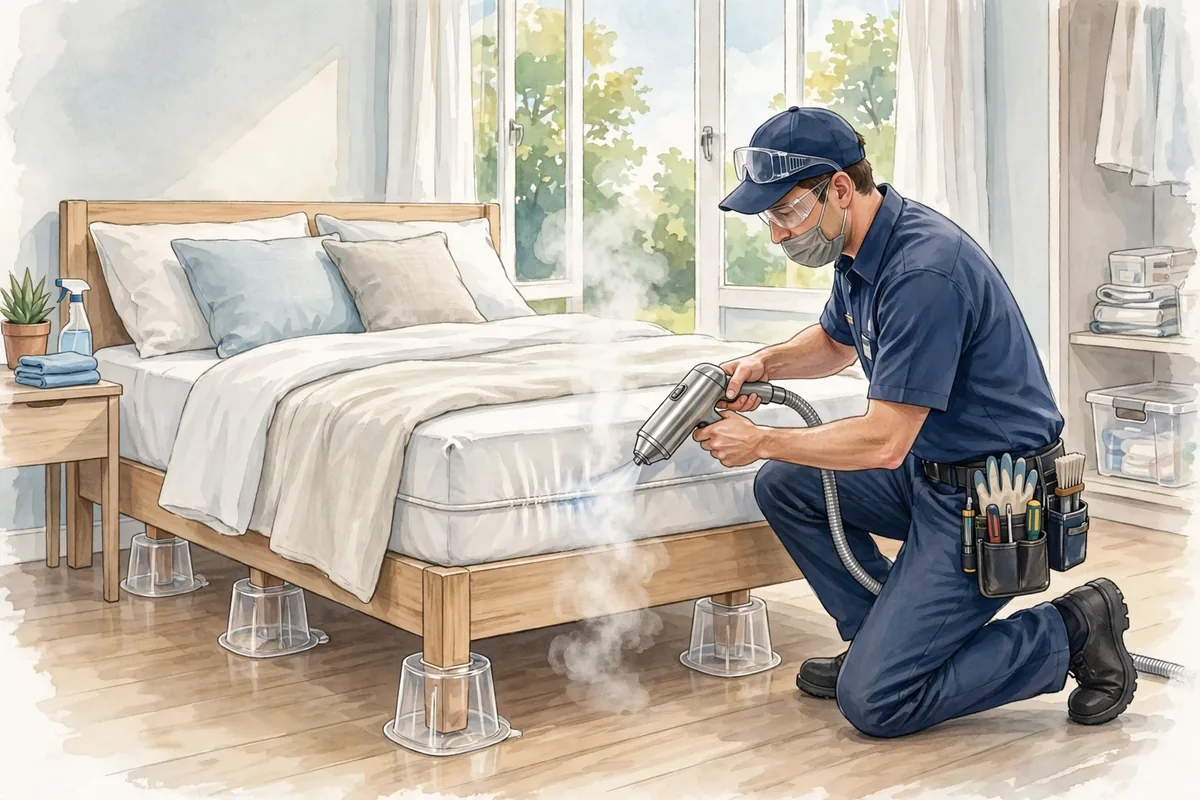
Heat remains the most decisive tool. A clothes dryer on high for 30 minutes kills all life stages in fabrics. Dry steam above 200 degrees Fahrenheit, moved slowly along mattress seams and furniture joints, kills bugs and eggs on contact and penetrates where no powder or spray can go. Heat works through physics the cuticle cannot resist.
Physical methods handle what heat cannot reach. Vacuum seams, joints, and baseboards with a crevice tool and discard the contents outside in a sealed bag. Encase the mattress and box spring in bed-bug-proof encasements for at least a year to trap bugs inside and seal the seams. Set interceptor traps under bed legs to catch traveling bugs and, just as importantly, to monitor whether the population is actually shrinking. Knowing whether bed bugs can bite through clothes also helps you dress defensively while the fight is ongoing.
For anything beyond the earliest, smallest infestation, hire a licensed pest management professional. Professionals combine EPA-registered residual products, applied directly into harborages, with follow-up visits timed to the egg hatch cycle. Whole-room heat treatment with professional monitoring is the single most reliable intervention available. The money spent on a professional early is almost always less than the money spent after months of folk remedies have let the population explode.
When to See a Doctor for a Bug Bite
Bed bugs are not known to transmit diseases, but bites can still create medical problems that deserve attention.
Call 911 or seek emergency care for signs of a severe allergic reaction: difficulty breathing, swelling of the lips, tongue, or throat, dizziness, fainting, or a racing heartbeat with widespread hives. Severe reactions to bed bug bites are uncommon but documented.
See a doctor promptly if a bite shows infection signs: increasing redness, warmth, swelling, or pain after the first day or two, red streaks spreading from the bite, pus or drainage, or fever. Scratching bites open invites bacteria, and cellulitis needs medical treatment.
See a doctor for very numerous or blistering bites, bites not improving after two weeks of basic care, or itching severe enough to disrupt sleep and daily life. Young children with widespread bites and people with weakened immune systems should seek care sooner. Our bite and sting warning signs checklist covers the complete list of red flags.
Frequently Asked Questions
Does salt kill bed bugs by dehydrating them like slugs?
No. Slugs have no waterproofing, so salt draws water straight out of their tissues. Bed bugs are protected by a waxy cuticle layer specifically built to prevent water loss. Salt crystals sitting on that wax layer cannot trigger osmosis, so the slug analogy fails at the first step.
What about Epsom salt or sea salt?
They fail for the same reason. The type of salt does not matter because the problem is not the salt, it is the insect’s waterproof cuticle. No salt has a mechanism to breach the waxy layer or reach the eggs glued inside seams.
Will a thick line of salt at least keep bed bugs away from the bed?
It may cause temporary detouring around heavy piles, which some people mistake for effectiveness. The bugs reroute within days, feed from another angle, and keep breeding. A barrier that the pest simply walks around is not control.
Is there any study showing salt kills bed bugs?
I could find none. No published study, no university extension recommendation, and no registered product support the claim. The evidence for salt is not thin; it is absent.
What is the fastest legitimate way to start fighting bed bugs tonight?
Run all bedding and clothing through a hot dryer for 30 minutes, vacuum the mattress seams and bed frame joints thoroughly, and place interceptor traps under the bed legs. These steps attack the actual biology of the infestation. If bites continue after a couple of weeks, call a licensed pest professional.
Medically reviewed by Dr. Sarah Jones, MD.
This article is for informational purposes only and isn’t medical advice. If you’re worried about a bite or sting, talk to a healthcare professional.