
You’re staring at a cluster of red bumps on your ankle after yard work, wondering whether ants or mosquitoes got you. Sorting out ant bite vs mosquito bite is simpler than it looks: fire ants sting and leave pus-filled blisters, mosquitoes leave itchy raised wheals, and ordinary ants leave small red bumps that fade fast. Here’s how to read the clues on your skin.
Spot the difference: side-by-side comparison #
| Clue | Fire ant sting | Ordinary ant bite | Mosquito bite | |—|—|—|—| | Immediate feeling | Sharp burning pain | Mild pinch or nothing | Often unfelt at first | | First hours | Red bump, intense itch | Small red bump | Soft, pale, raised wheal | | After 12–24 hours | White pus-filled pustule | Bump fades | Wheal may firm up, still itchy | | Pattern | Cluster where ants swarmed | Single or few | Scattered, often on exposed skin | | Scratching it | Risks infection of pustules | Low risk | Can break skin, prolong itch |
The single best differentiator is the pustule. If white, pus-filled blisters appear about a day after the attack, you’re dealing with fire ants — mosquitoes don’t do that. Mosquito bites, by contrast, start as soft raised welts that itch fiercely but stay blister-free.
Pattern tells a story too. Fire ants swarm: you’ll see a tight cluster of stings on the foot, ankle, or leg where you stood on or near the mound. Mosquito bites are more scattered — a few on the arms, one on the neck — wherever skin was exposed while you sat still.
Timing helps when memory is fuzzy. Mosquito itch usually starts within minutes and can linger for days. Fire ant pain hits immediately and hard, then the itching phase follows as pustules form. If you remember sharp burning pain at the moment of attack, think ants.
When the picture is mixed or you’re unsure what bit you, a systematic look at the clues — pattern, timing, and how the reaction evolves — can narrow it down further.
Fire ant stings: the pustule giveaway #
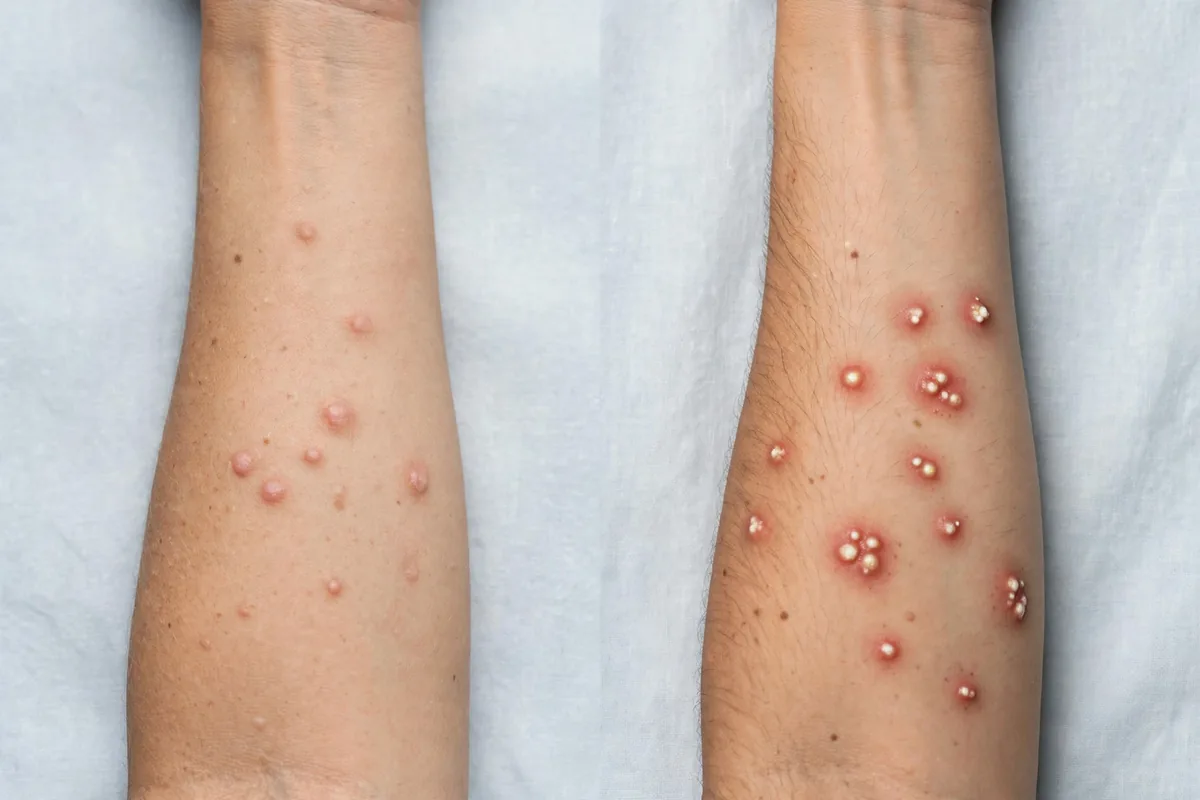
Fire ants are the reason ant stings have a reputation. They grip with their jaws and sting repeatedly, injecting venom that triggers a distinctive chain reaction.
What you’ll see: burning pain for the first minutes, then red bumps within an hour, then white pustules by roughly 24 hours. These pustules are usually a normal, sterile reaction to the venom — not an infection — even though they look alarming.
What not to do: don’t pop or pick the pustules. Breaking them opens the door to real bacterial infection, which is the main complication of fire ant stings. Let them dry and crust over on their own, usually within a few days.
Care basics: wash with soap and water, apply a cool compress for itching, and consider an oral antihistamine per label directions or an over-the-counter hydrocortisone cream used as directed. Keep the area clean and covered if you’re likely to scratch in your sleep.
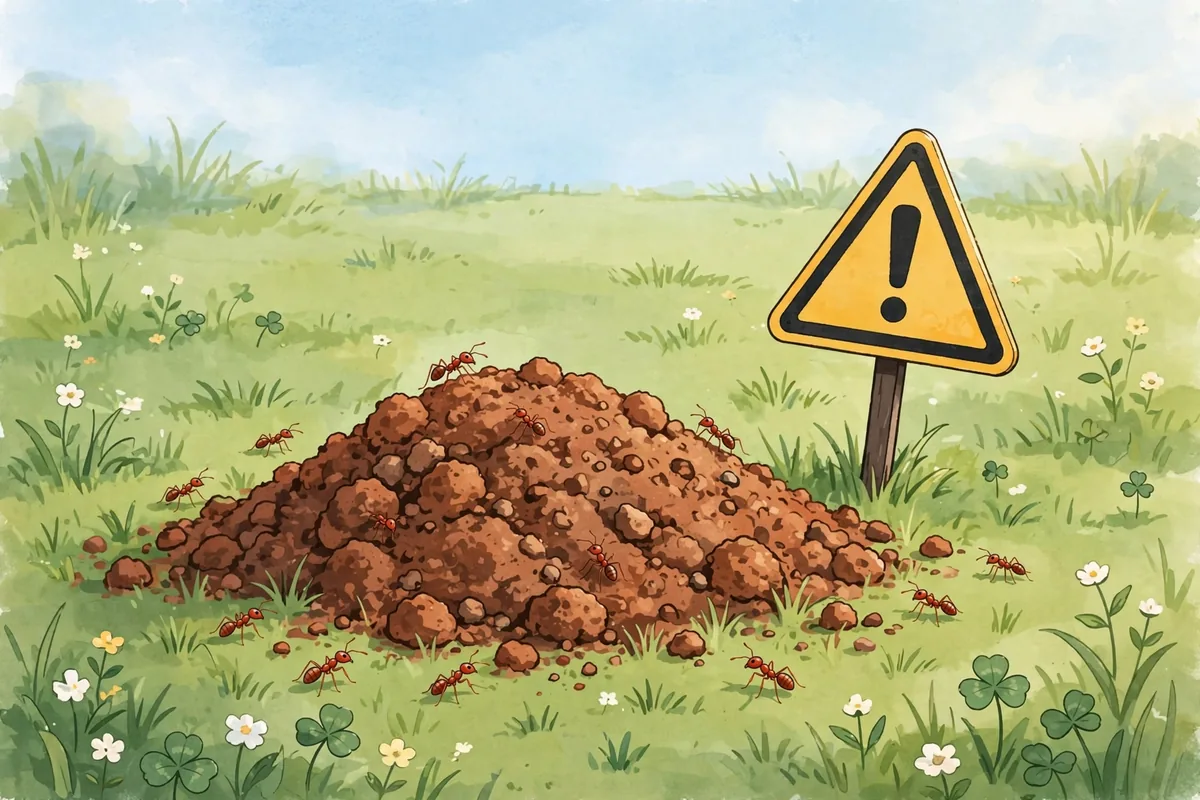
Know your ants: fire ants build distinctive fluffy mounds in sunny, open areas — lawns, field edges, sidewalk borders. Learning to recognize a fire ant mound versus a regular ant hill before you step on one is the best prevention there is. If you’ve been stung many times at once, or you have any allergy symptoms, treat it as urgent — see the warning section.
Ordinary ant bites and other lookalikes #
Not every ant is a fire ant. Most common ants — pavement ants, carpenter ants, field ants — bite defensively with their jaws and inject little or no venom.
Ordinary ant bites show up as small red bumps that may itch or sting mildly for a short while, then fade within a day or two without blistering. If your bumps never developed pustules, you were probably visited by regular ants, not fire ants.
Mosquito bites are the main lookalike in the first hours, before fire ant pustules appear. Mosquito welts are softer, puffier, and centered on a tiny puncture. They itch intensely — sometimes worse than ant bites — but they don’t burn the way fire ant stings do, and they never turn into pus-filled blisters on their own.
Other mimics: chigger bites cluster at sock lines and waistbands with ferocious itching; flea bites dot the ankles in tiny dark-centered bumps; bed bug bites appear in lines or clusters after sleep. Context is your best diagnostic tool: where you were, what you were doing, and how fast the reaction appeared.
If the main problem is relentless itching rather than identification, the practical steps to reduce bite itching work for mosquito welts and mild ant bumps alike.
What to do for each #
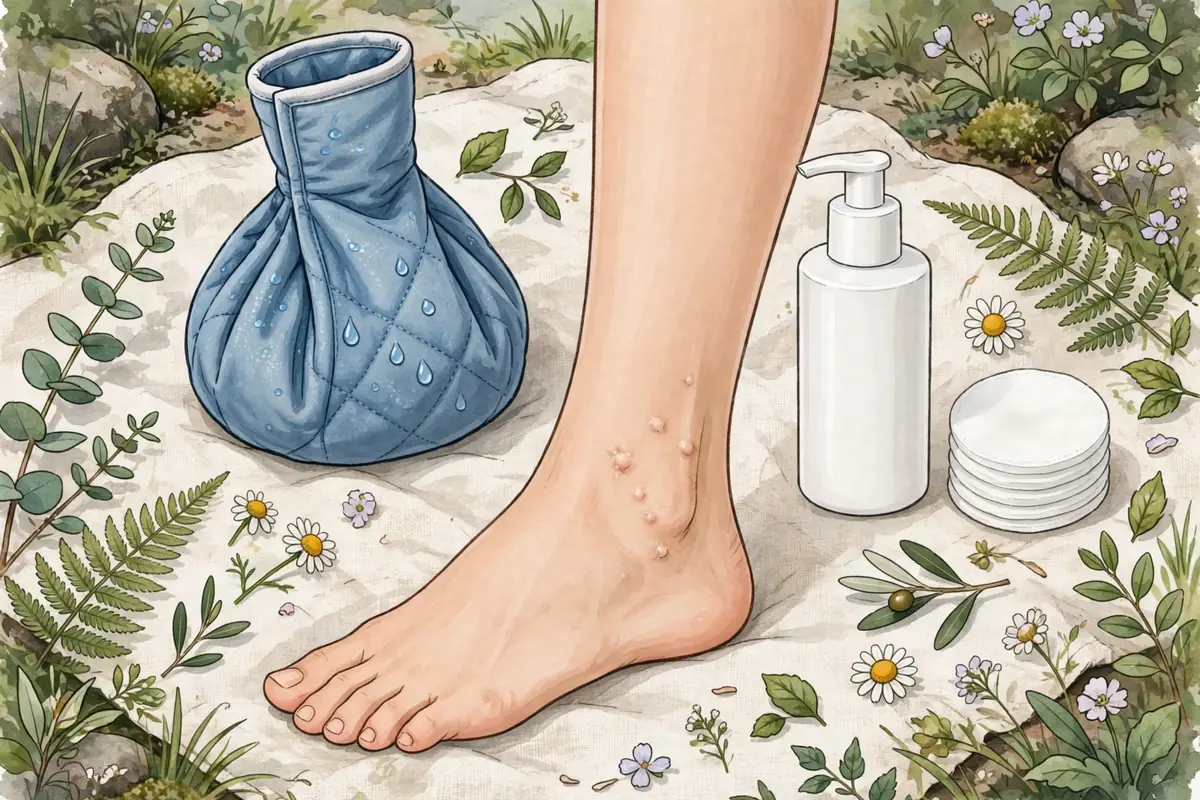
For mosquito bites: wash gently, apply a cool compress for 10–15 minutes, and use an oral antihistamine per label directions or hydrocortisone cream as directed for itching. Don’t scratch — broken mosquito bites heal slower and can scar. Most fade within a few days.
For ordinary ant bites: the same gentle routine. These are the mildest of the three and usually need nothing more than soap, water, and patience.
For fire ant stings: wash, cool compress, anti-itch measures — plus the pustule rule. Don’t pop, don’t pick, keep clean. Watch each sting for signs of infection (spreading redness, increasing pain, warmth, fever) over the next few days.
For any of them: skip harsh home remedies like bleach, alcohol, or toothpaste — they irritate healing skin without helping. And note your reaction: if you develop hives away from the bite site, swelling of the face or lips, or any breathing changes, that’s an allergic emergency, not a local skin issue.
Prevention going forward: wear closed shoes and socks in grassy or sandy areas, avoid standing on or near ant mounds, and use an EPA-registered insect repellent on exposed skin when mosquitoes are active. A quick scan of the ground before you sit or step saves most of these encounters.
Warning signs: when to seek care #
Call 911 immediately if you have trouble breathing or swallowing, swelling of the face, lips, tongue, or throat, widespread hives, dizziness or fainting, or a racing heartbeat after bites or stings. Fire ant venom can trigger severe allergic reactions, and multiple stings raise the risk. If you carry an epinephrine auto-injector, use it right away — but still call 911, because epinephrine buys time and does not replace emergency care.
Seek urgent care if you were stung many times at once (especially a child, older adult, or someone with a known insect allergy), redness spreads well beyond the bite area, red streaks appear, pustules become increasingly painful or drain cloudy fluid after the first couple of days, or you develop fever. A bite or sting near the eye, or one that isn’t improving after several days, also deserves a clinician’s look.
Frequently asked questions #
Do all ant bites turn into blisters? #
No. Only fire ant stings reliably produce the white pustules, and that’s because of their venom. Ordinary ants — pavement ants, carpenter ants, sugar ants — leave small red bumps that fade without blistering. No pustules after a day or so means it probably wasn’t a fire ant.
How do I know it was a fire ant and not a regular ant? #
Three clues: sharp burning pain at the moment of attack, a cluster of stings where ants swarmed (often feet or ankles), and white pustules forming within about 24 hours. Fire ants also build visible fluffy mounds in sunny spots — if you were standing near one, that settles it.
Which itches worse, ant bites or mosquito bites? #
It varies person to person. Mosquito bites often itch more intensely in the first day, while fire ant stings itch longer as the pustules heal. Your own immune response matters more than the insect — some people barely react to mosquitoes and swell dramatically from ant stings, and vice versa.
Can mosquito bites ever look like fire ant pustules? #
Not on their own. Mosquito bites stay as itchy welts. If a mosquito bite develops pus, increasing pain, or spreading redness, that’s likely a secondary bacterial infection from scratching — not part of the normal mosquito reaction — and it deserves medical attention.
Medical and editorial note #
This guide is general information for telling ant bites and mosquito bites apart, not medical advice. Reactions vary widely between people, and only a clinician who sees your skin can diagnose it with confidence. If a bite looks unusual, is getting worse instead of better, or worries you, see a healthcare professional.


