
Fire ant mound vs regular ant hill identification hinges on three things: fire ant mounds are dome-shaped, fluffy mounds of loose soil up to 18 inches across with no visible entrance hole, while regular ant hills are smaller, flatter, and almost always show a distinct central opening. Get this right, because stepping on a fire ant mound can mean hundreds of stings within seconds — the most common serious ant encounter in the southern US.
Fire ant mound: the signature look #
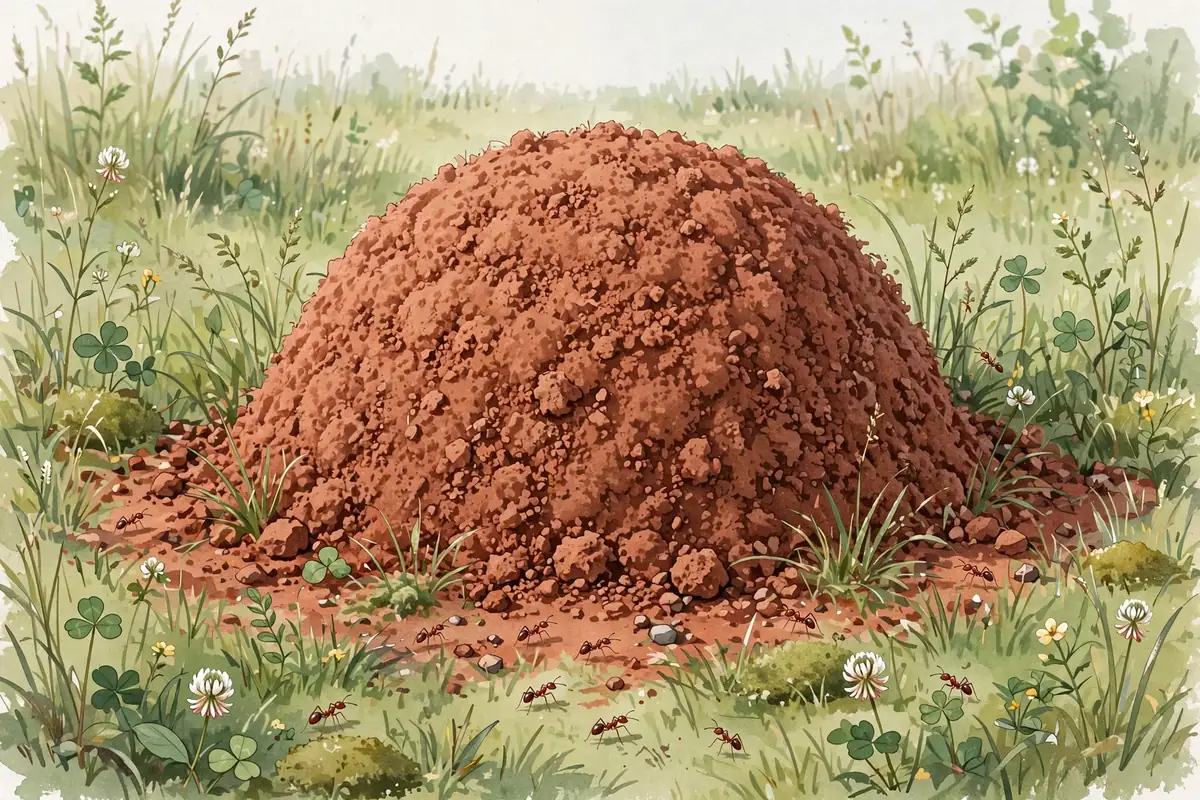
Shape and size: A classic fire ant mound is a dome or cone of soil, often 6–18 inches across and up to 12+ inches tall in undisturbed areas. Fresh mounds are soft and fluffy, made of finely worked soil.
The telltale signs:
- No visible entrance hole. This is the single best field mark. Fire ants enter and exit through underground tunnels, so the mound surface looks smooth and unbroken — no central crater, no obvious door.
- Fluffy, loose texture. Fresh mounds crumble easily; the soil is fine-grained and loosely packed, unlike the firmer crust of many other ant hills.
- Soil color. Mounds are often made of soil from deeper underground, so they may look different from the surface soil — sometimes redder or sandier.
- Location. Open, sunny areas: lawns, pastures, playgrounds, roadsides, around utility boxes. Fire ants avoid deep shade. They are found across the Southeast, Texas, and expanding west and north.
- No sticks, leaves, or debris mixed in. The mound is clean worked soil.
- After rain: mounds rebuild fast — a flattened mound can reappear within a day or two, which is why the same spot keeps “coming back.”
The ant test (from a safe distance): If you disturb the edge of a suspected mound with a long stick, fire ants swarm out almost instantly in large numbers, climbing the stick aggressively. Regular ants respond more slowly and in smaller numbers. Do not do this with your foot.
Regular ant hills: what harmless mounds look like #
Common harmless ants — field ants, pavement ants, harvester ants — build mounds that differ in consistent ways:
- A visible central entrance hole (or several) is the norm. Look for the small crater-like opening with excavated soil ringed around it.
- Lower and flatter profile. Many are just a few inches across, a gentle rise rather than a dome.
- Coarser debris. Harvester ant mounds often include gravel, seed husks, and pebbles. Field ant mounds mix in grass and thatch.
- The ants themselves look different. Most regular ants are black or brown and uniform in size; fire ants are reddish-brown with darker abdomens and vary noticeably in size within one colony (workers range from small to large).
- Location clues: pavement ants nest along sidewalks and foundations (fine soil piles in cracks); carpenter ants nest in wood, not soil mounds at all.
Important caveat: some native ant species build mounds that resemble fire ant mounds, and young fire ant mounds are small and easy to miss. When in doubt in the Southeast, treat an unidentified mound with caution until you are sure.
Side-by-side comparison table #
| Feature | Fire ant mound | Regular ant hill | |—|—|—| | Shape | Rounded dome, fluffy | Low, flat, or cratered | | Size | 6–18+ inches across | Usually under 6 inches | | Entrance hole | None visible | Central hole typical | | Texture | Soft, loose, fine soil | Firmer, often mixed debris | | Ants | Reddish, mixed sizes, swarm fast | Black/brown, uniform, slower | | Location | Open sunny lawns, pastures | Varied: pavement, wood, gardens |
Why it matters: fire ant behavior #
Fire ants do not sting like bees — they bite to grip, then sting repeatedly from the abdomen, pivoting in a circle. A disturbed mound can deploy hundreds of ants onto your legs in under a minute, and each ant can sting multiple times. The venom forms the characteristic white pustules that appear within a day.
Children are especially vulnerable — they cannot always escape a swarm quickly, and they play exactly where mounds form. Our guide on fire ant stings in children covers the warning signs parents should know. And whatever you do, do not pick at the resulting pustules — see what not to do with fire ant sting pustules.
You found a fire ant mound: what to do next #

Immediate safety:
- Mark it. Place a flag, cone, or ring of stones several feet out so everyone knows the boundary.
- Keep children and pets away. Dogs that sniff or dig at mounds get swarmed on the nose and mouth.
- Do not stomp, dig, or flood it yourself. Disturbing a mound without killing the colony just relocates it — often closer to your house.
- Mow around, not over. Mower vibrations trigger defensive swarms.
Treatment options:
- Bait products (the recommended homeowner approach): slow-acting baits are carried into the colony and kill the queen. Apply per label directions, in warm weather when ants are actively foraging — usually when soil temperatures are between about 70–90°F. Results take days to weeks.
- Mound drenches: fast-acting liquid treatments applied directly to the mound, also per label. Best in cooler parts of the day.
- Professional treatment for: large infestations, mounds near play areas or schools, or anyone in the household with a fire ant allergy.
Prevention: fire ants spread via mating flights and floating colonies after floods. Regular lawn inspection in warm months, prompt bait treatment of new mounds, and keeping play areas clear of debris that shelters colonies all help.
Warning signs: when to seek care #
Call 911 immediately for: trouble breathing or swallowing; swelling of the face, lips, tongue, or throat; widespread hives; dizziness, faintness, or collapse; or a racing heartbeat — after any fire ant encounter. Use prescribed epinephrine if available, then call 911.
See urgent care or your doctor the same day for: stings numbering in the dozens; nausea, vomiting, or dizziness after a swarm attack; spreading redness with red streaks; pus beyond the normal pustule stage with fever; or swelling that keeps expanding after 48 hours.
Frequently asked questions #

How fast can fire ants rebuild a mound? #
Very fast. After rain or disturbance, a colony can rebuild a visible mound within a day or two. If the same spot keeps reappearing, the colony is still alive underground — baiting is more effective than repeatedly flattening the mound.
Can fire ant mounds be flat or hard to see? #
Yes. Young colonies and colonies in compacted or frequently mowed areas may show only a low rise. After heavy rain, mounds can look like simple piles of fluffy soil. In fire ant territory, treat any unfamiliar soft soil mound with suspicion.
Are fire ants the only ants that swarm when disturbed? #
No, but they are the fastest and most aggressive common US species. Harvester ants and some others defend too, but fire ants’ combination of numbers, speed, and repeated stinging makes them the most dangerous mound-dwelling ant in the country.
Do fire ants bite pets? #
Yes — pets are frequent victims, especially dogs that dig or sniff at mounds. Signs include sudden yelping, pawing at the face, and small red bumps or pustules on sparsely furred areas. Brush ants off immediately (they grip with their jaws, so rinse with water) and contact your vet if swelling is severe or the pet seems distressed.
Medical and editorial note #
This guide is general information for educational purposes and is not medical advice. Fire ant allergies can be life-threatening; anyone with a known allergy should carry prescribed epinephrine and have an emergency plan discussed with their healthcare provider.


