
Pubic Lice vs Scabies: Symptoms Compared
Intense itching in the pubic area is distressing, and the first question most people ask is what is causing it. Two parasites sit at…
You found something tiny and white, and now the question is bed bug eggs vs flea eggs: identification guide territory. Getting this right matters more than most pest questions, because…
You found something tiny and white, and now the question is bed bug eggs vs flea eggs: identification guide territory. Getting this right matters more than most pest questions, because the two infestations demand completely different responses: one centers on the bedroom, the other on the pet. Mistaking one for the other wastes weeks and money on the wrong plan.
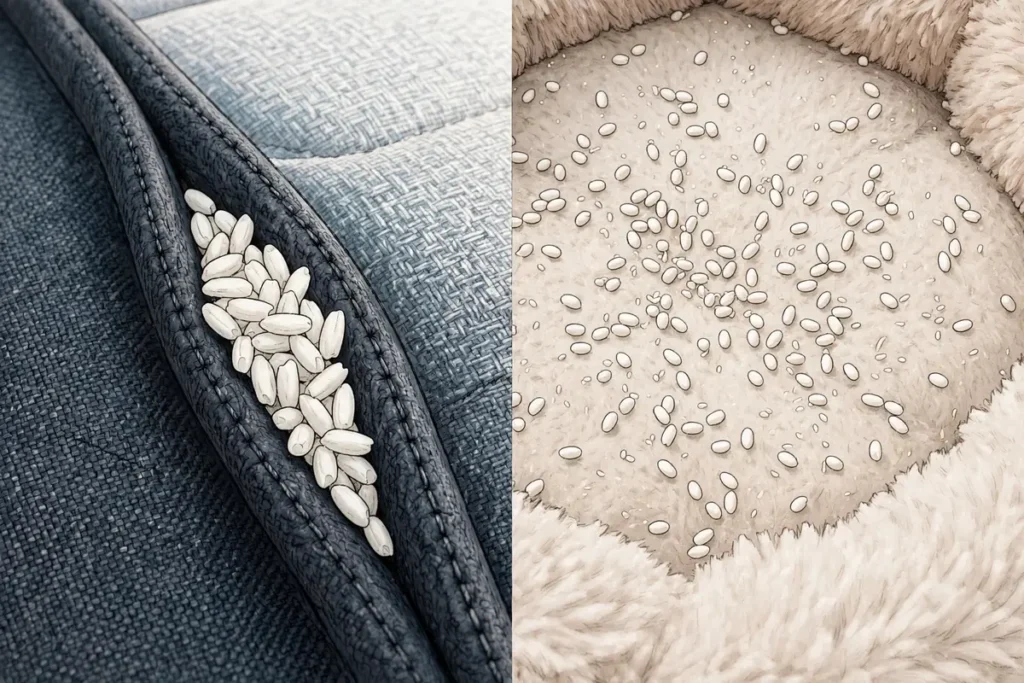
Here is the direct answer: bed bug eggs are about 1 millimeter long, pearly white, slightly elongated like miniature rice grains, and glued firmly in place, usually tucked into mattress seams, bed frame cracks, and other tight crevices near where people sleep. Flea eggs are smaller, about half a millimeter, smooth and oval like tiny grains of salt, pearly white, and not sticky at all, so they fall off the host animal and end up scattered in pet bedding, carpets, and wherever the pet rests.
This guide walks through each egg in detail, compares them side by side, maps out exactly where to search, covers the common look-alikes that cause false alarms, and explains what finding each one means for your next steps. It does not include pesticide or heat-treatment instructions: for elimination, the right call is a licensed pest professional, and for pets, your veterinarian.
Bed bug eggs are among the smallest evidence of the infestation, which is why infestations go unnoticed until the population grows. Each egg is about 1 millimeter long, roughly the size of a pinhead. They are elongated ovals, and multiple pest and extension sources describe them as resembling miniature grains of rice. Freshly laid eggs are pearly white to translucent and slightly shiny; older eggs darken a little toward pale yellow, and eggs more than about five days old may show a dark eye spot near one end, the developing nymph visible through the shell. Once hatched, the empty shell turns transparent with an open cap at one end.
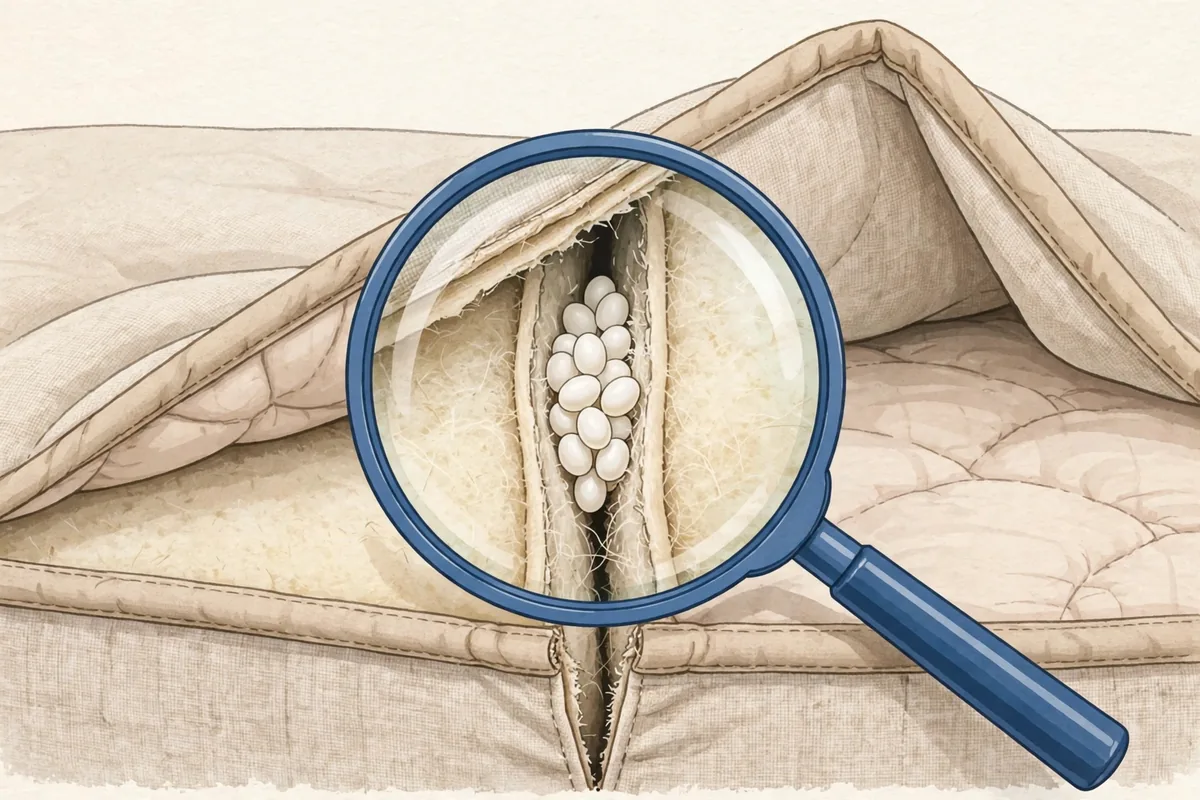
The single most diagnostic feature is the glue. The female bed bug coats each egg in a sticky, cement-like secretion that bonds it to the surface. These eggs do not roll, do not brush off easily, and are found exactly where they were laid: pressed into tight crevices. You will find them singly or in small clusters, tucked into mattress piping and seams, along the wooden frame under a box spring, in screw holes and joints of the bed frame, behind headboards, and in cracks near the bed. The University extension literature consistently places them within a few feet of where people sleep, because the female stays near her food source.
A female bed bug needs blood meals to produce eggs, and after a single feeding she can lay roughly one to seven eggs per day for about ten days before needing to feed again, with lifetime totals in the hundreds. At typical room temperature, above about 70 degrees Fahrenheit, most eggs hatch in six to ten days; cooler temperatures stretch that timeline. That steady output is why a small cluster of eggs today can become a visible problem within a month, and why early identification has real value.
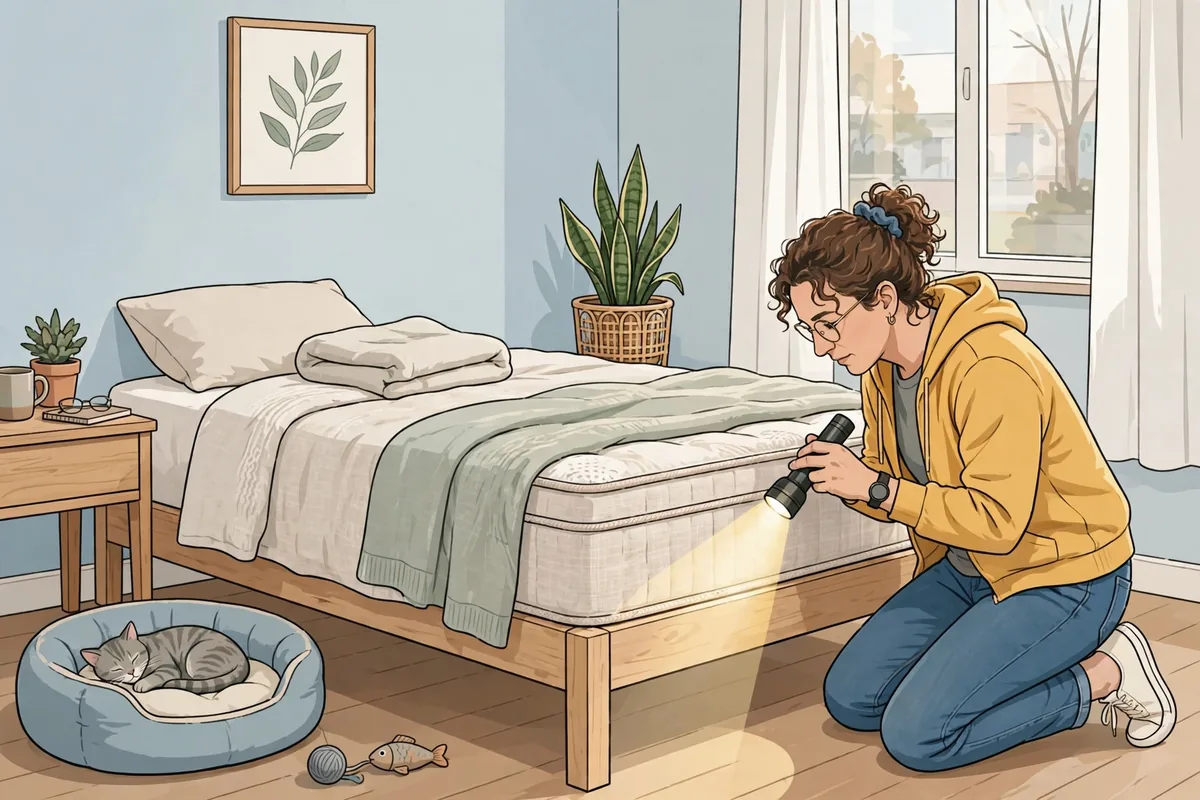
To inspect, use a bright flashlight and look along the seams and piping of the mattress, pulling fabric taut so the crevices open. Check the box spring’s underside, the bed frame joints, and the wall behind the headboard. If the eggs are bed bug eggs, they will be stuck fast, clustered in the tightest spots, and accompanied by other signs over time: shed skins, dark fecal spots, and eventually the flat reddish-brown adults themselves.
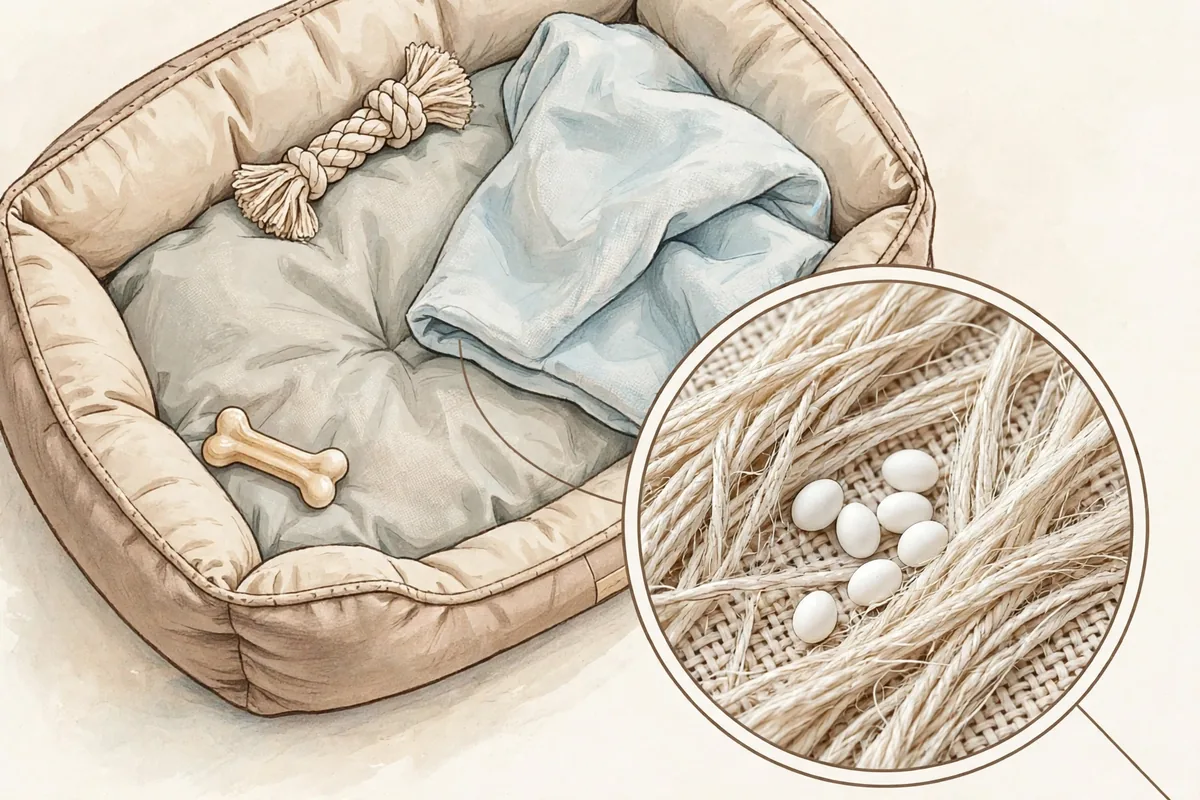
Flea eggs are even smaller and behave completely differently. Each egg is about half a millimeter long, roughly 0.3 to 0.5 millimeters, oval, smooth, and pearly white, often compared to grains of salt or fine sand. Unlike bed bug eggs, flea eggs have no adhesive coating. The female flea lays them in the pet’s fur, and because they are smooth and non-sticky, they fall off within hours, especially when the animal moves, shakes, or scratches.
That single difference in stickiness explains the entire geography of a flea problem. Flea eggs do not stay on the animal; they land wherever the pet spends time. The hotspots are pet bedding, the carpet or rug where the pet naps, upholstered furniture the pet uses, and cracks in flooring near resting areas. If your dog sleeps at the foot of your bed, expect eggs there; if the cat favors a sunny windowsill cushion, check that. The eggs accumulate in these resting zones because that is where they fall, day after day.
A female flea can lay around 20 to 30 eggs per day after blood meals, with lifetime totals reaching into the hundreds. The eggs hatch in 2 to 14 days depending on temperature and humidity, faster in warm, humid conditions, releasing tiny larvae that feed on organic debris and adult flea feces, the dark specks called flea dirt, in the same environment. This is the well-known salt-and-pepper pattern of a flea infestation: white eggs mixed with dark flea dirt in pet bedding. Note that the eggs themselves are white; some low-quality pest pages describe flea eggs as dark, but that confuses the eggs with the flea dirt lying beside them.
Because the eggs fall off the host, finding flea eggs on the pet itself is unusual. If you part the fur and see white specks that stay put and are glued to hair shafts, those are more likely lice nits than flea eggs. Flea eggs belong to the environment, not the animal, and that fact alone resolves a large share of identification confusion.
| Feature | Bed bug eggs | Flea eggs |
|---|---|---|
| Size | About 1 mm, pinhead size | About 0.5 mm, salt-grain size |
| Shape | Elongated oval, like miniature rice grains | Round to oval, smooth like grains of salt |
| Color | Pearly white, translucent when fresh; eye spot after about 5 days | Pearly white to off-white, no eye spot |
| Sticky or loose | Glued firmly to surfaces with a cement-like secretion | Smooth, non-sticky; fall and scatter freely |
| Where found | Mattress seams, box spring, bed frame cracks, headboard joints | Pet bedding, carpets, upholstery, pet resting areas |
| Relationship to host | Laid near sleeping humans, stays in hiding spots | Laid on the pet, falls off into the environment |
| Hatch time | About 6 to 10 days at room temperature | 2 to 14 days depending on warmth and humidity |
| Female output | Roughly 1 to 7 per day after a blood meal | Roughly 20 to 30 per day after blood meals |
| Empty shells | Transparent with an open cap at one end | Less commonly noticed; larvae leave the area |
The fastest field test is the touch test: if the tiny white specks are stuck fast in a crevice and resist brushing, think bed bug eggs. If they roll freely or scatter in pet bedding, think flea eggs. Location is the second test: tight crevices near the bed point to bed bugs; pet resting areas point to fleas. Either test alone can mislead, but together they are strongly informative.
Start with the bedroom, because that is where bed bug evidence concentrates. Strip the bed and inspect the mattress seams, piping, tags, and any tufts or buttons. Flip the box spring and check its wooden frame and the dust cover underside. Examine the bed frame’s joints, screw holes, and slats with a flashlight. Look behind the headboard and along the baseboard and wall within a few feet of the bed. Bed bug eggs will be in the tightest, darkest of these spots, glued in place.
Next, check where pets spend time, which is where flea eggs accumulate. Pull back pet bedding and look at the fabric surface and folds for the salt-like white specks. Check the carpet or rug beneath and around pet resting spots, the cushions of favored furniture, and if you have one, the area under a crate. A simple detection trick used by many inspectors: put on a dark rubber glove and run your hand over carpet or upholstery, then look for white dots against the dark glove. A magnifying glass helps at this scale; both eggs are at or below the limit of comfortable naked-eye inspection.
Do not forget transitional zones. If the pet sleeps on the human bed, both egg types can be present in the same room, and you may need to sort them by the stickiness and location rules above. Cars are another shared zone: a pet that rides along can seed flea eggs into the back seat, while a used mattress or piece of furniture can carry bed bug eggs into the home. When the evidence does not fit either pattern cleanly, that is useful information too: it may point to a third possibility, covered in the next section.
For a structured approach to recording bite and sign evidence before you call anyone, our bite and sting clue checklist gives you a simple framework. Written notes with dates beat memory when a professional asks what you found and where.
Several ordinary household things masquerade as pest eggs, and knowing them prevents panic.
Dandruff and dry skin flakes are the most common false alarm on bedding. They are irregular, flat, and brush away with zero resistance. Real eggs have consistent oval shapes.
Sesame seeds and food crumbs in bed suggest bed bug eggs to the anxious eye, but seeds are far larger, brownish, and hard. Bed bug eggs are a millimeter of pearly white.
Fabric lint and pills from sheets look like tiny white specks but pull apart into fibers under magnification. Eggs stay intact as smooth ovals.
Carpet beetle larvae are sometimes confused with flea evidence, but they are larger, hairy, brownish, and mobile; they are larvae, not eggs, and they feed on natural fibers rather than blood.
Lice nits are the closest true look-alike: they are also tiny, oval, and whitish. The difference is adhesion and address. Nits are glued to hair shafts on the host’s body; bed bug eggs are glued into environmental crevices; flea eggs are not glued to anything. If the specks are cemented to hair, think lice, not fleas or bed bugs.
Booklice and psocids are tiny pale insects sometimes found in humid rooms and bookshelves. They are harmless detritus feeders, not parasites, and their presence means moisture, not an infestation that bites.
When in doubt, collect a sample. Press clear tape gently over the specks, stick the tape to a white index card, and label it with the date and location. A pest professional can identify eggs from a taped sample far more reliably than from a phone photo, and the sample costs you nothing.
Finding bed bug eggs means a breeding population is established near where you sleep. Because eggs hatch in about a week and nymphs need blood to develop, the population compounds quickly: extension entomologists note populations can double roughly every couple of weeks under good conditions. Early professional intervention matters more with bed bugs than with almost any other household pest, because the longer the delay, the wider the spread through the home. Do not move the mattress to another room or start sleeping on the couch; that spreads the insects to new hiding spots and makes professional treatment harder.
Finding flea eggs means a pet-centered infestation with an environmental reservoir. The eggs you see represent only part of the life cycle: larvae and pupae are in the same bedding and carpet, and pupae in cocoons are the hardiest stage. This is why flea problems seem to vanish and return; the pupae wait out unfavorable periods and emerge when vibration and warmth signal a host. The response centers on the pet, through your veterinarian, plus the environment, through thorough laundering of pet bedding in hot water and frequent vacuuming of resting areas, which physically removes eggs and stimulates pupae to emerge where they can be dealt with.
Either finding deserves professional input rather than a hardware-store spray plan. Bed bugs have widespread resistance to many over-the-counter insecticides, and misapplied products scatter them deeper into the home. Flea products meant for the home can be dangerous to pets, and products meant for pets must be species-appropriate; what is safe for a dog can be toxic to a cat. The professional route is not upselling; it is the route with the fewest ways to make things worse.
Eggs themselves do not bite or cause disease, but the infestations behind them do produce bites, and bite reactions sometimes need medical attention. See a clinician promptly if you notice:
One reassurance worth having: neither bed bugs nor fleas in the United States are considered significant transmitters of disease to humans through their bites. The medical issues are allergic reactions, secondary infection from scratching, and the very real toll on sleep and peace of mind.
Can bed bug eggs and flea eggs be in the same house?
Yes, and pet-owning households with a bed bug introduction are exactly where it happens. The eggs sort themselves by the rules in this guide: glued clusters in bed crevices are the bed bug population, loose salt-like specks in pet bedding are the flea population. Treat them as two separate problems with two separate professional plans. Trying to handle both with one generic approach is how people end up treating the wrong thing twice.
How small is too small to identify without a magnifier?
Both eggs are at the edge of naked-eye identification: bed bug eggs at about 1 millimeter are visible as tiny white specks to people with good vision in good light, while flea eggs at half a millimeter really need magnification. A basic 10x loupe or a phone macro lens is enough. If you cannot resolve the shape even magnified, the taped sample method described above lets a professional do the identification.
Do bed bug eggs mean the adults are nearby?
Almost certainly. Females lay eggs within hiding distance of their blood source, typically within a few feet of the bed, and they lay continuously while feeding. Finding eggs without ever seeing an adult is common in early infestations because the adults hide well and feed at night. The eggs are often the first hard evidence, which is exactly why learning to recognize them matters.
Will washing sheets in hot water kill flea eggs?
Hot-water laundering with high-heat drying kills flea eggs, larvae, and adults in the washed items, and it is one of the most effective environmental measures available. The limitation is coverage: it only handles what goes through the machine. Eggs in carpet, upholstery, and pet resting areas outside the laundry remain, which is why laundering is paired with vacuuming and veterinary-coordinated pet treatment rather than used alone.
Can I just vacuum up bed bug eggs?
Vacuuming removes some eggs, but the glue is the problem: many eggs stay cemented in crevices despite suction, and a single surviving cluster restarts the population. Vacuuming is a useful supplement, especially with a crevice tool along seams, and the vacuum bag or canister contents should be sealed and discarded outdoors immediately. But vacuuming alone is not an elimination strategy for bed bugs, and relying on it as one gives the infestation time to spread.
Medically reviewed by Dr. Sarah Jones, MD.
This article is for informational purposes only and isn’t medical advice. If you’re worried about a bite or sting, talk to a healthcare professional.
Dr. Jones oversees StingHelp’s clinical verification process. Every guide is systematically evaluated against active Centers for Disease Control and Prevention (CDC), Environmental Protection Agency (EPA), and American Academy of Allergy, Asthma & Immunology (AAAAI) medical consensus standards to ensure symptom distinctions and care recommendations are clinically sound.
Explore physician-reviewed first-aid procedures, identification clues, and symptom comparisons for other common outdoor bites and stings.
Intense itching in the pubic area is distressing, and the first question most people ask is what is causing it. Two parasites sit at…

Every school year, the same scene plays out in kitchens across the country: a parent parts a child's hair, spots white specks, and feels…
You wake up with itchy red marks, and the internet offers two suspects: bed bugs or eczema. The question of bed bug bites vs…