
Straw Itch Mite vs Oak Mite Bites: Fall Rash ID
October is the peak month for one of the most baffling skin complaints of the year. You rake leaves under the big oak in…
The Short Answer The difference between straw itch mite bites vs chigger bites is mostly a difference of where you were and what you were doing. Straw itch mite bites…

The difference between straw itch mite bites vs chigger bites is mostly a difference of where you were and what you were doing. Straw itch mite bites come from handling hay, straw, grain, or working around stored products infested with grain insects; the bites favor exposed skin like the face, neck, arms, and shoulders. Chigger bites come from sitting, walking, or lying in grassy, weedy, or wooded vegetation; the bites cluster where clothing fits tightly, at sock lines, waistbands, and underwear elastic. Both cause intensely itchy red bumps that appear in warm months and peak in late summer and fall, which is why people confuse them. But the exposure story, the bite distribution, and the creatures behind them are genuinely different, and knowing which one got you changes the prevention advice completely.
This confusion is especially common in October. Fall is simultaneously hay-handling season, garden cleanup season, and leaf-pile season, so the same person can plausibly encounter both mites within days. Extension services in grain states and southern states alike field “mystery itch” calls every autumn from people who handled straw decorations, cleaned out a barn, or walked a field edge and woke up covered in welts. This guide separates the two by exposure, appearance, biology, and prevention, so you can work backward from your own story to the likely culprit.
If you remember only one thing from this article, make it this: straw itch mites find you through what you handled, chiggers find you through where you sat or walked. The exposure histories barely overlap, which makes your own memory the best diagnostic tool you have.
Straw itch mite exposure involves contact with hay, straw, grain, or materials associated with stored products. Classic scenarios include handling hay bales, stacking straw, cleaning grain bins, working in barns, mulching garden beds with straw, or even bringing straw bales home for autumn decorations. The straw itch mite, Pyemotes tritici, is a predator of grain-infesting insects; it does not seek people at all. You get bitten because you disturbed its hunting ground. Outbreaks often strike groups: everyone who helped unload the hay truck wakes up itching, which is itself a diagnostic clue.
Chigger exposure involves contact with vegetation. Classic scenarios include sitting on grass, walking through tall weeds or field edges, hiking, gardening in overgrown beds, golfing, or children playing in yards and parks. Chiggers are the larval stage of trombiculid mites, and the larvae quest on grass blades and low vegetation waiting for a passing host. They do not live in hay bales or grain bins; they live at the tips of plants in humid, shaded ground cover. If your itchy day involved a lawn, a trail, or a picnic blanket, chiggers are the far likelier suspect.
The stories can blur at the margins. Someone who spreads straw mulch in a weedy garden bed could encounter both. Farm workers moving between barns and fields get both exposures in a single day. And straw used as garden mulch sits on soil where chiggers may also quest, creating genuinely mixed exposures. When the history is mixed, the bite pattern and timing, covered next, help sort it out. When in doubt, treat for the itch the same way regardless; the distinction matters most for preventing the next round.
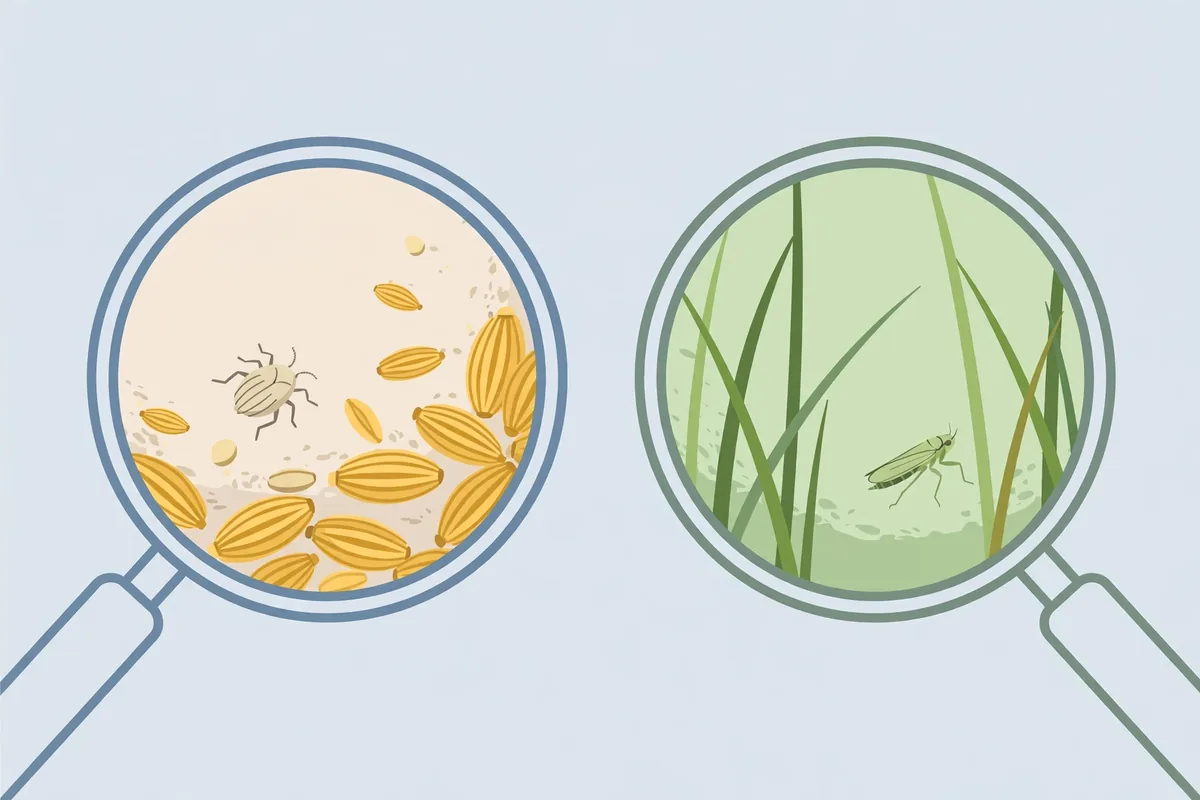
Though both are called “mites” and both are nearly invisible, straw itch mites and chiggers belong to different mite families with completely different life strategies. Understanding the biology explains why the bites look and behave differently.
The straw itch mite (Pyemotes tritici) is a tiny predatory mite, barely visible at about 0.2 millimeters, that normally hunts the larvae of grain moths, weevils, and other stored-product insects. Female mites are the biters. When their insect prey runs short, or when a person disturbs infested material, they bite people opportunistically. Their saliva contains a potent toxin that produces an outsized skin reaction relative to the mite’s size. Importantly, straw itch mites do not live on people, do not infest homes in the bed-bug sense, and do not reproduce on human skin. They are a hit-and-run nuisance tied to a specific material.
Chiggers are the six-legged larval stage of trombiculid mites, slightly larger than straw itch mites but still nearly invisible at around 0.15 to 0.3 millimeters. Only the larvae bite; adult trombiculid mites are harmless predators of small insects. A chigger larva climbs vegetation, grabs a passing host, and feeds by injecting saliva that dissolves skin cells, forming a feeding tube called a stylostome. Contrary to the old myth, chiggers do not burrow into skin or lay eggs under it. They feed for a few days if undisturbed, then drop off to continue their life cycle in the soil.
The practical upshot is that neither pest colonizes your body or your home the way lice or bed bugs do. Straw itch mites stay with the infested material; remove yourself from the hay and the biting stops. Chiggers stay on the vegetation; leave the field and the exposure ends, though the larvae already attached may feed for a while. Neither requires fumigating your house. Both require treating the itch and avoiding the source next time.
Here the two diverge in ways you can actually see. Both produce red, itchy bumps, but the details differ enough to be useful when combined with the exposure story.
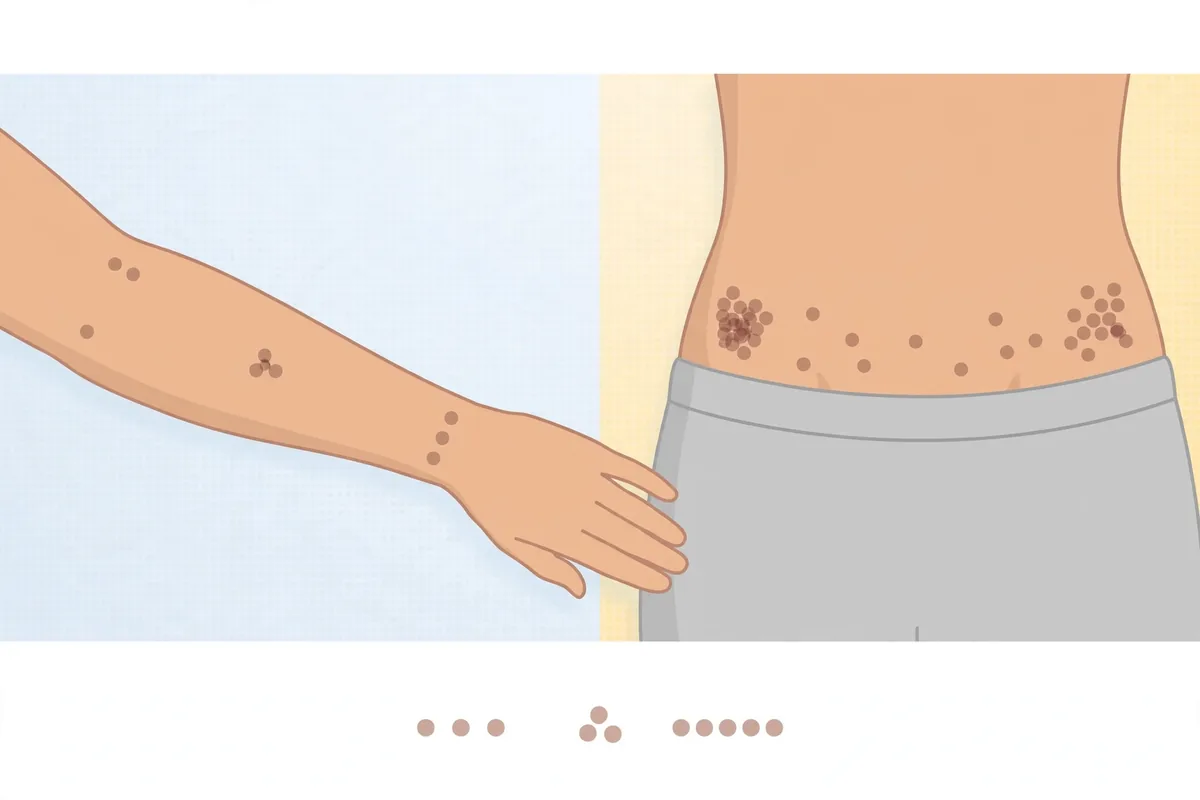
Straw itch mite bites are often described as large, red, raised wheals, sometimes with a central blister or pustule. Dermatology sources describe a distinctive pattern sometimes called the “comet sign”: a central welt with a trailing reddened track, though not every bite shows this. The bites favor exposed skin, the face, neck, forearms, and shoulders, because the mites encounter whatever skin is uncovered during handling. The itching is intense, often rated among the worst of the common mite bites, and the welts can persist for a week or more. Because the reaction is partly to the mite’s potent saliva toxin, the bumps can look alarming, large and angry, even though the mite itself is nearly microscopic.
Chigger bites appear as clusters of small red papules, often with intense itching that peaks a day or two after exposure. The signature is location: chiggers migrate across the skin until they hit a barrier, so bites concentrate at sock lines, waistbands, underwear elastic, behind the knees, and in the armpits and groin. The bumps are smaller and more uniform than straw itch mite welts, and while the itch is famously fierce, the individual lesions look less dramatic. Chigger bites also take time to declare themselves; the itching often starts hours after exposure and worsens over the next day or two as the stylostome reaction develops.
Straw itch mite reactions often begin within hours of handling the material, sometimes while you are still working. Chigger itching typically starts several hours after you leave the vegetation and intensifies over 24 to 48 hours. If you were fine during the barn cleanup but started itching that evening, either is possible. If you felt fine all through a morning hike and started itching badly the next day in neat rows at your sock line, chiggers are the strong favorite.

| Feature | Straw Itch Mite Bites | Chigger Bites |
|---|---|---|
| The mite | Pyemotes tritici, predatory mite of grain insects | Larval trombiculid mites, questing on vegetation |
| Size | ~0.2 mm, nearly invisible | ~0.15–0.3 mm larvae, nearly invisible |
| Exposure | Handling hay, straw, grain, stored products, straw decor | Sitting/walking in grass, weeds, brush, field edges |
| Bite location | Exposed skin: face, neck, forearms, shoulders | Clothing barriers: sock lines, waistband, underwear, armpits |
| Bite appearance | Large red wheals, sometimes blistered; “comet sign” track possible | Small uniform red papules in clusters |
| Itch onset | Often within hours of exposure | Hours later, peaking 24–48 hours after |
| Group pattern | Everyone who handled the material itches | Everyone who sat in the same grass itches |
| Home infestation risk | No; mites stay with the material | No; larvae stay in vegetation |
| Peak season | Late summer through fall (harvest, straw handling) | Late spring through fall (warm, humid months) |
The good news is that treatment is nearly identical for both, because in both cases you are treating your skin’s reaction, not an ongoing infestation. Neither mite remains on you in a way that requires killing.
Start with the basics: wash the skin with soap and water, which removes any lingering mites and reduces the chance of secondary infection. Apply a cold compress to the worst areas for 10 to 15 minutes at a time. Over-the-counter options that help include calamine lotion, hydrocortisone cream at the lowest effective strength, and oral antihistamines for itching, particularly at night when scratching does the most damage. Keep fingernails short and try not to scratch, since broken skin invites bacterial infection, which is the main complication of both bite types.
Do not apply bleach, rubbing alcohol, or nail polish to the bites. These folk remedies are aimed at the myth that chiggers burrow into skin, which they do not, and they irritate already inflamed skin without helping. Do not take antibiotics “just in case”; antibiotics do nothing for bite reactions and contribute to resistance. Do not use high-potency prescription steroid creams borrowed from someone else’s medicine cabinet. And do not fumigate your home for either mite; since neither infests houses, you would be exposing your family to pesticides for zero benefit.
Because the sources differ, prevention diverges completely. This is where the correct identification pays for itself.
Preventing straw itch mite bites is about the material. Wear long sleeves, gloves, and a tucked-in shirt when handling hay, straw, or grain. Shower and change clothes promptly after working with these materials; do not sit on furniture or in the car in work clothes. Store straw decorations outside rather than bringing bales indoors, since mites can emerge from decorative straw inside the home. If you buy straw for gardening or decoration, ask whether it was stored in a way that minimizes insect infestation, and be extra cautious with old or musty bales, which are more likely to harbor the grain insects the mites prey on.
Preventing chigger bites is about the vegetation. Wear long pants tucked into socks in grassy or weedy areas, and choose permethrin-treated clothing for heavy exposure like field work or hiking; permethrin on clothing (never on skin) is one of the most effective chigger deterrents available. Use EPA-registered skin repellents containing DEET or picaridin on exposed skin according to label directions. After time in vegetation, shower promptly with soap and wash clothing in hot water, which removes unattached chiggers before they settle in to feed. Keep lawns mowed and clear brushy edges near play areas and patios.
Group outbreaks are common with both mites and are actually reassuring: they confirm an environmental source rather than something spreading person to person. If everyone who unloaded hay is itching, the hay is the source; launder work clothes hot, shower, and treat the itch. If everyone at the picnic is itching at the waistband, the grass is the source; same response. Neither situation calls for isolating anyone or treating people as contagious, because neither mite spreads from person to person.
Most straw itch mite and chigger bites resolve on their own within one to two weeks with basic itch care. But certain developments warrant medical attention.
See a doctor or urgent care if bites show signs of bacterial infection: increasing pain, spreading redness, warmth, swelling that worsens after the first few days, pus, red streaks extending from the bites, swollen lymph nodes, or fever. Scratching is the usual pathway from bite to infection. Our bite infection warning signs page has the complete checklist.
Seek care promptly if you develop a large number of bites with significant swelling, if itching is severe enough to prevent sleep for multiple nights despite over-the-counter measures, or if you notice signs of an allergic reaction such as widespread hives or swelling of the face. People with many dozens of bites, common in heavy straw itch mite exposures, sometimes need prescription-strength itch relief.
Call 911 for emergency signs: difficulty breathing, throat tightness, dizziness, or fainting after bites. Severe systemic reactions to these mites are uncommon, but any suspected anaphylaxis is an emergency. Our anaphylaxis guide explains what to watch for.
Note that in North America, chiggers are not considered significant disease vectors; the scrub typhus associated with trombiculid mites in Asia and the Pacific is transmitted by different species in the genus Leptotrombidium, not by North American chiggers. You do not need antibiotics or disease testing for typical chigger bites in the United States.
How can I tell if my bites are from straw itch mites or chiggers?
Work backward from your exposure. If you handled hay, straw, grain, or worked in a barn or with stored products shortly before the itching started, and the bites are on exposed skin like the face, neck, and forearms, straw itch mites are likely. If you sat or walked in grass, weeds, or brush, and the bites cluster at sock lines, waistbands, or underwear elastic a day or two later, chiggers are likely. Bite appearance helps too: larger wheals suggest straw itch mites, small uniform papules at clothing lines suggest chiggers.
Do straw itch mites infest your home like bed bugs?
No. Straw itch mites live in and around infested hay, straw, grain, and stored products; they do not colonize mattresses, furniture, or homes the way bed bugs do. The exception is straw brought indoors: decorative straw bales or straw pet bedding can harbor the mites and their grain-insect prey, causing bites inside the house until the material is removed. If indoor biting started after you brought straw decorations inside, remove the straw and the problem resolves. No fumigation is needed.
Do chiggers burrow into your skin?
No, this is a persistent myth. Chigger larvae pierce the skin and inject saliva that dissolves skin cells, forming a straw-like feeding tube called a stylostome, through which they feed. They do not burrow, do not lay eggs in skin, and do not live under the skin. Remedies aimed at “suffocating” burrowed chiggers, like nail polish or bleach, are based on this myth and only irritate the skin. The larva typically drops off within a few days; the lingering itch is your immune reaction to the feeding tube, not a creature living in you.
How long do straw itch mite bites and chigger bites last?
Both typically resolve within one to two weeks, though straw itch mite welts can linger toward the longer end because the reaction to the mite’s saliva toxin is vigorous. Itching usually peaks in the first few days and then gradually fades. If individual bites are still worsening after a week, or new bumps keep appearing without new exposure, see a clinician, since that pattern suggests either secondary infection or a different cause worth evaluating.
Can I get the same bites again from the same hay or field?
Yes, absolutely, and this is the strongest argument for prevention. Neither exposure confers immunity; you can be bitten every time you handle infested straw or walk through chigger habitat. Straw itch mites persist in infested material until the grain insects they prey on are gone, so the same hay supply can bite handlers for weeks. Chiggers return to the same favorable vegetation year after year. Protective clothing, prompt showering, and repellents turn a recurring misery into a non-event.
Medically reviewed by Dr. Sarah Jones, MD.
This article is for informational purposes only and isn’t medical advice. If you’re worried about a bite or sting, talk to a healthcare professional.
Dr. Jones oversees StingHelp’s clinical verification process. Every guide is systematically evaluated against active Centers for Disease Control and Prevention (CDC), Environmental Protection Agency (EPA), and American Academy of Allergy, Asthma & Immunology (AAAAI) medical consensus standards to ensure symptom distinctions and care recommendations are clinically sound.
Explore physician-reviewed first-aid procedures, identification clues, and symptom comparisons for other common outdoor bites and stings.

October is the peak month for one of the most baffling skin complaints of the year. You rake leaves under the big oak in…

Oak Mite Bites vs. Chigger Bites: The Body-Map Test That Tells Them Apart The fast answer: Look at where the bites are. Oak leaf…

Bird Mites After a Nest Removal — and Rodent Mites After the Mice Are Gone: Why the Bites Start When the Host Leaves The…