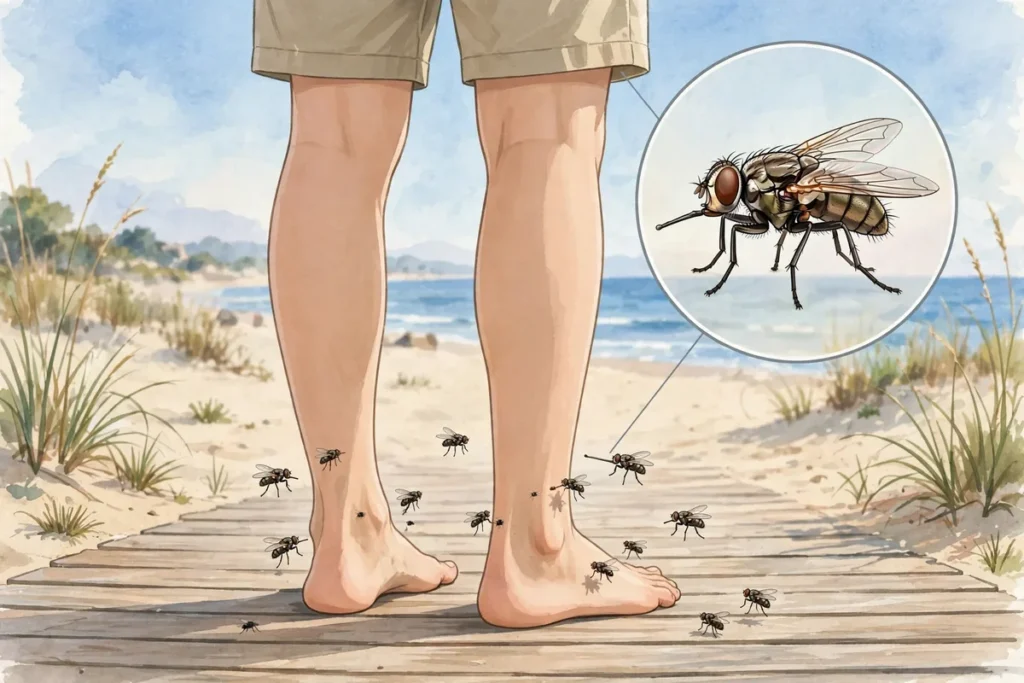
October, and your ankles are under attack. You’re getting sharp, stabbing bites around your socks and sandals — at the beach, in the backyard, at the kids’ soccer game — and there are no mosquitoes in sight. The culprit that explains this exact pattern is one most people have never heard of: the stable fly. Stable fly bites in fall follow one of the most predictable seasonal surges in the biting-insect world, peaking from September through November across much of the United States, and they specialize in exactly what you’re experiencing: painful ankle bites that seem to come out of nowhere.
This guide covers how to identify the stable fly (it’s not a housefly, though it looks like one), why your mosquito repellent isn’t working the way you expect, where fall encounters happen — beaches, farms, backyards, and ball fields — and what actually helps, from first aid to the source-reduction steps that cut populations at their roots.
Meet the Stable Fly: It’s Not a Housefly
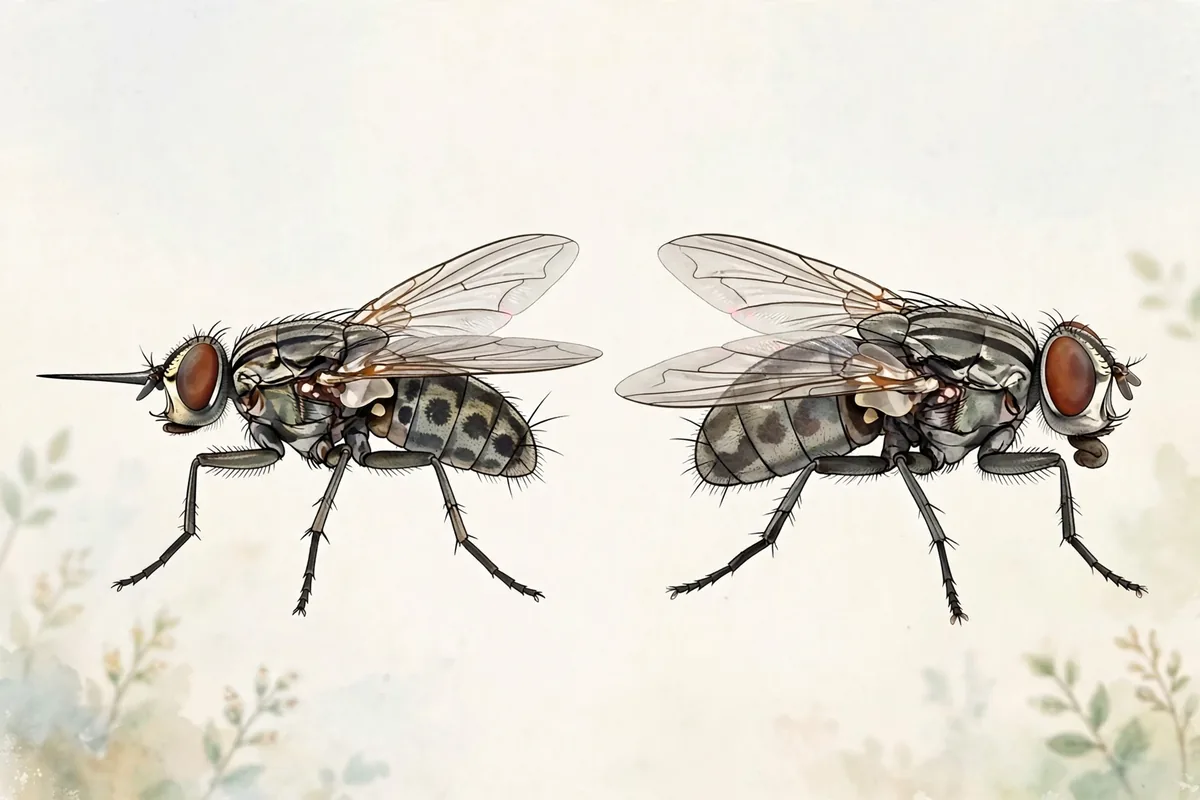
The stable fly (Stomoxys calcitrans) is a master of mistaken identity. At 5 to 7 millimeters long, gray, with a vaguely familiar fly shape, it looks almost exactly like a common housefly — which is why “but houseflies don’t bite” is the sentence everyone says right before learning about stable flies. House flies genuinely don’t bite. Stable flies absolutely do, and both males and females feed on blood, typically two to three times a day.
The telltale feature is the mouthparts. A housefly has soft, sponging mouthparts for lapping up liquids. A stable fly carries a long, stout, bayonet-like proboscis that juts forward from under its head — a piercing tool built for stabbing skin and drawing blood. If you can get close enough to look (or catch one for inspection), that forward-pointing beak is diagnostic. Two more field marks help: the stable fly’s thorax carries four dark longitudinal stripes, and its abdomen shows a checkerboard pattern of dark spots — sevenish spots that the housefly’s plain abdomen lacks.
The bite itself is distinctive too. Entomologists and public-health departments describe it as a sharp, stabbing pain — noticeably more painful than a mosquito bite, more like a needle jab. The flies prefer the lower legs and ankles, partly because they fly low and partly because ankles are what’s exposed. Midwestern public-health guidance notes the same seasonal picture: stable flies peak in late summer and early fall, bite ankles with a sharp stabbing pain, and will fly miles to find livestock, pets, and people. If your “mosquito bites” hurt like pinpricks, cluster at the ankles, and happen in broad daylight, you’re probably not dealing with mosquitoes at all.
Why Fall Is Stable Fly Season
Stable flies are present much of the warm season, but their populations follow a distinct curve that makes fall the worst stretch. University of Georgia entomologist Nancy Hinkle, who studies biting-fly ecology in the Southeast, describes the southern pattern: stable flies recede during the heat of summer, then surge from September through November. In Florida, the season runs October through April. UF/IFAS extension places peak abundance from late August through October and November. Midwestern public-health notices confirm the late-summer-to-early-fall peak for that region as well.
The biology behind the surge is straightforward. Stable fly larvae develop in decaying organic matter — wet hay, straw, grass clippings, silage, and manure mixed with plant material. Late-summer mowing, fall leaf accumulation, harvest-season agricultural activity, and the general buildup of damp organic debris create ideal breeding conditions just as temperatures settle into the flies’ preferred range. Adults live about three weeks and each female lays hundreds of eggs, so populations compound fast through September and October.
Fall also brings the human-fly collision points. Beach season’s tail end is notorious: on parts of the Gulf Coast, stable flies are called “dog flies,” and fall beachgoers in places like Destin, Florida, report getting chewed up on otherwise perfect October beach days — the flies breed in decaying seaweed and beach wrack. Backyard scenarios spike too: fall yard cleanup stirs up breeding material, kids’ sports run through October on grass fields bordered by exactly the kind of damp organic edges stable flies love, and anyone with horses, cattle, or even a few backyard chickens nearby is downwind of prime habitat.
Where Fall Encounters Happen
Beaches. The Gulf Coast “dog fly” phenomenon is the most dramatic fall scenario. Stable flies breed in decaying seaweed lines and beach vegetation, and onshore winds push them onto beachgoers. They’re day-biters and they’re persistent — victims describe being bitten repeatedly through the day despite moving spots. If you’re planning a fall beach trip to the northern Gulf, pack long pants and ankle protection, not just sunscreen.
Farms and stables. The name is honest: livestock operations are the primary habitat. Horses stomp, cattle bunch, and both suffer blood loss and stress. But you don’t need to own livestock — living within a few miles of stables, pastures, or even a neighbor with horses puts you in range, since stable flies readily fly miles seeking hosts.
Backyards and parks. The suburban version runs on grass clippings, mulch piles, compost, pet waste, and damp leaf litter. Fall is when all of these accumulate. Soccer fields, dog parks, and playgrounds edged with mulch or border plantings are classic bite sites — which is why the victims are so often kids in shorts and parents in sandals.
Patios and outdoor dining. Stable flies are attracted to large, dark, moving objects — which unfortunately describes people. They’ll find you on the deck as readily as in the pasture, especially downwind of any breeding source.
Why Repellent Often Fails (and What Works Instead)
Here’s the frustrating truth that the research brief flagged: stable flies are visual hunters that bite fast, and standard repellent strategies underperform against them. Extension guidance on biting flies notes that even high-DEET products provide only some protection — and when flies are swarming, swatting and running are counterproductive because agitated movement attracts more of them. USDA-affiliated research has found that picaridin-family repellents show activity against stable flies, and DEET does repel them to a degree, but no repellent makes you invisible to a determined fall swarm the way DEET does with mosquitoes.
The reason is behavioral. Mosquitoes hunt largely by scent — carbon dioxide, skin odors — which repellents disrupt effectively. Stable flies hunt substantially by sight: they’re drawn to large dark shapes, movement, and contrast. A repellent on your skin doesn’t change your silhouette. They land, stab, and feed in seconds, often before a contact repellent’s deterrent effect fully engages.
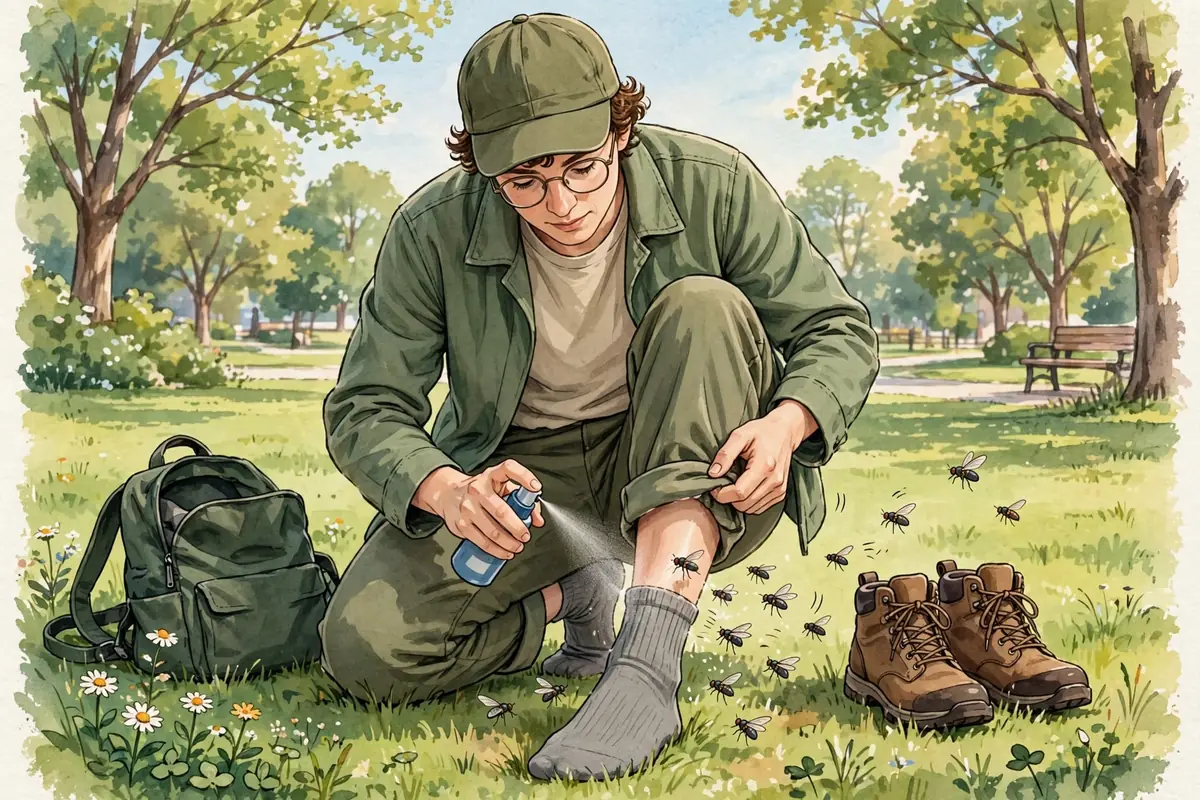
So what actually works? ### Physical barriers first. Long pants tucked into socks are the single most effective personal defense — boring, unfashionable, and devastatingly effective against an ankle-biting fly. Light-colored clothing helps; dark pants against green grass are a stable-fly bullseye. For beach trips, lightweight long pants beat shorts no matter the temperature.
Repellent as a supplement, not a strategy. Apply a DEET or picaridin product to exposed skin — particularly ankles and lower legs — understanding it’s a partial shield. Reapply per the label, especially after swimming or sweating.
Traps for small areas. Sticky traps and visual traps (dark balls or panels coated with sticky material) exploit the flies’ visual hunting — they fly to the dark object and get stuck. UF/IFAS notes these can be effective in small areas like yards, patios, and campsites. They’re a supplement, not a yard-wide solution, but around a patio or a kids’ play area they meaningfully cut biting pressure.
Source reduction — the real fix. Stable flies breed in decaying organic matter, so the long game is sanitation: clean up grass clippings, manage compost properly (hot composting kills larvae; soggy static piles breed them), pick up pet waste promptly, avoid piling mulch against activity areas, and clear fall leaf litter from damp corners. Around livestock, it’s manure and wet-hay management — the domain of farm operators, but worth raising with neighboring stable owners if you’re downwind.
| Method | Effectiveness vs stable flies | Notes |
|---|---|---|
| Long pants tucked into socks | High | Best single personal defense; targets their ankle preference |
| DEET/picaridin on skin | Moderate/partial | Helps, but won’t stop a swarm; reapply per label |
| Light-colored clothing | Moderate | Reduces visual attraction vs dark clothing |
| Sticky/visual traps | Moderate (small areas) | Good for patios and yards; exploit visual hunting |
| Source reduction | High (long-term) | Remove breeding material: wet hay, clippings, waste |
| Swatting and running | Counterproductive | Agitation attracts more flies |
First Aid for Ankle Bites
Stable fly bites hurt more than they harm. The typical course: sharp pain at the moment, then an itchy red bump that resolves in a few days. Treat them like any other biting-fly injury, with attention to the ankle-specific complications.
Immediate care: Wash the bites with soap and water. Apply a cold compress for 10 to 15 minutes — cold is the fastest route to pain and itch relief, and the cold compress technique for bites and stings works exactly the same here. An oral antihistamine can take the edge off the itching for people who react strongly.
Don’t scratch. Ankle skin takes a beating from footwear friction anyway, and scratched bites on the lower leg are prone to secondary infection. Keep nails short, and consider covering particularly itchy bites with a bandage to break the scratch cycle overnight.
Watch the lower-leg danger signs. The ankles and shins have relatively poor circulation compared to the rest of the body, and bites there deserve an extra day or two of attention. Increasing redness, warmth, swelling that spreads, red streaks traveling up the leg, pus, or fever suggest cellulitis — a bacterial skin infection that needs medical treatment, not more anti-itch cream. People with diabetes, circulation problems, or compromised immunity should be particularly vigilant about lower-leg bites and seek care earlier rather than later.
Allergic reactions to stable fly bites are uncommon but possible. Hives spreading beyond the bite sites, swelling of the face or lips, wheezing, or dizziness after bites warrant the same emergency response as any insect-induced allergic reaction.
For comparison with other biting flies that share the season, a look at black fly bite treatment covers similar first-aid ground — the principles transfer.
When to See a Doctor for Stable Fly Bites

- Call 911 for signs of severe allergic reaction: trouble breathing, throat or tongue swelling, dizziness, fainting, or widespread hives after bites.
- Seek same-day care for signs of skin infection: spreading redness, increasing warmth and swelling after 24-48 hours, red streaks, pus, or fever — especially with lower-leg bites.
- See a doctor promptly if you have diabetes, peripheral circulation problems, or an immune-compromising condition and develop multiple lower-leg bites; your threshold for professional evaluation should be lower.
- Get evaluated if bites aren’t improving after a week, keep recurring in the same spot (suggesting ongoing exposure worth investigating), or develop into open sores.
- Consider an allergist if you develop unusually large or blistering reactions to bites repeatedly — large local reactions deserve a professional assessment and a plan.
Frequently Asked Questions
Do stable flies bite at night?
Rarely. They’re daytime feeders, most active in daylight hours. If you’re getting bitten at night indoors, stable flies are unlikely culprits — consider mosquitoes or bed bugs instead. Daytime ankle attacks in fall, though, are textbook stable fly behavior.
Can stable flies bite through clothing?
Their piercing proboscis can penetrate thin, tight fabrics — a thin sock or light pantyhose isn’t a guarantee. Loose, thicker fabrics (jeans, canvas pants) are much harder to bite through. Tucking pants into socks works because it eliminates the gap at the ankle where skin is exposed, not because socks are armor.
Why are they only biting my ankles and not my arms?
Stable flies fly low and target the lower legs — it’s their evolved feeding preference, confirmed across livestock and human studies. Ankles are also simply the most exposed skin when you’re in shorts or sandals. Cover the lower legs and most of the problem disappears.
Will they go away after the first frost?
Populations crash with sustained cold, yes — but a light frost won’t end the season, and in the Gulf South the season can run into winter. Don’t use the first cold snap as an excuse to skip protection; the flies rebound during warm spells well into late fall.
Are stable fly bites dangerous? Do they spread disease to people?
For people, the harm is pain, itching, and the small risk of secondary skin infection — stable flies aren’t considered significant disease vectors for humans the way mosquitoes or ticks are. (They do transmit some livestock diseases, which is why agriculture takes them seriously.) Treat the bites, watch for infection, and focus your energy on prevention.
This article is for informational purposes only and isn’t medical advice. If you’re worried about a bite or sting, talk to a healthcare professional.