
Do Mothballs Kill Bed Bugs? Why Experts Say No
It's 2 a.m., you're itching, and you've just spotted telltale rust-colored spots along your mattress seam. A quick search suggests tossing mothballs under the…
Let us start with the reassurance, because you should keep borrowing books: the odds are strongly in your favor. Libraries are not bed bug hotspots, and the overwhelming majority of…

Let us start with the reassurance, because you should keep borrowing books: the odds are strongly in your favor. Libraries are not bed bug hotspots, and the overwhelming majority of borrowed books are perfectly clean. But bed bugs library books do occasionally intersect — entomologists confirm that books can serve as vehicles when they spend time in an infested home, since bed bugs hide in spines, page edges, and covers during the day. A calm, two-minute inspection habit plus one simple heat routine removes essentially all of the already-small risk.
This guide explains how books become carriers, how to check borrowed books without damaging them, what to do if you find signs of bed bugs, and how to handle the situation with your library — no shame, no panic, no giving up reading.
Bed bugs are hitchhikers, not book lovers. They do not eat paper or live in libraries as a rule; they feed on people, usually at night, and hide in tight, dark crevices by day. A book becomes a vehicle when it spends time in an infested home — most often on or near a bed, which is exactly where frequently-read bestsellers tend to live. The bug crawls into the spine, the gutter between pages, or under a dust jacket during the day, and rides along when the book is returned.
Library professionals are well aware of this. Trade publications for librarians have covered bed bug protocols in libraries, and entomologists note that heavily circulated books — the popular titles that move constantly between homes and bedside tables — are the plausible carriers, not the dusty reference volumes that sit on shelves for years. The risk concentrates in a specific chain: infested home → bedside book → return slot → your tote bag. Every link in that chain is low-probability, which is why actual cases are uncommon — but the chain is real, which is why a routine is worth having.
It helps to keep the scale honest. Libraries circulate millions of books, and most have inspection and quarantine procedures for returned materials. Your personal routine is a backstop, not a sign that libraries are unsafe. Think of it like checking hotel mattresses when you travel: a sensible habit for a low-probability event.
Build this two-minute check into your library habit — ideally in good light before the books go on your shelf or nightstand:
Start with the outside. Look along the spine, hinges, and under the dust jacket (if it has one). You are looking for the signs bed bugs leave: tiny rust-colored or dark spots (fecal staining), shed translucent skins, or pale oval eggs tucked into crevices. A quick glance is usually enough; you do not need to disassemble anything.
Fan the pages. Hold the book spine-up and fan the pages gently over a light-colored surface — a white table or a sheet of paper. Debris, skins, or live bugs will fall or become visible at the page edges. Check the gutter (the inner fold) where pages meet the spine, a favorite hiding spot.
Smell is not a reliable test. You may read that heavy infestations smell musty or sweet. By the time odor is detectable, the problem is far beyond one book — do not rely on your nose for a single-volume check.
For e-readers and audiobooks, none of this applies — digital borrowing carries zero bed bug risk, which is one more quiet argument for the library app on your phone.
If a book passes this check, shelve it with confidence. If you spot suspicious signs, do not panic — seal the book in a zip-top bag and read the next section. And remember the broader context: knowing how long insect bites typically last and whether bed bugs can bite through clothes helps you interpret any symptoms calmly rather than catastrophizing.

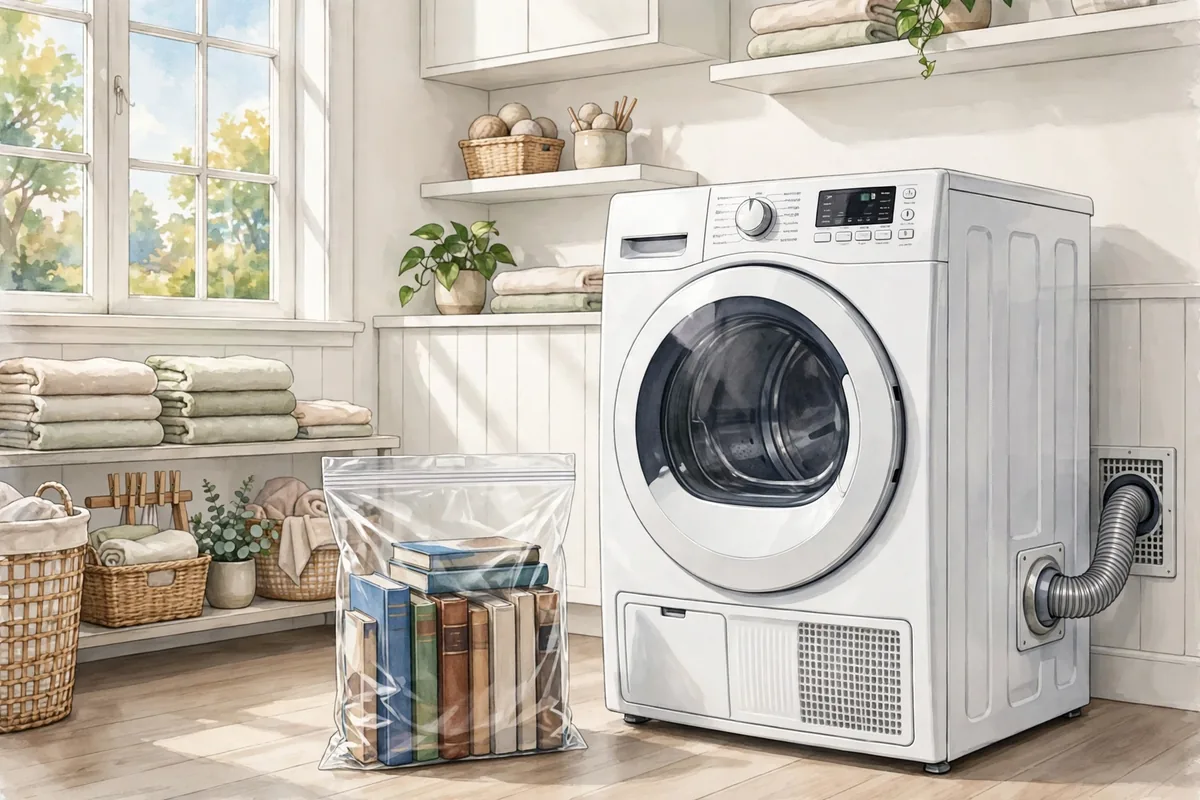
Here is the single most effective thing you can do: heat kills bed bugs at every life stage, and your clothes dryer is the tool. This is the same principle pest professionals rely on — sustained heat above about 120°F (49°C) is lethal to bed bugs, including eggs.
For books you want to be extra sure about — or any book that showed suspicious signs — seal it in a bag and run it through a hot dryer cycle. Practical method: place the book in a mesh laundry bag or pillowcase (to protect it), and run the dryer on high heat for 30 minutes. Paper tolerates this fine for a single cycle; libraries themselves use heat chambers on the same principle for suspect returns. Do not microwave books (metallic inks and bindings can spark) and do not put them in the oven — the dryer is the safe, controlled option.
For books that passed inspection, no treatment is needed at all. Reserve the dryer routine for books that looked questionable, books borrowed during a known local outbreak, or simply for your own peace of mind with high-circulation bestsellers. It is a targeted tool, not a every-book ritual — overdoing it risks damaging bindings for no benefit.
One caution: heat-treating a library book that you then damage is your responsibility, so use the protective bag and a single moderate cycle rather than repeated blasts. When in doubt, ask your librarian what the library prefers — many have their own quarantine procedures and would rather handle a suspect book themselves.
Finding a suspicious spot in a library book feels alarming, but the protocol is simple and contained:
If bites do appear and you are unsure what they are, our guide to bed bug bites in a line or cluster pattern can help you interpret what you are seeing — without self-diagnosing.

Many borrowers hesitate to report because they worry about blame or embarrassment. Reframe it: you are almost certainly not the source, you are the detector, and libraries genuinely prefer to hear about it. A simple, factual message works: “I found what looks like bed bug signs in [title], barcode [number]. It’s sealed in a bag. How would you like me to return it?”
Do not return a suspect book through the normal drop slot unbagged — that risks spreading the problem to the sorting area. Ask for instructions; most libraries will arrange a bagged return or pickup. And do not feel you need to announce it to fellow patrons or post about it — a quiet, direct report to staff is the helpful move.
It is also worth knowing that many libraries already run preventive routines: inspecting high-circulation returns, heat-treating suspect items, even using bed bug-sniffing dogs in some large systems. Your report plugs into an existing system, not an unprepared one.
A few structural habits make the whole question fade into the background:
None of this should diminish the library habit. Libraries remain among the safest, most valuable public resources — and a two-minute check is a small price for keeping it that way.
Bed bug bites themselves are a nuisance rather than a medical emergency, but see a clinician if:
If you suspect bed bugs are biting you at home, identification help from a pest professional matters more than a doctor visit — but infected or severe bite reactions always deserve medical attention.
How common are bed bugs in library books, really?
Uncommon. Entomologists describe books as a genuine but infrequent vehicle — the risk concentrates in heavily circulated books that spent time on beds in infested homes. Libraries move millions of clean books for every problematic one. A quick inspection habit covers the residual risk.
Can bed bugs live in a library long-term?
Libraries are not ideal bed bug habitat — there is no consistent nighttime host. Bugs that arrive in returned books may wander, which is why libraries inspect returns and quarantine suspects. Established, breeding library infestations are rare precisely because the environment does not support them well.
Will the dryer damage the book?
A single 30-minute high-heat cycle in a protective bag is generally safe for most books. Repeated or excessive heat can warp covers and loosen bindings, so reserve heat treatment for books with actual suspicious signs rather than every borrow. When in doubt, ask your librarian.
Should I tell the library, or just quietly return it?
Tell them — quietly and directly. A factual report (“I found signs in this title; it’s bagged; how should I return it?”) lets staff quarantine and treat the item, protecting the next borrower. Libraries have procedures for exactly this and appreciate the heads-up.
Do e-books and audiobooks carry any risk?
None whatsoever. Digital borrowing involves no physical object changing hands, so there is no hitchhiker vector. If bed bug anxiety is genuinely interfering with your reading life, the library’s digital collection is a complete, risk-free alternative.
Medically reviewed by Dr. Sarah Jones, MD.
This article is for informational purposes only and isn’t medical advice. If you’re worried about a bite or sting, talk to a healthcare professional.
Dr. Jones oversees StingHelp’s clinical verification process. Every guide is systematically evaluated against active Centers for Disease Control and Prevention (CDC), Environmental Protection Agency (EPA), and American Academy of Allergy, Asthma & Immunology (AAAAI) medical consensus standards to ensure symptom distinctions and care recommendations are clinically sound.
Explore physician-reviewed first-aid procedures, identification clues, and symptom comparisons for other common outdoor bites and stings.
It's 2 a.m., you're itching, and you've just spotted telltale rust-colored spots along your mattress seam. A quick search suggests tossing mothballs under the…

If you don't have a washer and dryer at home, the laundromat is a weekly fact of life — and so is a nagging…

You've just finished a great workout when a thought stops you cold: that pile of gym bags heaped together in the locker room —…