
Bed Bugs in Library Books: Borrower’s Guide
Let us start with the reassurance, because you should keep borrowing books: the odds are strongly in your favor. Libraries are not bed bug…
It's 2 a.m., you're itching, and you've just spotted telltale rust-colored spots along your mattress seam. A quick search suggests tossing mothballs under the bed as a cheap fix —…

It’s 2 a.m., you’re itching, and you’ve just spotted telltale rust-colored spots along your mattress seam. A quick search suggests tossing mothballs under the bed as a cheap fix — and at a few dollars a box, the idea is tempting when you’re exhausted and desperate.
But here’s the direct answer: do mothballs kill bed bugs? No. Researchers at Rutgers University tested mothballs against bed bugs and found they failed to wipe the bugs out even after seven days of exposure — most adults died, but the eggs and nymphs survived, which is all it takes for an infestation to rebound. Worse, using mothballs anywhere other than the sealed containers described on their label violates federal pesticide law, and the fumes can genuinely harm children and pets. This article explains why mothballs fail, what the real risks are, and which methods actually eliminate an infestation.
Bed bug infestations create a particular kind of panic. The bites itch, sleep becomes impossible, and professional heat treatments can cost a thousand dollars or more. In that moment, a grandmother’s advice — “just put mothballs around the bed” — feels like a lifeline. Mothballs are cheap, available at every dollar store and supermarket, and they carry the powerful smell of doing something.
The logic seems reasonable on the surface. Mothballs are pesticides, after all — they kill clothes moths, so why wouldn’t they kill another household insect? The problem is that bed bugs are not moths. Their biology, behavior, and hiding habits make them almost completely indifferent to the slow vapor mothballs release.
The most widely cited test of this idea comes from entomologists at Rutgers University, whose urban entomology team — led by researcher Changlu Wang — is among the most respected in bed bug science. In their tests, bed bugs exposed to mothballs failed to be wiped out after seven days. Roughly half of the adult bugs died, but the eggs and nymphs survived essentially unscathed.
A partial adult kill is not a treatment — bed bug eggs are the toughest life stage, and any eggs that survive hatch within weeks and reboot the infestation. In a real bedroom — larger, ventilated, full of cracks and crevices — the vapor concentration would be far lower than in the test, and the results would be even worse.
This finding lines up with how pest professionals talk about mothballs. The Cuyahoga County bed bug task force in Ohio explicitly tells residents not to place mothballs between the mattress and box spring or under and around the bed, noting the products are not labeled or approved for bed bug control and are not effective. When county-level task forces and published university research agree this firmly, it’s worth listening. If you’re dealing with mysterious itchy welts, a proper bed bug bite identification guide is a far better starting point than a box of mothballs.

To understand the failure, it helps to know how each side works. Mothballs don’t kill on contact like a spray. They work by sublimation — the solid slowly turns into a gas that fills an enclosed space. Clothes moths die because they’re sealed inside garment bags with that gas for weeks, breathing it constantly.
Bed bugs, meanwhile, are built for evasion. Adults are about the size of an apple seed and spend most of their time wedged into cracks: mattress seams, box spring joints, behind headboards, inside nightstand screw holes. A faint pesticide vapor drifting through an open bedroom doesn’t reach them at lethal concentrations. And bed bug eggs — tiny, cemented into hiding spots — are the toughest life stage of all. If a treatment can’t kill eggs, the infestation rebounds within weeks.
There’s a cruel irony here. Some research suggests that certain pesticide vapors can irritate bed bugs enough to make them scatter deeper into walls and adjacent rooms. A failed DIY treatment doesn’t just waste time — it can convert a contained bedroom problem into a whole-house problem. This is one reason entomologists consistently advise against improvised chemical approaches and point people toward proven prevention strategies instead.
Mothballs aren’t just ineffective — they’re genuinely hazardous when misused, and bed bug desperation is exactly the scenario that drives misuse. Traditional mothballs are made of naphthalene; most modern ones use paradichlorobenzene (PDB). Both are volatile chemicals that continuously release fumes into the air, and both are registered pesticides with strict label directions: they are meant to be used only in tightly sealed containers, like garment bags or trunks, to protect fabrics from moths. Scattering them around a bedroom or under a mattress is not on any label.
The health concerns are serious. Naphthalene exposure has been linked to hemolytic anemia — the destruction of red blood cells — and infants and young children face the highest risk, particularly those with G6PD deficiency, a common enzyme condition. Watch for fatigue, pale skin, rapid heartbeat, and dark urine. PDB carries its own concerns: at high exposures it can affect the liver and nervous system, causing headaches, dizziness, and nausea.
Pets face similar risks. Dogs and cats that chew mothballs can suffer vomiting, tremors, and in severe cases organ damage — suspect ingestion warrants an emergency vet visit. And because mothballs look a little like candy, small children may pick them up and put them in their mouths.
Ventilation makes everything worse. Mothball labels require sealed containers precisely because the fumes need to stay concentrated to work — and because those same fumes are harmful to breathe. In an open bedroom, you get the worst of both worlds: vapor too dilute to bother a bed bug, yet present in the breathing zone night after night.

This surprises most people, but it’s straightforward: mothballs are regulated as pesticides by the U.S. Environmental Protection Agency, and under federal law (the Federal Insecticide, Fungicide, and Rodenticide Act), using any pesticide in a way not specified on its label is illegal. Mothball labels specify sealed-container use against clothes moths. They do not list bed bugs. Spreading them around bedrooms, attics, gardens, or crawl spaces to fight bed bugs is off-label use — technically a federal violation.
Enforcement against individual homeowners is rare, but the law reflects the safety testing behind the label. When a product’s label says “use only in airtight containers,” that’s the manufacturer’s tested safety envelope. Step outside it and you’re running an untested chemical experiment in your own home.
The legal angle also matters for renters. Many leases and local housing codes require tenants to report bed bugs promptly so the landlord can arrange professional treatment. Quietly scattering mothballs instead of reporting can violate lease terms and, in multi-unit buildings, allow the infestation to spread to neighbors.
If mothballs are out, what works? The honest answer is that bed bugs are genuinely hard to eliminate, but the methods that work are well established. Heat is the most reliable killer: sustained temperatures above about 120°F destroy all life stages, including eggs. That’s why professional whole-room heat treatments — where licensed operators bring industrial heaters into a space and monitor temperatures for hours — have the best track record.
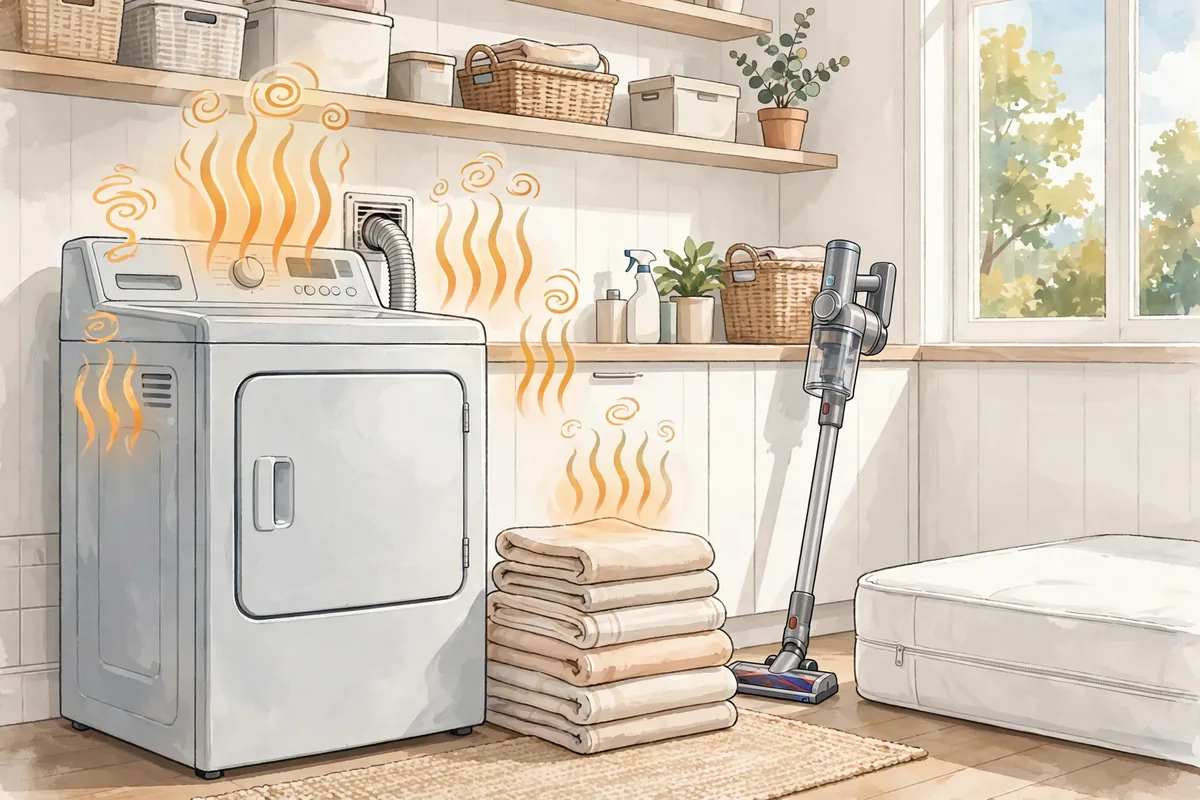
For items you can launder, the clothes dryer is your most powerful household weapon. Research published in the Journal of Economic Entomology (Naylor and Boase, 2010) found that tumble-drying infested laundry on high heat for at least 30 minutes killed every life stage. A hot wash at 140°F for 30 minutes worked too, but many home water heaters can’t sustain that — making the dryer the more dependable option.
Vacuuming helps as a supplement: a thorough pass with a crevice tool along mattress seams and baseboards physically removes bugs and eggs — seal and discard the bag outdoors immediately. Mattress encasements cut off hiding spots and make future inspections easier. None of these alone eliminates an established infestation, but together they form the backbone of what professionals recommend alongside targeted, labeled insecticide applications.
Skip the folk remedies and start with confirmation. Inspect mattress seams, box spring edges, and headboard joints with a flashlight, looking for live bugs, shed skins, and dark rust-colored spotting. If you find evidence, resist the urge to sleep on the couch — that just gives the bugs new territory to colonize.
Declutter the bedroom, but don’t drag infested items through the house. Bag anything suspect in sealed plastic before moving it, and launder what you can on the hot dryer cycle. Notify your landlord promptly if you rent — in most states they bear responsibility for professional treatment. If you own your home, get quotes from two or three licensed pest management companies and ask about their bed bug protocol: heat treatment, targeted residuals, and follow-up inspections mark a serious operator. While you wait, basic steps from a bite and sting first-aid checklist — cool compresses, not scratching — can keep things from getting worse.
Bed bugs are not known to spread disease to humans, but their bites can still cause problems worth medical attention. See a doctor or visit urgent care if you notice any of the following:
Do mothballs kill bed bugs at all?
No. Researchers at Rutgers University found that mothballs failed to wipe out bed bugs after seven days of exposure — roughly half the adults died, but the eggs and nymphs survived. Mothballs are not registered for bed bug use.
Are mothballs safe to put under my mattress?
No. Mothballs continuously release pesticide fumes meant only for sealed containers. Under a mattress, those fumes enter your breathing zone all night, and the mothballs sit within reach of children and pets. Naphthalene exposure is especially dangerous for infants and people with G6PD deficiency.
Is it really illegal to use mothballs for bed bugs?
Yes, technically. Mothballs are EPA-registered pesticides, and federal law prohibits using any pesticide in a manner inconsistent with its labeling. No mothball label lists bed bugs as a target pest or bedrooms as an approved use site.
What household item actually kills bed bugs?
A clothes dryer on high heat for at least 30 minutes is the most effective household tool — research shows it kills all life stages, including eggs. A hot wash at 140°F for 30 minutes also works, but many water heaters can’t maintain that temperature, making the dryer more reliable.
Should I just throw out my mattress?
Usually not. Discarding a mattress rarely solves an infestation because bed bugs hide in bed frames, nightstands, and baseboards too — and dragging an infested mattress through the house can spread them. A zippered mattress encasement plus professional treatment is the better approach.
Medically reviewed by Dr. Sarah Jones, MD.
This article is for informational purposes only and isn’t medical advice. If you’re worried about a bite or sting, talk to a healthcare professional.
Dr. Jones oversees StingHelp’s clinical verification process. Every guide is systematically evaluated against active Centers for Disease Control and Prevention (CDC), Environmental Protection Agency (EPA), and American Academy of Allergy, Asthma & Immunology (AAAAI) medical consensus standards to ensure symptom distinctions and care recommendations are clinically sound.
Explore physician-reviewed first-aid procedures, identification clues, and symptom comparisons for other common outdoor bites and stings.

Let us start with the reassurance, because you should keep borrowing books: the odds are strongly in your favor. Libraries are not bed bug…

If you don't have a washer and dryer at home, the laundromat is a weekly fact of life — and so is a nagging…

You've just finished a great workout when a thought stops you cold: that pile of gym bags heaped together in the locker room —…