
Two tiny mites, one maddening itch — but they are completely different problems. Chigger bites vs scabies is the comparison that decides your next step: chigger bites are a self-limited outdoor nuisance, while scabies is a contagious skin infestation that needs prescription treatment. Getting this right matters, so here is how to tell them apart.
The Decisive Comparison Table #
| Clue | Chigger bites | Scabies | |—|—|—| | What it is | Bites from larval mites (chiggers) encountered outdoors | An infestation of Sarcoptes scabiei mites living in the skin | | Do they burrow? | No — chiggers feed at the skin surface, then drop off | Yes — female mites tunnel into the top layer of skin and lay eggs | | Where you got it | Grass, brush, woods, gardens, berry picking, hiking | Prolonged skin-to-skin contact with an infested person, or shared bedding and clothing | | Itch pattern | Intense itching that starts hours after exposure and peaks in 1 to 2 days | Intense itching that is famously worse at night; can take 4 to 6 weeks to appear after first exposure | | The telltale mark | Clusters of red bumps or pimples where clothing fit tightly — ankles, waistband, behind knees | Thin grayish-white raised lines (burrows), often between fingers, on wrists, elbows, waist, and genitals | | Contagious? | No — chiggers do not live on you or spread person to person | Yes — spreads through close contact; household members often need treatment too | | How it resolves | Fades on its own in days to about 2 weeks | Does not go away on its own — needs prescription treatment from a doctor | | Treatment | Anti-itch care at home | Prescription mite-killing cream or lotion, plus laundering bedding and clothing |
Chigger Bites: The Outdoor Ambush #
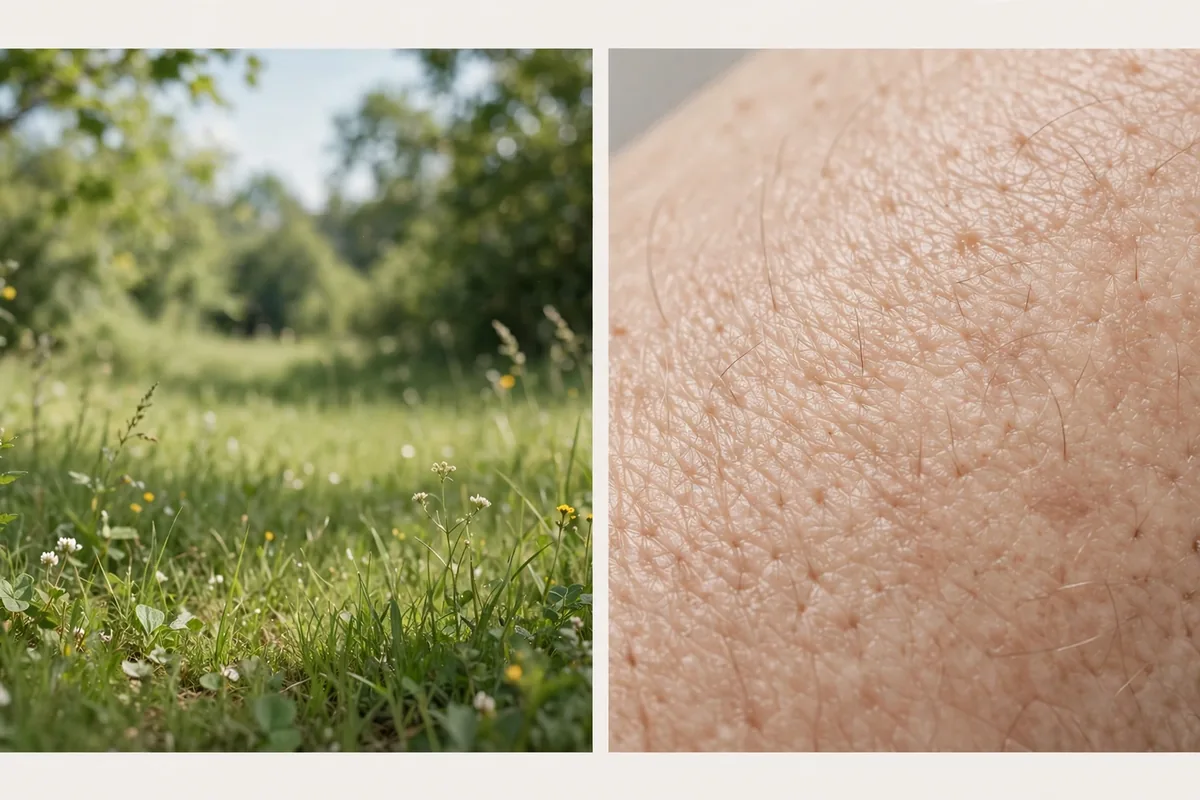
Chiggers are the larval stage of a mite, barely visible without magnification. Contrary to the old myth, they do not burrow under your skin — they attach at the surface, inject a digestive enzyme that breaks down skin cells, and feed on the liquefied tissue. The itching is your body’s reaction to that enzyme, and it typically starts 1 to 3 hours after the mite has already dropped off, peaking over the first day or two.
- Classic locations: ankles, lower legs, behind the knees, waistband, groin — anywhere clothing pressed the mites against skin.
- Classic story: “I was in tall grass or the garden yesterday, and now I am covered in itchy red bumps.”
- Duration: intense for several days, usually gone within two weeks.
- No parasite left behind: there is nothing to “suffocate” — nail polish and petroleum jelly tricks are myths, because the mite is already gone.
If your bites fit this pattern and you were recently outdoors, chiggers are the likely answer, and home care is usually enough.
Scabies: The Infestation That Needs a Doctor #
Scabies is a different category of problem. The mites burrow into the skin, lay eggs in the tunnels, and keep the cycle going until they are killed with medication. Take this seriously and do not try to ride it out.
- The signature sign: thin, grayish-white, slightly raised burrow lines, often with tiny blisters or bumps at the ends. Common sites are the webs between fingers, wrists, elbows, armpits, waistline, buttocks, and genitals.
- The signature timing: itching that intensifies at night, often severe enough to disturb sleep.
- The signature spread: it moves between people with prolonged close contact — partners, children, roommates, caregivers. If one person in a household has it, others should be evaluated too.
- Treatment is prescription-only: a doctor will order a mite-killing cream or lotion applied as directed, sometimes repeated after a week, plus hot-water laundering of bedding, clothing, and towels. Over-the-counter anti-itch products cannot cure scabies.
- Itching can linger: even after successful treatment, itch and bumps can persist for a few weeks as the skin clears dead mites. Your doctor can tell you what is expected versus what needs a recheck.
Do not downplay suspected scabies as “just bug bites.” It is common, it is treatable, and it will not resolve without proper medication.
Safe First Aid for Each #

For chigger bites:
- Shower with soap and water to wash off any mites still on the skin, and launder your clothes in hot water.
- Apply calamine lotion or a plain anti-itch cream to the bumps.
- Use a cold compress for 10 to 15 minutes to calm intense itching.
- An oral antihistamine per label directions can help, especially at night.
- Do not scratch — broken skin invites bacterial infection, which is the most common complication.
For suspected scabies:
- Do not try to treat it yourself with anti-itch creams alone — see a doctor for diagnosis and prescription treatment.
- While waiting for your appointment, avoid prolonged skin-to-skin contact with others and do not share bedding, towels, or clothing.
- Wash bedding and recently worn clothing in hot water and dry on high heat.
- Vacuum upholstered furniture and rugs.
- Follow the prescription directions exactly, including treating close contacts if your doctor advises it.
If bites show increasing pain, spreading redness, pus, or warmth, infection may be setting in — our doc on chigger bite infection warning signs covers exactly what to watch for.
Warning signs: when to seek care #
Call 911 immediately if you develop trouble breathing or swallowing, swelling of the face, lips, tongue, or throat, widespread hives, dizziness or fainting, or a racing heartbeat after any bite or exposure. If you carry prescribed epinephrine, use it first, then call for help.
See a doctor promptly if: itching is severe and worse at night with visible burrow lines (possible scabies — needs prescription treatment); a rash is spreading to household members; any bite develops spreading redness, red streaks, pus, increasing pain, or fever; or intense itching has not improved after about two weeks of home care. For itch relief that is safe while you wait, see our guide to reduce bite itching.
Frequently asked questions #

Can chiggers live in my bed and keep biting me? #
No. Chiggers do not infest homes or bedding the way bed bugs do. They feed once outdoors and drop off. If you are getting new itchy bumps night after night indoors, chiggers are unlikely — consider scabies, bed bugs, or another cause, and see a doctor.
How do doctors confirm scabies? #
A clinician looks for the characteristic burrows and rash pattern and may take a painless skin scraping to check for mites or eggs under a microscope. You cannot reliably confirm scabies yourself, which is why a visit matters.
Will scabies go away if I just wait? #
No. The mites keep reproducing in the skin until they are killed with prescription medication. Waiting only prolongs the itch and gives the infestation more time to spread to others.
Can I get scabies from a brief handshake? #
Transmission generally requires prolonged skin-to-skin contact, not casual touch. The exception is crusted scabies, a severe form in which mites are far more numerous and spread more easily — another reason a doctor should evaluate any suspected case.
Medical and editorial note #
This guide is general information, not medical advice, and it cannot diagnose a rash or infestation. Scabies requires prescription treatment, and only a healthcare professional can confirm the diagnosis. If you suspect scabies — especially with nighttime itching, burrow lines, or spread within a household — see your doctor promptly rather than self-treating.


