
Do DynaTrap Mosquito Traps Work? Honest Review
DynaTrap's ads promise up to an acre of mosquito protection with no zapping, no propane, and no chemicals — just plug it in and…
It's a warm July evening, the grill is going, and within ten minutes your ankles are under attack. You've heard the backyard advice a dozen times — skip the chemicals,…
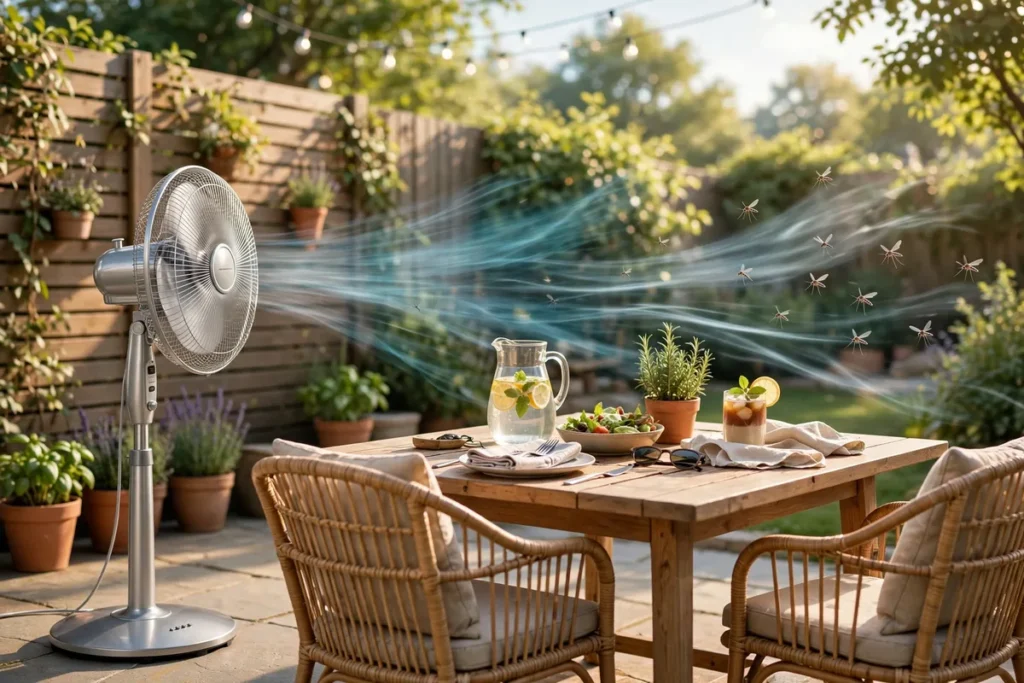
It’s a warm July evening, the grill is going, and within ten minutes your ankles are under attack. You’ve heard the backyard advice a dozen times — skip the chemicals, just point a fan at the patio. It sounds too simple to work. Mosquitoes are relentless, after all, and a twenty-dollar box fan doesn’t feel like serious protection.
Do fans repel mosquitoes? Yes — to a genuinely useful degree. Entomologists say a strong, well-placed fan can cut mosquito landings dramatically, because it attacks the two things mosquitoes depend on most: their weak flying ability and the scent trail they follow to find you. What a fan won’t do is eliminate mosquitoes from your yard or replace repellent where disease risk is real.
This article explains the science behind the fan trick, what researchers actually say, how to position fans for the biggest effect, and where fans fall short.
Mosquitoes are, by the standards of the insect world, terrible fliers. A healthy adult mosquito cruises at roughly one to one-and-a-half miles per hour and gets pushed around by even a light breeze. Point a fan generating a steady 5-to-10 mile-per-hour airflow at your seating area and you’ve created conditions most mosquitoes simply can’t fly through. They can’t hold a heading, they can’t hover long enough to land, and many give up and drift away to calmer air.
The second mechanism matters even more. Mosquitoes find you largely by following the plume of carbon dioxide you exhale, then zeroing in on body heat and skin odor as they get close. A fan shreds that plume. Instead of a clean, trackable scent trail drifting downwind, your exhaled CO2 gets scattered and diluted across the whole patio. The mosquito’s long-range guidance system goes blind, and it never gets close enough to switch to its short-range cues.
A bonus: moving air speeds sweat evaporation, slightly cooling you and reducing the heat signature mosquitoes use at close range. None of this kills mosquitoes — but as a personal-space defense, the physics is solid.
Pest-control trade publication PCT Online has directly taken on the claim that “fans are ineffective” against mosquitoes and found it doesn’t hold up — the physics of weak fliers plus scent-plume disruption makes fans one of the more defensible low-tech tools available. University of Florida medical entomologists, including longtime mosquito researcher Jonathan Day of UF’s Institute of Food and Agricultural Sciences, have recommended fans for patios and porches for years as a practical, no-chemical bite reducer.
The expert consensus comes with clear boundaries. Entomologists describe fans as a way to reduce bites in the immediate seating area — not as area-wide mosquito control and not as a substitute for EPA-registered repellents in places where mosquitoes carry West Nile virus, dengue, or other pathogens. A fan protects the bubble of moving air around you; step ten feet away to the grill and you’re back in the bite zone.
The honest expert verdict: fans are a real, evidence-backed layer of protection — one layer, not the whole strategy. Aggressive daytime biters like the Asian tiger mosquito may still find you at the edge of the airflow.
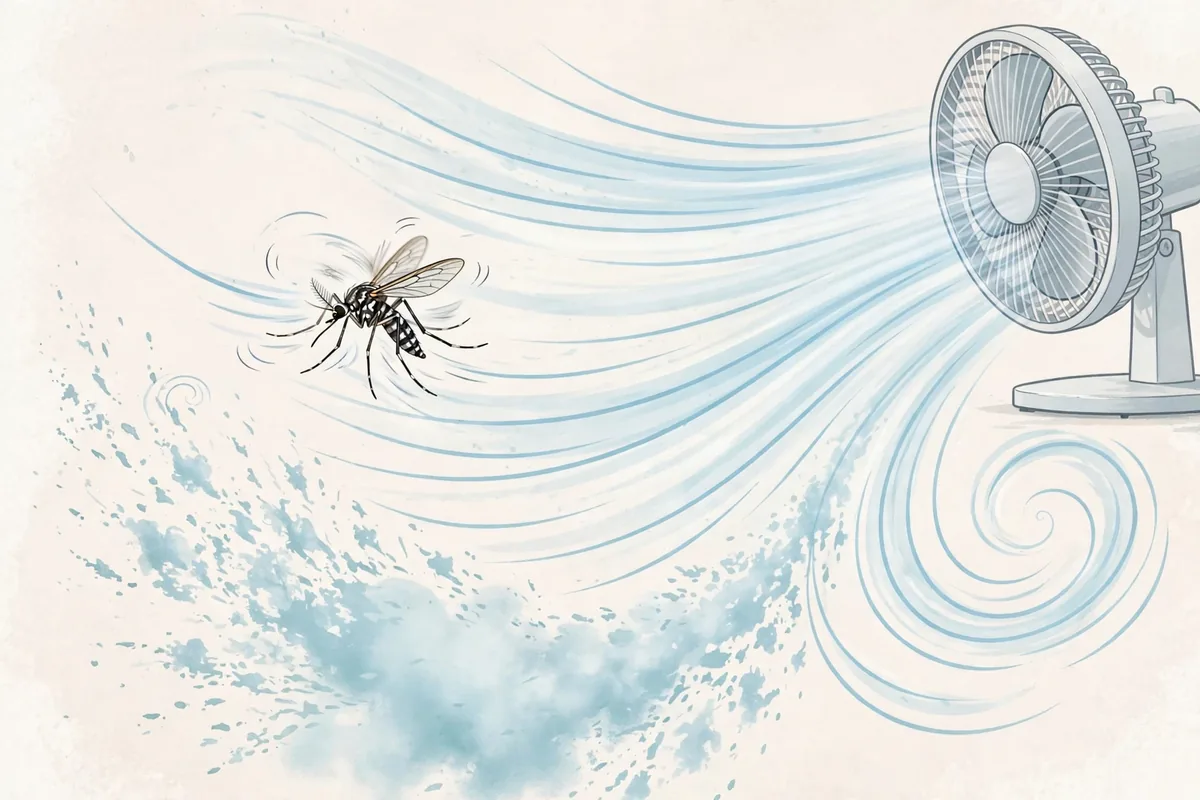
Placement decides whether your fan is a mosquito shield or background noise:
If you can feel a steady breeze on your bare legs, mosquitoes feel it too. If the air feels still where you sit, adjust.
Fans earn their keep in both settings, but the playbook changes. Indoors, a bedroom fan or a fan aimed across an open window at night can meaningfully reduce bites while you sleep — mosquitoes that slip inside have to fight the same airflow physics, and bedrooms are small enough that one fan genuinely covers the space. Pair it with intact window screens for the best result, since screens do the excluding and the fan does the disrupting. If mosquitoes keep getting into the house despite screens, our home and yard bite-prevention guide walks through the common entry points people miss.
Outdoors, fans are battling scale. A patio is an open system — mosquitoes can always approach from an unprotected direction, and wind gusts compete with your fan. That’s why outdoor setups need more airflow, lower placement, and realistic expectations: you’re defending a bubble, not the yard. For the yard itself, source reduction matters more than any device — dumping standing water, clearing clogged gutters, and treating unavoidable water features. Our mosquito bite prevention guide covers the full routine.
Ceiling fans deserve a special mention because people ask about them constantly. They help a little on a covered porch, but the airflow diffuses and weakens by the time it reaches seating height, and porch ceilings are often too high for the breeze to reach ankle level with any force. A cheap box fan on the floor will outperform an expensive ceiling fan for bite protection almost every time.

Honesty requires the other half of the story. Fans do not kill mosquitoes, reduce the mosquito population, or protect anyone outside the airflow. They don’t work through walls of vegetation, they can’t cover a whole yard, and on a truly still, humid evening with heavy mosquito pressure, determined biters will still find the calm pockets — behind furniture, under tables, on the side of your body facing away from the fan.
Fans also can’t fix the source. If your yard breeds mosquitoes — a forgotten kiddie pool, saucers under planters, a clogged gutter — no amount of airflow changes the fact that new biters emerge every few days all summer. And fans offer zero help against mosquitoes that bite through clothing or against species that hunt primarily by sight at close range once they’re already near you.
Most importantly, a fan is not a disease-prevention device on its own. In areas with active West Nile virus, dengue, or Zika transmission, public health guidance centers on EPA-registered repellents, protective clothing, and source reduction. Think of the fan as the free bonus layer that lets you use less repellent on a calm patio evening — not as a replacement for it when the stakes are higher. If you use plug-in repeller devices too, keep expectations realistic: electronic traps are no substitute for repellent or source reduction.
The fan works best as part of a stack. The classic combination is a fan plus an EPA-registered skin repellent — the fan handles the casual evening patio, and the repellent covers you when you leave the airflow to tend the grill or walk the dog. Because the fan is doing real work, many people find they can use repellent more sparingly on fan-covered evenings, which is a genuine quality-of-life win.
Mosquitoes bite hardest around dusk and dawn, so start the fans before sunset rather than after the first bites. Biting rhythms vary by species, so learn your local peak hours. Add long sleeves and light-colored clothing for the walk to and from the patio, and dump any standing water weekly so the local mosquito population never builds in the first place.
For households with kids or anyone pregnant, fans are an especially attractive layer because they involve zero skin-applied chemicals — see our guide to insect repellent safety for children and pregnancy for how to choose repellents for the rest of the stack. No single method is perfect, but a fan plus repellent plus timing plus source reduction is about as close to a bite-free summer evening as most backyards get.

Fans reduce bites; they don’t make medical problems impossible. Get prompt medical care if you notice any of these red flags after a mosquito bite:
Do fans really keep mosquitoes away, or is it a myth?
It’s real, not a myth. Mosquitoes are weak fliers, and a fan both physically prevents them from landing and scatters the carbon dioxide plume they follow to find you. Entomologists and pest-control trade publications back the effect — with the caveat that fans protect a bubble of moving air, not your whole yard.
What kind of fan works best against mosquitoes?
A high-velocity box fan or pedestal fan placed low and aimed across your seating area. What matters is felt airflow at ankle and leg height, where mosquitoes hunt. Oscillating models widen the protected zone. Outdoor-rated fans are a must for patio use.
Will a ceiling fan on my porch keep mosquitoes off?
Only a little. By the time ceiling-fan airflow reaches seating — and especially ankle — height, it’s usually too diffuse to stop mosquitoes. A floor-level box fan aimed across the seating area is far more effective for bite protection.
Do fans work against all mosquito species?
They help against most, since the weak-flier physics applies broadly. But aggressive daytime biters like Asian tiger mosquitoes, which hunt partly by sight at close range, may still reach you at the edges of the airflow. Pair fans with repellent for those situations.
Can I skip bug spray if I have a fan running?
On a calm patio evening with low disease risk, many people do. But don’t skip repellent based on a fan alone in areas with active mosquito-borne disease, when leaving the airflow, or during peak dusk biting hours. Treat the fan as one layer of a stack, not the whole plan.
Medically reviewed by Dr. Sarah Jones, MD.
This article is for informational purposes only and isn’t medical advice. If you’re worried about a bite or sting, talk to a healthcare professional.
Dr. Jones oversees StingHelp’s clinical verification process. Every guide is systematically evaluated against active Centers for Disease Control and Prevention (CDC), Environmental Protection Agency (EPA), and American Academy of Allergy, Asthma & Immunology (AAAAI) medical consensus standards to ensure symptom distinctions and care recommendations are clinically sound.
Explore physician-reviewed first-aid procedures, identification clues, and symptom comparisons for other common outdoor bites and stings.
DynaTrap's ads promise up to an acre of mosquito protection with no zapping, no propane, and no chemicals — just plug it in and…

Every summer, a new "hack" makes the rounds: skip the bug spray, just slick on baby oil. This year's version blew up on TikTok,…

It is the most common summer layering question in America: sunscreen or bug spray first? Get the order wrong and you either dilute your…