Direct answer: For people in the United States, CDC and EPA recommend using an EPA-registered insect repellent and following the product label. When used as directed, EPA-registered repellents are considered safe and effective, including during pregnancy and breastfeeding. Common active ingredients include DEET, picaridin, IR3535, oil of lemon eucalyptus (OLE), para-menthane-diol (PMD), and 2-undecanone. Permethrin is different: it is used on clothing and gear, not directly on skin.
For children, the label matters. CDC’s general public guidance says not to use OLE or PMD products on children under 3 years old. Adults should apply repellent to their own hands before putting it on a child’s face and should avoid children’s hands, eyes, mouth, cuts, and irritated skin.
Why “natural” versus “chemical” is the wrong first question
The most useful question is whether the product is EPA-registered for skin application and whether it is being used according to the label. EPA registration means the agency reviewed safety and effectiveness information for the labeled use. A product being plant-derived does not automatically make it safer, longer-lasting, or better for children.
Some products marketed as essential oils are not registered as insect repellents and may not have the same evidence for protection time or effectiveness. For areas where mosquitoes or ticks can transmit disease, choosing a proven repellent matters more than choosing a marketing label.
EPA-registered active ingredients commonly used on skin
| Active ingredient | Helps repel | Key practical point |
|---|---|---|
| DEET | Mosquitoes, ticks and other biting arthropods depending on product | Widely studied; use concentration and reapplication interval on the label |
| Picaridin | Mosquitoes, ticks and other biting insects depending on product | EPA-registered option with good skin tolerability for many users |
| IR3535 | Mosquitoes and some ticks depending on product | Follow the exact labeled directions and protection time |
| OLE / PMD | Mosquitoes and some ticks depending on product | CDC public guidance says not to use on children under 3 |
| 2-undecanone | Mosquitoes and ticks depending on product | Plant-derived registered option found in some U.S. products |
DEET: what parents should know
DEET is one of the most established repellent ingredients in the United States. EPA states that registered DEET products do not present a health concern to the general population, including children, when used according to label directions. The label tells you where the product can be applied, how often it can be reapplied, and what precautions are required.
Do not assume that a higher percentage always means “stronger” in every sense. In general, a higher concentration can provide longer protection up to a point, but the practical choice should match expected exposure time and the product label. Reapply only as directed.
Picaridin: another EPA-registered option
Picaridin is included in CDC’s recommended EPA-registered active ingredients for preventing mosquito and tick bites. Families who dislike the smell or feel of one product may find a different formulation easier to use consistently. Effectiveness depends on the concentration and product formulation, so compare labels rather than judging the ingredient name alone.
OLE and PMD are not the same as “pure lemon eucalyptus oil”
CDC distinguishes registered OLE/PMD repellent products from pure oil of lemon eucalyptus essential oil. Pure essential oil has not gone through the same validated repellent testing and EPA registration process for this use. CDC’s general public guidance also advises against OLE or PMD products for children under 3 years old.
Because labels can differ, use the age instructions on the exact product in your hand rather than relying on a generic internet chart.
Permethrin belongs on clothing and gear—not skin
Permethrin-treated clothing and gear can add protection against ticks and mosquitoes. CDC recommends permethrin products labeled for clothing and gear, but permethrin should not be applied directly to skin. Some clothing is sold pretreated, and some products are designed for treating boots, pants, socks, tents, or other gear.
Follow the label for drying time, laundering, retreatment, and which materials can be treated. Keep treatment products away from children during application and storage as directed by the label.
Repellent use during pregnancy and breastfeeding
CDC states that EPA-registered insect repellents are proven safe and effective when used as directed, even for pregnant and breastfeeding women. This matters because infections spread by mosquitoes and ticks can themselves create important health risks.
Pregnancy is not a reason to rely on an untested essential oil or skip protection in a high-risk setting. Choose an EPA-registered product, follow the label, combine repellent with protective clothing and screens, and discuss unusual skin reactions or individual medical concerns with the prenatal care team.
How to apply repellent to children safely

- Read the label every time, especially age restrictions and reapplication instructions.
- Do not let young children handle or spray the product themselves.
- An adult should spray or place repellent on their own hands first, then apply it to a child’s face.
- Avoid the child’s hands because children often touch their eyes and mouth.
- Do not apply repellent over cuts, wounds, irritated skin, eyes, or mouth.
- Use clothing, stroller netting, and other barriers to reduce how much exposed skin needs repellent.
- Wash treated skin when the protection is no longer needed, following label directions.
Protecting babies who are too young for a chosen product
Physical barriers become especially important for infants. Dress the baby in clothing that covers arms and legs when practical, and use mosquito netting over strollers or carriers. Keep netting secure enough that mosquitoes cannot easily enter and make sure it does not create a breathing or overheating hazard.
Do not improvise by applying a repellent to a baby if the label does not permit that age group.
Repellent and sunscreen: which goes first?
CDC advises applying sunscreen first and insect repellent second when both are needed. Reapplication schedules differ: sunscreen may need to be reapplied more often than repellent. Follow each label separately instead of automatically reapplying repellent every time sunscreen is reapplied.
Do not spray repellent directly onto the face
EPA advises spraying onto the hands first and then applying sparingly to the face, avoiding eyes and mouth. Do not spray in enclosed areas or inhale aerosol mist. Apply only to exposed skin or clothing as the product directs; do not apply under clothing unless the label specifically says to do so.
What if repellent irritates the skin?
Stop using the product, wash the treated skin with soap and water, and follow label first-aid instructions. If symptoms are significant, contact a healthcare professional or Poison Control in the United States. Bring or photograph the product label so the active ingredient and concentration are clear.
A reaction to one formulation does not prove that every EPA-registered repellent will cause the same problem. Fragrances, solvents, or inactive ingredients can differ.
Choosing protection for ticks versus mosquitoes
Not every product protects against every pest for the same amount of time. Use EPA’s repellent search tool or the product label to confirm whether the product is labeled for mosquitoes, ticks, or both and how long protection is expected to last.
For tick exposure, combine skin repellent with long clothing, tick checks, showering after outdoor activity, and permethrin-treated clothing or gear when appropriate. See StingHelp’s prevention hub for layered bite-prevention steps.
When exposure risk is higher
Repellent becomes particularly important during outdoor work, camping, hiking, hunting, yard work, travel to areas with mosquito-borne disease, and time in brushy or wooded tick habitat. The right product depends on the location, duration, pest, weather, clothing, and age of the user.
If local public-health authorities issue mosquito or tick alerts, follow those recommendations rather than relying on last year’s routine.
Common repellent mistakes

- Using more product than the label recommends.
- Reapplying too often.
- Spraying directly into a child’s or adult’s face.
- Applying to cuts, irritated skin, or under clothing.
- Letting children handle the bottle.
- Using permethrin directly on skin.
- Assuming an essential oil is equivalent to an EPA-registered product.
- Forgetting that sunscreen and repellent have different reapplication schedules.
- Using a mosquito-only product when tick protection is also needed.
A family packing checklist for outdoor days
- EPA-registered repellent appropriate for everyone who will use it
- Long, loose-fitting clothing when practical
- Hat and closed shoes for brushy/tick habitat
- Permethrin-treated clothing or gear when appropriate
- Stroller or carrier netting for infants
- Sunscreen
- Fine-tipped tweezers for tick removal
- Any prescribed epinephrine for known severe sting allergy
Frequently asked questions
Is DEET safe during pregnancy?
CDC says EPA-registered repellents are safe and effective when used as directed, including during pregnancy and breastfeeding. Follow the product label.
Can I use picaridin on a child?
CDC includes picaridin among recommended EPA-registered active ingredients. Use the age and application directions on the exact product label.
Can I put permethrin on my skin?
No. Permethrin repellents are used on clothing and gear as labeled, not directly on skin.
Should I choose the highest DEET concentration?
Choose based on the expected exposure time and label directions. Higher concentrations generally extend protection time rather than making each application inherently “more powerful.”
Related StingHelp guides
- Bite and sting prevention
- Mosquito and tick prevention around the home and yard
- Bug bite prevention for international travel
- Outdoor bite-prevention checklist
Authoritative sources
- U.S. EPA: Regulation of Skin-Applied Repellents
- U.S. EPA: Using Insect Repellents Safely and Effectively
- CDC: Preventing Mosquito Bites
- CDC: Preventing Tick Bites
Bottom line
Use an EPA-registered repellent that matches the pest and the person using it, follow the label, and combine repellent with clothing and environmental protection. EPA-registered repellents are considered safe when used as directed, including during pregnancy and breastfeeding. For children, keep the product out of their hands, avoid eyes/mouth/cuts, apply to the face through an adult’s hands, and follow age restrictions on the exact label.
Educational information only. Product labels and individual medical advice take priority over general online guidance.
How concentration relates to protection time
For several repellent ingredients, a higher concentration generally provides a longer duration of protection rather than making the product “more toxic to insects” on contact. This is why two DEET or picaridin products can have different labeled protection times. Choose a product that fits the expected time outdoors and reapply only as the label directs. More frequent application than the label allows does not create a safer or more effective plan.
Avoid repellent-sunscreen combination shortcuts
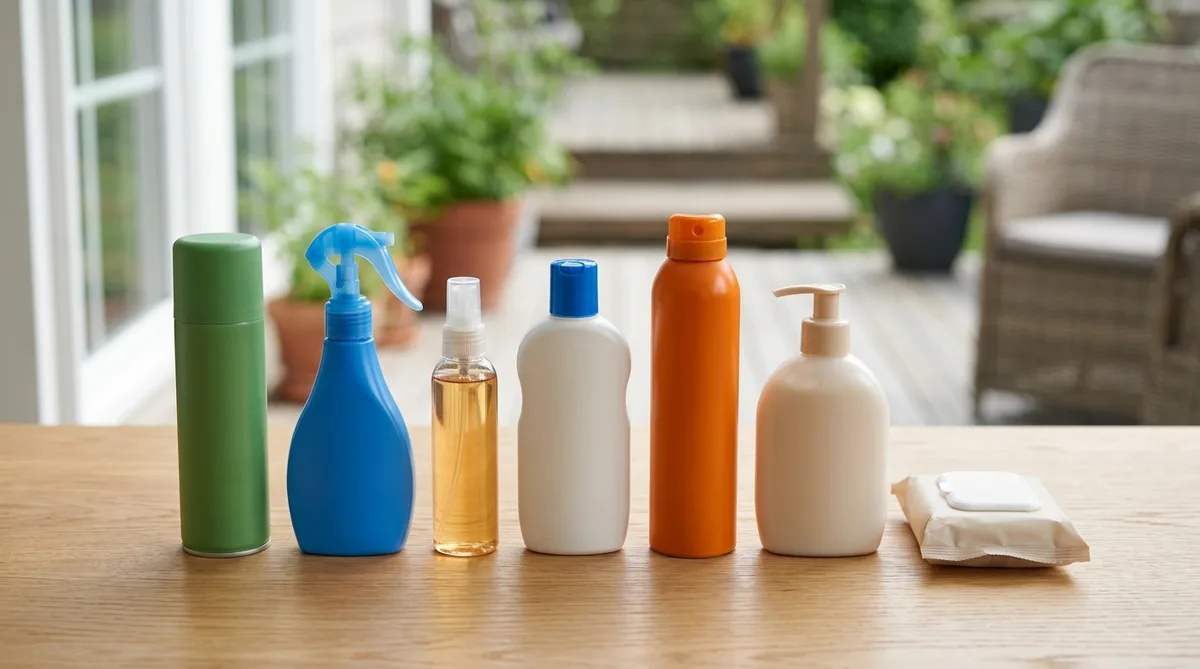
Repellent and sunscreen have different reapplication needs. CDC recommends sunscreen first and repellent second. A sunscreen may need to be reapplied after swimming, sweating, or a certain amount of time, while a repellent may still be active. Using separate products makes it easier to follow each label without applying more repellent than necessary.
Sensitive skin: test the plan, not just the ingredient
People with eczema, fragrance sensitivity, or previous reactions should pay attention to the entire formulation. Inactive ingredients, alcohols, fragrances, or solvents vary between products. Do not apply repellent over broken or actively inflamed skin. When a product causes burning, rash, or unexpected irritation, wash it off and stop using it. For a child or pregnant person with a significant prior reaction, ask a clinician or pharmacist about alternatives before the next high-exposure outing.
Repellent is only one layer of protection
For mosquitoes, use intact window and door screens, air conditioning when available, loose long sleeves and pants, and source reduction around standing water. For ticks, avoid brushing through tall grass when practical, stay toward the center of trails, perform full-body tick checks, shower after exposure, and inspect gear and pets. For infants, stroller or carrier netting can reduce the need for skin-applied products.
Travel changes the prevention calculation
Travel can increase the importance of consistent bite prevention because mosquito- and tick-borne disease risks differ by destination. Before international travel, review current CDC destination guidance rather than relying only on routine home habits. Pack enough repellent for the trip, confirm that the active ingredient is appropriate for the traveler, and remember that product names and concentrations sold overseas may differ from those in the United States.
Do repellents prevent bee or wasp stings?
Skin repellents designed for mosquitoes and ticks should not be treated as reliable protection against bees, wasps, hornets, or yellowjackets. Stinging-insect prevention depends more on avoiding nests, covering food and trash, wearing shoes outdoors, checking work areas, and moving calmly away from stinging insects. A product labeled for mosquitoes is not automatically a wasp repellent.
What about pets?
Do not apply a human insect repellent to a dog, cat, or other animal unless the product label specifically allows that use. Animals metabolize chemicals differently, and licking treated fur can create additional exposure. Use veterinary products recommended for the species and follow veterinary or label instructions.
Decision checklist before buying a repellent
- Which pest are you trying to prevent—mosquitoes, ticks, or both?
- How long will you be exposed?
- Who will use the product, including ages and pregnancy/breastfeeding status?
- Does the product have an EPA Registration Number?
- Does the label permit use on the intended age group and body areas?
- Will you also need sunscreen or permethrin-treated clothing?
- Can you combine the product with barriers such as long clothing, screens, or netting?
When to get help for a repellent exposure
If repellent gets into the eyes, is swallowed, is inhaled in a concerning amount, or causes a significant reaction, follow the product label and contact Poison Control or a healthcare professional in the United States. Severe breathing difficulty, collapse, or another life-threatening reaction requires 911.