
A wasp sting on eyelid treatment starts with cold and patience: apply a cold compress wrapped in cloth for 10–15 minutes, keep the eye closed and untouched, and take an oral antihistamine per label directions — dramatic swelling that looks alarming is usually normal and peaks within 24–48 hours. The eyelid’s loose tissue swells easily, so even a single sting can puff the eye nearly shut. This guide covers the safe steps, the things that make it worse, and the vision warning signs that change everything.
Immediate first aid: the first hour #
Step 1 — Stop and assess. Is your vision affected, or is it only the eyelid? Can you open the eye at all? A sting confined to the eyelid skin with normal vision underneath is the common, manageable scenario. If the sting hit the eyeball itself — sharp eye pain, a feeling of something stuck in the eye, or sudden vision changes — skip home care and seek same-day eye care immediately.
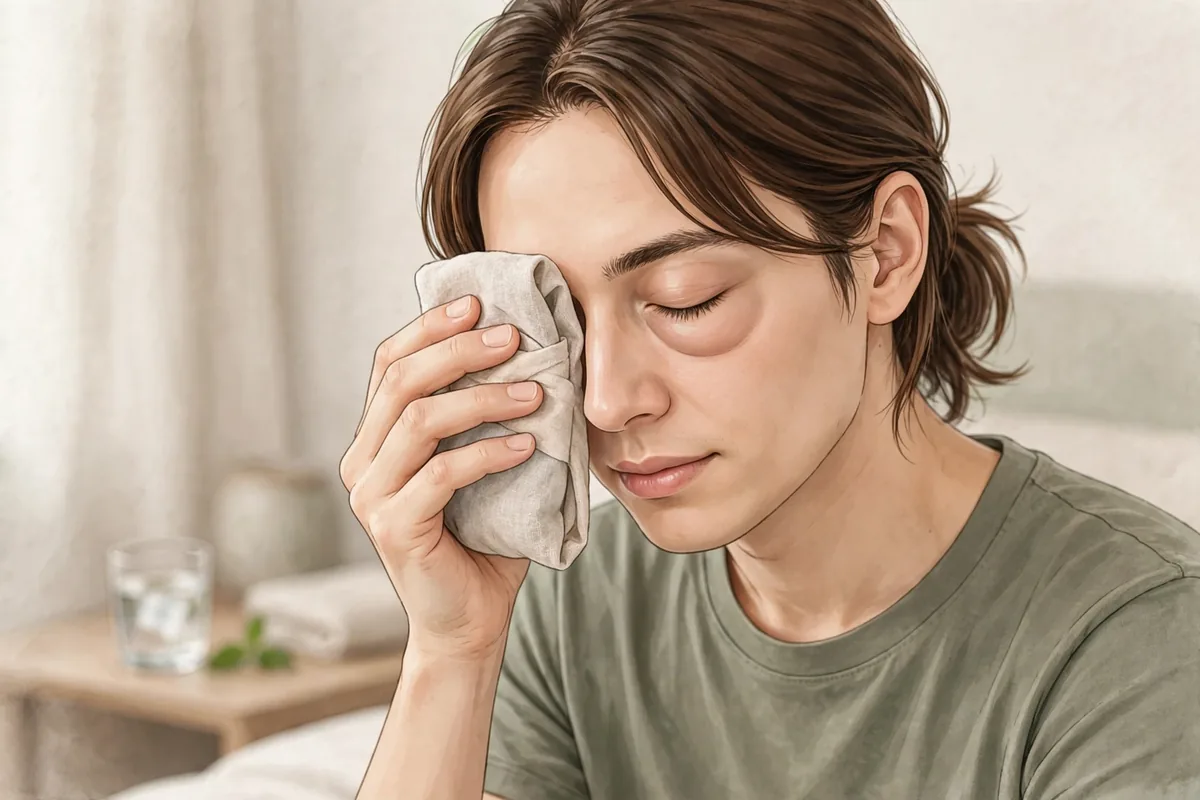
Step 2 — Cold compress. Wrap ice or a cold pack in a clean cloth and hold it gently against the closed eyelid for 10–15 minutes. Never apply ice directly to skin, and do not press hard on the eyeball. Repeat every hour as needed during the first day. Cold limits pain and slows the swelling response.
Step 3 — Oral antihistamine. An over-the-counter oral antihistamine per label directions can help with itching and the histamine-driven swelling. This is for eyelid-tissue swelling; it does not replace emergency care if allergy symptoms appear.
Step 4 — Clean hands, clean area. Wash your hands, and gently clean the skin around the sting with mild soap and water. Do not get soap in the eye.
Step 5 — Leave any stinger alone unless clearly visible on the skin. Unlike bee stings, wasp stingers rarely stay behind — wasps keep their stingers and sting repeatedly. If you see an embedded stinger on the eyelid skin, remove it gently by scraping sideways. Do not dig at the eyelid or try to extract anything near the eye surface itself.
What NOT to do: eye-area mistakes #
The eye region punishes improvisation. Avoid all of these:
- Do not rub the eye — even if it itches intensely. Rubbing worsens swelling and can scratch the cornea.
- Do not pry the eyelid open if swelling has sealed it shut. Forcing it risks injury; let the swelling resolve.
- Do not put creams, lotions, or home remedies in or around the eye. No toothpaste, no essential oils, no meat tenderizer, no “drawing” salves — none belong near eyes.
- Do not use leftover prescription eye drops — especially steroid or numbing drops — unless a clinician specifically directs you to.
- Avoid redness-reducing eye drops; plain preservative-free artificial tears are fine for surface irritation, but medicated drops need a doctor’s say-so.
- No makeup, no contact lenses until fully healed. Glasses only.
- Do not apply heat in the first 24–48 hours — heat increases swelling. Cold first; warmth only later if a clinician suggests it.
For general sting mechanics that apply everywhere on the body, our wasp sting first aid guide covers the fundamentals.
The next 48 hours: monitoring and recovery #
Expected course: swelling typically peaks at 24–48 hours, then recedes over 3–5 days. The eyelid may look alarming — puffy, red, nearly closed — while the eye underneath is perfectly fine. Mild itching and tenderness are normal. Some bruise-like discoloration can appear as swelling resolves.
Helpful measures:
- Sleep with your head elevated on an extra pillow — gravity helps drain eyelid swelling noticeably faster.
- Continue cold compresses through the first day; switch to as-needed after that.
- Stay upright and active during the day rather than lying flat — movement and vertical posture reduce facial swelling.
- Watch, don’t worry — but watch on a schedule. Check the eye every few hours for the warning signs below.
Keep a simple log: time of sting, swelling level, vision check (can you read text with the affected eye?), and any new symptoms. This is genuinely useful if you end up calling a clinician.
When it’s more than an eyelid sting #

Some situations need professional eye care, not home monitoring:
- Vision changes of any kind — blurriness, double vision, light sensitivity, or vision loss in the affected eye.
- Severe eye pain rather than eyelid soreness — pain in the eyeball suggests the sting reached the globe.
- A persistent gritty or scratching sensation after the first hours — possible corneal scratch or retained stinger fragment.
- Swelling that keeps worsening past 48 hours or shows no improvement by 72 hours.
- Pus, increasing redness spreading beyond the eyelid, or fever — possible infection.
- The sting was directly to the eyeball or cornea — this warrants same-day ophthalmology evaluation, because wasp and bee venom can damage internal eye structures in rare cases.
Children stung near the eye deserve a lower threshold for calling the pediatrician — they cannot always describe vision changes accurately. Our bee sting near the eye safety guide covers the pediatric angle in more detail.
Warning signs: when to seek care #
Call 911 immediately for: trouble breathing or swallowing; swelling of the face, lips, tongue, or throat beyond the stung eyelid; widespread hives; dizziness, faintness, or collapse; or a racing heartbeat. Use prescribed epinephrine if available, then call 911.
Seek same-day eye or urgent care for: any vision change; severe eyeball pain; a sting directly to the eye surface; swelling with no improvement after 48–72 hours; pus, fever, or spreading redness; or a persistent foreign-body sensation in the eye.
Frequently asked questions #

How long will my eye stay swollen shut? #
For a typical eyelid sting, the worst swelling lasts 24–48 hours, with steady improvement over 3–5 days. Complete resolution within a week is the norm. If swelling is still severe after 3 days with no improvement trend, get it checked.
Can a wasp sting on the eyelid damage my vision? #
A sting confined to the eyelid skin very rarely affects vision — the swelling looks dramatic but the eye underneath is usually untouched. The risk rises if the sting penetrated the eyeball itself, which is why any vision change, severe eye pain, or persistent grittiness needs same-day evaluation.
Should I take anything for the swelling? #
An oral antihistamine per label directions is the standard home measure for itching and histamine-related swelling. An over-the-counter anti-inflammatory per label directions may help with pain and swelling — talk to your doctor or pharmacist about what is appropriate for you, especially if you take other medications or have health conditions.
My child was stung on the eyelid at the playground — ER or wait? #
If breathing is normal, there is no face/lip/tongue swelling beyond the eyelid, and the child can see, home care with cold compresses and monitoring is reasonable — but call your pediatrician the same day for guidance. Go to urgent care or the ER promptly for any vision complaint, severe pain, rapidly worsening swelling, or any allergy signs.
Medical and editorial note #
This guide is general information for educational purposes and is not medical advice. Eye-area stings deserve extra caution — when in doubt about vision or eye pain, choose professional evaluation over waiting. If you have a known sting allergy, carry prescribed epinephrine and follow your emergency plan.


