
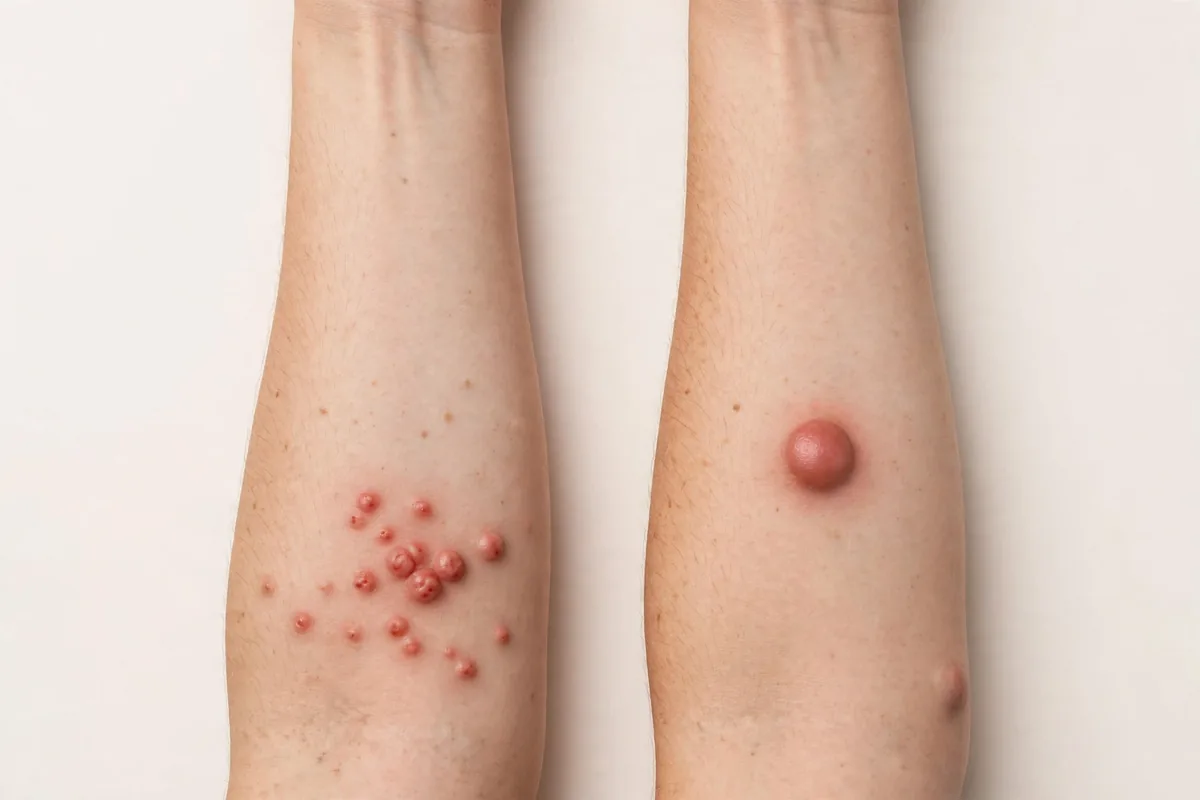
Fire ant bite vs spider bite — at first glance they can look alike: a red, painful bump that shows up after time outdoors. But they have different signatures. Fire ant stings arrive in clusters and form white pustules within about 24 hours; spider bites are usually single, solitary marks that evolve more slowly. Here is how to tell them apart, what each one does next, and when either one needs medical attention.
Side-by-side: fire ant stings vs. spider bites #
| Feature | Fire ant stings | Spider bites | |—|—|—| | Number of marks | Multiple — often dozens in clusters or rough circles | Usually a single bite site | | Pattern | Grouped where ants walked across skin | Solitary; no trail or cluster | | Pain onset | Immediate intense burning | Often painless at first; soreness develops later | | Pustules | White/yellowish pustules within 24 hours — the hallmark | Rare; most spider bites never form pustules | | Itch | Intense itching as pustules develop | Variable; mild to moderate | | Speed of change | Fast: red → wheal → pustule in one day | Slower: redness and tenderness over 1–3 days | | Context | Disturbed a mound, walked through grass, sat on the ground | Found the spider, or woke with a single unexplained mark |
The single most reliable differentiator is the pustule. Fire ant venom kills skin cells at each sting site, producing sterile pustules within about a day. The vast majority of spider bites never do this.
The fire ant pattern: clusters and burning #
Fire ant encounters are rarely subtle. Because each ant grips with its jaws and stings repeatedly while pivoting, and because a disturbed mound sends out hundreds of ants at once, the result is unmistakable:
- Immediate burning pain at each sting site, starting within seconds.
- Multiple red wheals appearing over the next hour, often in clusters on the feet, ankles, and legs — wherever skin met the ground or the mound.
- Pustules by the next day, each centered on a sting site. They itch intensely and then dry and scab over.
- A clear story: you were outdoors in fire ant territory (southeastern and south-central US), you stepped near or on a mound, and the pain started right away.
If your marks fit this picture, treat them as fire ant stings: brush off any remaining ants, wash the skin, apply cold, ease itching with label-directed options, and do not pop the pustules.
The spider bite pattern: single and slower #
Most spider bites in the US are medically minor. Spiders bite defensively — pressed against skin in clothing or bedding, or handled — and the typical result is:
- One mark, not many. A single red bump or two tiny puncture points, sometimes with mild swelling around it.
- Delayed symptoms. Unlike the instant burn of a fire ant sting, a spider bite may go unnoticed at first, with soreness, redness, or itching developing over hours.
- Slow evolution. The area may stay red and tender for several days, then fade. Most resolve without any dramatic phase.
- No pustules. A true spider bite very rarely forms the white pustules that define fire ant stings.
Two spiders deserve special mention because their bites can be medically significant: the black widow (intense muscle cramping and pain spreading from the bite, sometimes with sweating and nausea) and the brown recluse (a bite that develops a blister or dark center over days). These are uncommon, and most “spider bites” blamed on them turn out to be something else entirely — skin infections, other insect bites, or contact irritation. Do not self-diagnose a recluse or widow bite; if a single bite is worsening significantly after a couple of days, have a clinician look at it.
The 24-hour test: pustules settle the question #
If you are unsure what bit you, wait and watch for one day:
- Pustules appear within 24 hours → fire ants. No common spider produces this pattern. You can stop worrying about spiders and focus on fire ant aftercare.
- No pustules, single red mark → likely not fire ants. It may be a spider bite, another insect bite, or a skin irritation. Monitor it for the normal healing trend: shrinking redness and fading symptoms over several days.
- Single mark that is getting dramatically worse after 48 hours — expanding redness, blistering, a dark or purple center, severe pain — deserves medical evaluation regardless of the suspected cause.
This waiting approach works because the two injuries diverge so clearly in the first day. When in doubt, photograph the area at 12 and 24 hours; the progression (or lack of it) is genuinely useful information for a clinician.
First aid for both — and when to get help #
The initial care overlaps:
- Wash the area with soap and water.
- Apply cold for 10 to 15 minutes at a time to reduce pain and swelling.
- Do not scratch, squeeze, or pop anything. Fire ant pustules are sterile — breaking them invites infection. Squeezing a spider bite does nothing useful either.
- Ease symptoms with label-directed options: an oral antihistamine for itching, a low-strength hydrocortisone cream for local inflammation.
- Watch the trend. Healing means shrinking redness and fading symptoms day by day.
Get medical care promptly if you notice spreading redness after the first day or two, red streaks, pus, increasing pain, blistering, a dark or purple center, fever, or swollen lymph nodes. To judge whether what you are seeing is expected, the normal healing vs. infection guide walks through the comparison directly.
Warning signs: when to seek care #
Call 911 immediately for trouble breathing or swallowing, swelling of the face, lips, tongue, or throat, widespread hives, dizziness or fainting, a racing heartbeat, or severe muscle cramping and spreading pain after any bite or sting. If you carry an epinephrine auto-injector and show signs of a severe allergic reaction, use it first, then call 911.
Seek same-day medical care for a bite that is rapidly worsening after 48 hours, a blistering or dark-centered wound, signs of infection (spreading redness, warmth, pus, red streaks, fever), or a large number of fire ant stings at once — especially in a child.
Frequently asked questions #

How can you tell a fire ant bite from a spider bite? #
Count the marks and watch for 24 hours. Fire ant stings come in clusters with immediate burning pain and form white pustules within a day. Spider bites are usually single marks that develop more slowly and rarely form pustules. Pustules within 24 hours point strongly to fire ants.
Do spider bites form white heads like fire ant stings? #
Very rarely. The white pustule is the signature of a fire ant sting, caused by venom killing skin cells at the site. Most spider bites stay as red bumps or small sores without pustules. A “spider bite” with multiple pustules is almost certainly fire ant stings.
Can a spider bite look like multiple fire ant stings? #
Unusual. Spiders bite once, defensively, and move on — they do not produce the clustered, multi-site pattern of a fire ant attack. Multiple clustered marks after time outdoors in the Southeast point to fire ants, chiggers, or fleas far more often than spiders.
Should I worry about a brown recluse bite? #
Brown recluse bites are uncommon and most suspected cases turn out to be other conditions. That said, a single bite that develops significant blistering, a dark or purple center, or worsening pain over several days should be evaluated by a clinician rather than self-diagnosed. Do not try to identify the spider yourself from the wound.
Medical and editorial note #
This guide provides general information to help distinguish fire ant stings from spider bites and is not medical advice. Visual identification of bites is inherently uncertain, and serious conditions can mimic minor ones. If a bite is worsening, shows signs of infection, or simply worries you, have it evaluated promptly by a qualified healthcare professional rather than relying on pattern-matching alone.


