
A two-inch wasp buzzing your lawn is startling — but before you panic, you need the cicada killer wasp vs hornet ID. Most of the time, that giant is a cicada killer: a solitary, gentle wasp that hunts cicadas, not people. True hornets (bald-faced and European) are smaller, social, nest-defending, and far more likely to sting. This guide tells them apart in seconds and covers what to do about each.
Cicada killer vs hornet: the side-by-side ID table #
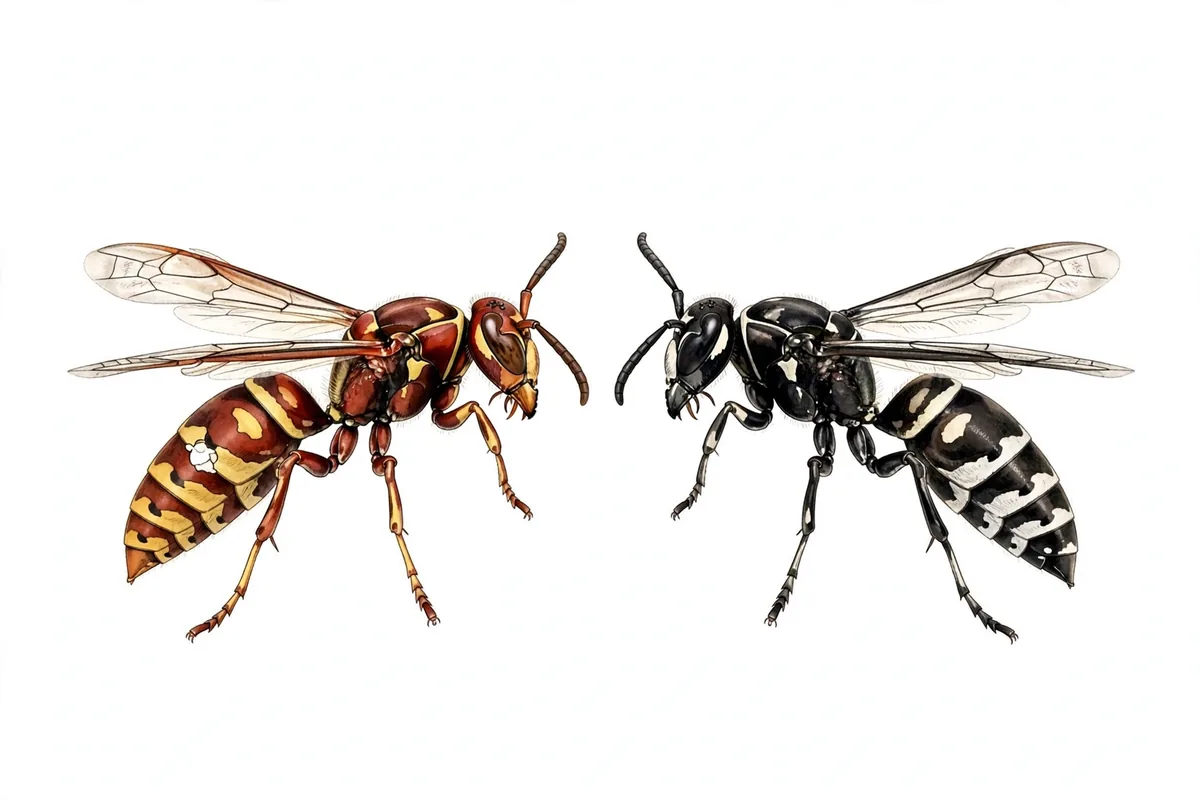
| Feature | Cicada killer | Bald-faced hornet | European hornet | |—|—|—|—| | Size | Very large — 1.5 to 2 inches | Medium — about 3/4 inch | Large — about 1 to 1.4 inches | | Color | Reddish-brown head and thorax, black abdomen with broken yellow stripes | Mostly black with distinct white or ivory markings on face and rear | Brown and yellow with a reddish-brown head and thorax — a “dirty” look | | Behavior | Solitary; hunts cicadas; males dive-bomb intruders for mating display | Social; guards large paper nests aggressively | Social; defends hollow-tree or wall-void nests | | Nest | Individual burrows in dry, sandy soil with dirt mounds at the entrance | Large gray paper nest hanging from trees, eaves, or shrubs | Large paper nest in hollow trees, wall voids, attics | | Sting risk to people | Extremely low — males cannot sting; females rarely do | High — attacks in numbers if the nest is disturbed | Moderate — defends nest; can sting repeatedly | | Sound | Loud, droning buzz from size | Higher-pitched buzzing | Deep buzz | | Season | Mid-July through August | Summer into fall | Summer into fall |
The quick read. If it is enormous, reddish, hovering over a bare patch of lawn with a dirt mound, and it is July or August — that is a cicada killer. If it is black with white markings and coming from a gray paper football hanging in a tree — that is a bald-faced hornet nest, and you should give it wide clearance.
Will a cicada killer sting you? #
Almost certainly not. Cicada killers are solitary wasps — they have no colony to defend, which removes the main reason social wasps attack people.
Males cannot sting. The ones dive-bombing you around the burrow area are males. Male wasps have no stinger (the stinger is a modified egg-laying organ, which males never had). They buzz and dart at intruders to protect their mating opportunities. It is unnerving, but it is theater — they are, in the words of one entomologist quoted by National Geographic, the “gentle giants of the wasp world.”
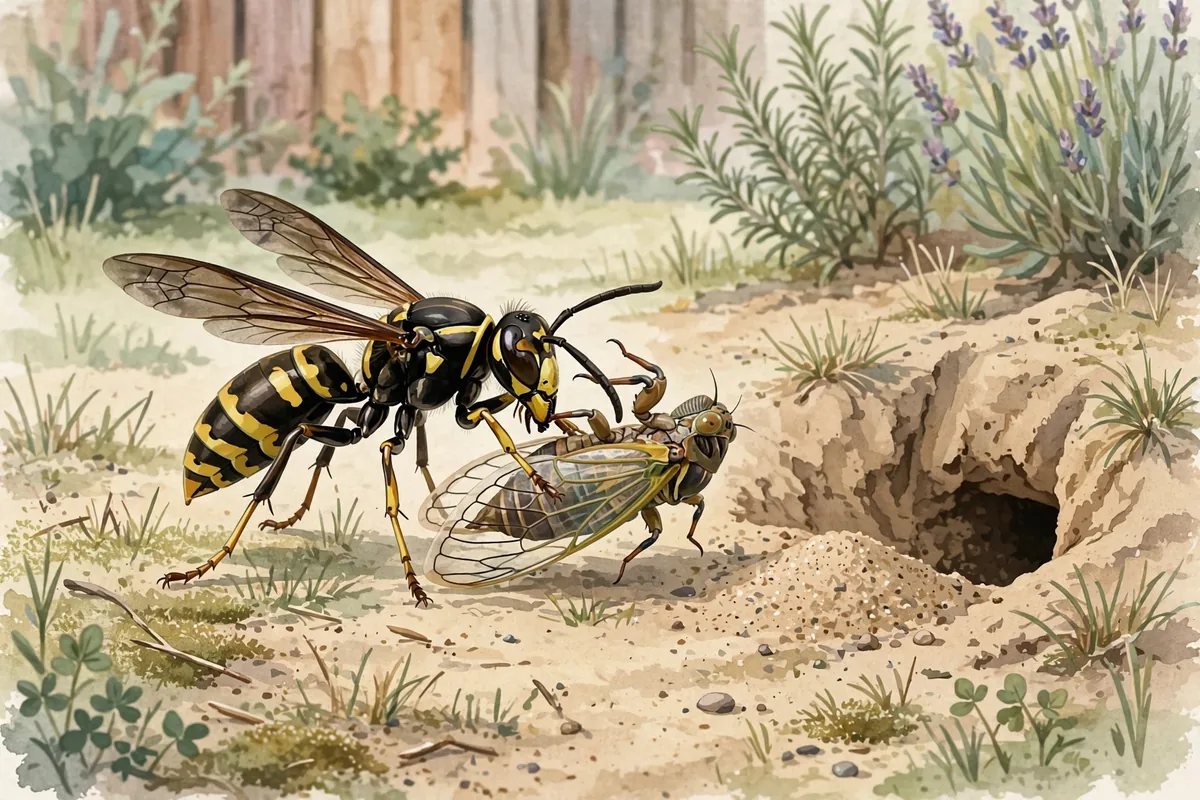
Females rarely sting people. A female’s sting is reserved for cicadas, which she paralyzes and drags back to her burrow as food for her larvae. She can sting — she has the equipment — but she will not use it on you unless she is grabbed with bare hands, crushed, or stepped on with bare feet. Reports of cicada killer stings are rare.
What to do about cicada killer burrows #
The burrows — dime-to-quarter-sized holes surrounded by piles of excavated sand or soil — are the main nuisance: they speckle lawns, gardens, sandboxes, and the edges of sidewalks during July and August. There is one generation per year, and the season is short (a few weeks).
If they are tolerable:
- Leave them alone. They are beneficial — each female removes cicadas from your yard — and they will be gone by late summer. The larvae overwinter in the burrow and adults emerge next July.
- Keep bare soil covered. Cicada killers prefer dry, bare, sandy soil. Overseeding, mulching, or ground cover in problem spots discourages nesting next year.
- Water the area. They prefer dry soil; consistent irrigation of the burrow area can make it less attractive (balance this against your lawn’s needs).
If they are in a high-traffic spot (sandbox, play area, walkway):
- Mark and redirect. A temporary barrier or a few days of detour is often enough — the season is short.
- Evening spot treatment. If you must act, apply a labeled wasp dust or insecticide directly into the burrow entrance in the evening when the female is inside, then wait a few days before filling the hole. Treat only the problem burrows, not the whole yard.
- Do not chase or swat. Swatting at the big, loud males is the one reliable way to create a scare (and you will never catch them — you will just agitate yourself).
Hornet nests are a different matter. A bald-faced hornet paper nest, a yellowjacket ground nest, or a European hornet void nest in a high-traffic area should not be handled by a homeowner with a stick. Keep people and pets clear, observe from a distance, and call a pest professional. For the general approach to hidden nest encounters, see what to do when wasps or bees chase you.
If a hornet stings you: first aid #
Unlike cicada killers, true hornets sting readily when their nest is threatened, and they can sting repeatedly since their smooth stingers do not lodge in the skin. If a bald-faced or European hornet stings you:
- Leave the area immediately. Walk briskly away — do not swat, do not wave your arms. Get indoors or at least 50 feet away. Hornets can release alarm pheromones that summon nestmates.
- Check for multiple stings. Brush any remaining insects off clothing and hair. Treat each site.
- Wash each sting site with soap and water.
- Apply cold. A cold compress or wrapped ice pack for 10–15 minutes per site reduces pain and swelling. Rotate sites if there are several.
- Soothe and relieve. An oral antihistamine per label directions helps with itching and swelling; a pain reliever per label directions can ease pain. Hydrocortisone cream or calamine lotion on the skin calms the local reaction. The general wasp sting first aid steps cover this sequence in more detail.
- Watch every site for infection signs over the next several days — increasing redness, warmth, pus, or fever.
Multiple stings deserve extra respect. A handful of hornet stings on a healthy adult is painful but usually self-limiting; dozens of stings (a nest-disturbance scenario) can cause systemic symptoms — nausea, dizziness, widespread pain — that warrant medical evaluation even without an allergy. The multiple stings medical care reference explains the thresholds.
Warning signs: when to seek care #
Call 911 immediately if you develop trouble breathing or swallowing, swelling of the face, lips, tongue, or throat, widespread hives, dizziness or fainting, or a racing heartbeat after a sting. If you have been prescribed an epinephrine auto-injector, use it first, then call 911 — epinephrine buys time but does not replace emergency care.
Seek urgent care or call your doctor if you took many stings at once (especially from a disturbed nest); if a sting is in the mouth, throat, or near the eye; if redness spreads well beyond the sting sites or you see red streaks; if pus, increasing pain after the first day, or fever develops; or if swelling does not improve after 3–5 days. Anyone with a known venom allergy should have an allergist-approved reaction plan — and know the difference between a large local reaction and anaphylaxis before outdoor season.
Frequently asked questions #

Are cicada killers dangerous to humans? #
No, not in any meaningful sense. They are solitary wasps with no colony to defend. Males cannot sting at all, and females reserve their sting for cicadas — reports of human stings are rare and require handling or crushing the wasp. True hornets, by contrast, are social nest-defenders that sting readily.
How can I tell a cicada killer from a murder hornet? #
Size and location are your best clues. Cicada killers are native across much of the US, appear in mid-summer, and nest in individual soil burrows. Asian giant hornets (“murder hornets”) are confined to a small area of the Pacific Northwest, are about 2 inches long with a large orange head, and live in underground colonies. The giant wasp in your yard in July is virtually always a cicada killer.
Do cicada killer wasps come back every year? #
Yes — adults emerge from the same soil each July through August, and females prefer the same dry, sandy, bare-soil conditions. If last year’s burrows were in your lawn, expect return visitors. Covering bare soil with grass, mulch, or ground cover and keeping it watered is the best long-term deterrent.
Should I kill cicada killers in my yard? #
Most entomologists recommend leaving them alone. They are beneficial cicada predators, they do not sting people under normal circumstances, and the season lasts only a few weeks. Reserve treatment for burrows in genuinely high-traffic spots (play areas, walkways), and use targeted evening applications rather than broad spraying.
Medical and editorial note #
This guide is general information about cicada killer wasps and hornets and is not medical advice. Sting reactions vary between individuals, and venom allergies can develop or change over time. If you are unsure about a reaction, have a known venom allergy, or feel unwell after a sting, contact a healthcare professional promptly.


