
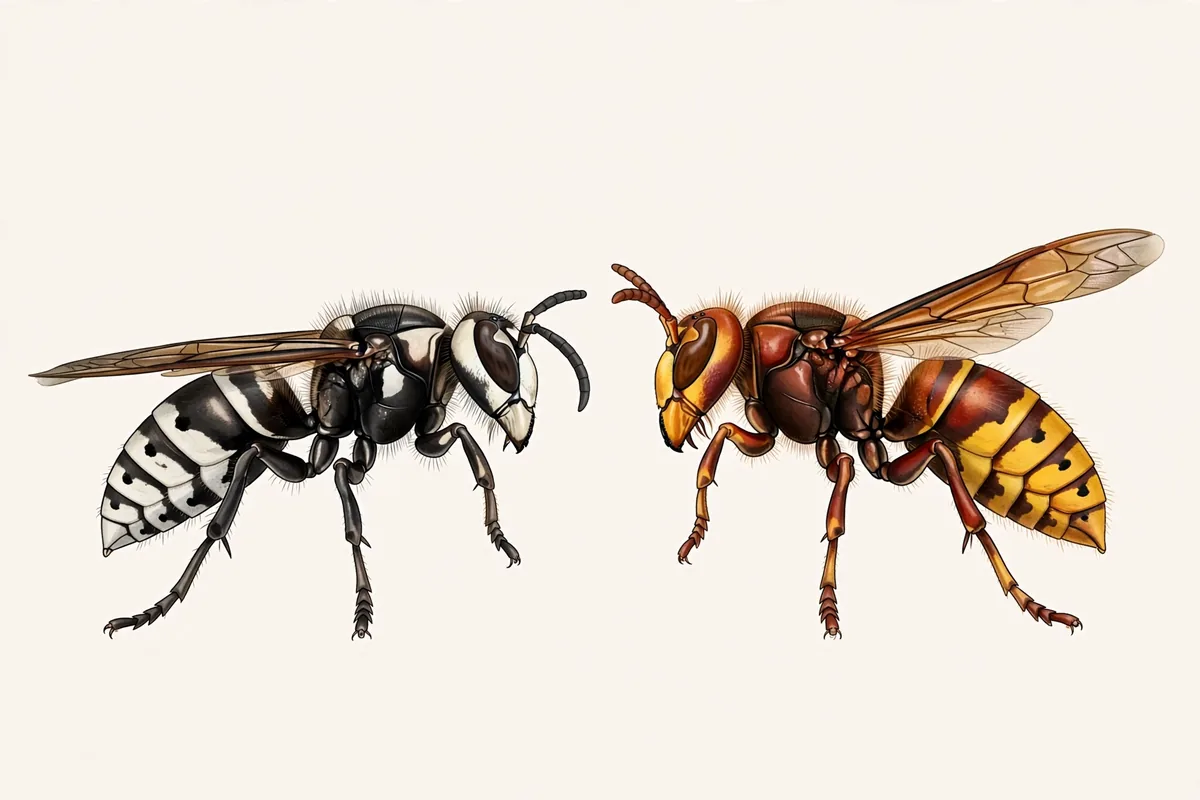
Bald faced hornet vs european hornet comes down to this: the bald-faced hornet is smaller (about 3/4 inch), black with white markings on its face and abdomen tip, and builds big gray paper nests in trees — while the European hornet is much larger (about 1.5 inches), reddish-brown and yellow, and nests inside hollow trees, walls, and sheds. Both are formidable defenders of their colonies, so correct identification decides how much distance you give them.
Telling them apart at a glance #
Bald-faced hornet (Dolichovespula maculata):
- Size: about 3/4 inch long — large for a wasp, but notably smaller than a European hornet.
- Color: black body with striking ivory-white markings. The face is mostly white (“bald-faced”), and the abdomen tip carries white bands. High contrast, unmistakable.
- Build: stocky, wasp-waisted, with a smooth shiny look.
- Temperament: extremely defensive of its nest. It will pursue perceived threats aggressively and — like all wasps — stings repeatedly. But away from the nest it is generally non-aggressive and can even be a useful pest predator.
European hornet (Vespa crabro):
- Size: about 1 to 1.5 inches long — the largest hornet commonly found in the US, and noticeably bigger than the bald-faced hornet. Queens are the largest of all.
- Color: reddish-brown head and thorax with a yellow-and-brown banded abdomen. The overall impression is large and amber, not black-and-white.
- Build: robust, heavy-bodied, with a powerful look.
- Temperament: defends its nest aggressively, and its sting is famously painful because of the insect’s sheer size. It is also active at dusk and around lights — the hornet you see thumping against a porch light at night is very likely this species.
Quick check: Black-and-white, smaller, white face = bald-faced hornet. Big, reddish-brown and yellow, attracted to lights = European hornet.
Nests: shape, location, and size tell the story #
Bald-faced hornet nests:
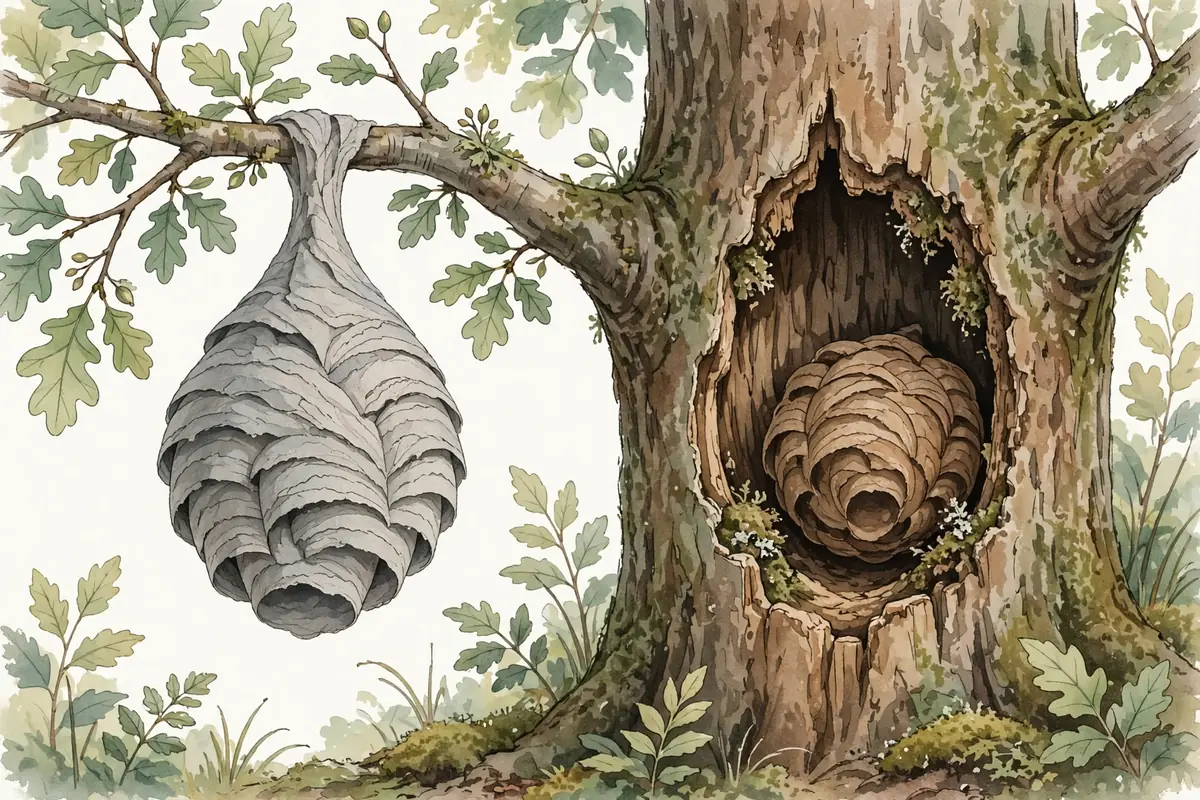
- Large, enclosed, teardrop- or football-shaped gray paper envelopes, often 12 inches or more across, hanging in trees, large shrubs, utility poles, or under eaves.
- One small entrance hole, usually at the bottom.
- Suspended in open air — you can see the whole nest from the outside.
- Colonies grow through summer, reaching hundreds of workers by late season.
European hornet nests:
- Built inside cavities: hollow trees, wall voids, attics, barns, and sheds. You rarely see the nest — you see heavy traffic entering one hole.
- The nest itself is a brownish paper structure, often with open combs rather than a fully closed envelope.
- Colonies are smaller than bald-faced hornet colonies (a few hundred workers at most), but the individual insects are so large that encounters feel dramatic.
The location clue is the fastest differentiator: a giant gray paper ball hanging in a tree is almost certainly bald-faced hornets; a steady stream of huge wasps entering a tree cavity or wall gap is European hornets.
Behavior: when each one becomes dangerous #
Away from the nest, neither wants a fight. Both species forage for insects, nectar, and fruit, and single hornets encountered on a walk are not looking for trouble. Bald-faced hornets hunt flies and other pests aggressively — they are beneficial predators when left alone.
Near the nest, both are dangerous. Bald-faced hornets are famous for their aggressive colony defense; they can pursue intruders and sting repeatedly. European hornets also defend vigorously, and because each sting delivers a large dose of venom, reactions tend to be more painful and swollen.
Key triggers to avoid:
- Vibrations near the nest — mowing, trimming, or hammering close by.
- Swatting at a single hornet near the colony (alarm pheromones summon defenders).
- Blocking or standing in the flight path of the entrance.
- At night: European hornets fly to lights, so turning off porch lights near a nest reduces encounters.
If you are stung: leave the area calmly, clean the site with soap and water, and apply a cold compress. For the full symptom picture and relief steps, see our guide on hornet sting symptoms.
Safety: living with hornets nearby #
Respect the perimeter. Give any active hornet nest a wide berth — at least 15–20 feet for daily activity, more if you must use loud equipment. Teach children to identify the nest location and stay clear.
Night lighting: European hornets are drawn to porch and security lights. If a nest is nearby, switch to motion-sensor lighting or keep windows near lights closed at night. Screens should be intact — a 1.5-inch hornet indoors is an alarming surprise.
Food and fruit: fallen fruit, open garbage, and sugary drinks attract both species. Clean up promptly in late summer.
Nest removal — call a professional. Hornet nests are not DIY projects:
- Bald-faced hornet colonies at peak season hold hundreds of aggressive defenders.
- European hornet nests inside walls or cavities can be partially hidden, and spraying the entrance may drive hornets deeper into the structure.
- Anyone in the household with a sting allergy makes professional removal non-negotiable.
While you wait: mark the area, keep pets and children away, and avoid lawn work near the nest. For general yard habits that reduce nesting pressure, review our outdoor bite prevention checklist.
A note on the Asian giant hornet #
Some readers confuse these two with the Asian giant hornet (the so-called “murder hornet”). That species is even larger (up to 2 inches) and is a separate identification question — it is not established across the US the way these two are. If you believe you have found Asian giant hornets, report them to your state agriculture department rather than handling it yourself.
Warning signs: when to seek care #
Call 911 immediately for: trouble breathing or swallowing; swelling of the face, lips, tongue, or throat; widespread hives; dizziness, faintness, or collapse; or a racing heartbeat. Use prescribed epinephrine if available, then call 911.
Seek urgent care or your doctor the same day for: multiple stings; swelling that keeps spreading after 48 hours; red streaks, pus, or fever; a sting near the eye; or pain that is severe or worsening.
Frequently asked questions #

Is a European hornet sting worse than a bald-faced hornet sting? #
Usually, yes — the European hornet is nearly twice the size, so each sting tends to be more painful with more local swelling. But bald-faced hornets defend in larger numbers, so a nest disturbance can produce more total stings. The venom itself is comparable wasp-family venom; the difference is dose and quantity.
Will bald-faced hornets chase you? #
They can pursue intruders away from the nest — this is well documented. The defense radius is typically tens of feet, not hundreds of yards, but within that zone they are relentless. The right response is to walk away quickly and calmly, covering your face, not to swat.
Do European hornets really fly at night? #
Yes — unusually among hornets, European hornets are active after dark and are strongly attracted to lights. This is why they show up at porch lights and lit windows, and why nighttime encounters are more common with this species than with bald-faced hornets.
Are hornets beneficial? Should nests ever be left alone? #
Both species are skilled insect predators and help control garden and forest pests. A nest far from human activity — deep in a woodlot, high in a tree away from paths — can simply be left until winter, when the colony dies off naturally (only the queen overwinters). Nests near homes, play areas, or walkways are a different matter.
Medical and editorial note #
This guide is general information for educational purposes and is not medical advice. Hornet stings can trigger life-threatening allergic reactions; anyone with a known sting allergy should carry prescribed epinephrine and have an emergency plan reviewed with their healthcare provider.


