
Do Spiders Bite in Winter? Indoor Truth Explained
Introduction Yes, spiders can bite in winter, but winter spider bites are uncommon, and most of the spiders you see indoors during the cold…
Introduction The direct answer is simple, and it matters for safety: a Portuguese man o' war is not a jellyfish, even though it is often called one. A true jellyfish…
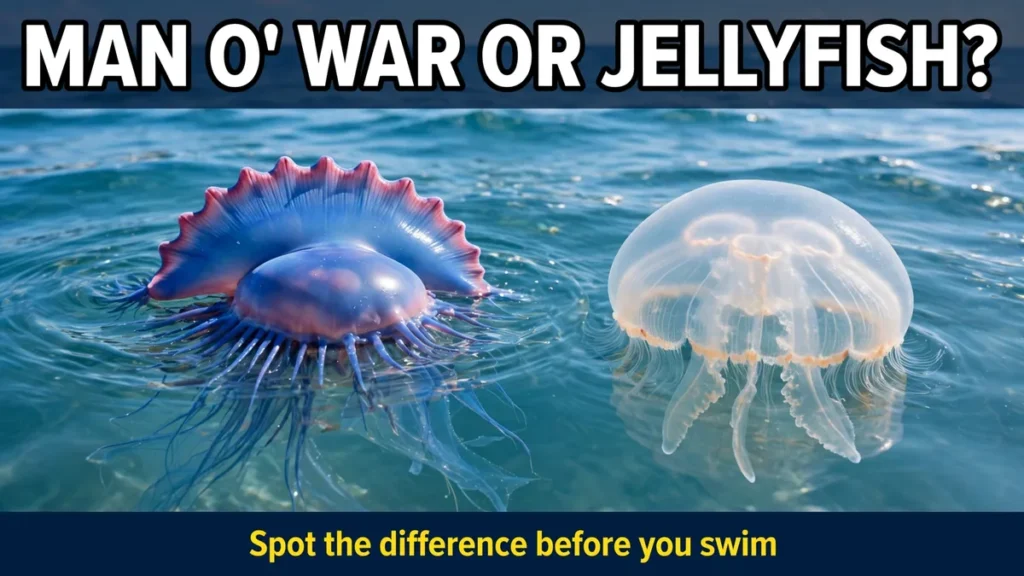
The direct answer is simple, and it matters for safety: a Portuguese man o’ war is not a jellyfish, even though it is often called one. A true jellyfish is a single animal with a soft, bell shaped body. A Portuguese man o’ war is a colony of many small organisms working together as one floating unit, and it is best recognized by the gas filled float, sometimes called a sail, that sits on the surface of the water. If you see a blue, pink, or purple balloon like float with very long tentacles trailing below it, treat it as a man o’ war and keep your distance. If you see a translucent dome or umbrella shape pulsing gently in the water, that is more likely a true jellyfish.
This distinction is not just a biology lesson. The two animals look different, they sting in somewhat different ways, and the safest first aid steps are not identical for every species. That last point is important. Advice that helps for one kind of sting can be unhelpful, or even harmful, for another. The safest approach at the beach is to get out of the water calmly, avoid touching the animal or any tentacles in the water or on the sand, rinse carefully, and ask a lifeguard for help when one is nearby. When you are unsure what stung you, or when symptoms are strong or spreading, seek medical help promptly rather than trying to guess the species on your own.
This guide explains how to tell a Portuguese man o’ war from a true jellyfish, what their stings tend to look and feel like, what to do first, what to avoid, and when to call for emergency help. It also explains why vinegar, a remedy many beachgoers have heard about, is not a universal answer. Some stings may benefit from vinegar, while others may be made worse by it, so careful, hedged guidance is better than a single rule for every sting. Where local lifeguards or posted beach warnings give specific advice for that beach on that day, follow their advice first, because they know which animals have been seen locally.
The Portuguese man o’ war, known by the scientific name Physalia physalis, is a siphonophore. That term describes a colony made up of many specialized organisms, called zooids, that live together and depend on each other. Some parts of the colony handle floating, some handle catching food, some handle digestion, and some handle reproduction. Together they function as one unit, but they are not one single animal in the way a jellyfish is. This is the core reason experts say the man o’ war is not a jellyfish, even though both belong to a broad group of stinging marine animals and both can sting people who touch their tentacles.
For a beachgoer, the practical lesson is that you cannot judge a man o’ war by the rules you use for a jellyfish alone. Its shape is different, its tentacles can be far longer, and its sting is often described as more painful than many common jellyfish stings. Knowing the float is the key to spotting it early, often before you are close enough to be stung.
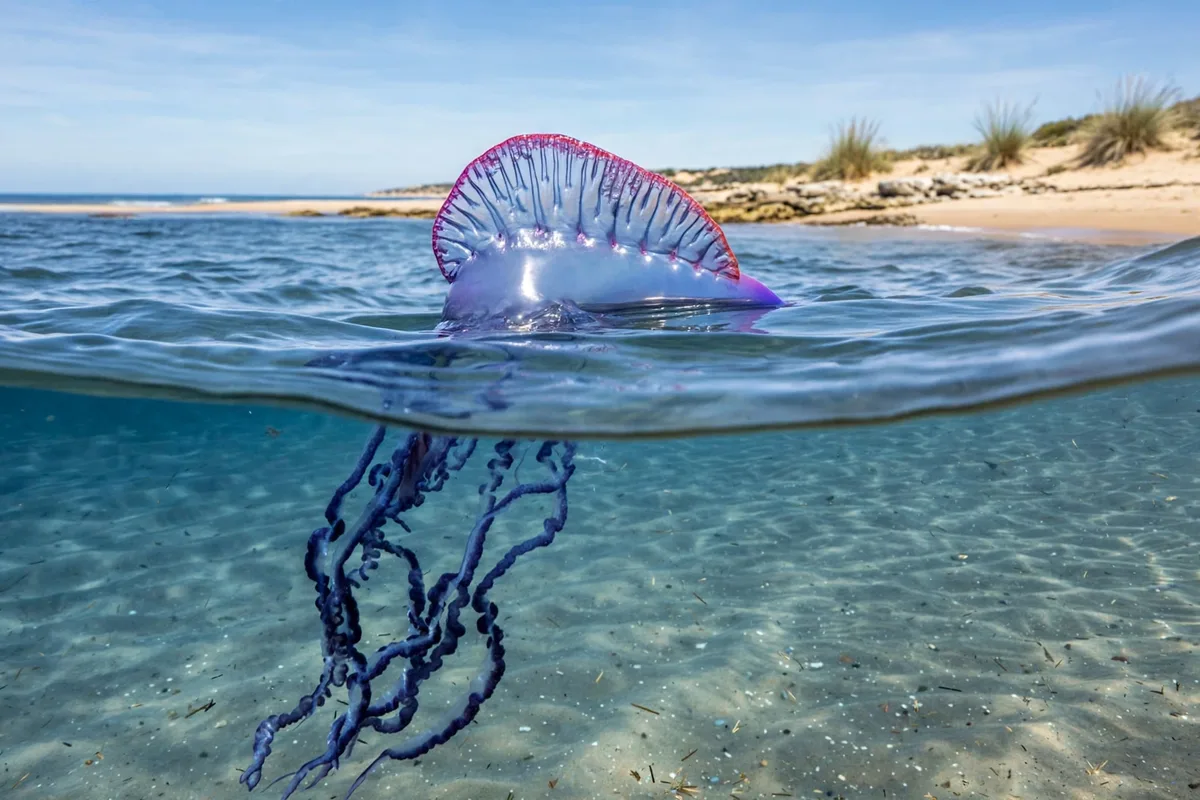
The most recognizable feature of a Portuguese man o’ war is its float. It is a gas filled, balloon like structure that rests on the surface of the water and can catch the wind like a small sail. The float is often blue, violet, pink, or purple, and it may look shiny or translucent in bright sunlight. The crest along the top can help the colony drift with the wind, which is one reason man o’ war can wash ashore in groups after strong winds or certain currents push them toward the coast.
Because the float sits at the surface, it can be visible from shore or from a boat before the tentacles are visible. That early warning is valuable. If you see one float, assume there may be others nearby, and assume tentacles may be present in the water even where you cannot see them clearly. Do not try to push the animal away, pick it up, or examine it closely. Even a man o’ war washed up on the sand can still sting, because its stinging cells may remain active for a time after the animal strands. Teach children the same rule: look, but do not touch, and tell an adult or a lifeguard right away.
Below the float, a Portuguese man o’ war trails tentacles that can be very long. In the water, those tentacles may stretch many feet, and in some cases they can extend far longer than the float itself. The tentacles carry stinging cells that fire on contact and deliver venom. That venom is what causes the sharp pain, redness, and skin changes that people notice after a sting.
The length of the tentacles helps explain why a sting can happen even when a swimmer never sees the float clearly. A person may brush against a tentacle trailing in murky water, near the surf line, or around a floating object. It also helps explain why sting marks from a man o’ war can look broad, irregular, or erratic. When a long tentacle drapes across skin, or when waves move it back and forth, the contact pattern can form a winding, zigzag, or branching mark rather than a single neat line. That pattern is not a certain diagnosis on its own, but it is one clue, along with the sighting of a float, that points toward a man o’ war rather than a typical jellyfish.
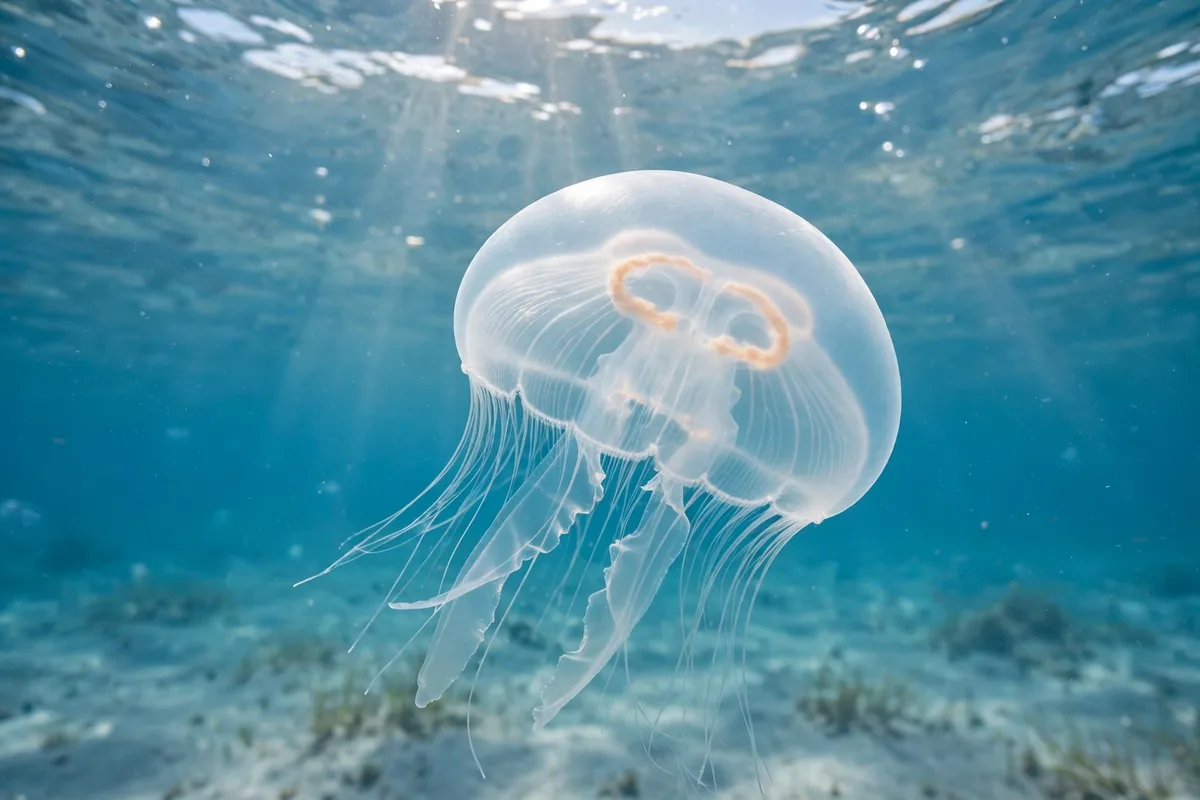
A true jellyfish is a single animal, not a colony. Its best known feature is the bell, a soft, dome or umbrella shaped body that pulses to move the animal through the water. Beneath the bell, many jellyfish have oral arms and tentacles that hang down and trail behind as the animal drifts. Some species are small and nearly clear, while others are larger and more colorful. Some have short tentacles, and some have longer ones, but the overall body plan is centered on that one bell.
True jellyfish live in oceans around the world, and different species are common in different regions and seasons. Some are mild stingers that cause only brief discomfort, while others can cause much stronger pain and more serious symptoms. For that reason, it is not safe to assume that every jellyfish is harmless, or that every jellyfish sting should be treated in exactly the same way. When you do not know the species, treat the sting seriously, watch symptoms closely, and get help if pain is severe or if symptoms spread beyond the sting area.
Jellyfish mostly drift with currents, tides, and wind, and they pulse their bells to steer or to stay in the water column. Swimmers often meet them by accident, especially in warm, calm water, near the surf, or where currents gather floating animals together. A jellyfish does not chase people, but contact with its tentacles can still happen quickly when a swimmer moves through the water where the animal is drifting.
Like the man o’ war, a true jellyfish stings through specialized stinging cells in its tentacles. When those cells contact skin, they can release venom and cause pain, itching, redness, and sometimes raised marks. The pattern often follows the line where the tentacle touched the skin, so jellyfish sting marks are often described as narrower and more linear than the broader, more erratic marks often linked to a man o’ war. Again, this is a tendency, not a guarantee. Tentacle length, water movement, the part of the body touched, and the species involved can all change how a mark looks. A sting mark alone should never be used to make a firm identification, and it should never replace medical advice when symptoms are worrying.
The table below summarizes the main differences in plain language. Use it as a quick reference on the beach, but remember that real animals vary, and a single feature is rarely enough for a certain identification.
| Feature | Portuguese man o’ war | True jellyfish |
|---|---|---|
| What it is | A colony of many small organisms acting as one unit, called a siphonophore | A single animal with one body |
| Most visible shape | Gas filled float or sail on the water surface, often blue, pink, or purple | Soft bell or dome that pulses in the water |
| Tentacles | Very long tentacles trailing below the float, sometimes many feet long | Tentacles and oral arms hanging below the bell, length varies by species |
| How it moves | Drifts with wind and currents, helped by its sail like float | Drifts with currents and pulses its bell to move |
| Where you may see it | On the surface, often blown ashore in groups after wind and currents shift | In the water column or near the surface, sometimes in groups after currents gather them |
| Typical sting mark tendency | Wider, more erratic, zigzag, or branching marks where a long tentacle draped across skin | Narrower, more linear tracks following the line of tentacle contact |
| Typical pain tendency | Often described as more painful and sometimes more severe than many common jellyfish stings | Varies widely by species, from mild to strong pain |
| Still a risk on sand? | Yes, a stranded man o’ war may still sting for a time | Yes, beached jellyfish and loose tentacles may still sting |
The difference in sting marks makes sense when you picture the two animals. A man o’ war tentacle is long and flexible, and waves can move it across a large area of skin in a winding path. A jellyfish tentacle may contact skin in a shorter, straighter line, especially when a swimmer brushes past it briefly. Skin type, the force of contact, and how long the tentacle stayed in contact also matter. A mark that looks dramatic does not by itself tell you how serious the sting is, and a mark that looks mild does not guarantee that symptoms will stay mild. Watch how the person feels overall, not just how the skin looks.
It is also possible to be stung by tentacle fragments that have broken off and are floating in the water or lying on the sand. Those fragments may be hard to see, which is why lifeguards sometimes close a stretch of beach or warn swimmers to stay out of the water after man o’ war or jellyfish are reported. If a beach has a warning flag, a posted notice, or a lifeguard announcement about stinging animals, respect it even if the water looks calm and clear.
In the water, look for shape and position before you look for color. A man o’ war float sits right at the surface and may bob with the waves like a small, shiny balloon. A jellyfish bell sits in the water and pulses, often just below the surface or deeper in the water column. If you see a float, swim away calmly without splashing wildly, and leave the water. If you see a pulsing bell, give it a wide berth and leave the water if jellyfish are numerous or if lifeguards advise it.
Visibility matters. In murky water, after a storm, or in choppy surf, you may not see either animal until contact happens. That is normal, and it is one reason beach warnings matter more than your own eyesight alone. If other swimmers report stings, if you see several animals washed up, or if the beach has posted a warning, staying out of the water is the safer choice, even if you have not personally seen an animal.
On the sand, a stranded man o’ war is often recognizable by its float, which may still show blue or purple color, with tentacles lying nearby or tangled in seaweed. A beached jellyfish often looks like a soft, jelly like dome that may be partly deflated, with tentacles or oral arms nearby. Both can still sting, so do not touch either one, do not let children or pets investigate them, and do not try to return them to the water with bare hands.
If you are walking the beach with children, make a simple rule before you arrive: if it looks like a balloon, a jelly blob, or a tangle of stringy material on the sand, do not touch it, step around it, and tell an adult. That rule is easy to remember and it covers both animals, plus other marine life that is best left alone.
In many real beach situations, you will not be able to tell with certainty whether a man o’ war or a jellyfish caused a sting. The animal may have been underwater, the water may have been cloudy, or the sting may have come from a loose tentacle fragment. That uncertainty is common, and it should not delay first aid. Get out of the water, remove any visible tentacles carefully without using bare hands, rinse as described below, and ask a lifeguard for help. If pain is strong, if the sting covers a large area, or if any worrying symptoms appear, seek medical care promptly. You do not need a perfect identification to get help, and medical staff can assess symptoms without it.
First aid for a man o’ war sting focuses on getting away from further stings, removing tentacles safely, easing pain, and watching for serious symptoms. Follow these steps in order, and ask a lifeguard for help as soon as you can.
First, leave the water calmly and avoid rubbing the sting area. Rubbing can press more stinging cells into the skin and may increase pain. Second, remove any visible tentacles carefully. Use tweezers, a gloved hand, a credit card edge, or a similar tool if one is available, and avoid touching tentacles with bare skin. If you have no tool, a towel or a piece of clothing can help you lift tentacles away, but take care not to press them further into the skin.
Third, rinse the area with saltwater, not fresh water, if saltwater is readily available. Many first aid guides advise against rinsing a man o’ war sting with fresh water at first, because fresh water may trigger more stinging cells to fire in some cases. Seawater from the ocean is a practical choice at the beach. Fourth, after rinsing, soaking or applying hot water is often suggested for man o’ war stings, if it can be done safely. Hot water should be comfortably hot, not scalding, and it should be tested on uninjured skin first. A common practical guide is to use water that is hot to the touch but not painful, for a period that feels helpful, while watching the skin for any sign of a burn. If hot water is not available, a warm compress may help. Stop and seek medical advice if pain worsens, if the skin blisters, or if symptoms spread.
Fifth, once the area has been rinsed and tentacles have been removed, you can consider pain relief and skin care as advised by a pharmacist or clinician, such as an over the counter pain reliever used exactly as directed, or a cool compress after the hot water step if that feels better. Avoid strong home remedies, harsh scrubbing, or applying alcohol, bleach, or other irritants to the sting. Keep the area clean, avoid scratching, and watch it over the next hours and days for spreading redness, warmth, swelling, fever, or worsening pain.
Vinegar is often discussed at the beach, and the advice is not simple. For some jellyfish species, vinegar is thought to help by stopping unfired stinging cells from firing. For other species, including some where vinegar is not advised, vinegar may make things worse or may not help at all. For a Portuguese man o’ war sting, many current first aid sources advise against relying on vinegar as a first step, and some advise hot water instead. Other older or local guides may still mention vinegar. This disagreement is exactly why hedged guidance matters.
The safest practical rule is this: if a lifeguard or a local beach authority gives specific advice for the animals present that day, follow that advice. If no lifeguard is available and you are unsure of the species, prioritize getting out of the water, removing tentacles safely, rinsing with saltwater, and using hot water carefully as described above. Do not delay getting medical help to search for vinegar, and do not pour vinegar on a sting if you have been told by a lifeguard or clinician not to use it. When in doubt, ask for help rather than trying a remedy you are unsure about.
First aid for a true jellyfish sting follows a similar pattern, with one important difference: the role of vinegar depends on the species. Follow these general steps, and adjust them if a lifeguard gives species specific advice.
First, leave the water calmly and avoid rubbing the area. Second, remove visible tentacles carefully with tweezers, a gloved hand, or a card edge, without using bare hands. Third, rinse with saltwater. As with a man o’ war sting, fresh water is often discouraged as an initial rinse, because it may trigger more stinging cells in some species. Fourth, if a lifeguard or local guide advises vinegar for the species present, vinegar may be applied as directed. If no such advice is available, or if you are unsure of the species, do not assume vinegar will help. In that case, hot water or a warm soak, used carefully as described above, is often a reasonable next step, and seeking medical advice is wise if pain is strong.
Fifth, after the initial steps, keep the area clean, avoid scratching, and monitor symptoms. Pain, itching, and redness often ease over hours, but they can return or worsen in some cases. Seek care if pain is severe, if the sting covers a large area, if symptoms spread, or if any of the red flag symptoms described later in this article appear. Children, older adults, and people with known allergies or health conditions should be watched more closely, and medical advice should be sought sooner for them.
There are many jellyfish species, and their venoms and stinging cells differ. A remedy that helps for one species may be neutral or unhelpful for another. That variation is why beach first aid posts, lifeguard stations, and local health guides sometimes give different advice in different places. It is not a sign that first aid is useless. It is a sign that local, species specific advice is valuable when it is available.
If you travel to a new beach, take a minute to read posted warnings and to ask a lifeguard about jellyfish or man o’ war activity. That short check can prevent a painful sting, and it can also tell you what first aid supplies, if any, the lifeguard station recommends. Carry basic supplies for your group, such as tweezers, a clean towel, and a way to contact help, but do not rely on a single home remedy as a substitute for lifeguard advice or medical care.
The table below gives a quick comparison, but it does not replace the detailed steps above or lifeguard advice.
| Step | Portuguese man o’ war | True jellyfish |
|---|---|---|
| Leave the water | Yes, calmly, without rubbing the sting | Yes, calmly, without rubbing the sting |
| Remove tentacles | Carefully, without bare hands, using tweezers or a card edge | Carefully, without bare hands, using tweezers or a card edge |
| First rinse | Saltwater rinse is often advised, avoid fresh water at first | Saltwater rinse is often advised, avoid fresh water at first |
| Vinegar | Often not advised as a first step, follow lifeguard advice | Depends on species, use only if lifeguard or local guidance advises it |
| Heat | Hot water soak, comfortably hot and not scalding, often suggested | Hot water soak, comfortably hot and not scalding, often suggested when appropriate |
| Watch for | Severe pain, spreading symptoms, breathing difficulty, or other red flags | Severe pain, spreading symptoms, breathing difficulty, or other red flags |
| Get help when | Pain is strong, area is large, symptoms spread, or you are unsure | Pain is strong, area is large, symptoms spread, or you are unsure |
Some common reactions can make a sting worse, even when they are well intentioned. Do not rub the sting vigorously, scratch it repeatedly, or apply sand to scrub the area. Do not urinate on a sting, a myth that has no reliable benefit and may add irritation. Do not apply alcohol, bleach, ammonia, or other harsh chemicals. Do not use ice directly on the skin for a long period without a barrier, and do not use water so hot that it burns the skin. Do not try to suck venom out, cut the skin, or apply a tight tourniquet. Do not delay calling for emergency help if red flag symptoms appear, in order to try home remedies first.
If a child is stung, stay calm, keep the child calm, and focus on the same steps: leave the water, remove tentacles safely, rinse, and get lifeguard help. Reassure the child that help is coming, and watch for any change in breathing, swelling, or alertness. Children may become frightened quickly, and calm adult behavior helps them stay still while tentacles are removed and while symptoms are assessed.
The best first aid is prevention. Before you swim, check for beach warning flags, posted notices, lifeguard announcements, and local beach condition reports. Many beaches use colored flags or signs to warn about surf, currents, and marine life. If a warning about man o’ war or jellyfish is posted, respect it. A warning does not mean the whole coastline is closed forever, but it does mean that swimming in that area on that day carries extra risk.
Wind direction matters for man o’ war in particular. Onshore winds can push floats toward the beach, and a beach that was clear in the morning may have stranded animals by the afternoon. If you arrive later in the day, check again, and look along the sand line before you let children run into the water. A quick scan for floats, jelly blobs, and tangled tentacle material can prevent an accidental step or touch.
Whenever possible, swim near a staffed lifeguard area. Lifeguards can warn you about current conditions, respond quickly to a sting, and give species specific first aid advice. They also have supplies and communication tools that a lone swimmer may not have. If you are at an unguarded beach, be extra cautious, swim with others, keep a phone accessible, and know how to reach emergency services in that location.
Supervise children closely near the water, and keep them away from stranded animals on the sand. Teach children to point out, not touch, anything unusual on the beach. Pets should also be kept away from stranded man o’ war and jellyfish, because a pet that noses or steps on tentacles can be stung and may need veterinary care. If a pet is stung, keep the pet calm, avoid touching tentacles with bare hands, rinse as advised by a veterinarian or emergency service, and seek veterinary help promptly if the pet shows distress, swelling, or difficulty breathing.
Protective swim clothing, such as a rash guard or a full body swim suit, can reduce the area of exposed skin and may lower the chance of a sting, although it does not make swimming risk free. Tentacles can still contact exposed skin on the face, hands, and feet, and they can sometimes sting through thin fabric. Still, covering up is a reasonable, low cost precaution, especially for children and for swimmers in areas where jellyfish are known to be present.
Timing also helps. If local reports show that man o’ war or jellyfish tend to appear after certain winds, tides, or seasons, plan swims accordingly and check daily reports rather than relying on last week’s conditions. Conditions change quickly at the coast, and a beach that was safe yesterday may not be safe today. When in doubt, ask a lifeguard, choose a different beach, or enjoy the sand and stay out of the water.

After a man o’ war or jellyfish sting, pain and redness often improve over hours, and skin changes often fade over days. Itching, mild swelling, and tenderness in the sting area are common in the first day or two. Keeping the area clean, avoiding scratching, and protecting it from further irritation can help. Loose, comfortable clothing is better than tight clothing that rubs the area. Avoid applying new scented lotions, harsh scrubs, or unproven remedies to freshly stung skin.
Watch the area over the next few days, not just the first hour. Some skin reactions can worsen after a delay, and some people develop a rash, blistering, or a longer lasting skin change in the sting area. If redness spreads outward, if warmth and swelling increase, if fever develops, or if pain worsens instead of easing, seek prompt medical care. Those changes can suggest infection or a stronger reaction, and they should not be ignored while waiting to see if they pass on their own.
For context on how warning signs can look after other kinds of stings, readers often find it helpful to review general guidance on bee sting warning signs and on mosquito bite warning signs, because the principle is the same: spreading redness, fever, and worsening symptoms are reasons to get care sooner rather than later.
Seek medical advice if the sting area blisters, breaks open, shows signs of infection, or does not improve as expected. A clinician can assess whether the skin needs specific wound care, whether an infection needs treatment, and whether an allergic or delayed reaction needs attention. Do not try to drain blisters, apply steroid creams without advice, or start antibiotics on your own. If you have diabetes, a weakened immune system, poor circulation, or a skin condition that affects healing, seek advice sooner, because skin injuries can be more complicated in those situations.
Keep a simple record of the sting if you can: when it happened, where you were swimming, what you saw in the water or on the sand, what first aid you used, and how symptoms changed over time. That record can help a clinician or a lifeguard understand what happened, especially if symptoms change later or if another person is stung in the same area.
Call 911 right away if you or someone near you has breathing difficulty, throat swelling, swelling of the lips or tongue, fainting, feeling faint, widespread pain, chest pain, confusion, or any other sign of a severe reaction after a man o’ war or jellyfish sting. Also call 911 if the person has a known severe allergy to stings, if symptoms come on rapidly and worsen quickly, or if the person cannot breathe comfortably, cannot speak normally, or becomes unresponsive. Do not wait to see if emergency symptoms improve on their own, and do not drive yourself to care if you are the person affected and you feel faint, dizzy, or short of breath.
If the person has an epinephrine auto injector prescribed for severe allergic reactions, and they show signs of a severe allergic reaction, use it as directed and still call 911. Epinephrine is not a substitute for emergency care, and symptoms can return after an initial improvement. Stay with the person, keep them lying down with legs raised if they feel faint and are breathing normally, and follow emergency dispatcher instructions until help arrives.
Seek prompt medical care, the same day if possible, if pain is severe or does not ease with basic first aid, if the sting covers a large area of skin, if the sting affects the face, eyes, mouth, or genitals, or if the person is a young child, an older adult, or someone with a known allergy or health condition that makes reactions riskier. Also seek prompt care for spreading redness, increasing warmth or swelling, fever, red streaks moving away from the sting, pus, worsening itching or pain, or any symptom that gets worse instead of better over hours.
Seek care sooner rather than later if you are unsure what stung you and symptoms are strong, if multiple stings occurred, or if you were stung in a remote location and cannot easily return for help if symptoms worsen. It is always reasonable to call a local nurse advice line, urgent care, or emergency services for guidance when you are unsure. Describing what you saw, when the sting happened, and how symptoms are changing will help the clinician advise you.
Certain situations deserve faster help even when the first symptoms seem moderate. Stings to the eyes need prompt medical assessment, because eye exposure can cause pain, swelling, and vision changes. Do not rub the eyes, and seek care right away. Stings inside the mouth or throat, which can happen rarely when a person swallows water containing tentacle material, also need emergency assessment, especially if swallowing or breathing becomes difficult.
People who have had a severe reaction to a previous sting, people who take medicines that affect allergic reactions, and people with asthma or heart conditions should also seek advice sooner, because a new sting can interact with those conditions in unpredictable ways. When in doubt, err on the side of getting checked. A prompt assessment is far safer than waiting at home while symptoms develop.
No, a Portuguese man o’ war is not a true jellyfish. It is a siphonophore, which is a colony of many small organisms that live together and function as one floating unit. A true jellyfish is a single animal with a bell shaped body. The two animals are related in the broad sense that both are stinging marine animals, but their body plans are different, and that difference helps explain why they look different and why their stings can differ.
Look for the float. A man o’ war has a gas filled float or sail on the surface, often blue, pink, or purple, with very long tentacles trailing below it. A true jellyfish has a pulsing bell or dome in the water, with tentacles and oral arms hanging below the bell. If you see a float, keep away and leave the water. If you are unsure, treat the animal as a possible stinger, give it a wide berth, and ask a lifeguard for help.
Man o’ war stings are generally described as more painful than many common jellyfish stings, and they can sometimes be more severe. That is a general tendency, not a rule for every person or every species. Some jellyfish species can also cause strong pain and serious symptoms, and individual reactions vary. Pain level alone does not tell you whether emergency care is needed. Watch for red flag symptoms, the size of the sting area, and how symptoms change over time.
Vinegar is not a universal remedy, and the right answer depends on the species and on local guidance. Vinegar may help for some jellyfish species by stopping unfired stinging cells, but it may not help, or may worsen, other stings. For man o’ war stings, many current guides advise hot water rather than vinegar as a first step. The safest approach is to follow lifeguard advice for the beach you are on, prioritize removing tentacles safely and rinsing with saltwater, and seek medical help when you are unsure or when symptoms are strong.
Yes, a stranded man o’ war may still sting for a time after it washes ashore, because its stinging cells can remain active. The same caution applies to beached jellyfish and to loose tentacle fragments on the sand or in shallow water. Do not touch stranded animals with bare hands, keep children and pets away, and tell a lifeguard if you see one on a public beach.
Leave the water calmly, avoid rubbing the sting, remove visible tentacles carefully without using bare hands, and rinse with saltwater. Then use comfortably hot water, tested first on uninjured skin, if that is available and safe. Keep the area clean, watch symptoms closely, and seek medical care promptly if pain is severe, if the sting area is large, if symptoms spread, or if any red flag symptoms appear. Call 911 for breathing difficulty, throat swelling, fainting, widespread pain, or other signs of a severe reaction.
Pain and redness often ease over hours, and skin changes often fade over days, but recovery varies by species, sting size, and individual reaction. Some people notice itching or tenderness for a few days, and some develop a longer lasting skin change in the sting area. Seek care if symptoms worsen instead of easing, if redness spreads, if fever develops, or if new symptoms appear after the first day. A clinician can advise on skin care and on whether further assessment is needed.
It depends on current conditions, not on the fact that one person was stung. If lifeguards have posted a warning, if many animals are present, or if several people have been stung, staying out of the water is safer. If conditions have cleared and lifeguards say swimming is safe, you can return, but check warnings again, swim near a guarded area, and watch for floats or bells in the water. If you were recently stung, protect the healing skin from further irritation and seek advice if you are unsure about swimming again soon.
A Portuguese man o’ war and a true jellyfish may both sting, and both deserve respect at the beach, but they are not the same animal. The man o’ war is a floating colony with a gas filled sail and very long tentacles, while a true jellyfish is a single animal with a pulsing bell. That difference shows up in how they look, in the shape of their sting marks, and often in how painful a sting feels. Man o’ war stings tend to leave wider, more erratic or zigzag marks and are often described as more painful, while jellyfish stings tend to leave narrower, more linear tracks. Those tendencies are useful clues, but they are not a certain diagnosis, and they should never delay first aid or medical help.
The safest beach habits are simple and consistent. Learn to recognize the float, respect beach warnings, swim near lifeguards when you can, and keep children and pets away from stranded animals. If a sting happens, leave the water calmly, remove tentacles safely without bare hands, rinse with saltwater, and use hot water carefully when appropriate. Treat vinegar with caution, because it helps some stings and worsens others, and follow lifeguard advice for the species present on that beach. Above all, watch for red flags and call 911 for breathing difficulty, throat swelling, fainting, widespread pain, or any sign of a severe reaction. Prompt care, spreading redness, fever, and worsening symptoms are all reasons to seek help sooner rather than later.
With a little knowledge before you swim, you can enjoy the beach with more confidence and respond calmly if a sting happens. Spot the float, give stinging animals a wide berth, and let lifeguards and clinicians help when you need them. That combination of prevention, careful first aid, and prompt medical care is the best way to handle both a Portuguese man o’ war and a true jellyfish.
Medical disclaimer: This article is for general information only and is not medical advice. It does not diagnose or treat any condition. If you have concerning symptoms, a known allergy, or symptoms that worsen, seek professional medical care promptly. This content is medically reviewed by Dr. Sarah Jones, MD, for general educational accuracy.
Dr. Jones oversees StingHelp’s clinical verification process. Every guide is systematically evaluated against active Centers for Disease Control and Prevention (CDC), Environmental Protection Agency (EPA), and American Academy of Allergy, Asthma & Immunology (AAAAI) medical consensus standards to ensure symptom distinctions and care recommendations are clinically sound.
Explore physician-reviewed first-aid procedures, identification clues, and symptom comparisons for other common outdoor bites and stings.

Introduction Yes, spiders can bite in winter, but winter spider bites are uncommon, and most of the spiders you see indoors during the cold…
Introduction: The Direct Answer A jellyfish sting and sea lice irritation are different problems with different causes, even though both can leave you itchy…

Introduction: The Short Answer If you found a large brown spider and you are trying to decide whether it is a fishing spider or…