
Portuguese Man O’ War vs Jellyfish: How to Tell Them Apart
Introduction The direct answer is simple, and it matters for safety: a Portuguese man o' war is not a jellyfish, even though it is…
Introduction: The Short Answer If you found a large brown spider and you are trying to decide whether it is a fishing spider or a wolf spider, habitat is usually…
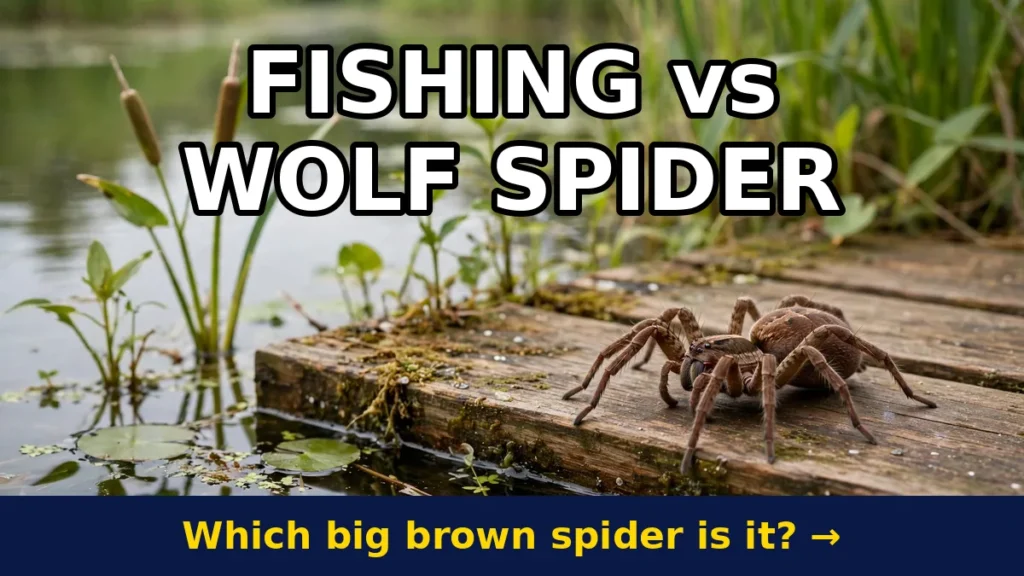
If you found a large brown spider and you are trying to decide whether it is a fishing spider or a wolf spider, habitat is usually the fastest clue. Fishing spiders are strongly tied to water. They live near ponds, lakes, streams, marshes, and other freshwater edges, and they often rest on vegetation, docks, rocks, or the water surface itself. Wolf spiders are ground hunters. They live in grass, leaf litter, gardens, fields, and under stones, logs, and debris, and they roam on the ground rather than waiting near water.
Size alone will not settle the identification, because both groups include large spiders and both are often brown with patterned markings. Behavior, eye arrangement, body shape, and location together give a much clearer answer. Fishing spiders tend to have a flatter, more sprawling posture, long legs that spread widely, and a habit of sitting still near water or even skating on the surface. Wolf spiders tend to have a sturdier, more compact hunting build, a distinctive eye pattern with two very large eyes facing forward, and a habit of running quickly across the ground when disturbed.
Both types can bite if handled, trapped against skin, or threatened, but bites are uncommon and usually cause only short term pain, redness, and swelling similar to a bee sting in most people. Neither group is considered a medically dangerous spider in the way that a few well known venomous species are, but any bite should still be cleaned, monitored, and checked promptly if symptoms spread or worsen. This guide compares appearance, habitat, eyes, behavior, webs, egg care, and bite care in detail, so you can identify the spider you saw, avoid handling it, and respond calmly if a bite happens.
The table below summarizes the main differences. Use it for a fast check, then read the detailed sections for the clues that match your sighting.
| Feature | Fishing Spider | Wolf Spider |
|---|---|---|
| Main habitat | Near freshwater: ponds, lakes, streams, marshes, docks | On the ground: grass, gardens, fields, leaf litter, under debris |
| Hunting style | Ambush near or on water, catches insects and small aquatic prey | Active ground hunter, chases prey on land |
| Body posture | Flatter, sprawling, legs spread wide | Sturdier, compact, built for running |
| Eye pattern | Two rows of four eyes, fairly even in size | Distinctive: four small eyes in a bottom row, two very large eyes above, two medium eyes on top |
| Web use | Does not use a prey-catching web, may use silk for shelter or egg sacs | Does not use a prey-catching web, carries egg sac and spiderlings |
| Egg care | Female carries or guards an egg sac, often near water vegetation | Female carries egg sac attached to spinnerets, then carries spiderlings on her back |
| Activity | Often still for long periods near water, quick dart when disturbed | Often runs quickly when disturbed, hides under cover |
| Bite risk | Low, mainly if handled or trapped | Low, mainly if handled or trapped |
| Typical reaction | Local pain, redness, swelling, usually short term | Local pain, redness, swelling, usually short term |
If your spider was on a dock, a pond plant, or the water edge, fishing spider is the stronger match. If it was running across a lawn, garden path, or basement floor far from water, wolf spider is the stronger match.
Fishing spiders belong to a group of large spiders adapted to life near freshwater. They are sometimes called dock spiders in some regions because they are often seen on docks and boathouses. They are skilled at sensing vibrations on the water surface and on nearby vegetation, which helps them detect prey. Their long legs spread their weight, which helps them rest on the water surface and move across it in short bursts.
Fishing spiders are among the largest spiders many people meet in North America. Body length varies by species and sex, and leg span can look much larger than body length because the legs are long and sprawled. Their color is usually brown, gray-brown, or dark brown, often with lighter markings, stripes, or spots that help them blend with bark, reeds, and shaded water edges. Some individuals look quite dark, while others look mottled and lighter. Color alone is not a reliable species test, because both fishing spiders and wolf spiders vary in shade with age, sex, and lighting.
Their body shape is a useful clue. Fishing spiders often look flatter and broader than wolf spiders, with legs held out to the sides in a wide stance. When they rest on a flat surface, they can look almost pressed down, with legs extended. That sprawling posture, combined with a waterside location, points toward a fishing spider more than a compact, upright hunting posture does.
Fishing spiders live where freshwater and cover meet. Look for them on pond edges, lake shores, slow streams, marsh plants, cattails, reeds, fallen logs near water, rocks at the waterline, docks, and boathouse walls. They often sit motionless for long periods, waiting for insects on the surface or on nearby plants. When disturbed, they may dart quickly across the water, dive briefly below the surface, or hide under a dock board or plant stem. That dive and water-surface behavior is very distinctive: wolf spiders do not normally live or hunt on open water in that way.
Fishing spiders do not build a web to catch prey. They hunt by ambush and by sensing movement. They may use silk to make a retreat among plants or under bark, and females guard egg sacs in vegetation near water. Seeing a large spider on a nursery-like silk retreat among reeds near a pond, with an egg sac nearby, fits the fishing spider pattern well.
Fishing spiders have eight eyes arranged in two rows of four. The eyes are more even in size than the wolf spider pattern, without the two strikingly large forward-facing eyes that make wolf spiders so recognizable. In the field, eye pattern is best checked with a photo zoomed in, rather than by handling the spider. Never pick up a large spider to check its eyes. Take a photo from a safe distance, note the location, and compare the eye rows later.
Other clues include leg banding, body markings, and the way the spider holds its legs. Fishing spiders often show pale markings along the body edge or a patterned stripe down the center, but patterns vary. Habitat plus posture plus eye arrangement together are far more reliable than any single marking.
For another close comparison that separates lookalike bites by pattern and location, see our guide on bed bug vs spider bites. The same careful observation method used here, location plus pattern plus behavior, applies there.

Wolf spiders are a large and widespread group of ground hunting spiders. They do not build webs to catch prey. Instead, they roam, wait in ambush on the ground, and chase down insects and other small invertebrates. They are common in lawns, gardens, fields, meadows, and woodland floors, and they sometimes wander into garages, basements, and ground floor rooms, especially in cooler weather or when hunting.
Wolf spiders are also large and brown, which is why they are so often confused with fishing spiders. Their bodies are sturdy and somewhat hairy, with strong legs built for running. Color is usually brown, gray, or tan, often with darker markings, stripes, or a patterned abdomen. Females carrying egg sacs or spiderlings can look larger and bulkier than males, and a female with dozens of tiny spiderlings on her back is unmistakable once you know what to look for.
Body shape helps here too. Wolf spiders tend to look more compact and robust than fishing spiders, with a slightly raised front body section and legs positioned for quick movement rather than wide sprawling on water. When disturbed on open ground, they usually run fast in short bursts and then freeze or dive under cover, rather than skating across water or diving into a pond.
Wolf spiders live on the ground. They shelter under stones, logs, leaf litter, mulch, garden pots, firewood, and debris. Some species dig burrows or use natural ground holes, while others simply hide under cover during the day and hunt at night. At night, their eyes can reflect flashlight or headlamp light with a bright shine, which is one reason people notice them on lawns after dark. That eyeshine, combined with ground habitat, is a strong wolf spider clue.
They are solitary hunters. They do not form colonies, and they do not build large sheet webs across plants. If you find a large brown spider in a funnel web on grass, that is more likely a grass spider than a wolf spider, even though the two are often confused. Web presence, or the lack of it, is therefore a useful separator, as explained in the grass spider comparison linked above.
Eye arrangement is the most reliable single feature for wolf spiders, when you can see it safely in a photo. Wolf spiders have eight eyes in three rows: four small eyes in a bottom row, two very large eyes in a middle row facing forward, and two medium eyes in a top row set farther back. Those two large middle eyes give wolf spiders a distinctive face, almost like a pair of headlights, and they help the spider hunt in low light.
If your photo shows two very large forward eyes with smaller eyes below and above, wolf spider is very likely, even if the spider is large and brown. Fishing spiders do not show that same two-large-eye pattern. Learning this one pattern will prevent many misidentifications, and it works better than judging size or color alone.
Female wolf spiders carry their egg sac attached to their spinnerets at the rear of the abdomen. After the eggs hatch, the spiderlings climb onto the mother’s back and ride there for a period before dispersing. A large spider with a round silk ball trailing behind it, or with many tiny spiders clustered on its back, is almost certainly a wolf spider. Fishing spider females also guard egg sacs, but they do not normally carry spiderlings on their backs in that same visible way. If you see spiderlings riding on a back, do not touch the spider, because the young can scatter quickly and the mother may be defensive.
The sections above cover the basics. The comparisons below help when a sighting is borderline, for example a large spider near a garden pond, or a spider found on a porch close to both grass and water.
Ask first: where exactly was it? On a dock, a boat, a pond plant, a stream rock, or the water surface itself points strongly to a fishing spider. On a lawn, garden bed, driveway, basement floor, or under a garden stone points strongly to a wolf spider. A porch or garage near a pond can be ambiguous, so check the next clues. A spider that runs across open water or dives into a pond when disturbed is behaving like a fishing spider. A spider that runs across dry ground and hides under leaf litter is behaving like a wolf spider.
Distance from water also matters. Fishing spiders rarely wander far from freshwater for long, while wolf spiders are found far from water in fields, lawns, and homes. If your sighting was well away from any pond, lake, or stream, wolf spider becomes much more likely, even if the spider was large.
Both groups include large species, so size alone should not decide the answer. Fishing spiders often have a wider leg span relative to body length and a flatter profile. Wolf spiders often look stockier, with a more raised front section and legs that look built for sprinting. Hairiness also varies, but wolf spiders often look more densely hairy on the legs and body, while fishing spiders can look smoother or more sleek. Use shape as a supporting clue alongside habitat and eyes, not as a final test on its own.
This is the clue to prioritize when you have a clear photo. Fishing spider eyes form two rows of four, fairly even in size. Wolf spider eyes form three rows with two very large middle eyes. Zoom into your photo and count the rows. If you see two large eyes dominating the face, choose wolf spider. If the eyes look more even across two rows, and the spider was near water, choose fishing spider. If the photo is blurry, note the habitat and behavior instead of guessing from eyes alone.
Neither group builds a prey-catching web, which already separates both from web-building spiders such as orb weavers and grass spiders. Fishing spiders may make silk retreats among waterside plants and guard egg sacs there. Wolf spiders may use burrows, ground holes, or cover, and they carry egg sacs rather than leaving them in a plant retreat. Finding a large spider inside a funnel web on grass suggests a different spider altogether, not a wolf or fishing spider, and that distinction is covered in the grass spider comparison.
Fishing spiders often freeze, then dart across water or dive. Wolf spiders often freeze, then sprint across ground and dive under cover. Both can be fast, and both will try to escape rather than attack. Neither will chase a person across a yard. If a spider runs toward cover rather than toward you, that is escape behavior, not aggression. Give it space, and it will usually leave on its own.
Both groups use brown, gray, and tan camouflage, and both show stripes, spots, and mottling that vary by species, sex, age, and light. A dark fishing spider can look like a dark wolf spider, and a light wolf spider can look like a light fishing spider. Photographs taken in shade, at night, or with flash can shift colors further. For that reason, do not identify by color alone. Combine habitat, posture, eyes, and behavior, and you will be right far more often.
For most people, no. Both groups can bite defensively, but bites are uncommon, and serious medical effects are rare. A typical bite causes immediate local pain, redness, and swelling, sometimes with itching, similar to a bee sting or a painful insect bite. Symptoms usually improve within a few hours to a couple of days with basic care. Severe allergic reactions are possible with any bite or sting, but they are not the expected outcome for these spiders.
That said, do not handle large spiders, do not try to pick one up to identify it, and do not let children or pets play with one. Bites most often happen when a spider is trapped in clothing, bedding, shoes, or a towel, or when it is pressed against skin during gardening, moving firewood, or cleaning a dock area. Shaking out shoes, gloves, and towels stored outdoors, and wearing gloves for yard and dock work, reduce bite risk more than any spray or trap.
If you are unsure what spider bit you, or if the spider looks very different from the descriptions here, take a photo from a safe distance if you can do so without risk, note the time and location, and monitor symptoms closely. Do not try to catch a spider that may bite again, and do not apply unproven remedies to a bite.
For a broader look at spider bite care and recovery steps, see our guide on effective treatment for spider bites. The same careful observation habits, location, pattern, timing, and photo evidence, help with spider identification too.
Stay calm and move away from the spider. Wash the bite area gently with soap and water, and apply a clean cool cloth or cool pack for short periods to ease pain and swelling. Keep the area clean and uncovered when possible, and avoid scratching, which can break skin and increase infection risk. An over the counter pain reliever or antihistamine may help if you normally use such products safely, but follow label directions and seek advice if you have medical conditions, take other medicines, or are caring for a child.
Monitor the area for the next day or two. Mild redness and swelling that slowly improve are common. Seek care sooner if redness spreads rapidly, pain increases after the first day, swelling becomes severe, pus appears, fever develops, or red streaks extend from the bite. Seek urgent care for trouble breathing, swelling of the lips, tongue, or face, widespread hives, dizziness, fainting, or other signs of a severe allergic reaction. Those signs are uncommon, but they need immediate help.
Do not apply harsh chemicals, bleach, alcohol soaks beyond gentle cleaning, or tight tourniquets to a bite. Do not cut the bite or try to suck out venom. Keep the bite clean, watch it, and get advice if you are unsure. If a child is bitten, monitor closely and seek advice early, especially if the child has a known allergy, a medical condition, or worsening symptoms.
Use this checklist in order, without handling the spider. First, note the location: water edge or dry ground. Second, note the behavior: water skating or diving, or ground sprinting and hiding under cover. Third, look at posture and body shape in your photo: flat and sprawling, or compact and sturdy. Fourth, zoom into the eyes if the photo allows: two rows of even eyes, or two very large forward eyes. Fifth, check for egg care: egg sac in waterside plants, or egg sac trailing behind and spiderlings on the back.
If three or more clues point the same way, your identification is likely correct. If clues conflict, habitat and eyes should carry the most weight. If you still cannot decide, that is fine. The safe response is the same for both: leave the spider alone, do not handle it, and use basic bite care if a bite occurs. You do not need a perfect species name to stay safe, and guessing confidently from color alone is the most common source of error.
Take a photo from a safe distance when you can. Photos help you compare eyes and markings later, and they help a clinician or local expert if a bite needs review. Note the date, time, location, and habitat in the photo caption or in a short note, because those details fade quickly from memory.
Prevention is simple and does not require spraying your whole yard. Reduce ground cover near doors and play areas by clearing leaf litter, stacked wood, and dense debris where wolf spiders hide. Keep grass trimmed and garden beds tidy, and seal gaps under doors and around ground floor windows where spiders wander indoors. Store firewood away from the house and off the ground, and shake out shoes, gloves, and outdoor towels before use.
Near water, be careful on docks, boathouses, and pond edges, especially when reaching under boards, lifting plant pots, or moving stored items. Wear gloves for dock and garden work, and use a flashlight at night when walking near water or across lawns, so you can see spiders before stepping near them. Teach children to look but not touch large spiders, and to tell an adult if they find one in shoes, bedding, or play equipment.
Indoors, vacuum corners, basements, and garages regularly, and remove clutter where ground spiders hide. A single large spider indoors does not mean an infestation. Wolf spiders are solitary hunters, and fishing spiders found indoors near water features are usually wanderers, not residents. Remove the spider safely with a cup and card if needed, release it outdoors away from the house if you can do so safely, and focus on sealing entry points rather than on chemical treatment.
Grass spiders are a common wolf spider lookalike, but they build funnel webs in grass and have a different eye pattern and spinneret shape. Orb weavers build round webs and are rarely confused once a web is noticed, because neither fishing nor wolf spiders build such webs. Nursery web spiders, close relatives of fishing spiders, also live near water and can look similar, but they carry egg sacs in their jaws and build nursery webs in plants, a behavior worth noting if you see it.
Another mistake is assuming every large brown spider is dangerous. Size and color trigger fear, but behavior, habitat, and eyes tell a calmer story for these two groups. A large spider on a dock is most often a fishing spider going about its normal life, and a large spider sprinting across a lawn is most often a wolf spider hunting insects. Both play a useful role in controlling insects, and both prefer to avoid people.
Finally, do not rely on internet photos alone without checking habitat and eyes. Many photos labeled as one species are actually another, and color variation makes photo matching unreliable. Use the checklist in this guide, prioritize habitat and eyes, and accept uncertainty when a photo is poor. Safe behavior does not depend on a perfect label.

Seek medical advice promptly if you notice any of the following red flags. This section is not a diagnosis, and it does not replace professional care, but it can help you decide when to get help sooner rather than later.
Seek care promptly if pain, redness, or swelling worsens after the first day instead of improving, or if redness spreads rapidly from the bite. Seek care if pus, increasing warmth, fever, chills, or red streaks appear, which can suggest skin infection. Seek care if swelling is severe, involves the face or eyes, or limits movement of a hand, foot, or joint. Seek care if a child is bitten and symptoms worsen, if the bitten person has diabetes, immune concerns, poor circulation, or a known allergy to bites or stings, or if you are unsure what spider caused the bite and symptoms are concerning.
Seek urgent or emergency care for trouble breathing, wheezing, swelling of the lips, tongue, or face, widespread hives, dizziness, fainting, confusion, or other signs of a severe allergic reaction. For life-threatening symptoms such as trouble breathing or fainting, call 911. Seek urgent care for a bite near the eye with vision change, eye pain, or rapidly increasing eye swelling. When in doubt, seek advice early. A clinician can examine the bite, check for infection or allergy, review your photo and habitat notes, and advise whether further care or follow-up is needed.
How can I tell a fishing spider from a wolf spider quickly? Start with habitat. Near water, on a dock, or on pond plants points to a fishing spider. On dry ground, lawn, garden, or basement floor points to a wolf spider. Then check the eyes in a photo if you can: two very large forward eyes mean wolf spider, while two even rows of eyes near water mean fishing spider. Habitat plus eyes together settle most cases.
Are fishing spiders bigger than wolf spiders? Not reliably. Both groups include large species, and leg span can make either group look enormous. Fishing spiders often have a wider leg span and flatter profile, while wolf spiders often look stockier, but size ranges overlap. Do not use size alone. Habitat, posture, and eye pattern are more reliable.
Do fishing spiders really walk on water? Yes, in the sense that they can rest on the water surface and move across it in short bursts, using surface tension and their long, spreading legs. They can also dive briefly below the surface when disturbed. That water-surface behavior is a strong fishing spider clue, because wolf spiders do not normally hunt on open water.
Do wolf spiders carry their babies on their back? Yes. Female wolf spiders carry an egg sac attached to their spinnerets, and after hatching, the spiderlings ride on the mother’s back for a period. That sight is distinctive. Do not touch a female carrying spiderlings, because the young can scatter and the mother may be defensive.
Can fishing spiders and wolf spiders bite people? Yes, both can bite defensively if handled, trapped against skin, or pressed in clothing or bedding. Bites are uncommon and usually cause only local pain, redness, and swelling that improve with basic care. Severe reactions are rare, but seek care promptly for spreading redness, worsening pain, fever, pus, or any sign of severe allergy.
Should I kill a large spider I find in my house? Not necessarily. A single wolf spider or fishing spider indoors is usually a wanderer, not an infestation. If you can do so safely, cover it with a cup, slide a card underneath, and release it outdoors away from the house. Focus on sealing entry points, clearing clutter, and shaking out shoes and gloves. Killing one spider does not prevent others from wandering in.
What should I do if I cannot identify the spider from a photo? Use the safe response for both types: leave it alone, do not handle it, and note habitat, behavior, and time. If a bite occurs, clean the area, monitor symptoms, and seek advice if symptoms worsen or red flags appear. A perfect species name is helpful, but it is not required for safe first aid and monitoring.
This article is for general information only and is not medical advice. It does not diagnose, treat, or replace professional care for any person. Spider bite reactions depend on the person, the bite location, allergies, and other health factors that only a qualified clinician can assess in person. Always clean bites gently, monitor symptoms, and seek medical advice if you are unsure, if symptoms worsen, or if any red flag in the When to See a Doctor section applies. If you think you may have a severe allergic reaction, seek emergency care promptly.
This content is medically reviewed by Dr. Sarah Jones, MD, for general accuracy. Review does not mean this article can diagnose your situation. For personal advice, please consult a qualified healthcare professional.
Dr. Jones oversees StingHelp’s clinical verification process. Every guide is systematically evaluated against active Centers for Disease Control and Prevention (CDC), Environmental Protection Agency (EPA), and American Academy of Allergy, Asthma & Immunology (AAAAI) medical consensus standards to ensure symptom distinctions and care recommendations are clinically sound.
Explore physician-reviewed first-aid procedures, identification clues, and symptom comparisons for other common outdoor bites and stings.

Introduction The direct answer is simple, and it matters for safety: a Portuguese man o' war is not a jellyfish, even though it is…

Introduction Yes, spiders can bite in winter, but winter spider bites are uncommon, and most of the spiders you see indoors during the cold…

Introduction: The Direct Answer A jellyfish sting and sea lice irritation are different problems with different causes, even though both can leave you itchy…