Every summer the advice resurfaces on camping forums and garden blogs: leave bars of Irish Spring soap around your campsite or rub it on your skin, and mosquitoes will stay away. It is cheap, it smells strong, and thousands of people swear by it. But does Irish Spring soap repel mosquitoes, or is this one of the internet’s most persistent pest myths?
It does not. There is no scientific evidence that Irish Spring repels mosquitoes, and the manufacturer itself, Colgate-Palmolive, has confirmed the product was never tested for insect-repelling properties. The myth has a genuinely interesting origin story, rooted in a real use of the soap that has nothing to do with insects. This article traces where the claim came from, explains why the logic fails against mosquito biology, audits the ingredients, and lists what actually keeps mosquitoes away.
Where the Myth Was Born: A Bar of Soap in the Garden
The Irish Spring mosquito claim did not appear from nowhere. It grew out of a real, long-running folk practice: gardeners hanging bars of strongly scented soap, often Irish Spring, from trees and stakes to deter deer, and garden columns repeat the trick for repelling deer and rabbits from vegetable beds. The strong fragrance genuinely bothers some mammals with sensitive noses, and for a low-stakes garden problem, the anecdotal success rate was enough to keep the practice alive for decades.
From there, the leap practically made itself. Campers and bloggers hunting for budget pest control encountered the deer-repellent lore and generalized it: if the strong scent drives away deer, perhaps it drives away mosquitoes too. The reasoning felt intuitive because it treated all pests as reacting to smell the same way. Garden forums bled into camping forums, the claim shed its deer context, and “Irish Spring repels mosquitoes” became a standalone factoid repeated without its origin story.
There is a second ingredient in the myth’s longevity: the soap’s reformulation drama. In February 2022, Colgate-Palmolive changed the Original Clean scent, upsetting loyal customers who insisted the new version smelled different. Every discussion of the change revived the repellent claim, with devotees arguing about which formula “worked better” against mosquitoes. Debates about unproven properties of two different unproven formulas kept the myth in circulation for years.
And then there is the manufacturer’s own position, which should have ended the discussion. Colgate-Palmolive has confirmed to news outlets that its products were not specifically tested to repel insects. A company that had discovered a mosquito repellent in its soap lineup would have strong commercial incentives to prove it and label it. The absence of any such testing, stated plainly by the maker, is about as definitive as a negative gets.
Why the Deer Trick Does Not Transfer to Mosquitoes
The core error in the myth is assuming that deer and mosquitoes experience the world through the same senses. They do not, and the difference explains everything.
Deer are mammals with keen noses that they use to evaluate food safety and detect danger. A strong, unfamiliar fragrance on a garden plant can plausibly make a deer hesitate, because smell is a primary channel through which deer assess their environment. The soap trick, to the extent it works at all, works on an animal that navigates by scent.
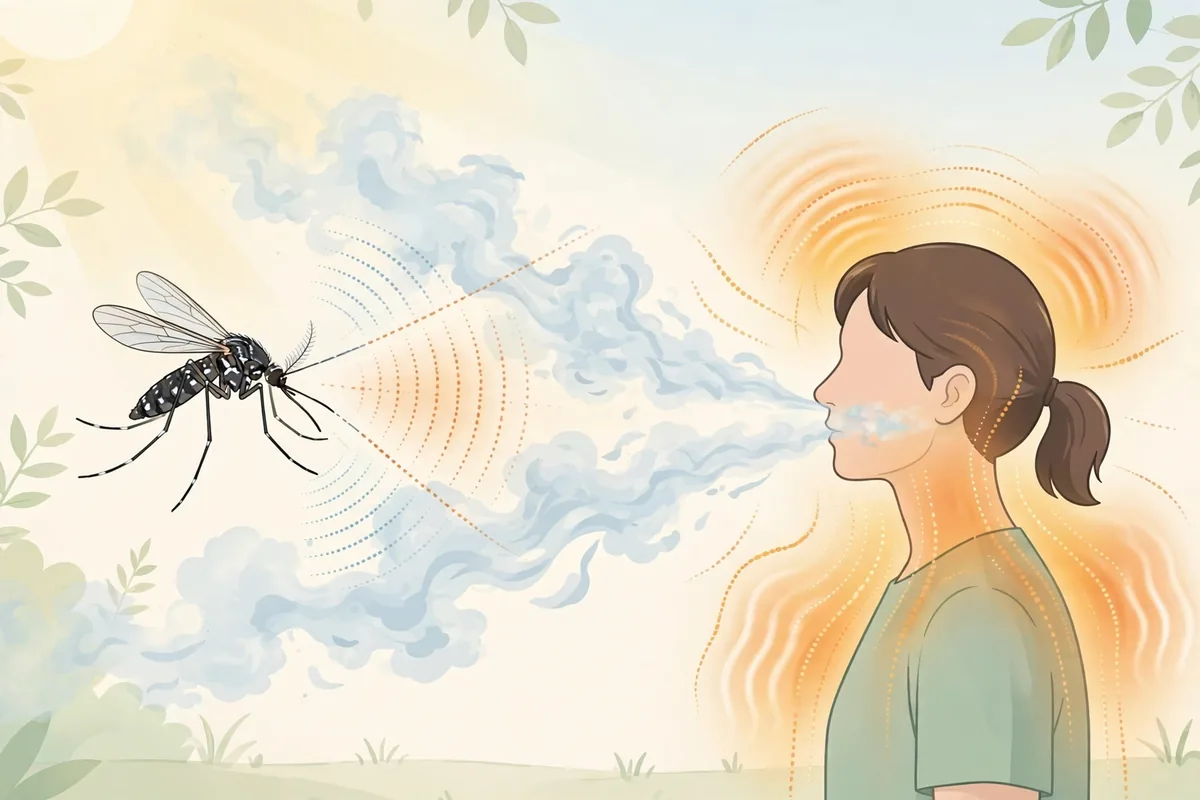
Mosquitoes hunt by an entirely different sensory suite. A female mosquito seeking a blood meal tracks carbon dioxide plumes exhaled by breathing animals, follows body heat and moisture gradients, and homes in on skin odors like lactic acid at close range. These are powerful, redundant guidance systems refined over millions of years of evolution. A bar of scented soap sitting on a picnic table does not stop you from exhaling carbon dioxide, does not cool your skin, and does not mask the lactic acid on it. The mosquito’s guidance systems keep working because the soap interferes with none of them.
This is the general principle behind most failed folk repellents: they target human senses rather than mosquito senses. The soap smells strong to us, so we assume it must overwhelm the mosquito. But the mosquito is not smelling the evening the way we are. It is following a carbon dioxide trail to a warm body, and no amount of fresh scent changes that physics.
How Mosquitoes Actually Find You

Understanding the mosquito’s host-seeking sequence shows exactly where a soap-based defense would need to intervene, and why it cannot.
The Long-Range Signal: Carbon Dioxide
From dozens of feet away, mosquitoes detect the carbon dioxide in exhaled breath. Your breath contains roughly 100 times more CO2 than ambient air, creating a plume the mosquito can follow upwind. This is the dominant long-range attractant, and it is why mosquito traps use CO2 generators and why groups of people attract more mosquitoes than individuals. No soap, candle, or ambient scent has any effect on the CO2 you exhale.
The Mid-Range Cues: Heat, Moisture, and Movement
As the mosquito closes in, it switches to heat and humidity gradients radiating from skin, plus visual tracking of movement and dark silhouettes. This is why mosquitoes find exposed ankles and why they are worse on still, humid evenings. Again, a scented bar of soap on the table changes nothing about your thermal signature.
The Close-Range Lock: Skin Chemistry
In the final approach, mosquitoes follow skin odors, particularly lactic acid, ammonia, and the unique microbial bouquet of your skin. This is the only stage where scent chemistry matters, and it is where real repellents operate. EPA-registered repellents like DEET, picaridin, and oil of lemon eucalyptus work by scrambling the mosquito’s odor receptors at close range, making it unable to complete the landing sequence. They are applied to the skin at calibrated concentrations and tested in controlled trials. A soap fragrance, designed to smell pleasant to humans at trace levels, does none of this.
Real repellency is therefore a precise, close-range, receptor-level effect, not a general “strong smell keeps bugs away” phenomenon. The myth fails because it misunderstands what repellency is.
The Ingredient Audit
What is actually in the bar? Irish Spring’s fragrance is a proprietary blend designed for a fresh, clean scent that appeals to human noses. The manufacturer does not publish a repellent-relevant ingredient list because there is not one: the product contains no EPA-registered repellent active ingredient, at no calibrated concentration, with no efficacy testing behind it.
Compare that with what a real repellent label carries. A DEET product states its percentage (commonly 20 to 30 percent for extended protection), carries an EPA registration number, and lists tested protection times against mosquitoes and ticks. Picaridin and oil of lemon eucalyptus products do the same. These are not marketing claims; they are regulated statements backed by standardized testing protocols. The Irish Spring wrapper makes no such statements because it cannot.
Some defenders of the myth point to specific fragrance notes and argue they must bother mosquitoes. This gets the toxicology backwards. Whether a scent annoys a human nose says nothing about whether it disrupts mosquito host-seeking at the concentrations present. Many genuinely unpleasant smells have no repellent effect, and some pleasant ones do. The only way to know is controlled testing, which has never been done for this product, by anyone, with any result.
One more wrinkle worth noting: some researchers have found that certain scented soaps can actually increase mosquito attraction for some people, likely by altering skin chemistry in ways mosquitoes notice. The evidence here is preliminary and soap-specific, not something to overstate, but it underscores the point: “strong scent” is not a synonym for “repellent,” and assuming otherwise can lead you exactly wrong.
Folk Repellents vs Tested Repellents

Irish Spring sits in a large family of folk mosquito defenses. Lining them up against tested options shows the pattern clearly.
| Method | Mechanism claimed | Evidence | Protection time | Verdict |
|---|---|---|---|---|
| Irish Spring soap | Strong scent overwhelms mosquitoes | None; maker confirms never tested | None demonstrated | Myth |
| Citronella candles | Scented smoke zone | Weak; tiny radius, wind defeats it | Minutes, highly variable | Marginal at best |
| Dryer sheets | Fragrance repels | No mosquito efficacy shown | None demonstrated | Myth |
| Bug-repellent wristbands | Scent halo around wearer | Poor; protects only the wrist area | Minimal | Ineffective |
| DEET (20-30%) | Scrambles mosquito odor receptors | Extensive EPA-reviewed testing | Up to 6 hours | Gold standard |
| Picaridin (20%) | Receptor disruption, low odor | Extensive EPA-reviewed testing | 8-12 hours | Excellent alternative |
| Oil of lemon eucalyptus | Plant-derived receptor effect | EPA-registered, tested | Up to 6 hours | Best botanical option |
| Protective clothing + screens | Physical barrier | Obvious and complete where applied | As long as worn | Essential complement |
The pattern is unmistakable. Everything in the top half relies on ambient scent doing a job that requires close-range receptor chemistry. Everything in the bottom half either delivers a tested active ingredient to the skin or physically blocks access. If you want to compare notes on another popular myth in this family, our article on whether mosquito repellent stickers work for kids covers a similar scent-based claim with the same evidence problem.
What Actually Keeps Mosquitoes Away
Effective mosquito defense is layered, and none of the layers involve bar soap.
Apply an EPA-registered repellent to exposed skin: DEET, picaridin, or oil of lemon eucalyptus, following the label. For children and during pregnancy, product choice matters, so check our guide to insect repellent safety for children and pregnancy before you buy. Treat clothing and gear with permethrin for outings in heavy mosquito areas; it bonds to fabric through several washes and kills mosquitoes on contact.
Manage the environment. Dump standing water weekly, since mosquitoes breed in anything from bottle caps to clogged gutters. Keep window and door screens intact. For yards, fans are surprisingly effective: mosquitoes are weak fliers, and a strong breeze disrupts their host-seeking flight. Time outdoor activities away from dusk and dawn peaks when possible, and wear long sleeves and pants in mosquito-heavy areas.
What you should not do is rely on any single scented product, whether it is soap, candles, wristbands, or essential oil diffusers, as your protection in an area with real mosquito pressure. Mosquitoes transmit West Nile virus, dengue, Zika, and other diseases in parts of the United States, so the stakes of ineffective protection are not just itchy ankles. Use methods with measured protection times, and treat folk remedies as what they are: interesting stories, not defenses.
When to See a Doctor for a Mosquito Bite
Most mosquito bites are harmless, but some situations need medical attention.
Call 911 or seek emergency care for signs of severe allergic reaction: difficulty breathing, swelling of the face, lips, or throat, dizziness, or fainting. Also seek emergency care for signs of serious mosquito-borne illness: high fever with severe headache, neck stiffness, confusion, or muscle weakness, which can indicate West Nile neuroinvasive disease.
See a doctor promptly for infection signs: a bite that becomes increasingly red, warm, swollen, or painful after the first couple of days, red streaks, pus, or fever. Large local reactions, sometimes called skeeter syndrome, with swelling spanning several inches, also deserve medical evaluation, especially in children.
See a doctor if you develop fever, rash, joint pain, or headache within weeks of mosquito bites, particularly after travel to areas with dengue, Zika, or chikungunya transmission. Our mosquito bite warning signs guide covers the full list of red flags in detail.
Frequently Asked Questions
Does Irish Spring soap repel mosquitoes?
No. There is no scientific evidence for the claim, and Colgate-Palmolive has confirmed the product was never tested for insect-repelling properties. The myth grew out of the soap’s folk use as a deer deterrent in gardens, which does not transfer to insects that hunt by carbon dioxide and body heat.
Why do so many people swear it works?
Confirmation bias does most of the work. Mosquito activity varies enormously with time of evening, wind, clothing, and location, so anyone trying the soap will experience bite-free stretches that feel like proof. Without a controlled comparison, usually against an evening without the soap under the same conditions, anecdotes cannot distinguish the soap’s effect from normal variation.
Will hanging soap around the yard at least help a little?
There is no evidence of even partial effectiveness against mosquitoes. Mosquitoes navigate to you by your exhaled carbon dioxide, body heat, and skin odors, none of which a scented bar of soap disrupts. Yard-level protection comes from removing standing water, using fans, and applying repellent to skin.
Did the 2022 scent reformulation change anything?
Only the fragrance, according to the manufacturer. Since neither the old nor the new formula was ever tested as a repellent, debates about which version “works better” against mosquitoes are debates about an unmeasured property of both. The reformulation changed how the soap smells to humans, nothing more.
What should I use instead for a camping trip?
Pack an EPA-registered repellent with DEET, picaridin, or oil of lemon eucalyptus, treat outer clothing with permethrin, bring a head net for heavy areas, and sleep under intact tent mesh. These are tested, measured defenses. Leave the soap for washing.
Medically reviewed by Dr. Sarah Jones, MD.
This article is for informational purposes only and isn’t medical advice. If you’re worried about a bite or sting, talk to a healthcare professional.