
You found a tick and the big question hits immediately: how long was the tick attached? The answer matters because disease risk climbs with feeding time — pathogens do not transfer the instant a tick bites. Here is how to read the clues on the tick itself, estimate the attachment window, and use that estimate when you talk to your doctor.
Reading the Engorgement Clues #
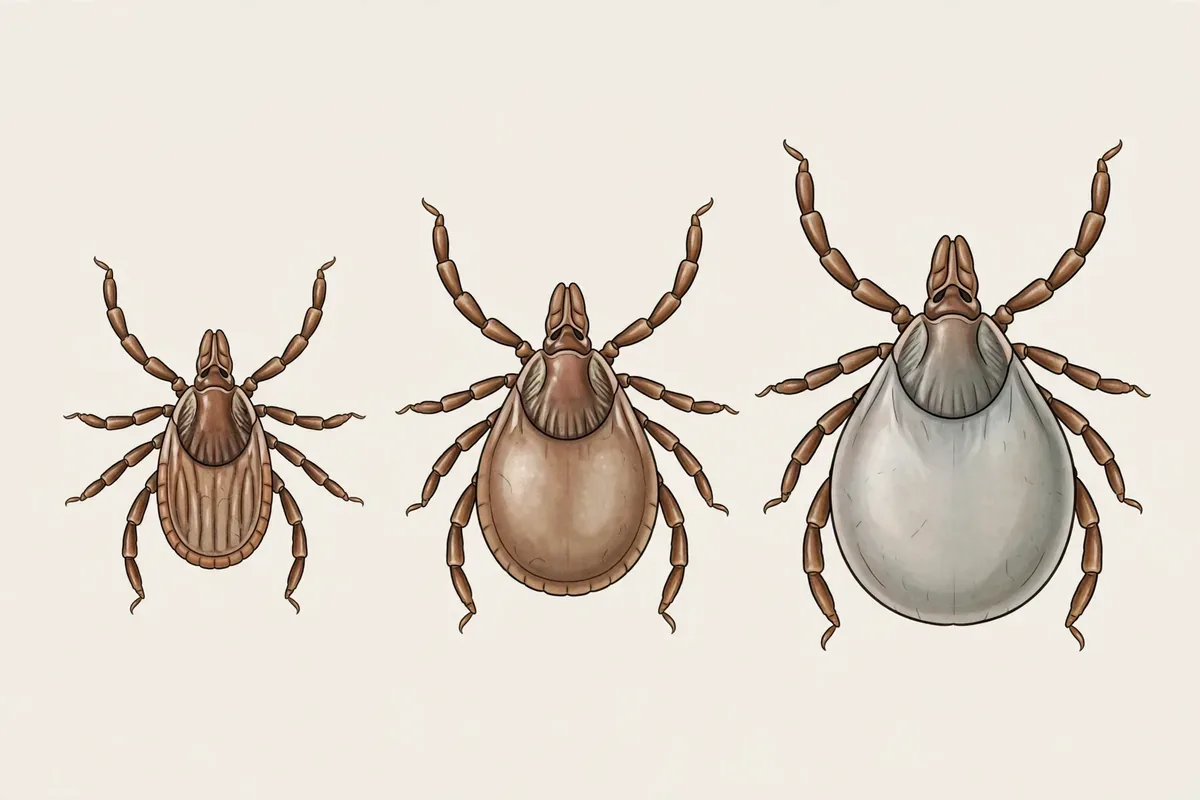
A feeding hard tick is essentially a slow balloon. As it drinks blood over days, its body changes in predictable ways. Compare what you see to these stages.
Stage 1 — Flat and unfed (likely under 24 hours):
- Body looks normal. The tick’s outline, color, and markings match reference photos of an unfed tick — flat, oval, legs clearly visible.
- Abdomen not stretched. The rear of the body is not swollen or rounded beyond its natural shape.
- What it suggests: attachment was probably recent, possibly within the last day. This is the lowest-risk window for most tick-borne infections.
Stage 2 — Partially engorged (roughly 1-3 days):
- Rear half swelling. The abdomen starts to round out and lift; the tick looks plump rather than flat.
- Color shifting. The body may darken or take on a reddish-gray tone as blood fills it.
- Legs less visible. Swelling starts to tuck the legs underneath the body silhouette.
Stage 3 — Fully engorged (roughly 3 days or more):
- Gray-blue balloon. The body becomes a smooth, gray, blue-gray, or olive-gray sac, often many times its original size — like a small bean or grape.
- Markings obscured. The scutum (hard plate behind the head) keeps its color, but the rest of the pattern stretches beyond recognition.
- Mouthparts deeply set. The tick resists removal more firmly because it has been cemented in place for days.
One caution: engorgement estimates are rough, not precise. Tick species, life stage (nymph vs. adult), and the host all affect feeding speed. Use these stages to place the tick in a broad window — under a day, a few days, or many days — rather than trying to pin down an exact hour count.
The Attachment Timeline #
Why does the clock matter? Understanding the general biology helps you interpret your estimate without panicking.
How feeding progresses:
- First contact to attachment. A tick may wander on skin or clothing for minutes to hours before settling. Wandering time does not count as feeding — only the period with mouthparts in the skin matters.
- The cement phase. Once settled, the tick secretes a cement-like substance to anchor itself. This happens in the first hours of feeding.
- Slow feeding phase. For the first 24-36 hours or so, the tick takes in relatively little blood. This is the window when transmission risk for infections like Lyme disease is lowest — public health guidance notes that Lyme bacteria generally require the tick to be attached for around 36 to 48 hours before transmission becomes likely.
- Rapid engorgement phase. After a couple of days, feeding accelerates dramatically, and the body balloons. Longer attachment generally means higher transmission probability for most tick-borne pathogens.
The honest bottom line: a flat tick found within hours of a hike is a much lower-risk situation than a fully engorged tick discovered after a weekend. Neither situation guarantees infection or rules it out — the estimate simply helps your doctor judge whether preventive steps make sense.
Documenting What You Find #
Your estimate becomes far more useful when it is recorded instead of remembered. Ticks get thrown away, memories blur, and doctors ask questions weeks later.
Do this when you find a tick:
- Photograph it. Take a clear close-up before removal if possible, with a coin or ruler for scale. Engorgement is much easier to judge in a photo than from memory.
- Note the date and time. Record when you found the tick and, if you know it, your last tick-free check (after yesterday’s hike, this morning’s shower).
- Note the location on your body. Write down exactly where it was attached — some infections have location-linked patterns your doctor may care about.
- Save the tick. Tape it to an index card or seal it in a bag with the date written on it. A saved tick lets a professional confirm the species and, if needed, test it. Our guide on whether to save a tick after a bite walks through storage and when testing helps.
Common estimation mistakes to avoid:
- Confusing species size with engorgement. A dog tick looks bigger than a deer tick even when unfed. Judge swelling relative to that species’ normal unfed size, not in absolute terms.
- Forgetting nymphs. A nymph that has fed for two days can still look “small” compared to an adult — but its relative engorgement is what counts.
- Counting wandering time. A tick found crawling on clothing was never attached. Only count time with the tick actually embedded.
What to Do Once You Have an Estimate #
Remove the tick correctly. However long it has been there, proper removal is the same: fine-tipped tweezers, grasp as close to the skin as possible, pull straight up with steady, even pressure. Full technique is in how to remove an attached tick safely. Do not burn it, smother it with petroleum jelly, or twist — folk methods can make the tick regurgitate into the bite.
Match your estimate to your next step:
- Under 24 hours, flat tick: clean the bite, save the tick, and monitor the site and your health over the coming weeks. Most doctors consider this a low-risk situation, but watchful waiting is still the right move.
- 24-48 hours, partially engorged: call your doctor or urgent care for advice. Depending on the species, your location, and local Lyme risk, a single preventive antibiotic dose may be discussed for deer tick bites in high-risk areas.
- Several days, fully engorged: contact your doctor promptly. Longer attachment warrants a more careful conversation about species-specific risks and what symptoms to watch for.
Watch for symptoms regardless of the estimate. Over the next few weeks, note any fever, headache, unusual fatigue, muscle aches, or rash — particularly an expanding circular rash. A short symptom diary with dates beats trying to recall details at an appointment.
Warning signs: when to seek care #
Call 911 immediately if you develop trouble breathing or swallowing, swelling of the face, lips, tongue, or throat, widespread hives, dizziness or fainting, or a racing heartbeat. Severe allergic reactions to tick bites are uncommon but always an emergency — use an epinephrine auto-injector first if you have one.
Seek prompt medical care if a fever, severe headache, neck stiffness, or rash develops in the days or weeks after a tick bite, or if the bite site shows red streaks, increasing pain, warmth, swelling, or pus. A tick bite that produces an expanding bull’s-eye or circular rash deserves same-day medical evaluation. If you removed a fully engorged tick, call your doctor even before symptoms appear — the attachment length alone justifies a conversation about preventive options.
Frequently asked questions #

Can a tick transmit disease in under 24 hours? #
For Lyme disease, transmission in under 24-36 hours is considered unlikely, and public health guidance generally cites around 36-48 hours of attachment before the risk becomes meaningful. However, other pathogens have different timelines — some can transmit faster — so “short attachment” means lower risk, not zero risk. Always clean the bite, save the tick, and monitor for symptoms.
Does an engorged tick mean I will get sick? #
No. Engorgement tells you the tick fed for a long time, which raises the probability of transmission — but most ticks are not carrying pathogens, and even infected ticks do not always transmit. Think of engorgement as raising the stakes of the conversation with your doctor, not as a diagnosis.
What if I found the tick already detached in my bed? #
You cannot estimate attachment time from a detached tick reliably, and you cannot be sure it fed on you at all. Save it in a sealed bag, check your body and your pets thoroughly for bite sites, and mention the finding to your doctor if any symptoms develop. Do a full tick check of bedding and, if you find more, consider having your home evaluated.
How accurate is the “gray bean” engorgement test? #
It is a useful rough gauge, not a measurement. A gray, balloon-like tick has clearly been feeding for multiple days; a flat tick with crisp markings has not. Everything between is a judgment call. Photograph the tick, save it, and let your doctor factor the estimate into the overall risk picture along with species and geography.
Medical and editorial note #
This guide offers general information about estimating tick attachment time and is not medical advice. Engorgement estimates are approximate and never replace professional judgment — if a tick was attached to you, talk to your doctor about species-specific risks, local disease prevalence, and whether preventive treatment is appropriate for your situation.


