
You pulled a tick off and the first thought is always the same: was it on me long enough to matter? How long does a tick need to be attached to transmit Lyme disease? The CDC’s position: infected blacklegged ticks generally need to be attached for more than 24 hours to transmit the bacteria, with many medical sources describing 36 to 48 hours or more as the higher-risk window. But treating that number like a stopwatch is a mistake. Here’s what the timing actually means — and what to do about it.
Why timing matters: how Lyme transmission works #
Lyme disease is caused by bacteria (mainly Borrelia burgdorferi in the US) that live in the tick’s gut. When a tick starts feeding, those bacteria don’t teleport into you — they need time to travel from the gut to the salivary glands and then into your skin. That migration is why attachment time matters so much. A tick you flick off after a few minutes or even a few hours of feeding is a fundamentally different exposure than one that’s been attached and swelling for two days.
A few essentials frame everything else:
- Only certain ticks carry Lyme. In the US, it’s blacklegged ticks (deer ticks) in the Northeast, mid-Atlantic, and upper Midwest, and western blacklegged ticks along the Pacific Coast. Dog ticks and lone star ticks don’t transmit Lyme — though they carry other diseases.
- Not every blacklegged tick is infected. Infection rates range from near zero to over 50% depending on region and tick life stage. In much of the Southeast, blacklegged ticks are rarely infected at all.
- Transmission isn’t instant, but it isn’t one fixed number either. The 24-hour figure is a general threshold from public-health guidance; laboratory studies suggest risk rises substantially after 36 to 48 hours of feeding. Either way, the message is identical: remove ticks promptly and you cut your risk dramatically.
Reading your tick: engorgement clues #
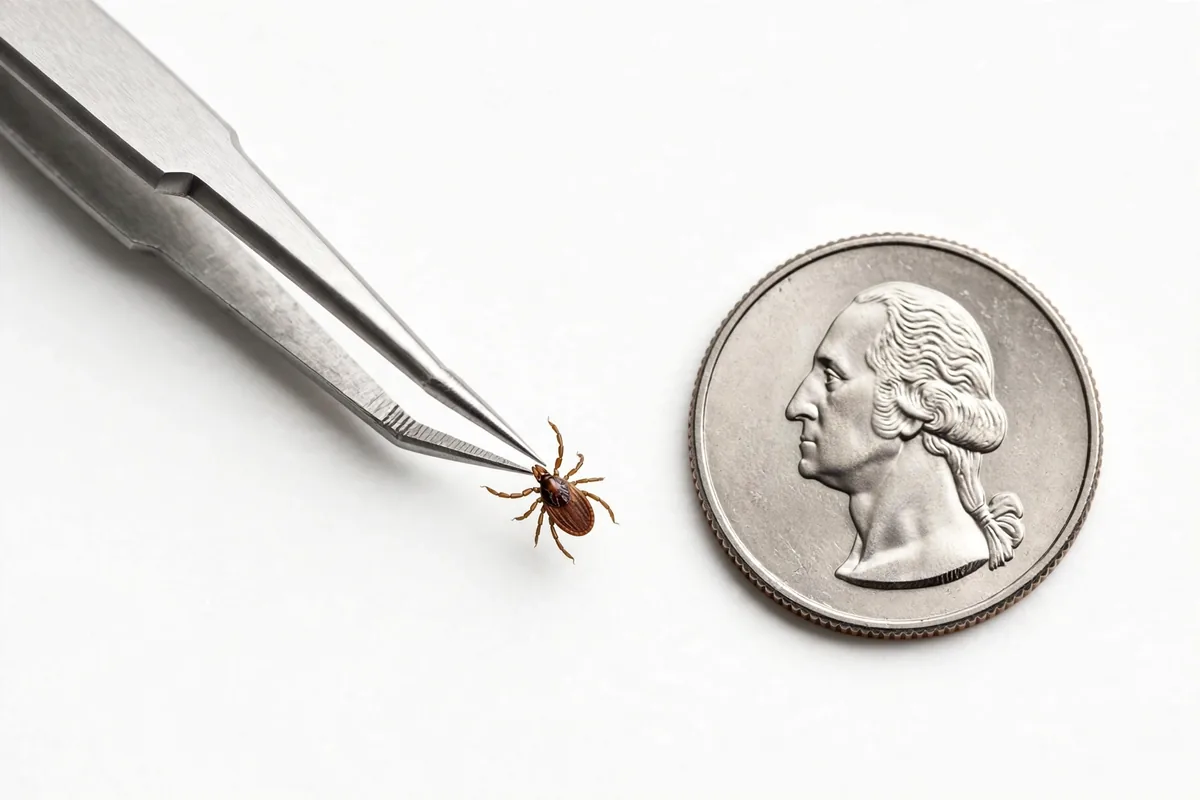
You can’t ask a tick how long it’s been there, but its body tells you something. Ticks feed slowly at first, then swell dramatically:
- Flat and small: likely attached for less than 24 hours. An adult female blacklegged tick is about the size of a sesame seed; a nymph is the size of a poppy seed — tiny, and the stage responsible for most infections because it’s so easy to miss.
- Partially engorged: roughly a day or more of feeding. The body looks rounder and slightly swollen.
- Fully engorged: two days or longer, often much longer. The body is bloated, grayish, and can be several times its unfed size — like a small bean.
Engorgement is a rough gauge, not a precise clock. Body weight, feeding site, and tick stage all affect swelling speed. But a flat, unfed tick is reassuring relative to a fully bloated one, and it’s worth noting what you see before you dispose of it.
Also note where you found it and when you might have picked it up. “Found it Friday evening after Saturday’s hike” is much more useful to a doctor than “sometime this week.” For a full picture of what to watch for in the days after, tick bite aftercare over the next few weeks lays out the monitoring routine.
Your tick timeline checklist #
The first minutes #
Remove the tick correctly: fine-tipped tweezers, grasp as close to the skin as possible, pull straight up with steady pressure. No twisting, no squeezing the body, no nail polish, petroleum jelly, or lit matches — stressing an attached tick can increase infection risk. Clean the bite with rubbing alcohol or soap and water. If you want to know the right technique in detail, how to remove an attached tick safely has the step-by-step.
The first 24 hours #
Note the date, time, body location, and the tick’s appearance (size, color, how engorged it looked). Save the tick if you like — a sealed bag or container with rubbing alcohol keeps it identifiable. Take a photo of the bite site for comparison later. A small red bump right away is common local irritation, not evidence of Lyme.
Days 2-14 #
Watch the bite site and your general health. The earliest Lyme symptom, the erythema migrans rash, typically appears 3 to 30 days after the bite and expands gradually — it’s usually not itchy or painful, and it doesn’t always look like a textbook bull’s-eye. Flu-like symptoms (fever, chills, fatigue, headache, muscle and joint aches, swollen lymph nodes) can appear with or without a rash.
Days 14-30 #
Keep watching. If a rash or fever develops at any point within about 30 days, call your doctor and mention the tick bite explicitly. Testing immediately after an otherwise symptom-free bite isn’t generally recommended — antibodies take weeks to develop, so early tests can falsely reassure. Your clinician decides if and when testing or preventive treatment is appropriate.
Why you shouldn’t rely on a stopwatch #

Three reasons the 24-hour number is a guide, not a guarantee:
- Attachment time is usually a guess. Ticks are painless to attach, and nymphs are nearly invisible. Most people can’t pinpoint when a tick latched on — if you discovered it already engorged, it was there a while, but “a while” could be 36 hours or four days.
- Other diseases move faster. Lyme isn’t the only tickborne illness. Ehrlichiosis and Rocky Mountain spotted fever, carried by other tick species, can transmit on shorter timelines. A “quick” bite doesn’t mean a safe bite across the board.
- The tick might not be the only one. People who find one tick after yard work or a hike often had others. Do a full-body check — behind ears, scalp, armpits, waistline, groin, backs of knees — and check pets and gear too.
The practical rule is simple: don’t try to calculate your way to safety. Remove every tick promptly, document the exposure, and watch for symptoms for a month.
Warning signs: when to seek care #
Call 911 immediately if you have trouble breathing or swallowing, swelling of the face, lips, tongue, or throat, widespread hives, dizziness or fainting, or a racing heartbeat — these signal a severe allergic reaction, which can follow any insect or tick bite. If you carry an epinephrine auto-injector, use it as prescribed and still call 911.
Call your doctor promptly — don’t wait for a scheduled visit — if: a rash develops around the bite or elsewhere (especially an expanding, non-itchy rash), you develop fever, chills, or flu-like symptoms within 30 days of the bite, the bite site becomes increasingly painful with spreading redness or warmth (possible infection), you notice new joint pain, facial droop, or heart palpitations weeks later (possible disseminated Lyme signs), or you’re unsure the whole tick came out. Mention the tick bite, the date found, and how engorged it looked.
Frequently asked questions #

If the tick was on me for less than 24 hours, am I safe? #
Much lower risk, not zero risk. Public-health guidance treats prompt removal as strongly protective, but attachment time is often uncertain, and other tickborne diseases can transmit faster than Lyme. Treat it as a low-risk exposure worth monitoring for 30 days, not a guaranteed non-event.
Does the type of tick change the timing? #
Yes. The Lyme timing guidance applies to infected blacklegged ticks. Dog ticks and lone star ticks don’t transmit Lyme at all, but they transmit other diseases with their own timelines. Identifying the tick species — or at least photographing it — helps your doctor assess your actual risk.
What if I don’t know when it attached? #
Assume the worst reasonable case and watch for 30 days. “Found it engorged Friday evening, last hiked Wednesday” is a multi-day attachment — mention that to your doctor. Uncertainty is the norm with tick bites, not a failure on your part.
Should I ask my doctor for preventive antibiotics? #
That’s a medical decision based on the tick species, how long it was attached, how quickly you can be seen, and your region’s infection rates. Preventive treatment is sometimes offered for high-risk bites seen within 72 hours. Bring the tick (or a clear photo) and your timeline notes to the appointment.
Medical and editorial note #
This page is general information about tick attachment time and Lyme disease risk and is not medical advice. Transmission risk depends on tick species, infection status, geography, and individual factors that only a healthcare professional can assess for your situation. If you’ve been bitten by a tick and are worried, contact your doctor — and if severe symptoms develop, seek care promptly.


