Direct answer: An Asian tiger mosquito bite is a mosquito bite caused specifically by Aedes albopictus. A “mosquito bite” is the broader category. The skin reaction usually cannot tell you whether an Asian tiger mosquito or another mosquito species bit you. Identification depends more on seeing the mosquito, its markings, local species, biting time, habitat, and exposure setting.
The phrase mosquito bite vs asian tiger mosquito bite pictures sounds as if the two should look different. Usually they do not. Asian tiger mosquitoes inject saliva while taking a blood meal just like other biting mosquitoes, and the immune response to saliva can create the same kinds of itchy red bumps, swelling, blisters, or darker spots described by CDC for mosquito bites generally.
The useful comparison is therefore not “two different bite shapes.” It is a comparison between a general mosquito exposure and one specific mosquito species. This guide explains what can actually distinguish Aedes albopictus, what cannot be inferred from a skin photo, how treatment compares, and when symptoms need medical attention.
[stinghelp_image filename=”mosquito-bite-vs-asian-tiger-mosquito-bite-01.webp” alt=”Educational comparison showing a generic mosquito and an Asian tiger mosquito beside similar nonspecific itchy bite reactions” caption=”The bite marks can look the same. The mosquito itself and exposure context are more useful for identifying Asian tiger mosquito exposure.”]
Mosquito Bite vs Asian Tiger Mosquito Bite: Quick Comparison
| Feature | Generic mosquito bite | Asian tiger mosquito bite |
|---|---|---|
| Meaning | A bite from any human-biting mosquito species | A bite specifically from Aedes albopictus |
| Skin appearance | Often an itchy red or skin-colored bump; reactions vary | Usually falls within the same range of nonspecific mosquito-bite reactions |
| Can the bite identify the species? | No | No; species identification requires evidence beyond the skin mark |
| Helpful identification clue | Exposure to mosquitoes in the area | Black mosquito with white-banded legs and characteristic pale markings, including a single pale stripe on the thorax |
| Typical activity clue | Depends on species; mosquitoes may bite day or night | Often active during daylight, but biting can occur outside a narrow time window |
| Immediate treatment | Wash, cool, control itch, avoid scratching | The same basic treatment for an uncomplicated bite |
What Counts as a “Mosquito Bite”?
A mosquito bite occurs when a female mosquito pierces the skin to take a blood meal. While feeding, the mosquito introduces saliva into the skin. The immune system reacts to proteins and other components in that saliva, producing itching and swelling.
CDC describes several possible mosquito-bite appearances: a puffy reddish bump that appears within minutes, a harder itchy reddish-brown bump that appears later, small blisters, or darker bruise-like spots. Some people have only mild reactions while others develop a much larger area of swelling, soreness, and redness.
None of those findings is exclusive to one mosquito species. That is why a small bump cannot reliably answer whether the culprit was an Asian tiger mosquito, a Culex mosquito, Aedes aegypti, or another mosquito.
What Is an Asian Tiger Mosquito?
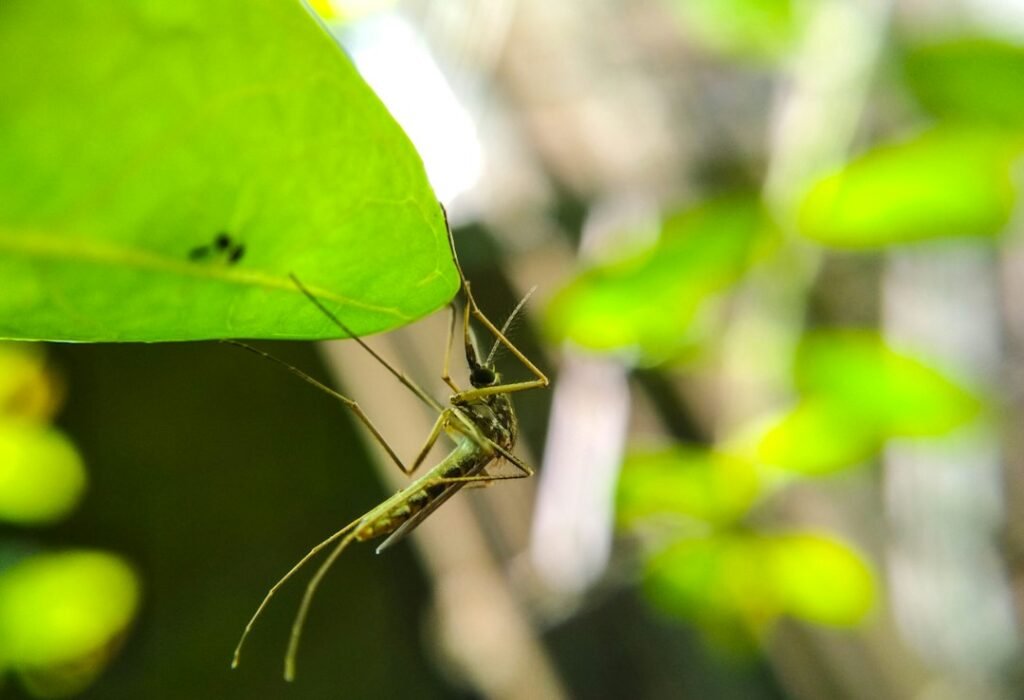
The Asian tiger mosquito is Aedes albopictus, a species recognized for strong black-and-white contrast. CDC describes it as black with white bands on the legs and white spots on the body. A prominent pale line along the upper body is one of its best-known visual features.
Aedes albopictus is established in many areas of the United States and in other parts of the world, including portions of Europe. CDC range maps show potential geographic distribution, but a range map does not mean every local mosquito is an Asian tiger mosquito and does not represent disease-transmission risk by itself.
Asian tiger mosquitoes commonly use small water-holding containers for breeding. CDC explains that Aedes females lay eggs on container walls near the waterline. Buckets, tires, planters, toys, cups, fountains, rain barrels, and other objects that hold a small amount of water can support development.
[stinghelp_image filename=”mosquito-bite-vs-asian-tiger-mosquito-bite-02.webp” alt=”Macro educational illustration of Asian tiger mosquito Aedes albopictus showing black body white leg bands and pale thorax stripe” caption=”Identifying the mosquito itself is much more informative than trying to identify Aedes albopictus from the skin reaction.”]
Mosquito Bite vs Asian Tiger Mosquito Bite Symptoms
The symptoms overlap because an Asian tiger mosquito bite is still a mosquito bite. Typical reactions include itching, a raised bump, redness or other color change, and local swelling. Some people may develop larger local reactions regardless of the exact mosquito species.
Symptoms that can occur after many mosquito bites
- Itchy raised bump or wheal.
- Localized swelling.
- Redness or darker discoloration.
- Several bites in exposed areas.
- Small blister in some people.
- Temporary soreness or tenderness.
A dramatic local reaction does not prove Asian tiger mosquito exposure. It may reflect the person’s immune response rather than a species-specific bite pattern. Likewise, a mild bite does not rule out Aedes albopictus.
How to Tell the Difference if the Bite Mark Is Not Enough
Use a hierarchy of evidence rather than image matching. The best evidence is the actual mosquito. A clear close-up photograph can sometimes show the characteristic black-and-white pattern of an Asian tiger mosquito. Geography and habitat are next: if Aedes albopictus is established in the area and the exposure occurred around container-heavy vegetation or yards, the species becomes more plausible.
Biting time is a supporting clue. Asian tiger mosquitoes are well known for daytime activity. However, CDC advises protecting against mosquitoes during day and night because different species overlap and activity can vary. A daytime bite therefore increases plausibility but is not proof.
Finally, avoid using the reaction itself as a taxonomic test. The phrase mosquito bite vs asian tiger mosquito bite how to tell the difference is best answered by identifying the mosquito, not by comparing bumps.
Pictures: Why Online Image Matching Can Mislead You
Skin photographs are influenced by time since the bite, skin tone, scratching, previous mosquito exposure, allergy tendency, body location, number of bites, and lighting. Two people bitten by the same mosquito species may have very different reactions, while bites from different mosquito species may look nearly identical.
If you are monitoring a reaction, take a dated photo in good light and use a ruler or another consistent reference for size. This is useful for tracking swelling and redness. It does not prove which mosquito species caused the bite.
If a mosquito is still nearby and can be photographed safely, focus on the insect’s legs, thorax, body markings, and overall shape. Do not delay care for serious symptoms just to get an identification photo.
Mosquito Bite vs Asian Tiger Mosquito Bite Treatment Differences
For an uncomplicated reaction, there is usually no meaningful mosquito bite vs asian tiger mosquito bite treatment differences. Basic care is based on symptoms rather than mosquito species. Wash the area with soap and water. Use a cold pack wrapped in cloth for short periods to reduce swelling and itching. Avoid scratching because broken skin can become infected.
CDC notes that an over-the-counter antihistamine or anti-itch cream may help some people. Use medicines according to the label. For children, pregnancy, significant chronic medical conditions, or possible medication interactions, ask a pharmacist or healthcare professional when uncertain.
Do not cut the bite, squeeze it, burn it, or apply harsh chemicals. Those methods do not remove mosquito saliva and can injure the skin.
What If the Reaction Is Much Larger Than a Normal Bump?
Some people develop a large local inflammatory reaction after a mosquito bite, sometimes called Skeeter syndrome. The swelling can extend far beyond the original bite and may be warm, red, itchy, firm, or painful. The size of the reaction reflects the immune response and does not identify the mosquito species.
If swelling is extensive, painful, recurrent, or interferes with normal movement or daily activity, seek medical advice. The StingHelp guide on Asian tiger mosquito bite vs Skeeter syndrome explains how a routine bite differs from a large local reaction.
How to Recognize an Infected Mosquito Bite
Scratching can damage the skin barrier and allow bacteria to enter. CDC says an infected bite may become red, warm, or develop a red streak extending outward. Increasing pain, pus, drainage, worsening swelling, or fever are additional reasons to seek medical assessment.
An infected-looking lesion does not identify the original mosquito species. Treat infection as a medical issue in its own right. Avoid squeezing or attempting to drain the area at home.
Useful distinction: A large itchy reaction soon after a mosquito bite may be inflammatory, while increasing tenderness, drainage, red streaking, and progressive worsening raise more concern for infection. When uncertain, a clinician can assess the pattern.
Does an Asian Tiger Mosquito Bite Mean You Will Get Dengue, Zika, or Chikungunya?
No. Asian tiger mosquitoes can serve as vectors for several viruses in appropriate settings, but not every mosquito is infected and most bites do not transmit disease. CDC notes that Aedes albopictus can spread dengue, Zika, and chikungunya viruses, while Aedes aegypti is generally a more important vector for some of these infections because it feeds more strongly on people.
The local bump does not reveal whether a virus was transmitted. Disease risk depends on pathogen circulation, geography, travel, mosquito infection, season, and exposure. A bite that looks ordinary can occur without disease, and a large bite reaction is not proof of viral infection.
If fever, severe headache, rash, significant joint pain, unusual weakness, bleeding symptoms, or another systemic illness develops after mosquito exposure—especially after travel—contact a healthcare professional and describe the location and dates of exposure.
When to Get Medical Help
| Finding | Recommended action |
|---|---|
| Small itchy bump that is stable or improving | Use routine mosquito-bite care and monitor |
| Very large local swelling or pain | Consider healthcare advice, especially if severe or limiting activity |
| Increasing warmth, tenderness, pus, drainage, or red streaking | Seek evaluation for possible infection |
| Fever or significant systemic illness after travel or mosquito exposure | Contact a clinician and provide travel/exposure details |
| Confusion, seizure, severe weakness, or other serious neurologic symptoms | Seek urgent or emergency care |
| Trouble breathing, throat/tongue swelling, fainting | Seek emergency care immediately |
[stinghelp_image filename=”mosquito-bite-vs-asian-tiger-mosquito-bite-03.webp” alt=”Medical decision chart for ordinary mosquito bite, large local reaction, infection signs, and emergency symptoms” caption=”Treatment decisions should be based on symptoms and severity, not on trying to identify the mosquito species from the bite mark.”]
How to Prevent Asian Tiger Mosquito Bites
CDC recommends EPA-registered insect repellents and protective clothing. Use repellents exactly as directed. Wear loose-fitting long sleeves and pants where practical. Permethrin-treated clothing and gear can add protection, but permethrin products intended for fabric should not be applied directly to skin.
Asian tiger mosquito control around homes depends heavily on removing small water sources. Once each week, empty and scrub, turn over, cover, or discard water-holding items such as buckets, planters, toys, tires, birdbaths, flowerpot saucers, and trash containers. Keep water-storage containers tightly covered and repair window and door screens.
For a broader prevention plan, use the Prevention, Repellents & Personal Protection section and the Mosquito Bites hub.
Information-Gain Checklist: Which Clues Are Worth the Most?
- High value: a clear photograph or specimen of the mosquito.
- High value: local mosquito surveillance and confirmed species range.
- Moderate value: daytime activity and container-heavy habitat.
- Moderate value: repeated encounters with black-and-white mosquitoes around the property.
- Low value: the shape, color, or size of a single ordinary bite bump.
- Very low value: matching your skin photo to an unlabeled internet image.
Related StingHelp Guides
If you are unsure whether the mark came from a mosquito at all, start with the What Bit Me? Identification & Comparisons hub. For home treatment questions, use First Aid & Treatment. If redness is spreading, the skin is draining, fever is worsening, or systemic symptoms appear, use the Safety / Red Flags section and seek appropriate medical care.
Frequently Asked Questions
Do Asian tiger mosquito bites look different from ordinary mosquito bites?
Not reliably. The skin reaction overlaps with bites from other mosquito species. The mosquito itself is much more useful for identification.
Are Asian tiger mosquito bites more itchy?
Some people may perceive certain mosquito bites as more irritating, but itch intensity varies greatly by person and immune response. It is not a dependable species-identification feature.
Do Asian tiger mosquitoes bite during the day?
Yes, they are well known for daytime biting. However, mosquito activity can overlap, and CDC recommends bite protection during both day and night.
Can I tell an Asian tiger mosquito by its stripes?
The species has distinctive black-and-white markings, including white-banded legs and a pale stripe on the thorax. Similar-looking mosquitoes can cause confusion, so clear photographs and expert identification are preferable when species matters.
Can an Asian tiger mosquito bite cause a large swollen area?
Yes. A susceptible person can develop a large local reaction after a mosquito bite. The large reaction does not prove which mosquito species was responsible.
When should I worry about a mosquito bite?
Seek medical advice for worsening pain, significant swelling, pus, spreading redness, red streaking, fever, or systemic illness. Breathing difficulty, throat or tongue swelling, fainting, or severe rapidly worsening symptoms require emergency care.
Bottom Line
For mosquito bite vs asian tiger mosquito bite pictures, the key fact is that an Asian tiger mosquito bite is one type of mosquito bite, not a visually distinct skin diagnosis. Most bite marks cannot reveal the species. Identify Aedes albopictus from the mosquito, geography, behavior, and habitat when possible; treat uncomplicated bites with routine care and seek medical help for infection signs, significant systemic illness, or severe allergic symptoms.
Authoritative References
- CDC — About Mosquito Bites
- CDC — Life Cycle of Aedes Mosquitoes
- CDC — Potential Range of Aedes Mosquitoes
- CDC — Preventing Mosquito Bites
- CDC — How Dengue Spreads
Editorial review recommended before publication. This article is for general education and does not replace individualized diagnosis or treatment.