Newsletter Subscribe
Enter your email address below and subscribe to our newsletter

 ByQamar
Direct answer: Asian tiger mosquito bite and brown dog tick bite can both leave red, itchy, swollen, or tender skin, so the mark alone cannot reliably identify the cause. Compare the exposure setting, whether an arthropod was actually seen, lesion distribution, geography, and symptom progression. Use simple first aid and seek care for severe, worsening, or systemic symptoms.
If you are comparing asian tiger mosquito bite vs brown dog tick bite pictures, start with the exposure story rather than the photo. A witnessed attachment, contact with an irritating caterpillar, a cluster after environmental exposure, or a mosquito seen feeding is more informative than whether the mark is round, raised, red, or has a central dot.
Skin has a limited set of inflammatory responses. Bites, contact hairs, scratching, allergy, and secondary infection can all produce overlapping redness and swelling. This guide therefore separates identification from triage: what probably caused the mark is one question; what you should safely do next is another.
| Clue | Asian tiger mosquito bite | brown dog tick bite | How useful? |
|---|---|---|---|
| Exposure mechanism | Look for a witnessed feeding/attachment or plausible habitat exposure. | Look for the characteristic feeding, contact, or environmental exposure. | High when witnessed. |
| Skin appearance | Redness, itch, tenderness, swelling, or a papule may occur. | Redness, itch, swelling, papules, or rash may occur. | Low by itself because findings overlap. |
| Distribution | May be single or multiple depending on exposure. | May be single, clustered, or scattered depending on cause. | Moderate with exposure history. |
| Geography | Species distribution and disease risk vary by region. | Species distribution and exposure risk vary by region. | High for plausibility. |
| Systemic symptoms | Fever, headache, widespread rash, breathing difficulty, or neurologic symptoms change urgency. | Systemic or airway symptoms change urgency regardless of cause. | High for triage. |
[stinghelp_image filename=”asian-tiger-mosquito-bite-vs-brown-dog-tick-bite-01.webp” alt=”Asian tiger mosquito bite versus brown dog tick bite exposure and symptom comparison” caption=”Educational comparison of exposure clues; skin appearance alone is not diagnostic.”]
An Asian tiger mosquito (Aedes albopictus) lands, feeds briefly, and flies away. A hard tick attaches and can remain on the skin while feeding. Finding an attached tick is therefore strong evidence of tick exposure, while a mosquito is often gone before the reaction is noticed. Either exposure can still produce a small red or itchy bump.
Asian tiger mosquitoes are often associated with daytime biting and small water-holding containers around homes. CDC recommends preventing mosquito bites with EPA-registered repellents and protective clothing rather than trying to identify mosquito species from a welt. CDC mosquito prevention guidance supports this approach.
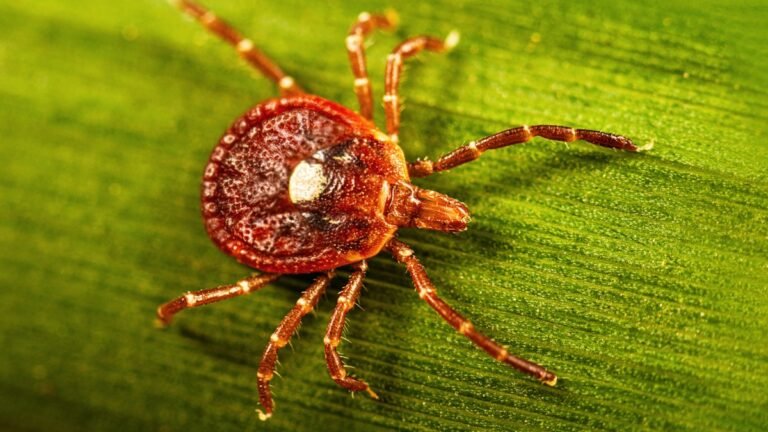
CDC describes the brown dog tick (Rhipicephalus sanguineus) as worldwide in distribution. Dogs are the primary host, but people can be bitten. In parts of the southwestern United States and along the U.S.–Mexico border, this tick can transmit Rocky Mountain spotted fever. CDC distribution guidance is more reliable than old range maps.
No. Attachment confirms tick exposure but not species. Scutum markings, mouthparts, body form, life stage, and geographic range are more useful when evaluated from the tick itself. If illness develops, clinicians still need the exposure location and symptom timeline even when exact species identification is unavailable.
Use a hierarchy of evidence. A witnessed exposure or recovered arthropod is more useful than a skin photo. Geography and habitat can make one cause much more plausible than another. Timing and distribution add context. Finally, the direction symptoms move over hours or days helps determine whether the issue is a mild local reaction, secondary infection, allergy, or a possible vector-borne illness.
Do not overinterpret a “bull’s-eye,” central punctum, blister, or red halo. Several unrelated conditions can create these features. If a clinician needs to assess a changing lesion, a sequence of dated photos plus exposure history is more useful than one close-up.
CDC guidance advises prompt tick removal rather than waiting for identification. After removal, clean the bite area and hands and monitor for illness. If a rash or fever develops after tick exposure, tell the clinician when and where the exposure occurred.
| Finding | Why it matters | Action |
|---|---|---|
| Mild local itch/swelling that is stable or improving | Often uncomplicated local inflammation. | Gentle care and monitoring may be reasonable. |
| Increasing warmth, pain, pus, red streaking, or fever | Possible secondary infection or another complication. | Seek prompt assessment. |
| Fever, severe headache, marked fatigue, new widespread rash, or illness after tick exposure | May be compatible with vector-borne illness. | Contact a clinician and report geography/timing. |
| Eye exposure, major facial swelling, or throat irritation | May threaten vision or airway depending on exposure. | Seek prompt/urgent care. |
| Trouble breathing, tongue/throat swelling, collapse, seizure, severe confusion, inability to wake | Potential emergency. | Call emergency services. |
[stinghelp_image filename=”asian-tiger-mosquito-bite-vs-brown-dog-tick-bite-02.webp” alt=”Medical decision guide after possible Asian tiger mosquito bite or brown dog tick bite exposure” caption=”Symptom-based guide for monitoring, prompt assessment, and emergency care.”]
Inflammation is not species-specific. Redness reflects increased blood flow; swelling reflects fluid and immune activity; itching can result from histamine and other inflammatory mediators. Different arthropods and contact exposures can trigger the same visible pathways, making lesion shape a weak species test.
Skin tone and photography matter too. Erythema can be subtle on darker skin, while phone cameras may exaggerate saturation or contrast. Scratching can create linear marks, crusting, or breaks that were not part of the original exposure. Topical creams can change color and texture.
Take a dated photograph in similar lighting and from a similar distance if the area is changing. Note whether itch, pain, warmth, and swelling are improving, stable, or worsening. Track whole-body symptoms separately: fever, headache, vomiting, dizziness, unusual fatigue, muscle aches, swollen lymph nodes, breathing symptoms, or rash elsewhere carries different significance from a localized itchy patch.
The overall trend matters more than a rigid day-by-day schedule. A lesion that becomes progressively hotter, more painful, larger, drains pus, develops red streaking, or is accompanied by fever deserves reassessment.
Bring the exposure date, location, travel history, activity at the time, and body site. Mention whether a tick was attached, whether an insect or caterpillar was seen, whether other people in the same environment have symptoms, and whether pets or stored plant material were involved. If the arthropod was safely photographed or saved after removal, that may help.
Provide a simple symptom timeline and any medicines already used. Pregnancy, immune suppression, severe allergy history, anticoagulant use, and major chronic disease can change treatment choices or the threshold for assessment.
For ticks and mosquitoes, use an EPA-registered repellent according to the label, wear protective clothing when practical, and perform tick checks after outdoor activity. Different regions have different species and seasonal patterns, so local public-health information is more useful than a static social-media map.
For environmental arthropods or caterpillar hairs, prevention may mean avoiding nests, contaminated vegetation, straw, hay, stored material, or infested furnishings. Do not disturb processionary caterpillar nests yourself. Professional pest or forestry services may be appropriate when the source is environmental.
[stinghelp_image filename=”asian-tiger-mosquito-bite-vs-brown-dog-tick-bite-03.webp” alt=”Prevention and red flag checklist for Asian tiger mosquito bite and brown dog tick bite” caption=”Practical prevention and red-flag checklist for bite and contact-rash exposures.”]
For an uncomplicated local reaction, the overall direction should be toward less pain, less swelling, and less interference with normal activity. Itching can persist after redness starts fading. Recovery need not be perfectly linear, but new systemic symptoms or a shift from improvement to deterioration deserves reassessment.
Do not use a fixed number of days as the only rule. Exposure type, scratching, skin sensitivity, and secondary irritation alter the timeline. The safer question is whether the person is getting better overall and whether any red flags have appeared.
Use online health information to understand low-risk first aid, prevention, and escalation thresholds. Do not use it to confirm a species from a skin photograph or to exclude serious illness when the exposure and symptoms are concerning. Prefer national public-health agencies, recognized medical organizations, and local authorities for regional risks.
If the person is becoming sicker, do not delay care while collecting more photos or searching for a perfect visual match. A clinician can assess the whole history and decide whether testing, allergy treatment, wound care, or vector-borne disease evaluation is appropriate.
Use four questions in order: Was there a clearly witnessed exposure? Is there an ongoing hazard that should be removed or avoided? Are symptoms staying local and improving? Are any red flags present? This framework works even when species identification remains uncertain and helps prevent unnecessary treatment based on a picture.
If the answer to the last question is yes, escalation takes priority over identification. If symptoms are mild and improving, continue low-risk care and prevention. If the exposure itself remains active—for example an attached tick, infested stored material, or a processionary nest—addressing that source is part of preventing repeat exposure.
Geography changes what is plausible, but it should not be used as a shortcut to diagnose a rash. In the United States, CDC tick surveillance and species maps are useful for understanding which ticks are established or reported in a region. In Europe, national public-health agencies and regional vector surveillance should guide interpretation because tick species, processionary caterpillars, and mosquito populations vary substantially between countries and even between neighboring regions.
Travel history matters just as much as home address. A person who develops symptoms after returning from another country should mention the destination, dates, outdoor activities, and any known arthropod exposure. Some vector-borne diseases are geographically focal, and risk can change over time. Current surveillance is more useful than an old map saved from social media.
Depending on the pattern, common lookalikes include contact dermatitis, eczema, hives, folliculitis, bacterial skin infection, bed bug or flea bites, scabies, chigger bites, and nonspecific irritation from plants or chemicals. A circular or expanding red area is not automatically a tick-borne disease, and a line of bumps is not automatically bed bugs. Exposure history and progression remain essential.
If several people exposed to the same environment develop similar symptoms, an environmental source becomes more important. If only one person is affected but has a witnessed attached tick, that evidence carries more weight. If the lesion is painful, hot, draining, or accompanied by fever, the immediate clinical issue may be infection or systemic illness rather than exact arthropod identification.
This checklist is intentionally symptom- and exposure-based. It helps people make a safer next decision without pretending that every bite or rash can be named from appearance alone.
Use the exposure mechanism, geography, lesion distribution, and progression. Appearance alone is rarely specific enough to prove the cause.
A witnessed exposure, attachment, habitat, or contact history is more useful than color or shape. Distribution and systemic symptoms add context.
Breathing difficulty, throat or tongue swelling, collapse, severe confusion, seizure, significant eye involvement, fever with systemic illness, and rapidly worsening infection-like changes are important red flags.
Use low-risk first aid, document the course, stop further exposure, and seek care based on severity rather than waiting for perfect identification.
Seek care for worsening pain, warmth, pus, red streaking, fever, a new spreading rash, severe swelling, eye or airway symptoms, or significant systemic illness.
Not routinely. Antibiotics treat bacterial infection when clinically indicated; they do not prevent ordinary inflammatory reactions after every bite.
For asian tiger mosquito bite vs brown dog tick bite pictures, do not diagnose from a skin picture alone. Compare what exposure occurred, geography, whether an arthropod was seen or attached, lesion distribution, and the direction symptoms are moving. Mild improving local reactions may be monitored with gentle care; systemic illness, severe allergy, eye/airway involvement, or worsening infection-like changes deserve prompt medical attention.